
 English
 Arabic
 Chinese (Simplified)
 Dutch
Dutch French
 German
 Italian
 Portuguese
 Russian
 Spanish
Real world learning is becoming more important because students are tired of learning things they cannot use.
That might sound blunt, but it is true.
A student can sit through a lesson, understand the explanation, take notes, and still walk away unsure how the information connects to real life.
That is where motivation starts to drop.
Not always because the student is lazy.
Not because the teacher is bad.
Often, the learning just feels too far away from the situations where it should matter.
And that gap is becoming harder to ignore.
Unsure of what is real world learning or what is the different learning styles Indeed breaks it down for you here.
The Question Students Keep Asking
There is one question that has followed education for years:
“When am I ever going to use this?”
Sometimes students say it with frustration.
Sometimes they do not say it at all.
But they feel it.
And that question matters more than many systems admit.
Because when a learner cannot see the purpose of what they are studying, the learning becomes harder to hold onto.
It becomes content.
Not skill.
Why Real World Learning Feels Different
Real world learning changes the feeling of education.
Instead of starting with information and hoping the student finds a use for it later, it starts closer to the situation.
A problem.
A task.
A conversation.
A decision.
A real need.
That changes the learner’s attention.
They are not just asking:
“What is the answer?”
They are asking:
“How does this help me do something?”
That is a very different kind of learning.
Learning by Doing Is Changing Modern Education in 2026
The Classroom Version vs the Real Version
A classroom version of learning is usually clean.
The instructions are clear.
The examples are controlled.
The answer is often expected.
Real life does not work like that.
Real situations are messy.
People speak quickly.
Problems change halfway through.
Instructions are incomplete.
You need to decide what matters.
This is why students can do well in a lesson and still struggle outside the lesson.
The skill has not transferred yet.
And transfer is the part education has to care about more.
Educational trends for 2026 broken down here for you!
A Simple Visual Breakdown
| If Learning Stays in the Lesson | If Learning Connects to Real Life |
|---|---|
| Students remember for a short time | Students use knowledge sooner |
| Mistakes appear later | Mistakes appear during practice |
| Motivation can drop | Purpose becomes clearer |
| Progress feels abstract | Progress feels visible |
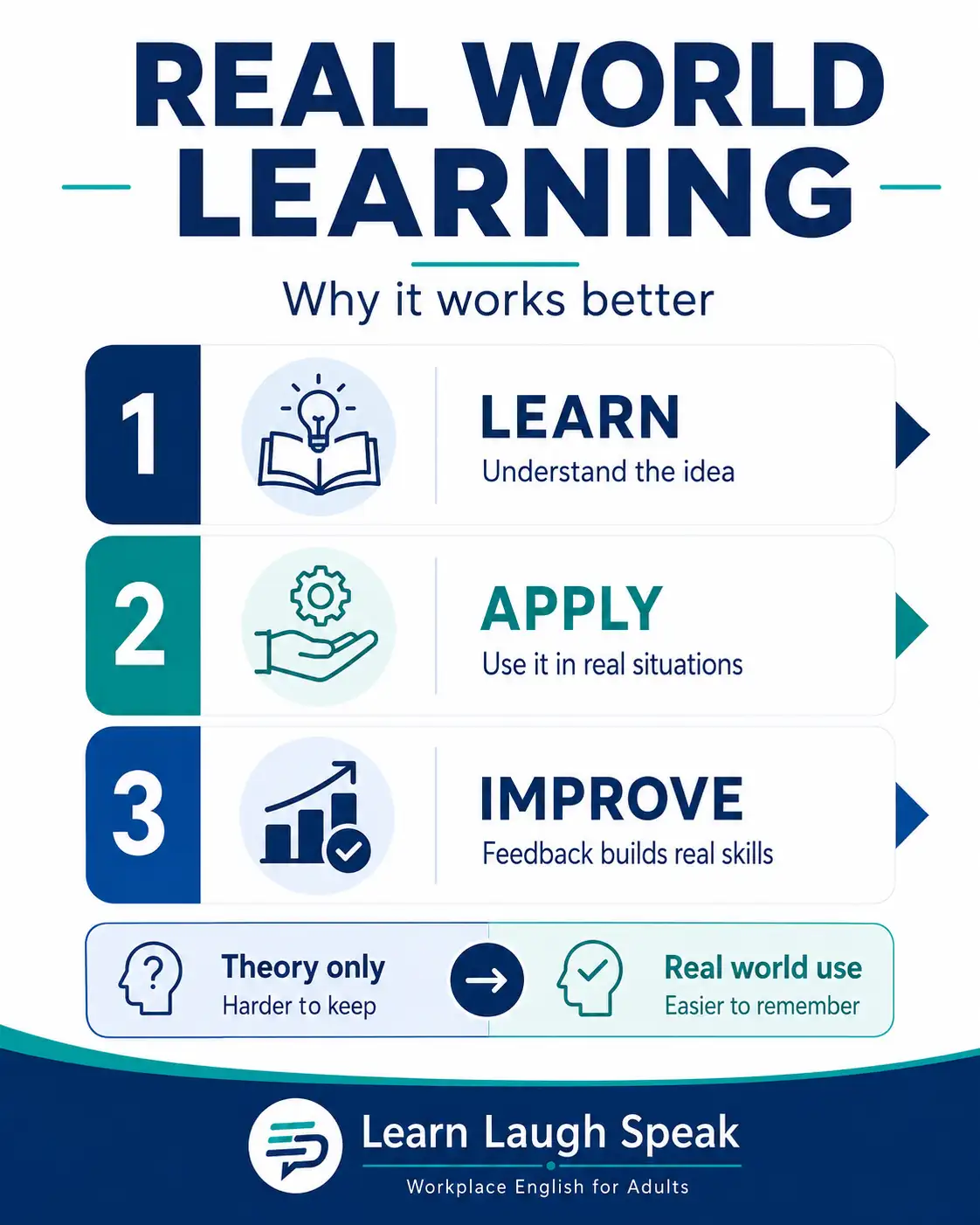
This is the real advantage of real world learning.
It makes learning easier to connect, easier to test, and easier to remember.
What Research Supports
This shift is not only a classroom opinion.
A major review published in PNAS found that active learning improved student performance in science, engineering, and mathematics. The review found that active learning raised average exam performance and reduced failure rates compared with traditional lecturing.
That matters because active learning and real world learning share the same foundation:
Students learn more deeply when they do something with the knowledge.
Not only hear it.
Not only write it down.
Use it.
The Real Reason Why Students Forget What They Learn
Why Relevance Changes Effort
Adults understand this immediately.
If something matters to your work, your attention changes.
If something helps you solve a real problem, you remember it more clearly.
If something feels useful today, you are more willing to practise it.
That is not magic.
It is relevance.
Relevance gives learning a reason.
Without it, students often rely only on discipline.
And discipline is not always enough, especially for adult learners with work, family, stress, and limited time.
Real World Learning and Adult Students
Adult students usually bring prior learning into the classroom.
Some have studied before.
Some know more than they think.
Some have gaps that were never corrected.
Some move quickly in one area but slowly in another.
That is why adult learning cannot be treated like a blank page.
A fixed path may be easy to organize, but it does not always respect what the learner already knows.
Real world learning works better for adults because it connects learning to need.
Not later.
Now.
Where Traditional Learning Often Stops Too Early
Traditional learning often stops at:
“Do you understand?”
But understanding is not the same as ability.
A student may understand a business phrase.
But can they use it in a meeting?
A learner may understand a grammar rule.
But can they use it naturally when writing?
Someone may understand the lesson today.
But will they remember it next week?
Those are different questions.
And they are better questions.
What Better Learning Should Measure
If education wants to be useful, it should not only measure completion.
It should measure whether the student can use what they learned.
A stronger learning system asks:
Can the learner apply it?
Can they repeat it later?
Can they correct mistakes?
Can they use it without help?
Can they adapt it in a new situation?
Those questions move learning away from theory alone.
They move it toward real progress.
Why Mistakes Matter More Than Perfect Lessons
A mistake is not just a sign that something went wrong.
It is information.
It shows where the learner is not ready yet.
In passive learning, mistakes can stay hidden for too long.
In real world learning, mistakes appear earlier because the student is using the skill.
That can feel uncomfortable.
But it is useful.
Because once the mistake is visible, it can be corrected.
This is one of the biggest advantages of practical learning: it gives teachers, platforms, and students better information.

The Feedback Problem on Real World Learning
Practice without feedback is not enough.
A learner can repeat the same mistake many times and feel like they are improving.
That is why feedback needs to be specific.
Not just:
“That is wrong.”
But:
“This is the mistake.”
“This is why it happened.”
“This is what to try next.”
Feedback turns practice into progress.
Without it, practice can become repetition without improvement.
How Real World Learning Looks in English
English is one of the clearest examples.
A student can memorize vocabulary and still struggle to speak.
They can understand grammar but still write awkwardly.
They can pass exercises but freeze when the conversation becomes real.
That is because language is not only knowledge.
It is use.
It needs speed.
It needs confidence.
It needs repetition in context.
This is why English learning should not only ask students to recognize correct answers.
It should help them use English in real situations.
How Learn Laugh Speak Applies Real World Learning
At Learn Laugh Speak, every adult student follows a personalized learning path because every adult arrives with a different history.
Some students have prior learning.
Some have strong reading but weak speaking.
Some understand grammar but make repeated mistakes when writing.
Some can move faster because they already know parts of the level.
That is why the application starts with a level assessment and then continues tracking mistakes, gaps, and progress.
Students learn what they need, when they need it.
They do not have to repeat everything they already know.
They also do not skip the areas where they still need support.
That is where real world learning becomes practical.
It is not just about making lessons more interesting.
It is about helping students build English they can actually use outside the lesson.
What This Means for Modern Education
The future of education will not be only digital.
And it will not be only traditional.
It will be more connected.
Connected to the learner.
Connected to real situations.
Connected to feedback.
Connected to progress that can be seen.
The OECD’s Future of Education and Skills 2030 project describes education as preparing learners with the knowledge, skills, attitudes, and values needed to shape their future. That broader view supports the move toward learning that prepares students for real situations, not only academic tasks.
That is the direction education is moving.
Less isolated content.
More usable skill.
Final Thought on Real World Learning
Real world learning matters because students do not need more disconnected information.
They need learning that becomes useful.
They need to practise.
They need feedback.
They need to see why the lesson matters.
And most of all, they need to use what they learn before it fades.
That is why real world learning is not just another education trend.
It is a better answer to a problem students have felt for a long time:
“I learned it… but I still can’t use it.”
One thought on “Why Real World Learning Is Becoming the Future of Education”
Pingback: Knowing the Real Price of Land Clearing in 2026 - Learn Laugh Speak