
 English
 Arabic
 Chinese (Simplified)
 Dutch
Dutch French
 German
 Italian
 Portuguese
 Russian
 Spanish
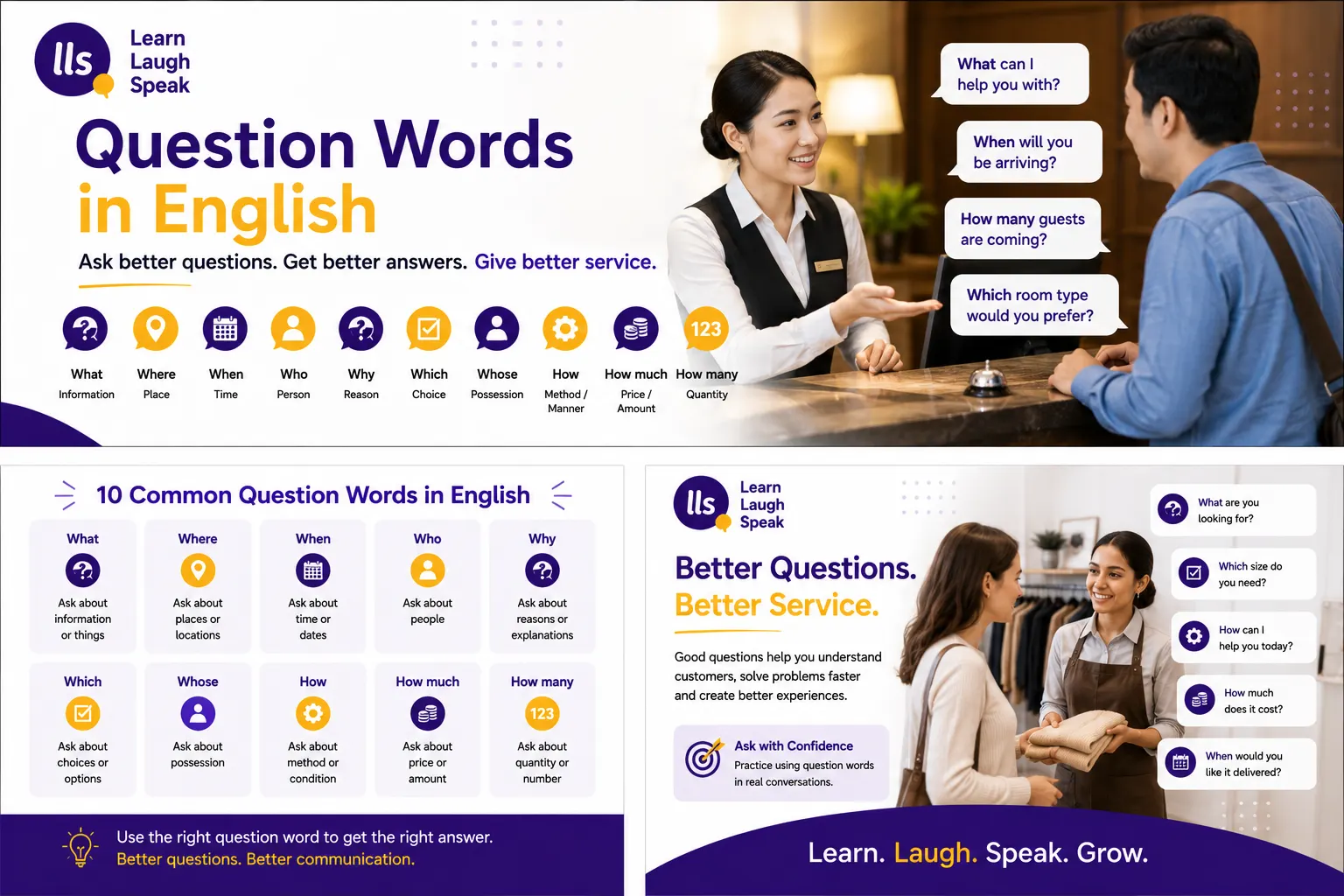
Question words in English help you ask for clear information. The most common question words are what, where, when, who, why, which, whose, how, how much, and how many.
In service-based businesses, these words help you understand customers, solve problems, give better service, and avoid confusion.
Asking good questions is one of the most important communication skills in English. This is especially true if you work in hospitality, retail, tourism, restaurants, customer service, sales, reception, or any job where you speak with customers every day.
Many English learners know basic question words, but they do not always know how to use them naturally in real conversations. A small mistake can make a question sound too direct, unclear, or incomplete.
For example:
“You want what?” sounds direct and possibly rude.
“What would you like?” sounds polite and professional.
This guide will help you understand question words in English and use them correctly in service-based businesses.

Why Question Words Matter in Service-Based Businesses
In customer service, questions help you understand what the customer needs. If you ask the wrong question, you may give the wrong answer, delay service, or create frustration.
Good questions help you:
- understand customer needs
- confirm details
- solve problems faster
- offer better options
- avoid mistakes
- sound polite and professional
- build trust
- show that you are listening
- improve the customer experience
For example, in a hotel, a receptionist may need to ask:
“When will you be arriving?”
In a restaurant, a server may ask:
“What would you like to drink?”
In a shop, an assistant may ask:
“Which size are you looking for?”
In customer support, an agent may ask:
“How can I help you today?”
These questions are simple, but they are powerful when used correctly.
What Are Question Words in English?
Question words are words we use to ask for information. They are sometimes called WH-words because many of them begin with wh.
The main question words in English are:
- what
- where
- when
- who
- why
- which
- whose
- how
- how much
- how many
Each question word has a different purpose.
| Question word | Use it to ask about | Example |
|---|---|---|
| What | information, things, actions | What would you like? |
| Where | place or location | Where are you staying? |
| When | time or date | When will you arrive? |
| Who | a person | Who is the reservation for? |
| Why | reason | Why was the order cancelled? |
| Which | choice | Which option do you prefer? |
| Whose | possession | Whose bag is this? |
| How | method, condition, manner | How can I help you? |
| How much | price or uncountable quantity | How much does it cost? |
| How many | countable number | How many guests are coming? |
Learning the meaning is the first step. The next step is learning how to use these words in natural service conversations.
Question Words in English: Basic Structure
Most information questions follow this structure:
Question word + auxiliary verb + subject + main verb
For example:
Where do you live?
When did you arrive?
What would you like?
How can I help you?
But in service English, some common questions use polite structures.
For example:
What do you want?
This is grammatically correct, but it can sound too direct.
Better:
What would you like?
Or:
How can I help you today?
Politeness matters because service-based businesses depend on tone as much as grammar.
Using “What” in Customer Service
What is used to ask about information, things, actions, or needs.
Common service questions with what:
What would you like?
What can I help you with today?
What name is the booking under?
What time would you prefer?
What seems to be the problem?
What type of room are you looking for?
What size do you need?
What happened with your order?
In service situations, what is useful, but it should be used politely.
Instead of:
“What do you want?”
Say:
“What can I help you with today?”
Instead of:
“What is your problem?”
Say:
“What seems to be the issue?”
Small changes make your English sound more professional.

Using “Where” for Locations and Directions
Where is used to ask about places, locations, and directions.
Common examples:
Where are you staying?
Where would you like to sit?
Where is your room located?
Where did you leave your bag?
Where should we deliver the order?
Where is the nearest restroom?
Where would you like the driver to meet you?
For hospitality and tourism, where is especially important.
Example conversation:
Guest: “I need help finding the meeting room.”
Staff: “Of course. Where is your event being held?”
Guest: “In the Ocean Ballroom.”
Staff: “Thank you. It’s on the second floor, next to the elevators.”
The question helps the staff member give the correct direction.
Using “When” for Time and Scheduling
When is used to ask about time, dates, arrivals, appointments, and deadlines.
Common examples:
When will you arrive?
When would you like to book the appointment?
When did the issue happen?
When would you like the order delivered?
When is your check-in date?
When do you need this by?
When would be a good time to call you back?
In service-based businesses, time questions help avoid mistakes.
Example:
“When do you need the room ready?”
This is better than assuming the customer’s schedule.
Using “Who” for People
Who is used to ask about a person.
Common examples:
Who is the reservation for?
Who should I contact?
Who will be attending the meeting?
Who did you speak with earlier?
Who is responsible for the booking?
Who will collect the order?
In service English, who helps confirm identity and responsibility.
Example:
“Who should I put as the main contact for the reservation?”
This sounds professional and clear.
Using “Why” Carefully
Why asks for a reason. It is useful, but it can sometimes sound direct or challenging if used in the wrong tone.
For example:
“Why are you late?”
This can sound accusatory.
Better:
“May I ask what caused the delay?”
Or:
“Could you tell me what happened?”
In customer service, use why carefully.
Useful polite examples:
Why was the order cancelled?
Why did the payment not go through?
Could you explain why this happened?
May I ask why you would like to change the booking?
When the situation is sensitive, what happened often sounds softer than why.
Using “Which” for Choices
Which is used when there are options or choices.
Common examples:
Which room would you prefer?
Which size are you looking for?
Which colour would you like?
Which payment method would you like to use?
Which option works better for you?
Which date would you prefer?
Which package are you interested in?
Use which when the customer needs to choose from a limited number of options.
Example:
“We have morning and afternoon availability. Which time works better for you?”
This is clear and helpful.
Using “Whose” for Possession
Whose is used to ask who something belongs to.
Common examples:
Whose bag is this?
Whose name is on the reservation?
Whose phone was left at the table?
Whose order is this?
Whose card was used for the payment?
In service businesses, whose is useful for lost items, bookings, payments, and shared orders.
Example:
“Whose name should I put on the invoice?”
This sounds polite and professional.
Using “How” for Process, Condition, and Help
How is one of the most useful question words in English.
It can ask about:
- method
- process
- condition
- experience
- service
- help
Common examples:
How can I help you?
How was your stay?
How would you like to pay?
How do you spell your name?
How would you like this delivered?
How can we improve your experience?
How did everything go today?
In service-based businesses, how often sounds friendly and open.
Example:
“How can I make this right for you?”
This is a strong customer service question because it shows you want to solve the problem.
“How Much” and “How Many”
Many English learners confuse how much and how many.
Use how many with things you can count.
Examples:
How many guests are coming?
How many rooms do you need?
How many bags do you have?
How many people are in your group?
Use how much for prices or things you do not count individually.
Examples:
How much does it cost?
How much time do we have?
How much luggage do you have?
How much information do you need?
Quick rule:
How many = countable things
How much = price or uncountable things
Better Service Questions Using Question Words
Here are useful examples for service-based businesses.
| Situation | Better question |
| Greeting a customer | How can I help you today? |
| Taking an order | What would you like to order? |
| Confirming a booking | What name is the reservation under? |
| Asking about time | When would you like to arrive? |
| Offering options | Which option works best for you? |
| Asking about quantity | How many guests will be joining you? |
| Asking about price | What is your budget? |
| Finding a location | Where would you like the delivery sent? |
| Solving a problem | What seems to be the issue? |
| Following up | How was everything today? |
These questions are practical because they help you guide the conversation.
Question Words in Hospitality English
Hospitality workers use questions constantly. Whether you work in a hotel, restaurant, resort, café, tour company, spa, or reception area, question words help you serve guests better.
Useful hospitality questions:
What name is the booking under?
When will you be checking in?
Where would you like to sit?
How many people are in your party?
Which room type would you prefer?
How was your meal?
What can I help you with today?
When would you like the taxi to arrive?
Where should we send your luggage?
How can we make your stay more comfortable?
These questions sound professional and guest-focused.
Question Words in Retail and Shopping
Retail staff also use question words every day.
Useful retail questions:
What are you looking for today?
Which size do you need?
Which colour would you prefer?
How much would you like to spend?
How many items would you like?
Who is the gift for?
When do you need it by?
Where would you like this delivered?
How would you like to pay?
Would you like a receipt?
Question words help the staff member understand the customer faster.
Question Words in Customer Support
Customer support needs clear questions because the agent must understand the problem before solving it.
Useful support questions:
What seems to be the problem?
When did this issue start?
Where are you seeing the error message?
Which device are you using?
How often does this happen?
Who did you speak with before?
What have you already tried?
How can I contact you if we need more information?
These questions help collect details without sounding aggressive.
How to Sound More Polite When Asking Questions
Grammar is important, but tone is also important.
You can make questions more polite by adding phrases like:
Could you tell me…?
May I ask…?
Would you mind telling me…?
Can I check…?
Just to confirm…
Could you please explain…?
Examples:
Direct:
“When are you arriving?”
Polite:
“Could you tell me when you’ll be arriving?”
Direct:
“What is your name?”
Polite:
“May I ask your name, please?”
Direct:
“Why do you want a refund?”
Polite:
“Could you tell me what happened with the item?”
In service English, polite questions often create better conversations.
What Not to Say and What to Say Instead
| What not to say | What to say instead |
| What do you want? | How can I help you today? |
| Why are you angry? | Could you tell me what happened? |
| Where you go? | Where are you going? |
| You need what? | What do you need, please? |
| How many money? | How much does it cost? |
| Who this is for? | Who is this for? |
| What problem? | What seems to be the issue? |
| Why you cancel? | May I ask why you’d like to cancel? |
| Which one you want? | Which one would you prefer? |
These small changes help you sound clearer, calmer, and more professional.
Common Mistakes with Question Words in English
1. Forgetting the auxiliary verb
Incorrect:
Where you live?
Correct:
Where do you live?
2. Using “how many” for price
Incorrect:
How many is this?
Correct:
How much is this?
3. Using “why” too directly
Too direct:
Why did you do that?
Better:
Could you explain what happened?
4. Mixing up “who” and “whose”
Who asks about a person.
Whose asks about possession.
Example:
Who is calling?
Whose phone is this?
5. Asking incomplete questions
Incorrect:
What time arrival?
Correct:
What time will you arrive?
Or more natural:
What time will you be arriving?
Practice Activity: Build Better Questions
Change the direct or incorrect question into a better service question.
- What you want?
- Where bathroom?
- How many is this?
- Why you late?
- Who reservation?
- Which you want?
Suggested answers:
- How can I help you today?
- Where is the bathroom, please?
- How much does this cost?
- Could you tell me what caused the delay?
- What name is the reservation under?
- Which one would you prefer?
Practise these out loud. Focus on sounding calm and polite.
Learn Question Words in English with Learn Laugh Speak
At Learn Laugh Speak, we teach adult learners English for real communication, not only grammar exercises. Question words are a perfect example of this.
It is useful to know the rule. But it is more important to know how to use the question in a real situation, such as helping a guest, answering a customer, joining a meeting, or solving a problem at work.
With Learn Laugh Speak, students practise reading, writing, speaking, listening, vocabulary, grammar, and pronunciation at the right level. This helps learners build confidence step by step and use English in real-life situations.
If you work in hospitality, retail, tourism, customer service, or any service-based business, learning how to ask better questions in English can improve your confidence and your customer communication.
FAQs About Question Words in English
What are question words in English?
Question words in English are words used to ask for information. Common examples include what, where, when, who, why, which, whose, how, how much, and how many.
Why are question words important?
They help you ask clear questions, understand people better, collect information, solve problems, and communicate more professionally.
What are WH-words?
WH-words are question words that often begin with wh, such as what, where, when, who, why, which, and whose.
What is the difference between how much and how many?
Use how many for countable things, such as guests, rooms, bags, or items. Use how much for price or uncountable things, such as money, time, luggage, or information.
How can I ask more polite questions in English?
Use phrases like “Could you tell me…”, “May I ask…”, “Can I check…”, or “Would you mind telling me…”
What question words are useful in hospitality?
Useful hospitality questions include “What name is the reservation under?”, “When will you arrive?”, “How many guests are coming?”, and “How can I help you today?”
How do I practise question words?
Practise by making real questions for real situations, such as restaurants, hotels, shops, meetings, interviews, or customer support conversations.
Final Thoughts on Question Words in English
Learning question words in English helps you ask better questions, understand answers, and communicate more clearly in service-based businesses.
Start with the basics: what, where, when, who, why, which, whose, how, how much, and how many. Then practise using them in real situations.
The better your questions are, the easier it is to help customers, solve problems, and sound confident in English.
5 thoughts on “Question Words in English Learning: How to Ask Better Questions”
Hello it’s me, I am also visiting this web site regularly, this website is genuinely good and the viewers are actually sharing pleasant thoughts.
Hi Marsha. Thanks for the feedback. It is great to hear you are enjoying the blog.
Hello! I’ve been reading your weblog for a long time now and finally got the bravery to go ahead and give you a shout out from Lubbock Texas! Just wanted to tell you keep up the great job!
Hello there Texan! Thanks for the feedback! Glad you like the articles! Take care and enjoy your day!
Pingback: Vibration Therapy Benefits: What the Science Says - Learn Laugh Speak