
 English
 Arabic
 Chinese (Simplified)
 Dutch
Dutch French
 German
 Italian
 Portuguese
 Russian
 Spanish
For adults working in a second language, learning how to be polite in English at the office can feel confusing. What sounds polite in one culture may sound distant, cold, or even rude in another.
Politeness in the workplace is not about being overly formal or quiet.
It’s about making your communication easy to receive.
This guide focuses on how politeness actually works in modern professional English — based on real workplace behavior, not textbook rules.
A Practical Guide for Adults Using English at Work
Glossary of 50 Jobs Terms You Need To Know

Why Being Polite in English at the Office Matters More Than You Think
In international workplaces, language often shapes perception faster than performance.
A global workplace communication survey by LinkedIn Learning found that over 60% of managers say tone and clarity influence how they judge professionalism, sometimes even more than technical skill.
That means:
The way you phrase a request can affect trust
The way you disagree can affect credibility
The way you write an email can affect how seriously you’re taken
Being polite in English at the office is not about being “nice” — it’s about being effective.
What Politeness Really Means in Professional English
In many English-speaking workplaces, politeness is shown through:
Softening language, not weakening it
Giving people options, not commands
Showing awareness of time and workload
This is why professionals often say:
“Could you…” instead of “Do this.”
The goal is respect without hesitation.
Common Corporate Buzzwords (With Definitions of Each)
The Core Principle: Task-Focused, Not Person-Focused
One of the strongest politeness principles in professional English is this:
Focus on the task, not the person.
This keeps communication neutral and professional — especially in stressful situations.
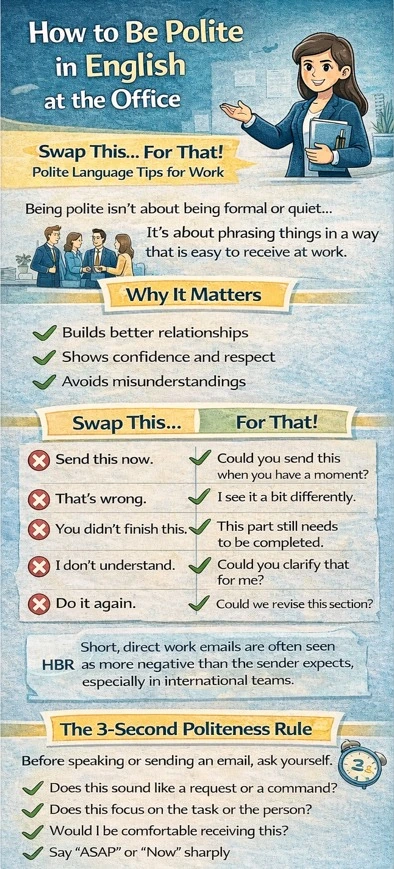
“Swap This for That” — Polite in English at the Office Examples
Here are real, practical swaps professionals use every day:
| Instead of saying… | Try saying… |
|---|---|
| “Send this now.” | “Could you send this when you have a moment?” |
| “That’s wrong.” | “I see it a bit differently.” |
| “You didn’t finish this.” | “This part still needs to be completed.” |
| “I don’t understand.” | “Could you clarify that for me?” |
| “Do it again.” | “Could we revise this section?” |
These swaps change tone without changing meaning.
How to Show Frustration Professionally in English
How to Be Polite in English at the Office in Meetings
Meetings are where politeness and confidence must work together.
Professional habits that help:
Let others finish speaking
Use soft entry phrases
Keep your questions short and neutral
Polite meeting phrases:
“If I can just add one point…”
“May I ask a quick question?”
“Could we revisit that idea?”
“From my perspective…”
These phrases allow you to participate without interrupting or sounding aggressive.
How to Be Polite in English at the Office in Emails
Emails often sound more direct than intended because tone is invisible.
A study by the Harvard Business Review found that short, direct emails are frequently perceived as more negative than the sender expects, especially in cross-cultural teams.
Simple politeness upgrades:
Add a soft opening: “I hope you’re doing well.”
Use “Could you…” instead of “Please…”
End with appreciation: “Thank you for your time.”
Example:
Instead of:
“Send the file.”
Use:
“Could you please send the file when you have a moment? Thank you.”
How to Be Polite When You Disagree at Work
Disagreement is normal — how you express it matters.
Polite disagreement structures:
“I see your point, and I’d like to add…”
“That’s one option — another approach could be…”
“I’m not sure that will meet our timeline.”
These keep discussions professional, not personal.
Cultural Differences in Being Polite at Work
In some cultures:
Directness shows honesty
Authority shows leadership
In many English-speaking workplaces:
Softening shows professionalism
Collaboration shows leadership
Understanding this difference helps adult learners avoid sounding too blunt or too passive.
Polite in English at the Office: “Three-Second Politeness Rule”
Before you speak or hit send on an email, ask yourself:
Does this sound like a request or a command?
Does this focus on the task or the person?
Would I be comfortable receiving this?
This simple pause improves tone instantly.
How to Practice Being Polite in English at the Office Alone
You don’t need a partner.
Try:
Rewriting one work email per day in a more polite tone
Practicing meeting phrases out loud
Recording yourself making requests in different styles
Collecting polite phrases you hear from colleagues
Politeness becomes natural through exposure and repetition.
Common Mistakes That Reduce Politeness
❌ Being too direct under pressure
❌ Skipping greetings in emails
❌ Using emotional words (“annoyed,” “frustrated”)
❌ Interrupting without a soft phrase
❌ Sounding rushed or impatient
Professional politeness is about calm delivery, not formal language.
Final Thought: Polite in English at the Office
To be polite in English at the office is not about sounding formal or quiet.
It’s about being:
clear
respectful
collaborative
easy to work with
Those qualities build trust faster than perfect grammar ever will.
The Importance of Using Please and Thank You in Customer Service
Learn Laugh Speak — Polite in English at the Office
At Learn Laugh Speak, we help adult professionals master real communication — from polite requests and professional emails to confident meetings and workplace problem-solving.
With 33,000+ CEFR-aligned lessons, learners practice English as it’s actually used at work, not in textbooks.

2 thoughts on “How to Be Polite in English at the Office Every Day”
Pingback: How Startups Can Build a Scalable Language Learning App - Learn Laugh Speak
Pingback: How AI in English Learning Helps Students Practise Smarter - Learn Laugh Speak