
 English
 Arabic
 Chinese (Simplified)
 Dutch
Dutch French
 German
 Italian
 Portuguese
 Russian
 Spanish
Math homework often feels like a mountain you cannot climb. You sit at your desk for hours staring at a single equation that makes no sense. AI tools are changing how you handle these challenges by acting as a personal tutor that is available at any time. These apps do not just give you the answer, but they show you how to get there.
If you have a complex narrative to decode, you should use a Word Problem Solver to break down the text into math symbols. This helps you understand what the question actually asks you to do before you start calculating. Many students struggle because they cannot translate words into numbers, and this tool bridges that gap effectively.
Accuracy is everything when you are working with numbers and variables. You can type your problem manually or use your phone camera to scan your homework. A Photo Math Solver allows you to snap a picture of your handwritten notes or a textbook page. Make sure your handwriting is clear and the lighting is good so the software reads every number correctly.
Once you have the solution on your screen, you must look at the step by step breakdown. The real value of using technology for math is not the final number at the bottom of the page. The value is in the logic used to move from one line to the next. This is where you learn the rules of algebra or calculus that you might have missed during class.
You should always verify the logic provided by the tool. AI is very smart, but it can sometimes misinterpret a complex symbol or a blurry image. Check the work against your textbook or your teacher’s examples. If the steps look different from what you learned in school, try to figure out why the tool chose a different path.
After you understand the process, you need to practice without the help of the software. Try a similar problem from your workbook on your own. Use the AI only at the end to check if your work is correct. This builds your confidence and ensures you actually learned the material instead of just copying it.
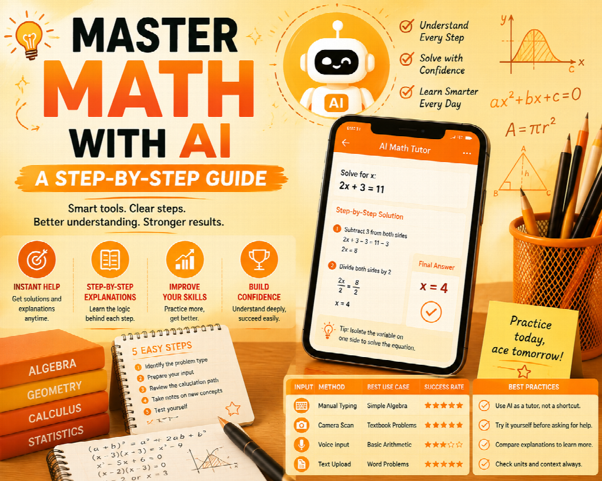
Step-by-Step Guide to Using AI for Math
Step 1: Identify the Problem Type
Before you open any app, look at your assignment. Is it a basic arithmetic problem, a graphing challenge, or a word problem? Knowing the type of math helps you choose the right feature within the tool. Some features are better for geometry while others excel at long division or fractions.
Step 2: Prepare Your Input
If you are typing the problem, use the correct symbols for exponents and square roots. If you are using the camera, flatten the paper and ensure there are no shadows covering the numbers. Clear input leads to clear results. If the AI gets the initial numbers wrong, the entire solution will be useless to you.
Step 3: Review the Calculation Path
When the tool generates the answer, scroll through every single step. Do not skip to the end. Read the explanations provided for each move. If the tool subtracts five from both sides of an equation, make sure you understand why that was the necessary move to isolate the variable.
Step 4: Take Notes on New Concepts
If the AI uses a formula you have never seen before, write it down in your notebook. You can ask the tool to explain that specific formula or look it up in your textbook. Using AI is a great way to discover shortcuts or alternative methods that your teacher might not have mentioned yet.
Step 5: Test Yourself
Close the app and try to solve the same problem on a blank piece of paper. If you get stuck, open the app again to see where you went wrong. Repeat this process until you can finish the entire problem without looking at your phone or computer.
Tips and Best Practices
Use AI as a tutor rather than a shortcut. The goal of school is to build your brain power, not to see how fast you can finish a worksheet. If you only use these tools to get answers, you will fail your exams where phones are not allowed. Think of the AI as a teacher who is sitting next to you helping you when you get stuck.
Set a timer before you ask for help. Try to solve the problem on your own for at least ten minutes. If you are still confused after that time, then it is okay to use an AI tool. This struggle is actually good for your brain because it forces you to think deeply about the concepts.
Compare different tools if a problem is very hard. Sometimes one AI might explain a concept better than another. You can see which explanation makes the most sense to you. Different algorithms might use different methods to reach the same result, which gives you a broader view of the subject.
| Input Method | Best Use Case | Success Rate |
| Manual Typing | Simple Algebra | High |
| Camera Scan | Textbook Problems | High |
| Voice Input | Basic Arithmetic | Medium |
| Text Upload | Word Problems | High |
Common Mistakes to Avoid
One of the biggest mistakes students make is ignoring the units of measurement. If a problem asks for the answer in meters and the AI gives you a number, make sure the unit is correct. AI sometimes focuses only on the numbers and forgets the context of the question. You must always stay engaged with the problem.
Do not rely on AI for every single question on your homework. If you have twenty problems to do, try to do fifteen of them entirely on your own. Use the tool for the five hardest ones. This balance ensures that you are still practicing your mental math skills while getting help where it is truly needed.
Another mistake is using the tool during a practice quiz. You need to know what you know and what you do not know. If you use help during practice, you will have a false sense of security. You might think you are ready for the test when you actually do not understand the core concepts.
Avoid using AI when you are tired or distracted. It is easy to just mindlessly copy the steps when you are not focused. You will not remember anything the next day if you are just going through the motions. Only use these tools when you are alert and ready to learn the logic behind the math.
Conclusion
AI tools are powerful allies for any student who wants to improve their math skills. They provide instant feedback and clear explanations that can help you overcome frustration. By following a structured process, you can turn these tools into a private tutoring session. Remember to always verify the results and practice independently to truly master the subject. Math does not have to be a mystery when you have the right technology to guide you through the steps. Focus on the process, ask questions, and use these resources to build a stronger foundation for your future studies.