
 English
 Arabic
 Chinese (Simplified)
 Dutch
Dutch French
 German
 Italian
 Portuguese
 Russian
 Spanish
There are times when you may need to leave work before the end of your shift—due to a doctor’s appointment, a personal matter, or an unexpected emergency. No matter the reason, knowing how to leave work early professionally helps you maintain good communication and show respect for your role and team.
How To Ask Your Manager About Leaving Early Today
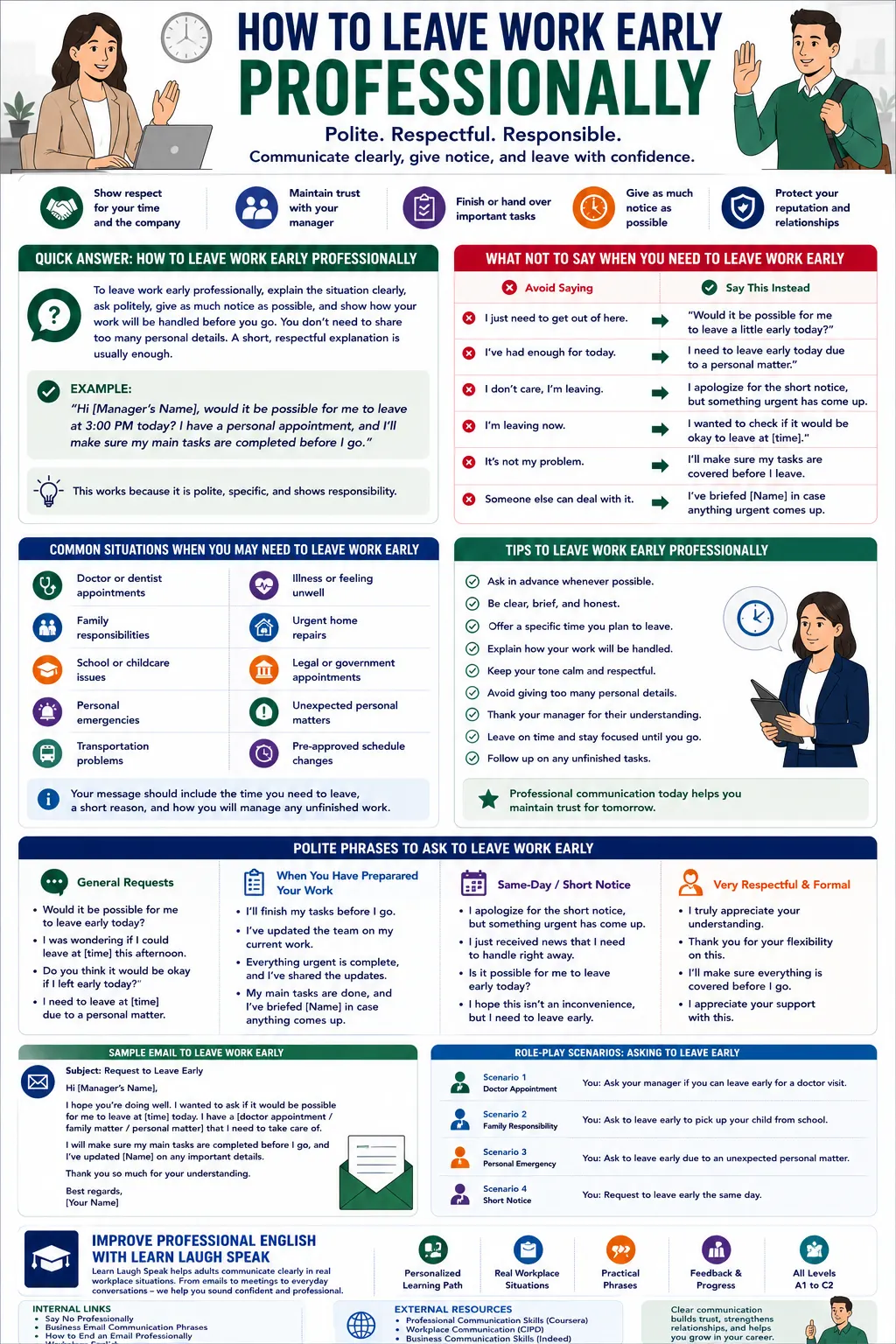
Quick Answer: How to Leave Work Early Professionally
To leave work early professionally, explain the situation clearly, ask politely, give as much notice as possible, and show how your work will be handled before you go. You do not need to share too many personal details. A short, respectful explanation is usually enough.
Example:
“Hi [Manager’s Name], would it be possible for me to leave at 3:00 PM today? I have a personal appointment, and I’ll make sure my main tasks are completed before I go.”
This works because it is polite, specific, and shows responsibility.
What Not to Say When You Need to Leave Work Early
Some phrases can sound careless, emotional, or unprofessional. Even if you are stressed, it is better to stay calm and focus on the reason, timing, and work coverage.
| Avoid Saying | Say This Instead |
|---|---|
| “I just need to get out of here.” | “Would it be possible for me to leave a little early today?” |
| “I’ve had enough for today.” | “I need to leave early today due to a personal matter.” |
| “I don’t care, I’m leaving.” | “I apologize for the short notice, but something urgent has come up.” |
| “I’m leaving now.” | “I wanted to check if it would be okay to leave at [time].” |
| “It’s not my problem.” | “I’ll make sure my tasks are covered before I leave.” |
| “Someone else can deal with it.” | “I’ve briefed [Name] in case anything urgent comes up.” |
Professional language helps you protect your time while still showing respect for your manager, team, and responsibilities.
Common Situations When You May Need to Leave Work Early
There are many valid reasons someone may need to leave before the end of the workday. The key is to communicate clearly and give enough information without overexplaining.
Common situations include:
- doctor or dentist appointments
- family responsibilities
- school or childcare issues
- personal emergencies
- transportation problems
- illness or feeling unwell
- urgent home repairs
- legal or government appointments
- unexpected personal matters
- pre-approved schedule changes
In most cases, your message should include the time you need to leave, a short reason, and how you will manage any unfinished work. Exploring mastering academic writing helps professionals structure clear, concise workplace messages that get the point across without oversharing unnecessary personal details.
Why It’s Important to Say You Need to Leave Work Early Professionally
Leaving early affects not just your work, but also your team and any responsibilities you share. When you explain the situation clearly and politely, you show maturity, consideration, and reliability. Communicating professionally also helps avoid misunderstandings and keeps a strong relationship with your manager and coworkers.
Polite Phrases to Say You Need to Leave Work Early
Here are respectful ways to let your manager or team know:
- “Would it be okay if I leave a bit early today? I have a personal matter to attend to.”
- “I wanted to let you know I need to leave at [time] due to an appointment.”
- “There’s something urgent I need to take care of. Would it be possible to leave a little early?”
✅ Tip: Be polite, give enough notice, and let them know how your work will be handled.

Leave Work Early Professionally: If It’s a Last-Minute Situation
Sometimes things come up suddenly. You can still sound professional:
- “I apologize for the short notice, but something urgent has come up and I need to leave early today.”
- “Unfortunately, there’s been a personal emergency I need to take care of right away. I appreciate your understanding.”
✅ Acknowledge the inconvenience and express appreciation.
How to Say You’ll Catch Up on Missed Work
It’s helpful to show responsibility for your tasks:
- “I’ll finish what I can before I leave and handle the rest first thing tomorrow.”
- “I’ve briefed [Colleague’s Name] so they’re aware in case anything comes up.”
- “I’ll check in remotely later if anything urgent arises.”
How to Say No to Extra Work Professionally in English
Leave Work Early Professionally: Email Example
Subject: Early Leave Request
Hi [Manager’s Name],
I hope you’re well. I wanted to ask if I could leave work early today at [time] due to [brief reason]. I’ll make sure my tasks are up to date and will follow up on anything pending tomorrow.
Thanks for your understanding.
Best regards,
[Your Name]
The Best Excuses to Leave Work Early (And How to Ask)
Mini Role-Play: Asking to Leave Work Early
Scenario: You’ve just realized you need to leave work early for a personal matter and you speak with your manager.
You:
“Hi [Manager’s Name], sorry for the short notice—I just found out I need to leave a bit early today due to a family issue. Would it be alright if I left around [time]?”
Manager:
“Thanks for letting me know. Can you make sure your tasks for today are covered?”
You:
“Yes, absolutely. I’ll wrap everything up before I go and leave notes for anything that needs follow-up.”
✅ Shows clarity, accountability, and professionalism.
How to Say I Need to Go Home from Work Today Professionally
Role-Play: Leaving Early from a Part-Time or Shift Job
Scenario: You work a part-time shift and need to leave early for an appointment.
You (to your supervisor):
“Hi [Supervisor’s Name], I have a medical appointment this afternoon. Would it be possible to leave an hour early today? I’ve checked and the floor should still be covered.”
Supervisor:
“Thanks for checking ahead. That should be fine. Can you finish stocking before you go?”
You:
“Of course. I’ll have it done before I clock out.”
✅ Even in part-time or hourly jobs, communication matters.
Role-Play: Leaving Early While Working Remotely or in a Hybrid Role
Scenario: You’re working remotely and realize you need to end the day earlier than planned.
Message to your manager:
Hi [Manager’s Name], I wanted to give you a heads-up that I need to log off around [time] today due to a personal obligation. I’ve updated my progress in our shared file and will check emails before the end of the day.
Follow-up (next day):
“Thanks again for your flexibility yesterday—I was able to complete [task] and will finish [remaining task] this morning.”
✅ This keeps communication open and shows that even remotely, you are dependable and proactive.
Leave Work Early Professionally: Practice Prompts
- You have a dentist appointment in the afternoon. Practice saying it politely.
- You’re working from home and need to log off early. What message would you send?
- You forgot about a personal commitment and must leave soon. How do you explain it professionally?
- You’re on a shift job and realize you need to leave an hour earlier. How would you approach your supervisor?
✅ Use these prompts to role-play with a partner or record yourself.
Downloadable Template: Leave Work Early Email
[Copy and customize this template for your situation]
Subject: Request to Leave Work Early
Hi [Manager’s Name],
I hope this message finds you well. I wanted to let you know I have a [brief reason—appointment, personal matter, etc.] and would like to request to leave work early today at [time].
I’ll ensure my current responsibilities are handled before I leave and will follow up on anything outstanding tomorrow. Please let me know if this works or if you’d prefer I adjust my time.
Thanks for your understanding.
Best regards,
[Your Name]
Leave Work Early Professionally: What to Avoid Saying
Even if you’re frustrated or stressed, avoid saying:
- ❌ “I just need to get out of here.”
- ❌ “I’ve had enough for today.”
- ❌ “I don’t care—I’m leaving.”
✅ Keep your message respectful and focus on the facts.

Improve Professional English with Learn Laugh Speak
Learn Laugh Speak helps adults communicate clearly in real workplace situations.
That includes:
- asking to leave work early professionally
- writing polite workplace emails
- speaking with managers
- explaining personal situations clearly
- joining meetings
- using professional English with confidence
Every student starts with a level assessment from A1 to C2. From there, learners follow a personalized path based on their level, goals, mistakes, and progress.
If you want to sound more confident and professional in English at work, Learn Laugh Speak helps you practise the phrases you need for real communication.
2 thoughts on “How to Say I Need to Leave Work Early Professionally”
Pingback: English Used in Crypto: Web3, Trading & Blockchain Culture
Pingback: How to Give Instructions Professionally in English