
 English
 Arabic
 Chinese (Simplified)
 Dutch
Dutch French
 German
 Italian
 Portuguese
 Russian
 Spanish
Business English becomes useful when it helps you handle a real moment at work.
Your manager asks for a quick update. A client changes the subject unexpectedly. You need to disagree in a meeting without sounding rude. You understand the problem, but the English has to come out clearly and quickly.
That is the idea behind Learn Laugh Speak business English.
The goal is not to collect impressive vocabulary. It is to build the English adults actually need for meetings, emails, presentations, interviews, customer conversations, problem-solving, and everyday communication with international colleagues.
If you are new to the subject, our guide to what Business English means explains the difference between general English and English used for professional situations.
What Learn Laugh Speak Business English Means
Learn Laugh Speak business English is workplace-focused English practice for adults who need to communicate more confidently and clearly at work.
It combines the core language skills — reading, writing, listening, speaking, grammar, and vocabulary — with professional situations where the learner has a clear task to complete.
That task might be:
- giving a status update
- asking a colleague for clarification
- explaining a delay
- writing a client email
- presenting an idea
- discussing a problem with a manager
- preparing for an interview
- speaking with an international customer
The important point is that the English has a purpose.
The British Council’s Business English resources also focus on practical workplace communication such as meetings, emails, interviews, and professional conversations.
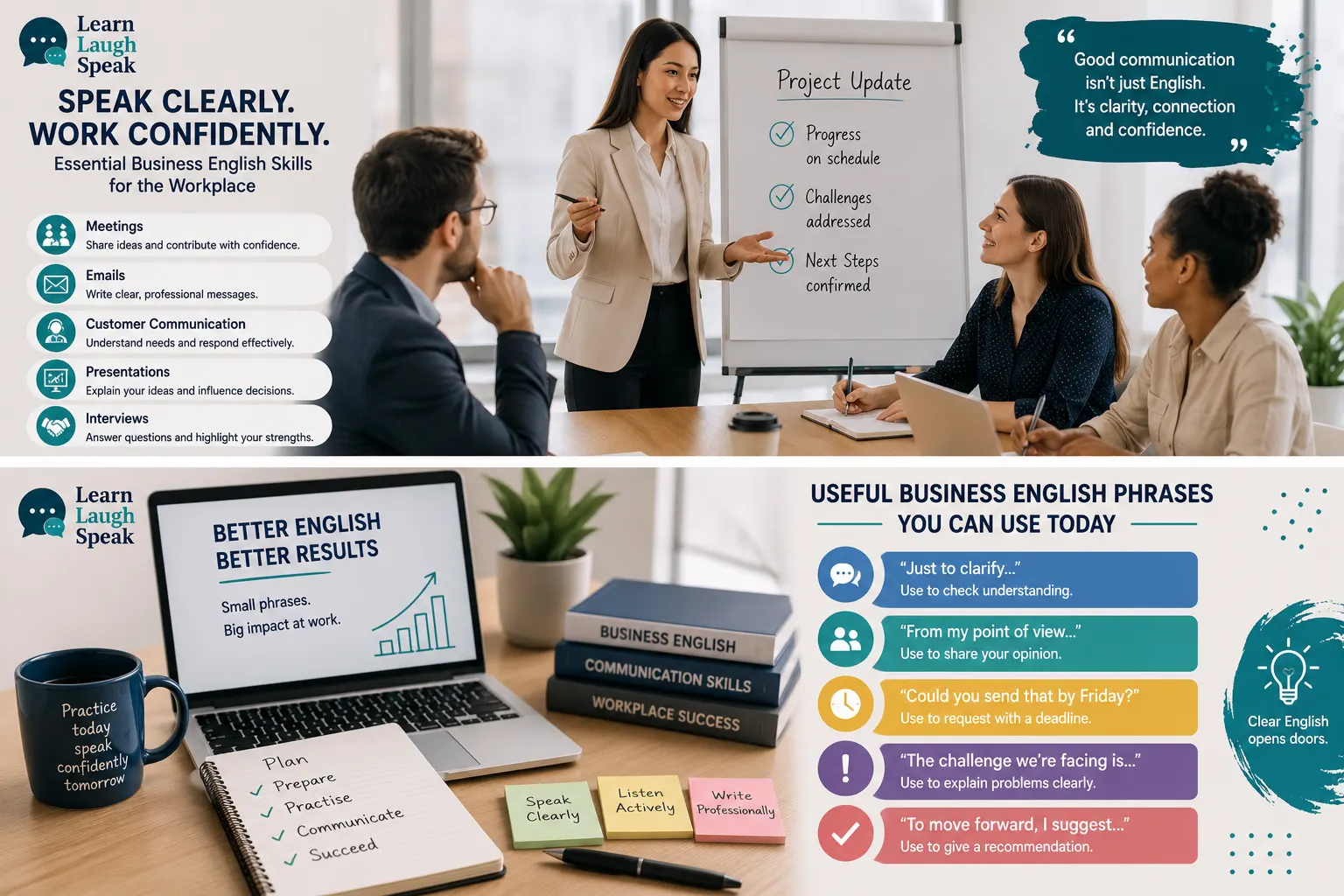
Start With the English Your Job Actually Requires
A useful question is not:
“How good is my English?”
A better question is:
“Where does English make my job harder?”
A professional may read reports comfortably but struggle to speak without preparation.
Another learner may speak confidently with colleagues but spend 20 minutes rewriting a simple email because they are unsure about tone.
Someone working in hospitality may need guest-facing English. A project manager may need meeting language, timelines, and problem-solving vocabulary. A sales professional may need discovery questions, objections, follow-ups, and negotiation language.
This is why professional English works best when it is connected to the actual responsibilities of the job.
The Cambridge English Workplace English Tool takes a similar approach by looking at the reading, writing, speaking, and listening demands of specific roles rather than treating workplace English as one single ability.
You can also review the Learn Laugh Speak English levels from A1 to C2 to understand how language ability develops over time.
Learn Laugh Speak Business English for Real Workday Situations
A useful Business English lesson should feel connected to something that could happen before the end of your working day.
For example, imagine that your manager asks:
“Can you send me a quick update before lunch?”
The vocabulary is not difficult.
The challenge is deciding what information matters and how much detail to include.
A clear response might be:
“Yes. I’ll send you a short update before 12. The main issue is the supplier delay, but the rest of the project is on schedule.”
That one reply requires several skills at the same time:
- understanding the request
- identifying the important information
- using an appropriate professional tone
- keeping the message concise
- confirming the next action
That is why Learn Laugh Speak business English is more useful when learners practise complete workplace situations rather than isolated words.
Why Workplace Phrases Work Better Than Word Lists
Knowing the word clarify is useful.
Knowing when to say:
“Just to clarify, are we confirming Friday as the final deadline?”
is much more useful.
A word gives you meaning.
A phrase gives you something you can actually do.
Instead of learning only:
Delay
Learn:
“We are expecting a slight delay.”
Instead of:
Recommend
Learn:
“Based on the results, I would recommend…”
Instead of:
Available
Learn:
“I’m available after 2:00 if you would like to discuss it.”
This is also why collocations and sentence patterns matter so much in professional communication. Adults rarely need a dictionary definition in the middle of a meeting. They need a phrase they can retrieve quickly and adapt.
Our guide to Business English phrases for workplace conversations gives more examples of practical language you can use immediately.
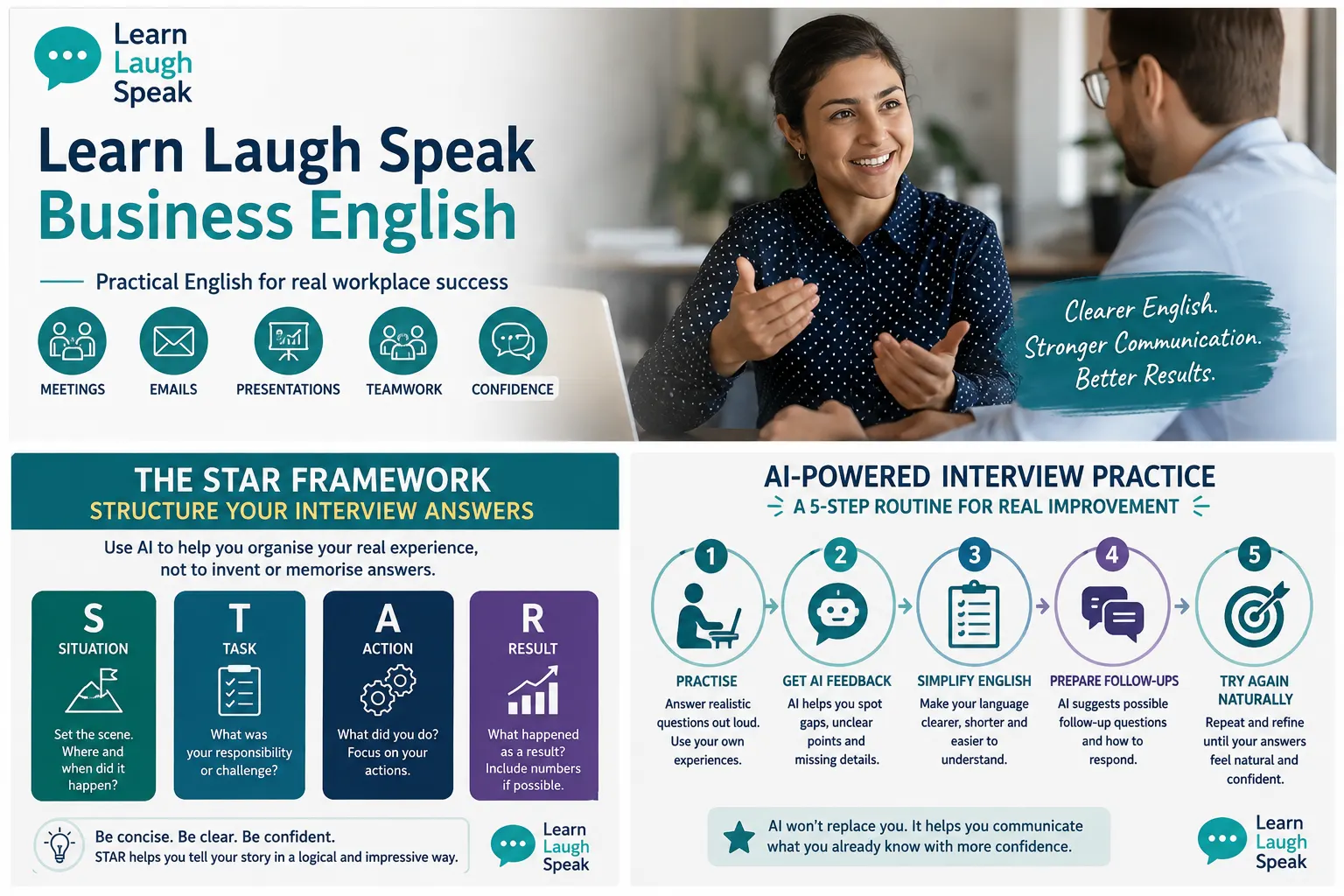
Learn Laugh Speak Business English for Meetings and Conversations
Meetings are difficult because several language skills happen at once.
You have to listen, understand the subject, decide whether you need to speak, organise your idea, choose the right tone, and respond while the conversation is still moving.
That is why meeting practice should go beyond memorising phrases such as “I agree” or “I disagree.”
The learner needs to practise the purpose behind the language.
Giving a Clear Update Without Overexplaining
A common mistake is starting too far back.
Instead of:
“So basically, last week we had the meeting, and then there were a few things that happened with the supplier…”
Try:
“The main update is that the supplier has delayed delivery by two days. We have adjusted the schedule, and the project is still on track.”
The second version gives the listener the key information first.
A simple structure helps:
Main point → important detail → next action
For example:
“The main issue is the delivery date. It has moved from Tuesday to Thursday, so I’m updating the installation schedule today.”
Learn Laugh Speak Business English for Clarifying and Checking Understanding
Clarifying is one of the most useful professional skills because it prevents small misunderstandings from becoming larger problems.
Useful phrases include:
“Just to clarify, do you mean the final version or the draft?”
“Can I check one detail before we continue?”
“When you say ‘urgent,’ do you mean today?”
“So, if I understand correctly, you would like us to…”
This is a good example of Learn Laugh Speak business English working at sentence level. The learner does not need a complicated explanation of grammar. They need to recognise the situation and choose language that fits.
For more examples, see our guide to essential language functions in Business English.
Disagreeing Politely Without Sounding Weak
Professional disagreement is not about avoiding the word “no.”
It is about showing that you understand the other person’s position before presenting your own.
Compare:
“No, that won’t work.”
With:
“I understand the reasoning, but I think we may have a timing problem.”
Or:
“I see your point. My concern is that we don’t have enough data yet.”
These sentences are not weaker. They are more useful because they keep the conversation moving.
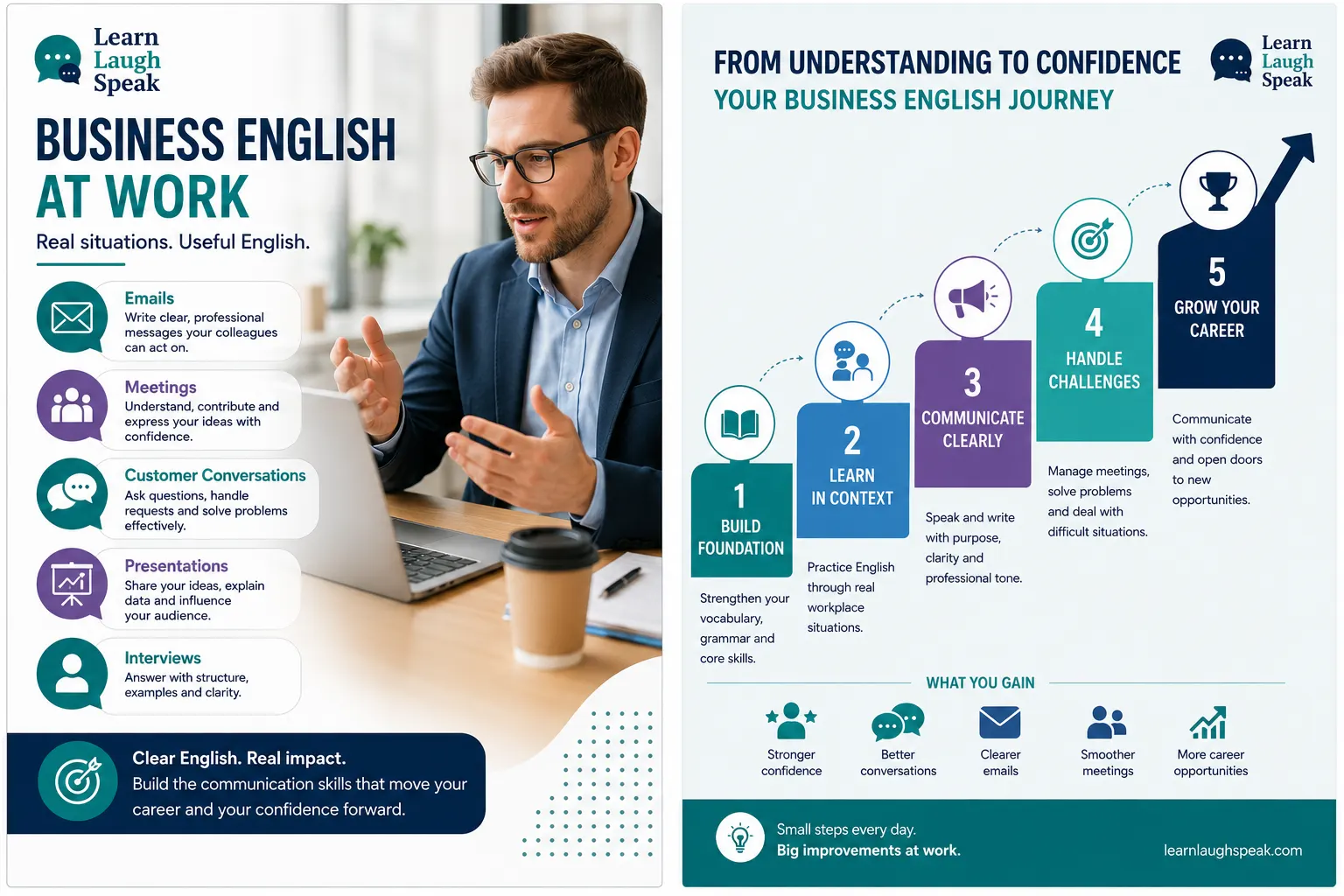
Learn Laugh Speak Business English for Different Professional Roles
There is no single Business English vocabulary list that works equally well for everyone.
A hotel receptionist may need:
- polite requests
- directions
- reservation language
- complaint handling
- explanations of hotel policies
A sales professional may need:
- discovery questions
- pricing language
- objection handling
- negotiation
- follow-up emails
A project or operations manager may need:
- timelines
- status updates
- risk language
- process explanations
- problem-solving
- instructions
A senior manager may need:
- presentations
- negotiations
- strategic explanations
- decision-making language
- meeting leadership
The grammar underneath these conversations may overlap, but the situations do not.
Learn Laugh Speak business English becomes more relevant when learners connect their English practice to the situations, vocabulary, and communication patterns of their own work.
A Simple Weekly Practice Routine for Busy Professionals
Adults do not always need longer study sessions.
They need practice that is specific enough to transfer into real work.
A simple weekly routine can work well.
Monday: Identify one situation that was difficult last week.
Tuesday: Learn three to five useful phrases connected to that situation.
Wednesday: Listen to or read examples and notice tone, structure, and vocabulary.
Thursday: Produce your own version without copying the model.
Friday: Use the language at work or simulate the situation, then review what still feels difficult.
For example, your weekly theme might be explaining delays.
You could practise:
“We are running slightly behind schedule.”
“The delay is due to…”
“The revised delivery date is…”
“To avoid further delays, we are…”
The goal is not to memorise the page.
The goal is to make the language easier to retrieve the next time the situation happens.
Learn Laugh Speak Business English Practice: Learn, Use, Repeat
A simple practice loop is:
Learn → Notice → Use → Adapt → Repeat
First, learn a useful phrase or communication pattern.
Then notice it in real emails, lessons, meetings, or professional conversations.
Next, use it yourself.
After that, adapt it to a different situation.
Finally, repeat it until the phrase no longer feels like something you studied.
That is when Learn Laugh Speak business English starts becoming part of your working vocabulary.
Measure Progress by What You Can Do at Work
Progress is not only:
“I learned 50 new words.”
It can also be:
- writing emails faster
- asking a question without rehearsing it first
- understanding a client on the first attempt
- giving shorter, clearer meeting updates
- translating less before speaking
- asking someone to repeat something without feeling embarrassed
- explaining problems with more confidence
- making fewer mistakes in recurring situations
These changes are practical because they affect how easily you can do your job.
Our guide to improving English communication skills covers more ways to build confidence in real communication.
Learn Laugh Speak Business English for Teams
Workplace English is not only an individual learning issue.
Multilingual teams can experience communication problems through:
- misunderstood instructions
- inconsistent customer communication
- unclear internal updates
- employees avoiding meetings
- managers not knowing where language gaps exist
- difficulty explaining technical or operational information
For companies, the goal should not necessarily be to make every employee sound the same.
A more useful question is:
“Does this person have the English required to perform this role confidently and accurately?”
That may mean stronger speaking for one employee, better writing for another, or improved listening for someone who attends international meetings.
Learn Laugh Speak business English can support this by connecting structured English learning with the communication demands employees face in their actual roles.
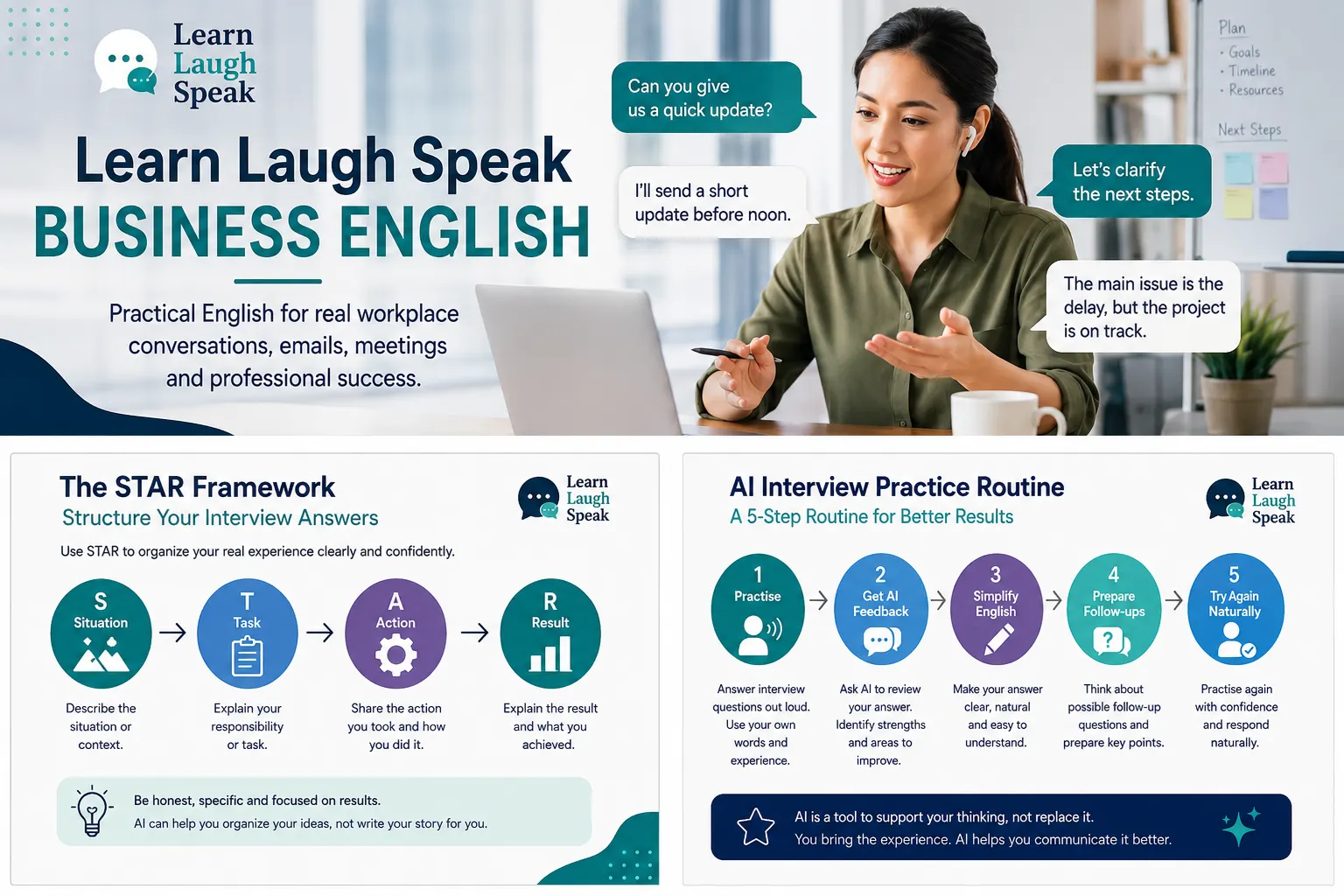
Clear English Beats Complicated English at Work
Professional English does not need to sound complicated.
Compare:
“We are presently experiencing operational difficulties that have resulted in an unforeseen postponement.”
With:
“We have had an operational problem, so the delivery will be delayed.”
The second sentence is easier to understand.
That matters when teams already deal with different accents, different first languages, video calls, technical vocabulary, poor connections, and time pressure.
Adding unnecessary complexity does not make communication more professional.
Often, it makes it less effective.
A useful rule is:
Be accurate first. Be sophisticated second.
Once the idea is clear, you can refine the tone and vocabulary.
Our article on how to sound more professional in English explains how clarity, precision, and tone usually matter more than using bigger words.
Learn Laugh Speak Business English FAQs
What Is Learn Laugh Speak Business English?
Learn Laugh Speak business English is workplace-focused English learning for adults.
It develops the reading, writing, listening, speaking, grammar, vocabulary, and communication skills needed in professional situations such as meetings, emails, interviews, presentations, customer conversations, and teamwork.
Is Business English Different From General English?
Yes.
General English prepares you for broad everyday communication.
Business English focuses more directly on the language used to complete professional tasks, such as giving updates, writing emails, negotiating, asking for clarification, dealing with customers, or presenting information.
The British Council Business English section provides additional examples of workplace-focused English practice.
Do I Need Advanced English Before Learning Business English?
No.
A learner does not need to reach C1 or C2 before using English professionally.
An A2 employee may need to confirm a booking or explain a simple process. A B1 learner may need to participate in routine meetings. A C1 manager may need to negotiate, present strategy, or handle complex conversations.
The language should match both the learner’s English level and the requirements of the job.
The Council of Europe’s Common European Framework of Reference for Languages is the international framework commonly used for English levels from A1 to C2.
Does Learn Laugh Speak Business English Cover Speaking and Writing?
Yes.
Learn Laugh Speak business English is not limited to vocabulary or written exercises. Professional communication depends on reading, writing, listening, and speaking working together.
A learner may need to understand an email, discuss it in a meeting, answer a question, and then write a follow-up message.
That is why all four core language skills matter.
Is Business English Only for Office Workers?
No.
Business and workplace English are relevant across hospitality, tourism, customer service, logistics, technology, healthcare, sales, management, administration, and many other industries.
The situations simply change according to the job.
A hotel employee and a software engineer may need very different vocabulary, but both still need English that helps them perform their work clearly and confidently.
The most useful Learn Laugh Speak business English practice is therefore the practice that connects directly to the communication you actually need.
Final thoughts
Good Business English is not about sounding like a corporate textbook.
It is about being able to do your job in English.
Understand the email.
Join the meeting.
Ask the question.
Explain the problem.
Speak to the client.
Give the update.
Write the follow-up.
And do those things without spending all your mental energy translating every sentence before you use it.
That is the practical purpose of Learn Laugh Speak business English.
Start with your actual English level. Identify where communication becomes difficult during your working day. Practise that situation deliberately.
Then take the language out of the lesson and use it where it matters.