
 English
 Arabic
 Chinese (Simplified)
 Dutch
Dutch French
 German
 Italian
 Portuguese
 Russian
 Spanish
A quiet training room can feel polite, but it’s not always productive. People nod. The trainer moves on. Then, ten minutes later, half the group is lost and everyone pretends they’re fine.
That’s the problem.
Good questions do more than fix confusion. They help learners check their understanding, connect new ideas to real tasks, and build the confidence to speak in front of others. For English learners, this matters even more.
Asking a clear question in a tutorial, workplace session, or group project is not just about getting an answer. It’s also speaking practice.
A better question can turn a difficult lesson into something usable. A vague one often leaves everyone guessing.

Start With What You Already Understand
The best questions usually begin with a small piece of understanding. Instead of saying, “I don’t get it,” try to name the part that makes sense first.
For example: “I understand the first step, but I’m not sure how to choose the right option after that.”
That sentence does three useful things. It shows the trainer where to begin. It saves time. It also makes the speaker sound more prepared, even when they’re confused.
This works well in technical training, language lessons, and workplace onboarding. Someone studying a Cert III in Instrumentation and Control, for instance, may deal with practical electrical and measurement concepts that require precision. A better question would not be, “What does this mean?” It would be, “I understand what the sensor is measuring, but how do we decide when the reading shows a fault?” That question gives the trainer something specific to answer.
Specific beats broad. Every time.
Use Simple Question Frames
When nerves take over, even advanced learners can forget the words they know. A simple question frame helps. It gives the brain a structure to follow.
Try phrases like:
“Could you explain the difference between…?”
“What does this word mean in this situation?”
“Can you show one more example?”
“Is this correct if I say it this way?”
“What should happen after this step?”
These questions are short, but they’re powerful. They work in English classes, online tutorials, job training, and group work. They also sound natural. No one needs a long, perfect sentence to ask for help.
In fact, shorter is often better. A question with too many details can bury the real problem. One clear sentence gives the teacher, trainer, or group member room to respond properly.
Ask Earlier Than Feels Comfortable
Many learners wait too long. They hope the next slide will explain everything. Sometimes it does. Often, it doesn’t.
Then confusion stacks up. One missed word becomes a missed instruction. A missed instruction becomes a mistake in the task. By the end, the learner doesn’t know where the problem started.
Ask earlier.
There’s no prize for staying silent until the end. In group work, early questions can prevent the whole team from heading in the wrong direction. In tutorials, they help the trainer adjust before the room gets lost.
A useful timing phrase is: “Before we continue, can I check something?”
It’s polite, clear, and easy to say. It also signals that the question is about understanding the current step, not interrupting for no reason. Most trainers appreciate that. The good ones definitely do.
Turn Confusion Into a Choice
Sometimes the hardest part is not asking the question. It’s knowing what to ask.
When that happens, turn the confusion into a choice. Instead of saying, “I’m confused,” offer two possible meanings.
For example: “Does this mean we should finish the report first, or should we discuss the results before writing?”
That kind of question helps everyone. It gives the speaker control. It gives the listener options. It also avoids the awkward silence that often follows a very broad question.
This approach is especially useful for students living away from home or learning in a new city. Someone settling into university accommodation Brisbane, for example, may be adjusting to campus life, shared housing, Australian classroom expectations, and English communication at the same time. In that situation, clear questions make daily life easier. Asking, “Do we submit this online, or bring a printed copy to class?” is much more useful than quietly worrying about doing the wrong thing.
Listen to the Answer, Then Confirm It
A good question is only half the job. The next step is checking the answer.
This is where many learners lose confidence. They ask, receive an answer, and then nod even if they only understood 70 percent of it. Better to confirm.
Try saying: “So, just to check, we need to finish the first part today and send the rest tomorrow?”
This technique does two things. It proves understanding. It also gives the other person a chance to correct any mistake immediately.
In English learning, this is gold. It builds listening skills, speaking accuracy, and confidence in one short exchange. It also sounds professional. People who confirm instructions are usually seen as careful, not slow.
Small habit. Big difference.
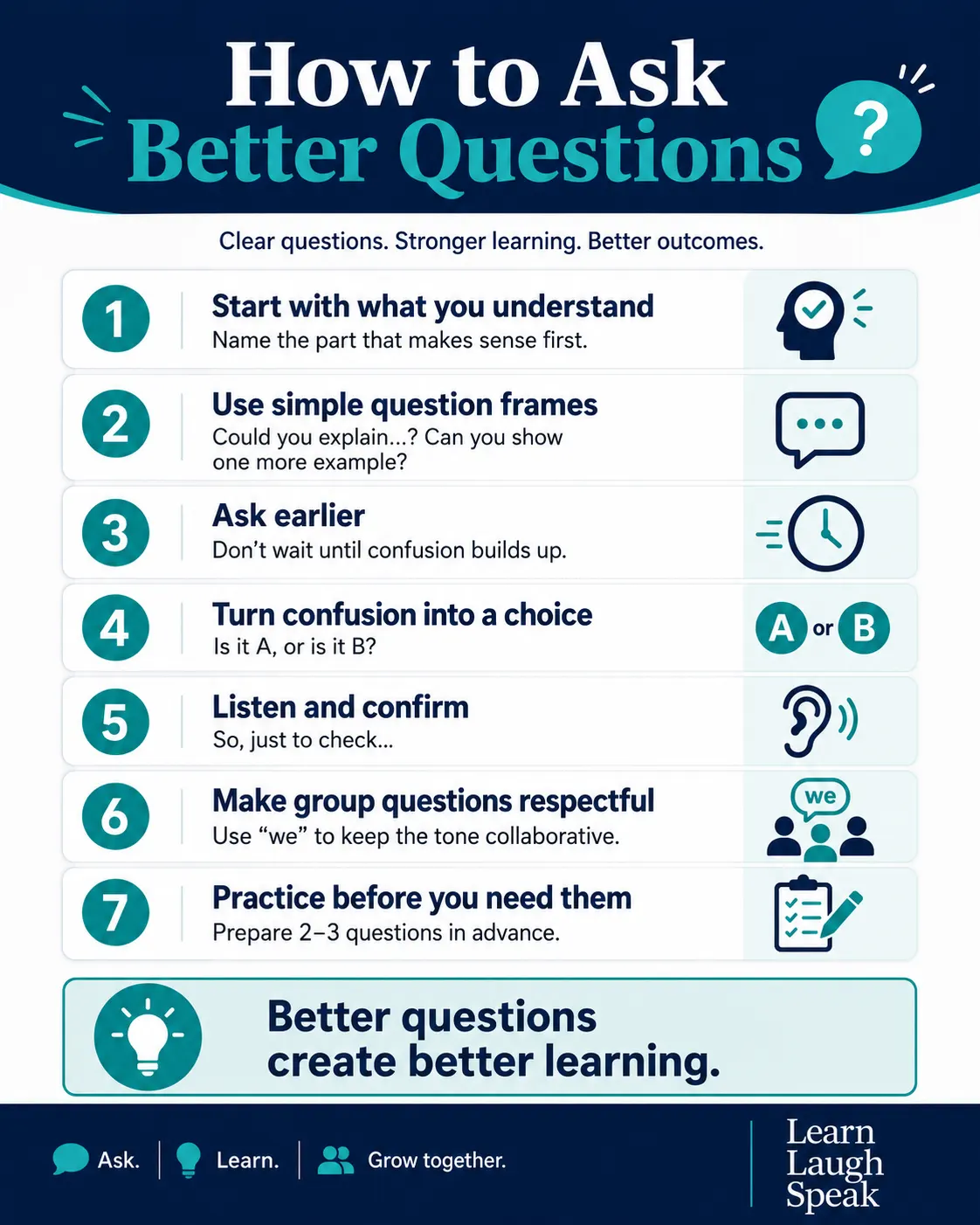
Make Group Questions More Respectful
Group work can be tricky. Nobody wants to sound bossy. Nobody wants to look unprepared either.
The best group questions invite others in without blaming anyone. Instead of saying, “Why didn’t you do this part?” try, “Can we check who is handling this part so we don’t miss it?”
That changes the tone completely.
Good group questions often use “we” because the task belongs to the group. “What should we finish first?” sounds better than “What are you doing?” “How should we divide this?” sounds better than “Who’s responsible?”
Tone matters. Especially in English, where a sentence can be grammatically correct but still sound too direct. A softer question can keep the discussion friendly while still moving the work forward.
Practice Questions Before You Need Them
Asking better questions is a skill. It improves with practice, not pressure.
Learners can prepare useful question phrases before a class, tutorial, meeting, or training session. They can also write down two or three questions while studying, then choose the clearest one to ask. This removes some of the stress from speaking.
The goal is not perfect English. The goal is useful communication.
A question can be short. It can be simple. It can even include a mistake. What matters is whether it helps the learner get the information they need and stay involved in the task.
Better questions create better learning moments. They make training less passive, tutorials less intimidating, and group work less messy. Best of all, they help learners speak up with more confidence, one clear sentence at a time.