
 English
 Arabic
 Chinese (Simplified)
 Dutch
Dutch French
 German
 Italian
 Portuguese
 Russian
 Spanish
If you have ever tried using a general-purpose AI tool to build a lesson or study plan, you know the frustration. You type in a topic and get back something that reads like it was written by someone who has only read about teaching, never done it. Getting the output to actually fit your students or your goals often took so much back-and-forth that it was faster to just do the work yourself.
That was the first wave of AI in education, powerful in theory and clunky in practice. Across K-12 classrooms, adult language learning platforms, and corporate training programs, a newer generation of tools has moved past generic text generation into something closer to genuine co-creation. Instructors are going from idea to ready-to-use material in minutes instead of hours.

AI for Adult English Learners: Personalization at Scale
For adult language learners, the real promise of AI isn’t novelty. It’s personalization at a scale that was never possible before.
Traditional language instruction runs into the same structural problem every time: every learner arrives with a different vocabulary base, different pronunciation challenges, different native-language interference, and different goals. A Brazilian professional preparing for business meetings has almost nothing in common with a Vietnamese student preparing for university entrance exams, yet both might land in the same “intermediate English” course working through identical generic material.
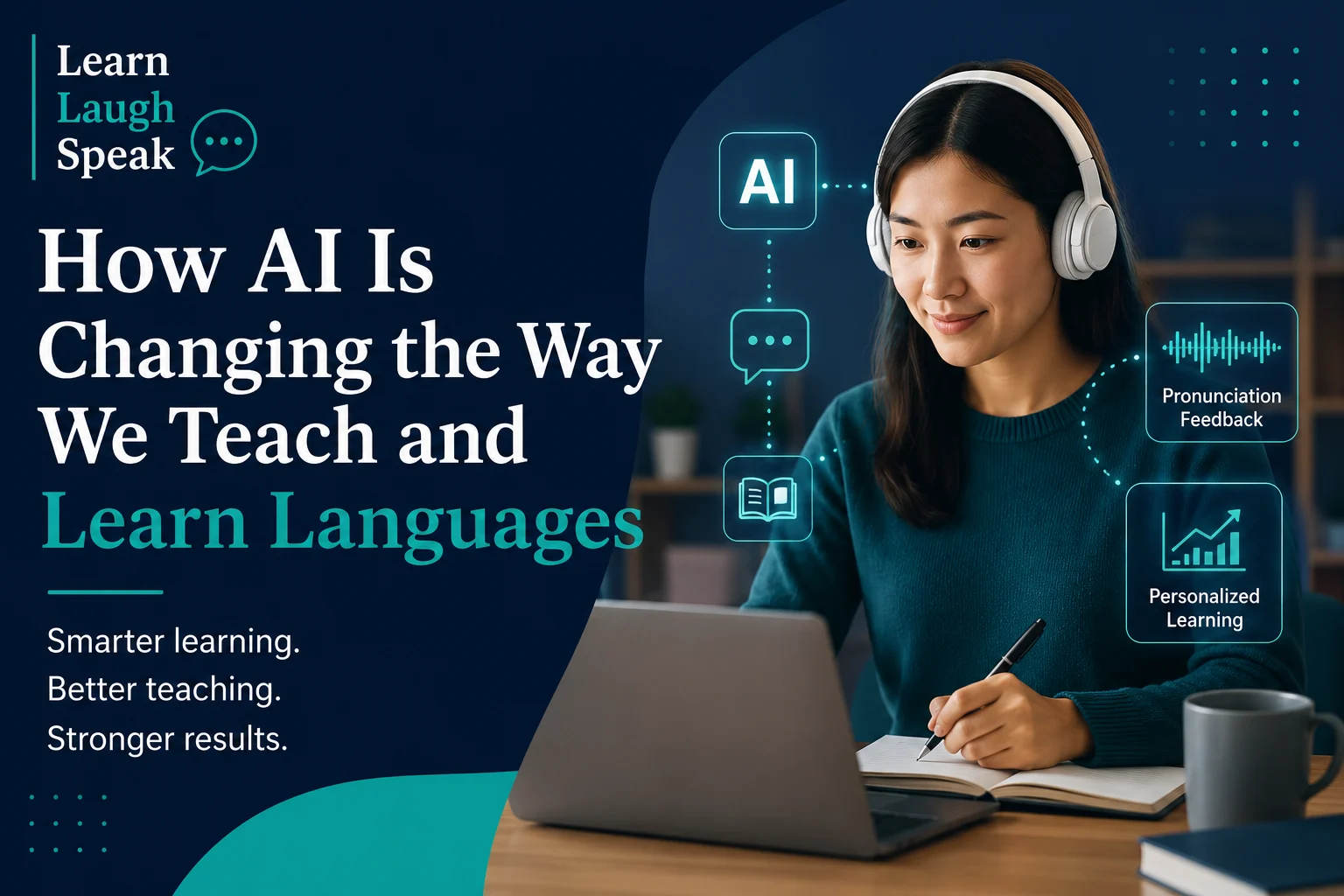
AI is starting to open that up. Modern language platforms can generate reading passages calibrated to a learner’s exact proficiency level, adjust exercise difficulty in real time, and give instant feedback on grammar and pronunciation, all without a human teacher in the room. The University of Illinois College of Education points to personalized content and immediate feedback as among AI’s most meaningful contributions to modern education.
The emotional impact of this shift is measurable. A study published in Frontiers in Public Health followed 272 undergraduate students learning English as a foreign language, comparing an AI-personalized instruction group against a control group over four weeks:
- Pleasure in learning rose from a mean score of 3.21 before the study to 4.02 after, among students using AI-personalized instruction.
- Language anxiety dropped from 3.78 to 3.12, meaning learners felt measurably less stressed and self-conscious.
- Self-efficacy, a learner’s belief in their own ability to succeed, climbed from 3.45 to 4.12.
That self-efficacy number matters more than it might look. It’s one of the strongest predictors of whether someone sticks with learning a language long-term. When AI removes the friction of one-size-fits-all instruction and gives learners content that feels built for them, they don’t just learn faster, they feel better about learning in the first place. That’s a real shift for anyone who has sat through a class that felt too fast, too slow, or simply beside the point.
What this looks like in practice:
- Adaptive exercises that respond to how you’re actually performing, not how the curriculum assumes you should be.
- Customized content that reflects the professional or everyday situations you actually care about.
- Instant feedback on grammar and pronunciation, without scheduling a session or waiting on a reply.
AI doesn’t replace a good teacher, but it closes the gap between lessons by keeping learners engaged and supported the rest of the time.\
The Rise of AI Lesson Planners in K-12 Classrooms
To see how fast this is moving, it helps to look at a domain under just as much time pressure: the K-12 classroom.
Teachers have long been among the most time-poor professionals, spending evenings and weekends building lesson materials, writing worksheets, and creating differentiated activities for students at different ability levels. It’s exactly the kind of repetitive, high-stakes prep work AI is well-suited to speed up.
One example is Chalkie, an AI lesson plan generator that produces curriculum-aligned lesson slideshows, worksheets, and differentiated activities from a single prompt in under 30 seconds. Still independent and privately funded, the platform grew from 500,000 to over 1,000,000 teachers in about four months, closing a $4 million round from TriplePoint Ventures in early 2026.
The specifics of any one tool matter less than what this growth signals: educators across every context want tools that handle the mechanical work of content creation, so they can focus on what actually needs a human, building relationships, reading the room, and adapting in real time. That’s true whether you’re teaching phonics to a seven-year-old or business vocabulary to a working professional.
AI in Corporate Training and Language Programs
The same pattern shows up in corporate learning and development. Onboarding new hires, running compliance training, and building skills assessments are all time-consuming tasks that historically fell to small L&D teams juggling too many priorities.
AI is shifting that math. Companies are increasingly using it to generate onboarding modules customized for specific roles, compliance training that updates when regulations change, and skills assessments that evaluate real employee competencies. The throughline is the same: AI absorbs the prep work so the people responsible for learning can focus on delivery, coaching, and follow-through.
For companies running English training for staff, this matters directly. AI tools can now generate role-specific vocabulary exercises, simulated business conversations, and comprehension checks built around the actual content a team works with. A sales team practicing client negotiation language needs a fundamentally different learning experience than a logistics team learning customs documentation, and AI makes it practical to build both without doubling the workload.

Why AI Personalization Works So Well
- It meets learners where they are. AI can assess a learner’s current level and generate content that pushes them forward without being so difficult that they get discouraged, something traditional classes often miss because they have to teach to the middle.
- It adapts in real time. As a learner improves or struggles, AI-powered tools adjust difficulty, repeat what needs reinforcement, and skip what’s already mastered, keeping the experience efficient rather than repetitive.
- It creates a low-pressure practice space. Many adult learners feel self-conscious speaking a new language in front of others. AI gives them a private space to practice pronunciation, make mistakes, and get instant, objective feedback without embarrassment.
- It frees up instructors for higher-value work. When AI handles the repetitive parts of content creation and feedback, teachers and trainers get more time for what actually moves learners forward: encouragement, relationship-building, and adapting to individual needs as they come up.
Human judgment still matters here. A tool without a clear sense of what the lesson needs to accomplish will still hand back something generic. But the direction is clear: purpose-built tools are increasingly handling the scaffolding work, freeing instructors to focus on teaching.
Frequently Asked Questions
Q: What is the biggest change in AI for education?
A: The biggest change is the shift from general-purpose AI text generators to specialized, purpose-built tools that act as co-creators for educators and learners. These new tools are designed to handle specific educational tasks like creating curriculum-aligned lesson plans, personalizing exercises, and providing instant feedback, moving beyond the generic templates of earlier AI.
Q: How does AI specifically help adults learning English?
A: AI helps adult English learners primarily through deep personalization. It can generate learning materials tailored to an individual’s specific proficiency level, professional goals, and native language challenges. This leads to more effective learning, reduced anxiety, and increased confidence, as learners engage with content that is relevant and appropriately challenging for them.
Q: Will AI replace language teachers?
A: No. The goal of modern educational AI is not to replace teachers but to augment their abilities. AI excels at handling the time-consuming preparation work — creating materials, differentiating exercises, and providing instant feedback. This frees up human teachers to focus on what they do best: building relationships, providing encouragement, and adapting to the nuanced needs of their students in real time.
Q: Why is AI personalization so effective?
A: AI-powered personalization is effective because it directly addresses the unique challenges of each learner. Traditional classes often use a one-size-fits-all approach, but AI can adapt in real time, adjusting difficulty based on performance and creating content relevant to a learner’s specific goals. This tailored experience makes learning more efficient and boosts self-efficacy — a learner’s belief in their own ability to succeed.
Q: How can using an AI learning tool reduce stress?
A: These tools can reduce the stress and anxiety often associated with language learning by creating a private, non-judgmental practice environment. Learners receive instant, objective feedback on things like pronunciation and grammar without the self-consciousness of making mistakes in front of a person. As studies show, this personalized, low-pressure experience can significantly lower language anxiety and increase pleasure in learning.
Q: What are the benefits of AI in corporate training?
A: For corporate training, AI enables L&D teams to scale personalized language programs without scaling their headcount. It can generate role-specific vocabulary exercises, simulate business conversations, and create assessments tied to a company’s actual work. This ensures training is directly applicable to an employee’s job, increasing engagement and effectiveness.

Conclusion
Instructors and learning designers have always spent a disproportionate share of their time on the work that happens before teaching: writing, formatting, differentiating, sequencing. It’s necessary work, but it isn’t what moves learners forward.
What moves learners forward is a skilled, present, responsive person who notices confusion, offers encouragement, and adjusts on the fly. AI can’t do that part. What it can do is take hours of prep work off the table so that human energy goes where it matters most.
Tools like Chalkie’s AI worksheet generator handle the mechanical work – building differentiated activity sheets for mixed-ability classrooms in seconds – so teachers can focus on the responsive, human part of instruction.
For an adult learning English, that shift shows up as content that feels built for your level, your goals, and your schedule. For an L&D manager building a language program for a global team, it means scaling personalization without scaling headcount. The tools are still maturing, but the direction benefits learners and teachers alike.