
 English
 Arabic
 Chinese (Simplified)
 Dutch
Dutch French
 German
 Italian
 Portuguese
 Russian
 Spanish
Lab managers do not lose money because a citation check takes a few extra seconds. They lose money when a purchased credit pack sits half-used until the six-month window closes, or when every anxious postdoc Deep Verifies decorative references the week before a grant report. The procurement question is narrower than “is verification good.” What matters is whether the buying shape matches how a group actually clears bibliographies with a Citation Checker.
I buy tools for a mid-size STEM lab. I can approve a pack. I cannot rewrite every manuscript. My failure mode is quiet budget waste: credits that expire, exports nobody files, and Deep Verify spends with no written reason. CiteTrue only belongs on the purchase list if the team treats credits like timed inventory, not like infinite peace of mind.
Free Daily Buckets Versus Packs Versus Subscriptions
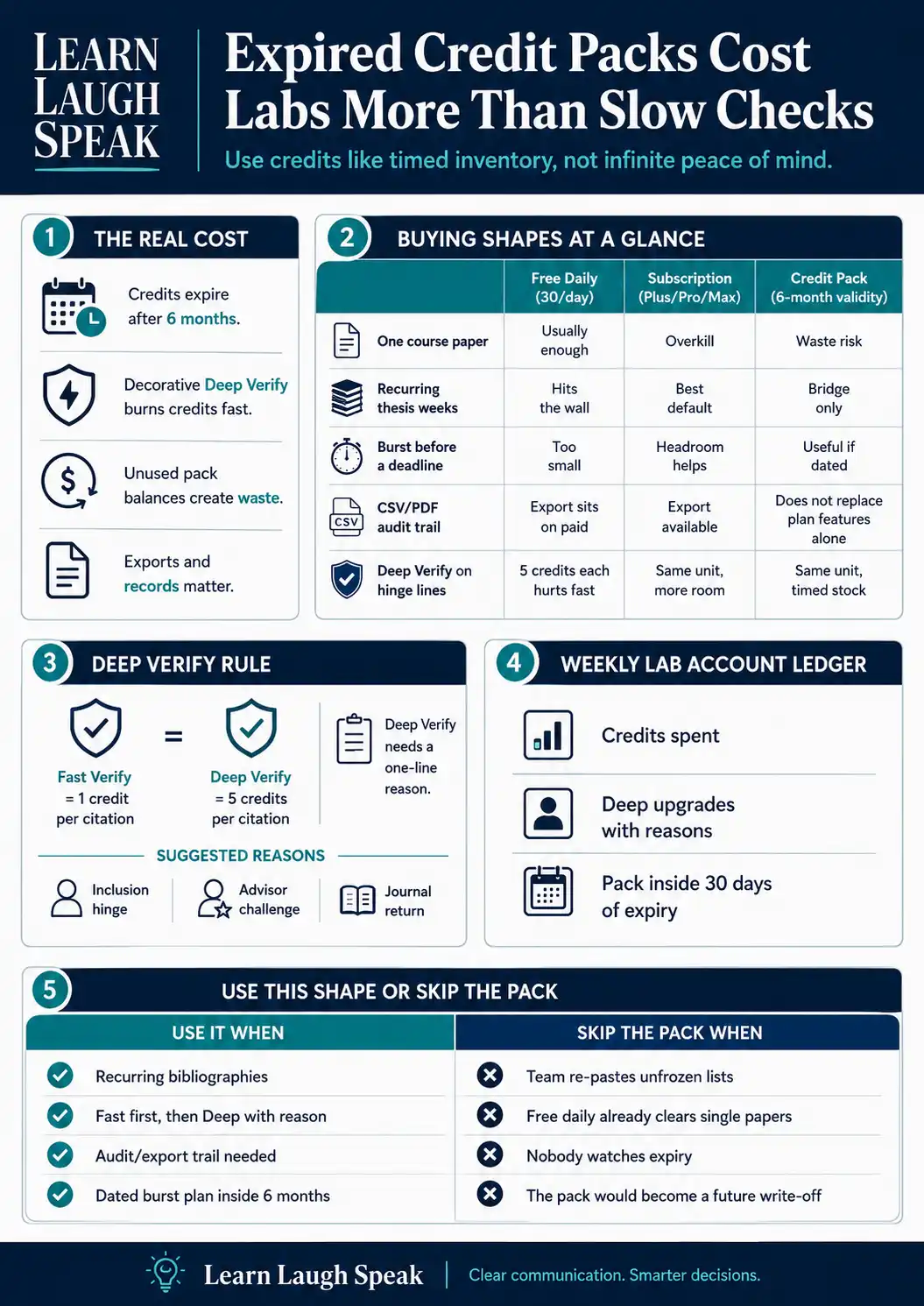
CiteTrue sells three useful shapes, and labs mix them up. Free gives 30 verification credits every day with a 30-citation batch ceiling. That is fine for one short paper under discipline. It is a bad plan for three thesis chapters landing in the same afternoon. Paid monthly plans raise the ceiling: Plus at 1,000 credits per month, Pro at 3,000, Max at 20,000, with yearly billing advertised as a 40% save versus monthly. Credit packs sit beside those plans. Pack credits are valid for six months from purchase. Subscription credits are used first, then pack credits in expiration order.
That last sentence is the sticky note on my purchase form. If someone buys a pack “just in case” and the lab keeps living on free daily resets, the pack becomes a calendar liability. In my testing, the expensive outcome was never a slow card. It was unused pack balance crossing the expiry line while people still complained they “needed more credits.”
| Buyer job | Free daily | Subscription | Credit pack |
| One course paper | Usually enough | Overkill | Waste risk |
| Recurring thesis weeks | Hits the wall | Best default | Bridge only |
| Burst before a deadline | Too small | Headroom helps | Useful if dated |
| CSV/PDF audit trail | Export sits on paid | Export available | Does not replace plan features alone |
| Deep Verify on hinge lines | 5 credits each hurts fast | Same unit, more room | Same unit, timed stock |
Read the table as routing, not as marketing. Free is a filter with kill rules. Subscription is for repeated monthly volume. Packs are timed bridges. Buying a pack because free felt stressful—without changing the team’s re-paste habits—just moves the stress onto a future expiry date.
Deep Verify Spend Needs A Verbal Approval Rule
Fast Verify costs one credit per citation. Deep Verify is an on-demand second pass that widens database coverage and costs five credits for that line. For a lab, the unit math is the management problem. Ten decorative Deep upgrades burn fifty credits and still leave the argument untouched. Ten hinge upgrades on Unsure methods citations can save a desk reject. The tool cannot tell those jobs apart. The lab manager can.
Our rule is blunt. Anyone may Fast Verify. Deep Verify needs a one-line reason in the shared notes: inclusion hinge, advisor challenge, or journal return. No reason, no upgrade. That rule cut our morning spend without forbidding the heavy pass when it mattered.
What The Expiry Sticky Note Forced Us To Change
I started dating pack purchases on a physical sticky note beside the lab card. The observable result was ugly at first: we had burned roughly a third of a pack on whole-list re-runs after every minor edit, then watched the rest approach expiry while people still pasted the same bloated bibliography five times. I stopped approving “top-up” packs until the group agreed to freeze the list before a finalize pass. The rework dropped. The pack lasted like inventory instead of like anxiety medication.
When An Export Trail Matters More Than Extra Credits
Some buyers chase max credits and forget the job is auditability. If the PI wants a CSV or PDF trail for an advisor packet, paid plan features matter more than another timed pack. An AI Citation Checker that catches Not Found lines but leaves no shareable record still creates meeting churn. Buy the shape that matches the artifact you need to file, not the biggest number on the pricing grid.
Score Three Buying Paths On The Same Lab Week
I score purchases against one frozen week: two manuscript bibliographies, one conference abstract list, and one advisor packet that needs an export. That is the only fair compare. Marketing pages will always make every tier sound kind.
- Free-only week: each person uses the daily thirty with a closed pass. Fail signal is mid-list Exceeded during a shared crunch hour.
- Subscription week: one shared paid ceiling, Fast first, Deep only with a reason. Fail signal is Deep upgrades without notes.
- Pack bridge week: subscription first, then pack credits in expiry order for a known burst. Fail signal is buying the pack before the burst date is real.
The moment I forced that scorecard, “we need more credits” stopped being a vibe. Either the free day cleared a disciplined pass, or we had a dated reason to pay. Either Deep spend had a written hinge, or it was theater.
Why I Scrapped One Rushed Pack Request
I scrapped a rushed pack request the week after a student re-pasted a 40-line list four times on free credits, then claimed the tool was “too limited.” The cards had already shown the same year mismatch on the second run. More credits would not have fixed the habit. I deleted the purchase draft and asked for a freeze-and-finalize protocol instead. That single discard saved the lab from another six-month timer.
How Subscription Credits Should Drain Before Pack Stock
Operational detail matters for shared accounts. Subscription credits are used first, then pack credits in order of expiration. If people treat the pack as the default bucket while a monthly plan still has headroom, they accelerate expiry risk for no reason. I posted that order next to the sticky note so nobody “saves” the subscription for later and burns the timed stock first.
What A Shared Lab Account Must Record Each Week
Shared accounts fail when nobody owns the ledger. I ask for three lines in the lab wiki every week: credits spent, Deep upgrades with reasons, and whether any pack is inside thirty days of expiry. Without that, CiteTrue becomes a group chat rumor about “the tool being empty.” With it, purchasing arguments stay tied to dated inventory instead of mood. The wiki entry also stops one person from quietly burning the shared ceiling on decorative re-checks while everyone else hits Exceeded mid-list.

Where Timed Credits Still Need Human Judgment
Packs and plans do not remove manual review. Unsure cards still need a PDF or DOI check. Very new or thinly indexed sources can look absent even when the paper is real. Non-English coverage can vary. Credits are inventory for existence checks, not a substitute for reading the methods section you are about to cite.
Use This Buying Shape Or Skip The Pack
Use CiteTrue on a lab account when bibliographies are recurring, hinge lines get Fast Verify first, Deep Verify needs a written reason, and any pack has a dated burst plan inside six months. Prefer a subscription when monthly volume and exports are the real jobs.
Skip a credit pack if the team still re-pastes unfrozen lists for comfort, if free daily credits already clear disciplined single papers, or if nobody will watch the expiry date. In those cases the pack is not insurance. It is a future write-off wearing a productivity label.