
 English
 Arabic
 Chinese (Simplified)
 Dutch
Dutch French
 German
 Italian
 Portuguese
 Russian
 Spanish
Whether you’re in a business meeting, replying to an email, or working with a colleague, knowing how to respond with the right tone is essential. Being able to show agreement clearly and respectfully helps build trust and keep communication smooth. This guide shares useful phrases for agreeing in English — especially for professional and workplace situations.
Quick Answer: Professional Phrases for Agreeing in English
When agreeing in English professionally, you should choose phrases that match the situation and tone. Sometimes a simple phrase like “I agree with that” is enough. In other situations, you may need to sound more thoughtful by explaining why you agree.
For example:
“I agree with that approach because it helps us stay focused on the deadline.”
This sounds professional because it does more than say yes. It shows that you understand the idea, support it, and can explain your reasoning clearly.
How to Reply to a Job Offer (With Examples)
Why Professional Agreement Matters
In many work environments, your ability to agree respectfully and clearly makes a big impact. It shows that you:
- Understand and support ideas
- Can collaborate well with others
- Communicate clearly and professionally
When you’re agreeing in English, it’s not just about saying “yes” — it’s about saying it the right way.
How to Professionally Accept Offers in English
Different Levels of Agreement in Professional English
Not every agreement needs the same strength. Sometimes you fully agree, sometimes you partly agree, and sometimes you agree but want to add a condition or next step. Learning these differences helps you sound more natural and professional.
Use these phrases depending on how strongly you agree:
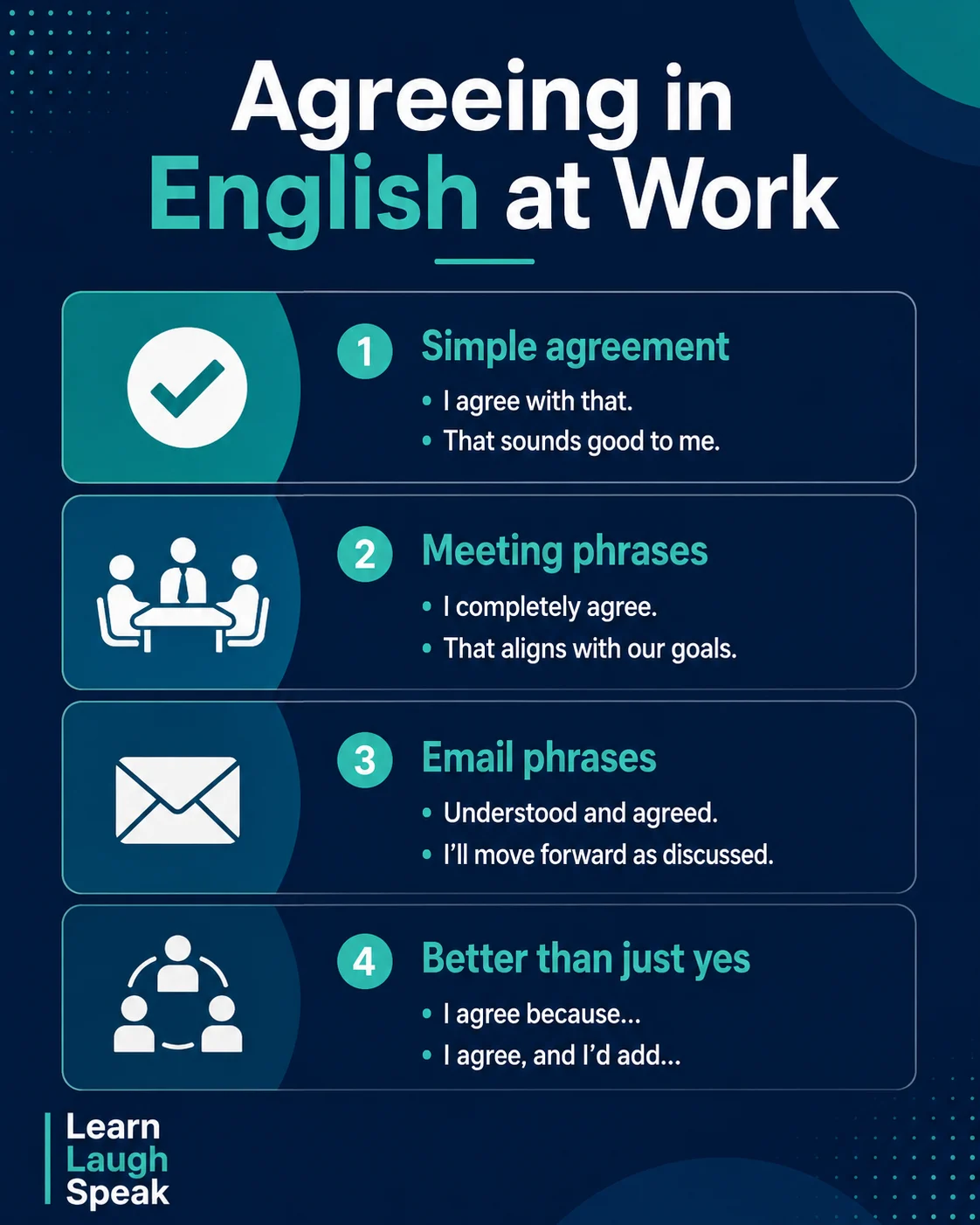
- Full agreement: “I completely agree with that.”
- Polite agreement: “That sounds good to me.”
- Strategic agreement: “That aligns with our current goals.”
- Careful agreement: “I agree overall, but I think we should review one detail first.”
- Collaborative agreement: “I agree, and I’d like to build on that idea.”
- Email agreement: “Understood and agreed. I’ll move forward as discussed.”
- Meeting agreement: “Yes, I support that approach.”
This section helps readers understand that professional agreement is not only about saying yes. It is about choosing the right tone.
What Not to Say When Agreeing in English
Some agreement phrases can sound too casual, passive, or unclear in workplace English. A stronger phrase should sound confident, respectful, and connected to the conversation.
| Avoid Saying | Say This Instead |
|---|---|
| “Yeah.” | “Yes, I agree with that.” |
| “Sure, whatever.” | “That works for me.” |
| “I guess so.” | “I agree with the main idea.” |
| “Fine.” | “That sounds good to me.” |
| “If you say so.” | “I trust your judgment on this.” |
| “Okay, I’ll just do it.” | “Understood. I’ll move forward as discussed.” |
| “Everyone else agrees, so yes.” | “I agree because this approach makes sense for our goals.” |
These small changes help you sound more confident and professional when agreeing in English.
Professional Agreement Phrases by Situation
Use these examples when you need to agree clearly in common workplace situations.
- In a meeting: “I completely agree with that point.”
- In an email: “Thanks for confirming. I’m aligned with the plan.”
- With a manager: “I agree with the direction and will move forward.”
- With a client: “That approach works well for the project goals.”
- With a coworker: “Yes, that makes sense. Let’s proceed with that.”
- During planning: “I support that timeline.”
- During problem-solving: “I agree, and I think this could help us avoid the same issue later.”
Common Phrases for Agreeing in English
These phrases work well in a variety of professional situations:
1. “I agree with that.”
Simple, direct, and respectful. Works in meetings or one-on-one conversations.
2. “That sounds good to me.”
Polite and supportive — good for informal work chats or confirming plans.
3. “Absolutely.”
Strong and enthusiastic — great when you fully support the idea.
4. “You’re right about that.”
Validates someone’s idea and shows respect.
5. “I think that’s a great idea.”
Adds encouragement while agreeing.
6. “I’m on board with this.”
Shows support for group decisions or projects.
7. “That aligns with what I was thinking.”
Helpful when reinforcing shared understanding or strategy.
How to Handle a Job Offer When You’re Waiting on Another

Agreeing in English During Meetings
Meetings often require you to respond quickly and respectfully. Agreeing during group discussions shows that you are listening, engaged, and willing to collaborate. Some helpful phrases include:
- “I completely agree with that point.”
- “Yes, that makes perfect sense.”
- “That’s in line with what I was about to say.”
- “I support that idea fully.”
These phrases help you contribute positively without dominating the conversation.
Agreeing in English in Emails and Messages
Written communication is just as important as spoken. When you agree with something in a message or email, it’s important to be clear and polite. Here are some examples:
- “Yes, I agree and will begin as discussed.”
- “Thanks for confirming — I’m aligned with the plan.”
- “Understood and agreed. I’ll take care of this task.”
Using short, confident responses like these helps maintain a professional tone.
Polite and Professional Ways to Agree to Work in English
Better Email Examples for Agreeing Professionally
Example 1: Agreeing with a plan
Hi [Name],
Thanks for sharing the plan.
I agree with the proposed approach, and the timeline works well from my side.
I’ll move forward with the next steps as discussed.
Best regards,
[Your Name]
Example 2: Agreeing but adding one point
Hi [Name],
I agree with the main direction.
One small point I’d like to confirm is the deadline for the final review.
Once that is clear, I’m happy to move forward.
Best regards,
[Your Name]
Agreeing in Collaborative Discussions
When working on projects or team tasks, showing agreement helps build momentum. Collaborative phrases help support others and keep ideas moving forward:
- “That approach works well with our goals.”
- “Yes, let’s proceed with that strategy.”
- “I can support that timeline.”
These kinds of phrases keep group energy positive and productive.
How to Agree Without Sounding Passive
It’s good to agree, but you don’t want to sound like you’re just going along with everything. Here are ways to show thoughtful agreement:
- Add your reason: “I agree because that timeline helps us stay on track.”
- Offer encouragement: “That’s a strong suggestion — I support it.”
- Ask a follow-up: “Yes, and what would be our next step?”
This helps show that your agreement is based on thinking, not just politeness.
When to Be Cautious About Agreeing
Agreeing too quickly or too often might make you seem unsure of your own views. Before agreeing:
- Make sure you understand the full context
- Ask questions if something is unclear
- Speak up if you have reservations
Professional communication isn’t just about agreeing — it’s about contributing with thought.
Professional Communication: How to Enhance Your Skills with Effective Tools

Final Tip: Practice Agreeing in English Naturally
Like any part of language learning, using phrases for agreeing in English takes practice. Role-play common workplace conversations with a colleague or teacher. Try different phrases and tones until you find what feels natural and professional.
Keep a short list of go-to expressions nearby when writing emails or joining meetings. Over time, agreeing will feel easier, and your confidence will grow.
Final Thought: Agree with Clarity and Confidence
Using the right phrases for agreeing in English helps you sound professional, respectful, and confident. It’s a small part of communication — but it has a big impact.
Want to get better at real-world business English? Join Learn Laugh Speak and gain practical experience with workplace conversations, role-play lessons, and more.
2 thoughts on “Clear, Professional Phrases for Agreeing in English”
Pingback: 10 Proven Steps to Increase Your English Now - Learn Laugh Speak
Pingback: How to go from A1 to C2 Quickly & Correctly - Learn Laugh Speak