
 English
 Arabic
 Chinese (Simplified)
 Dutch
Dutch French
 German
 Italian
 Portuguese
 Russian
 Spanish
Digital education for adults has changed how people return to learning.
That part is obvious.
Adults can now study from home, at work, on a phone, during a break, late at night, or whenever life gives them space.
They can access lessons without travelling.
They can restart learning after years away.
They can use apps, platforms, videos, digital tools, and online assessments to build skills in ways that were not possible before.
But technology alone does not create progress.
That is the part modern education needs to be honest about.
A digital course can still be confusing.
An app can still feel random.
A video can still be passive.
A platform can still leave the adult learner unsure about what to do next.
So the real question is not:
“Is learning digital?”
The better question is:
“Is the digital learning actually helping the adult improve?”
That is where digital education has to become smarter.

Digital Education for Adults Has Solved One Problem, But Not All of Them
Access matters.
For many adults, digital learning makes education possible again.
A person who cannot attend a physical class can still study.
A worker with a changing schedule can still continue.
A parent can learn after the house is quiet.
Someone who feels embarrassed about returning to education can start privately.
That is powerful.
The World Bank describes digital technologies in education as important for expanding digital literacy and skills development for learning, civic participation, entrepreneurship, and employment.
But access is only the first step.
Once the adult arrives, the learning still needs to guide them.
That is where many digital education systems fall short.
They give adults content.
But not always direction.
The Problem With Digital Learning That Feels Like a Library
A digital library can look impressive.
Hundreds of lessons.
Dozens of modules.
Videos, exercises, downloads, and resources.
But for an adult learner, too much choice can become a problem.
They may ask:
Where should I start?
Is this lesson too easy?
Is this too advanced?
What have I already learned?
What should I practise next?
Am I improving or just completing things?
This is one reason digital education for adults needs more than content storage.
A library gives access.
A learning system gives direction.
Those are not the same thing.
Adults do not want to wander through lessons hoping they choose the right one.
They need a path that helps them use their time well.
Technology Should Reduce Confusion, Not Add More
Digital tools should make learning clearer.
But sometimes they do the opposite.
A platform can have too many menus.
A course can have too many options.
A dashboard can show progress without explaining what the progress means.
A learner can finish lessons and still not know whether their ability has improved.
That creates digital noise.
Modern adult education should remove that noise.
The learner should be able to see:
where they are now
what they have already done
what still needs work
what mistake keeps appearing
what the next useful step is
how progress is being measured
Technology should not make adults feel like they are managing another complicated system.
It should help them focus on learning.
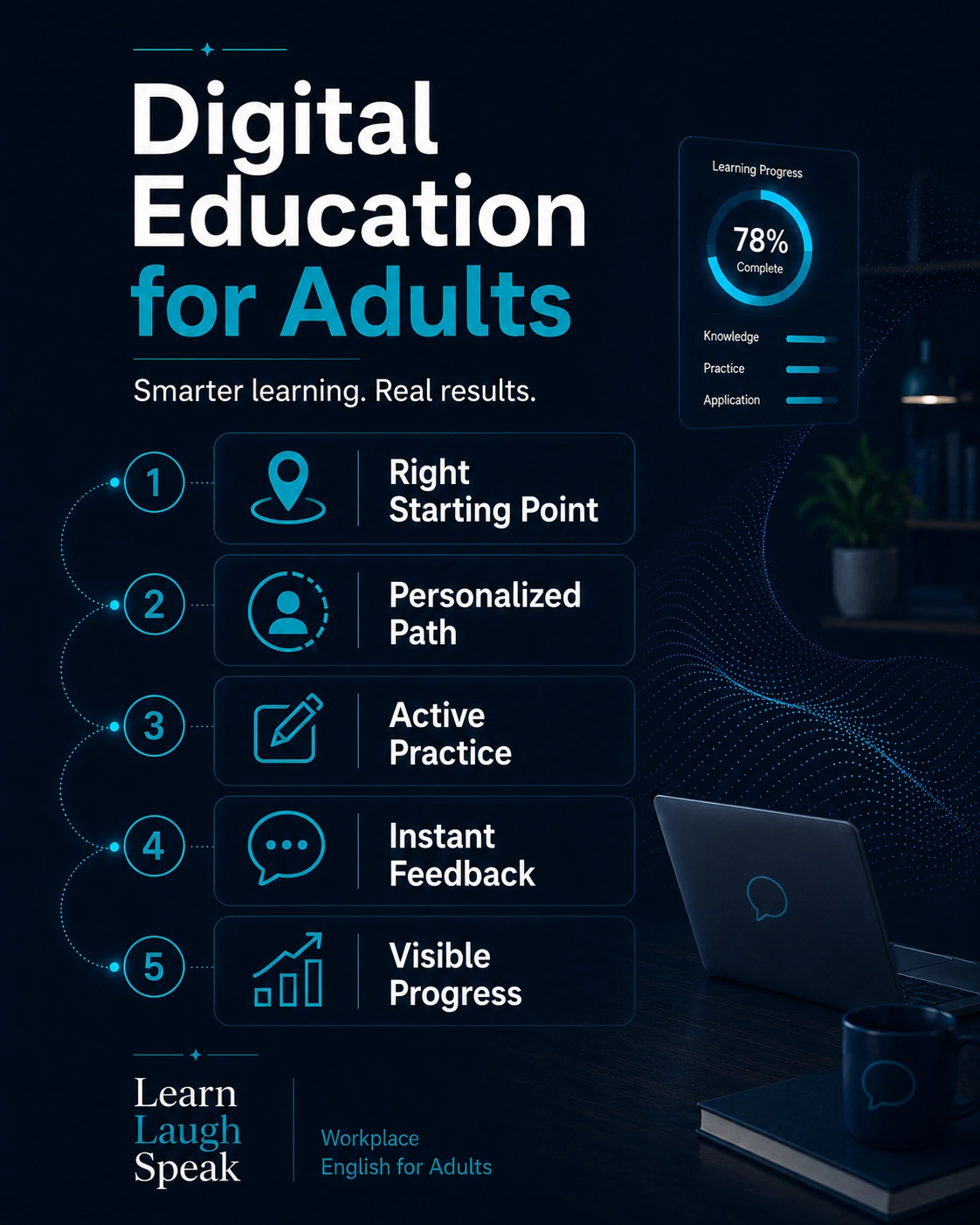
What Good Digital Education Should Do for Adults
| Digital Education Feature | What It Should Help Adults Do |
|---|---|
| Level assessment | Start from the correct place |
| Personalized path | Avoid wasting time on what they already know |
| Progress tracking | See improvement clearly |
| Feedback | Understand mistakes and next steps |
| Flexible access | Continue learning around real life |
| Active practice | Use skills, not only watch lessons |
| Review tools | Return to weak areas before they disappear |
This is the difference between having technology and using technology well.
Digital learning should not only look modern.
It should make progress easier to understand.
Adults Need Digital Learning That Respects Prior Experience
Adults do not arrive as blank pages.
They bring work experience, previous education, confidence, old mistakes, unfinished courses, and habits built over years.
Some adults can move faster because they already know parts of a subject.
Others have hidden gaps that make progress slower.
A digital system should notice that.
If every learner starts from the same place, the technology is not really personal.
It is just a fixed course on a screen.
The OECD notes that adult learning systems need to be more flexible and responsive, and that recognizing informal learning is important because adults gain a lot of learning through work experience and informal exchanges.
That matters because adults often know more than a standard course assumes.
But they may also have gaps that a standard course misses.
A better digital system should help identify both.
Digital Education Should Make Practice Active
Watching a lesson is not the same as using a skill.
Reading an explanation is not the same as applying it.
Clicking through a module is not the same as improving.
Adults need digital education that makes them practise.
That could mean answering questions from memory, correcting mistakes, applying a skill in a realistic task, writing something, speaking, reflecting, or using feedback to try again.
Passive learning can feel productive in the moment.
But active practice is what helps learning become usable.
This matters because adults usually return to education for a reason.
They want a skill they can use.
Not just content they can complete.
Feedback Is Where Digital Education Becomes Useful
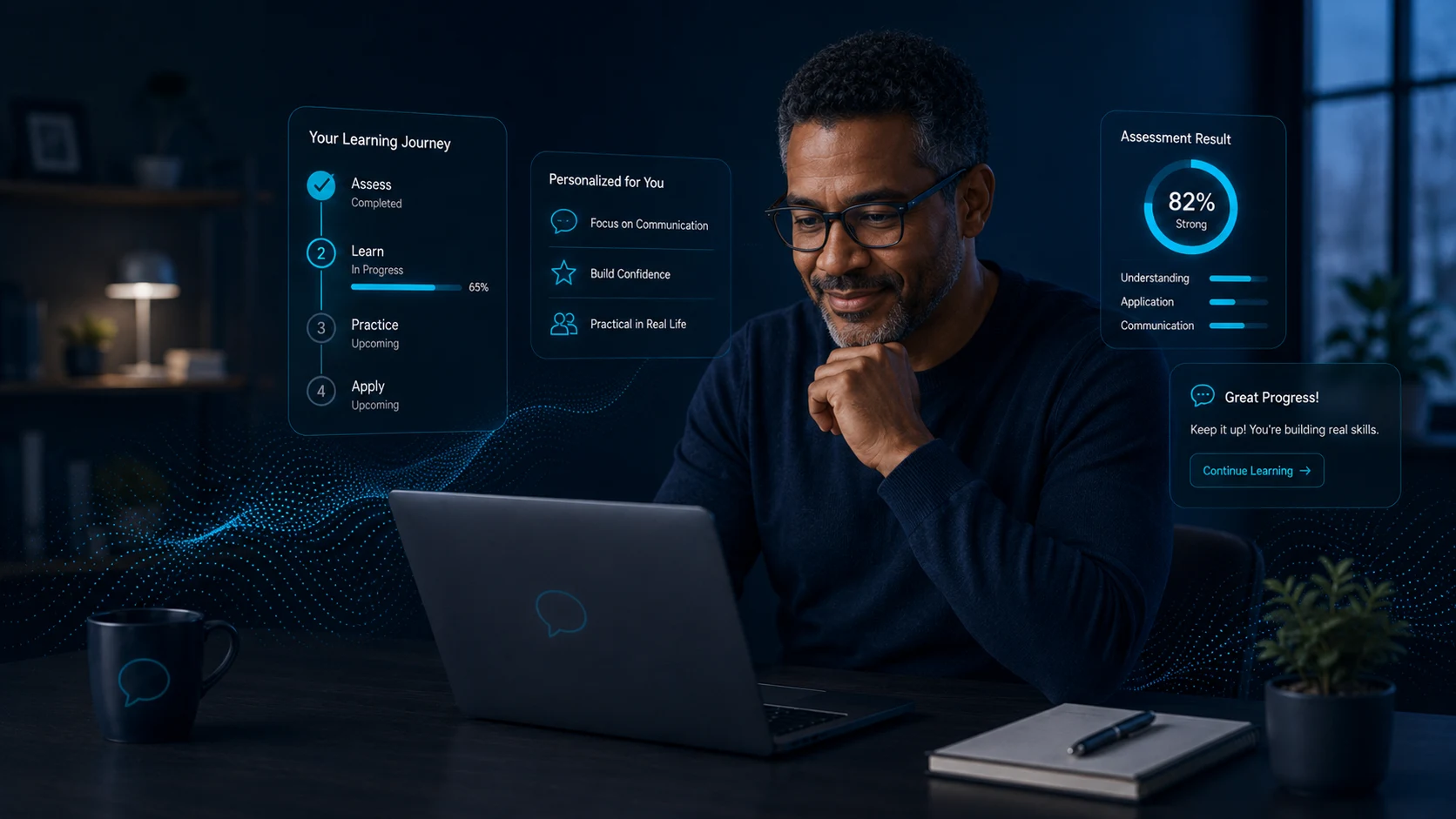
Feedback is one of the most important parts of digital learning.
Without it, adults may repeat the same mistake again and again.
They may feel like they are studying, but the weak area remains hidden.
Good feedback shows:
what happened
why it happened
what to practise next
whether the mistake keeps appearing
how to improve the next attempt
The Education Endowment Foundation describes feedback as information given to learners about their performance in relation to learning goals, with the aim of improving learning outcomes.
For adults, feedback is not only helpful.
It saves time.
It stops effort from being wasted in the wrong direction.
Flexibility Still Needs Structure
Digital learning is often sold as flexible.
Learn anytime.
Learn anywhere.
Learn at your own pace.
That sounds good, and it can be useful.
But flexibility without structure can become a problem.
If adults can study anytime, they can also delay anytime.
If they can choose anything, they may not know what to choose.
If they can move at their own pace, they may not know when to move forward.
So the strongest version of digital education is not freedom without guidance.
It is flexible structure.
The learner can study around real life, but the path still makes sense.
They can return after a break, but they do not have to start again.
They can move faster when ready, but slow down when mistakes appear.
That is what adult learners need.
Digital Skills Are Part of the Learning Experience Too
There is another layer here.
Adults are not only learning through digital tools.
They are also learning how to use digital tools.
For some adults, the platform itself can feel like a barrier.
Logins.
Dashboards.
Online forms.
Audio tools.
Video lessons.
Practice screens.
Progress reports.
New digital habits.
The World Bank highlights digital skills as important for lifelong learning, civic participation, entrepreneurship, and employment in a rapidly digitizing world.
That means digital education should not assume every adult is already confident with technology.
Good design should make the tool easy to use, so the learner can focus on the skill, not the system.
Digital Education for Adults Should Feel Personal, Not Automatic
There is a risk with digital learning.
It can feel automatic.
The platform gives the lesson.
The learner completes it.
The system moves forward.
But adults are not machines.
They need learning that responds to where they are.
A good digital education system should recognize:
prior learning
current level
repeated mistakes
weak areas
progress patterns
when the learner is ready to move forward
when more practice is needed
This is what makes digital education useful.
Not the screen.
Not the number of lessons.
Not the fact that it is online.
The real value is whether the system helps the learner make better progress.
How Learn Laugh Speak Uses Digital Education for Adults
Learn Laugh Speak is built for adults who need English they can actually use.
Students do not begin from a random lesson.
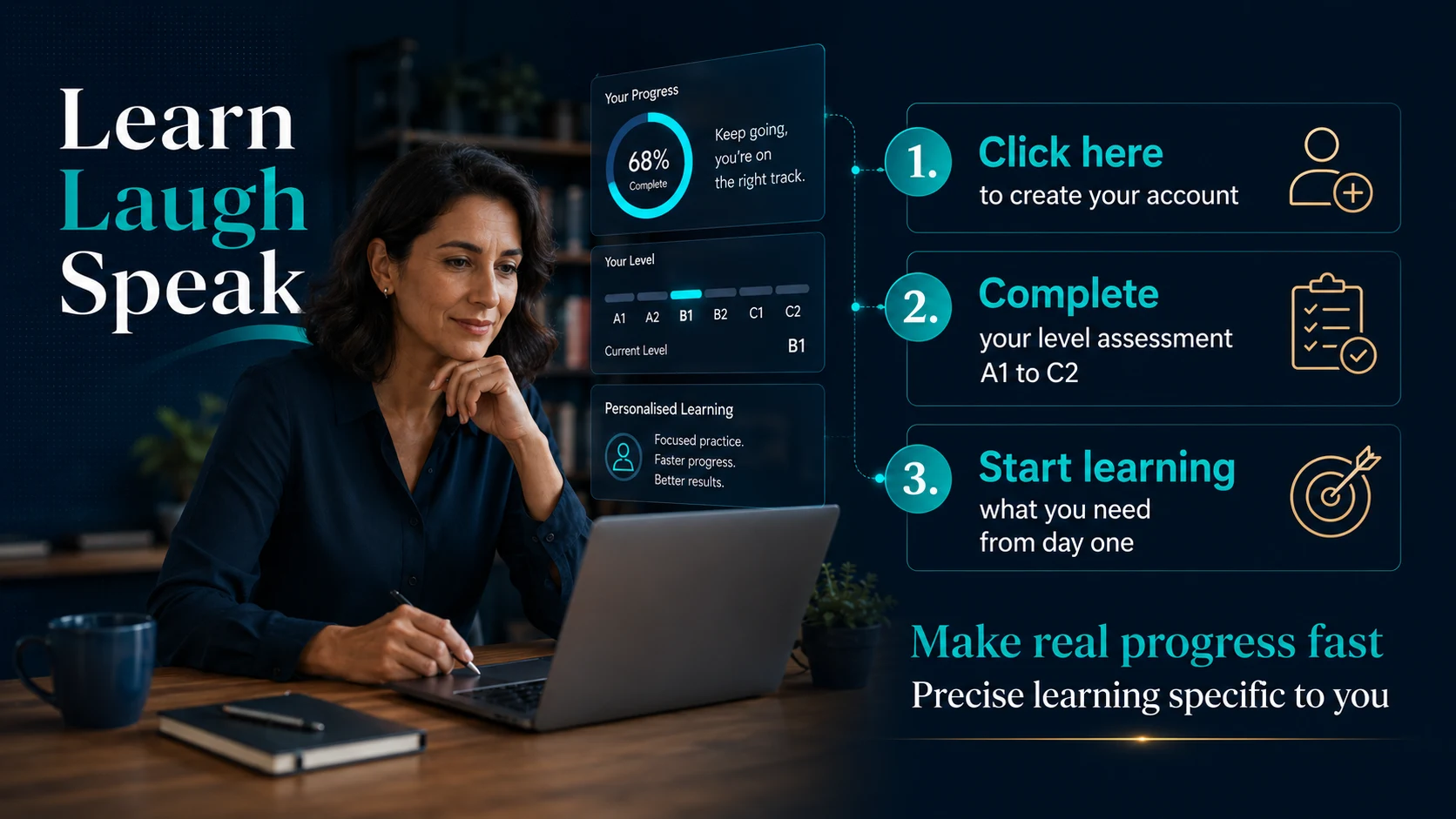
They begin with a level assessment so the platform can understand where they are now.
That matters because adult learners arrive with different histories.
Some have prior learning.
Some have hidden gaps.
Some can move faster through what they already understand.
Some need more support where mistakes are still appearing.
From there, each learner follows a personalized path based on level, progress, mistakes, and needs.
This connects directly to digital education for adults because the goal is not simply to put lessons online.
The goal is to make learning more accurate.
Students learn what they need, when they need it.
They do not waste time repeating everything they already know.
They also do not skip the areas where support is still needed.
That is how digital education becomes useful for real adult progress.
What Digital Education Should Avoid
Digital education should avoid:
too much content without guidance
fixed paths that ignore prior learning
progress tracking that only measures completion
flexibility without structure
lessons with no feedback
platforms that feel harder than the learning itself
passive videos with no active practice
treating every adult learner the same
These problems are common.
But they are not unavoidable.
Good digital learning design can fix them.
Final Thought
Digital education for adults is powerful when it is designed around real adult learning needs.
Technology can improve access.
But access is not enough.
Adults need guidance, structure, feedback, flexibility, active practice, and visible progress.
They need digital learning that understands where they are, what they already know, what they still need, and what should happen next.
The future of adult education will not be defined by who has the most content online.
It will be defined by who helps adults make the clearest progress.
That is what digital education for adults needs to get right.
Still need or have questions to be answered on digital education for adults in 2026? Send us a message!