
 English
 Arabic
 Chinese (Simplified)
 Dutch
Dutch French
 German
 Italian
 Portuguese
 Russian
 Spanish
Personalized learning paths matter because adult students do not arrive at learning from the same place.
That is the part many traditional systems miss.
One student may have studied English years ago but forgotten most of it.
Another may understand grammar but struggle to speak.
Another may have strong reading skills but weak writing.
Another may already know parts of the level and only need help with specific gaps.
Yet too often, all of them are placed into the same structure.
Same lesson.
Same order.
Same pace.
That may be easy to manage, but it is not always the best way to learn.
Because adult students do not need a path designed for the average learner.
They need a path designed for where they are now.
Adults in 2026 are increasingly engaging in learning that is self-directed, flexible, and immediately applicable to their professional or personal lives.
Personalized Learning Paths From Lesson 1
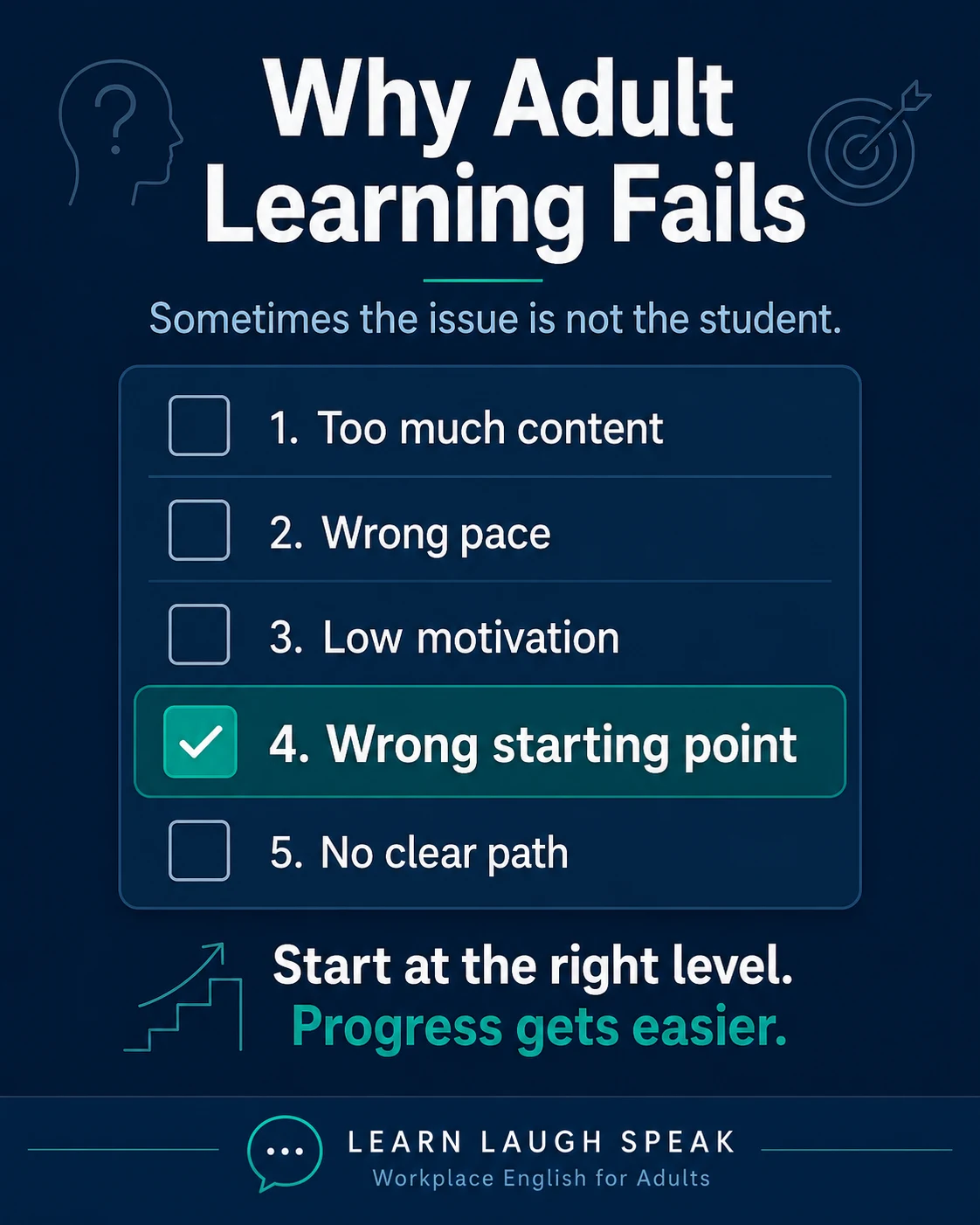
A lot of learning fails before it even begins.
Not because the student is not motivated.
Not because the teacher is bad.
But because the starting point is wrong.
If the material is too easy, the student gets bored.
If it is too difficult, they feel lost.
If it ignores what they already know, they waste time.
If it skips what they struggle with, the gaps stay hidden.
That is why placement matters so much.
A good learning journey should not begin with a guess.
It should begin with understanding.
Adult Students Bring History With Them
Children often start learning from a more predictable place.
Adults do not.
Adults bring:
old lessons
prior experience
work pressure
confidence issues
habits from previous learning
skills that are strong in one area and weak in another
That makes adult learning more complex.
But it also creates opportunity.
Because adults often learn faster when the system respects what they already know.
They do not need to repeat everything.
They need to strengthen the parts that are holding them back.
This is where personalized learning paths become valuable.
They make learning more precise.
Addressing prior learning—both through active pedagogical engagement in the classroom and formal recognition in education/workforce systems—is a critical factor for success.
The Difference Between a Fixed Path and a Personal Path
A fixed path says:
Start here.
Complete this.
Move to the next lesson.
A personal path asks something better:
What does this student need next?
That one question changes the learning experience.
It moves the focus away from finishing content and toward building ability.
| Fixed Learning Path | Personalized Learning Path |
|---|---|
| Same order for everyone | Adjusts to the student |
| Time-based progress | Ability-based progress |
| Repeats known content | Focuses on gaps |
| Mistakes are corrected later | Mistakes guide the next step |
| Progress can feel slow | Progress feels more relevant |
This does not mean structure disappears.
It means structure becomes smarter.
Why Mistakes Are the Most Useful Data
Mistakes are not just something to correct.
They are information.
They show where learning is not secure yet.
A student may think they understand something, but their mistakes show a different story.
Maybe they use the wrong tense again and again.
Maybe they write sentences that are technically correct but unnatural.
Maybe they understand a phrase when reading, but cannot use it when speaking.
Those mistakes are not failures.
They are signals.
A strong learning system pays attention to those signals.
That is how learning becomes personal.
Why Completion Is Not the Same as Progress
This is one of the biggest problems in education.
A student can complete lessons and still not improve enough.
They can finish modules.
They can pass small checks.
They can move through a course.
But if they cannot use what they learned later, the progress is not strong enough.
Completion is easy to measure.
Real progress is harder.
Real progress asks:
Can the student use this without help?
Can they remember it later?
Can they apply it in a different situation?
Can they correct the mistake next time?
That is what matters.
Personalized Learning Paths Make Learning More Efficient
Adult students usually do not have time to waste.
They are learning around work, family, stress, and responsibilities.
So efficiency matters.
Not rushing.
Efficiency.
That means learning should focus on what creates progress.
If a student already understands something, they should not be forced to repeat it endlessly.
If a student keeps making the same mistake, they should not be pushed forward too quickly.
Personalization helps balance both sides.
Move faster where the student is ready.
Slow down where the student needs support.
That is how learning becomes more effective.
A Simple Example in English Learning
Imagine two adult students at the same general level.
One speaks confidently but writes with many mistakes.
The other writes well but freezes when speaking.
Should they follow the exact same lesson path?
Probably not.
They may share a level, but they do not share the same learning need.
One needs more accuracy work.
The other needs more real-time practice.
This is why level alone is not enough.
A level tells you where the student is broadly.
A personalized path tells you what the student needs next.
That is the difference.
Personalized Learning Is More Effective Than Traditional Education . Read this!
Why Motivation Improves When Learning Feels Relevant
Adults stay motivated when learning feels useful.
When a lesson connects to a real weakness, it feels worth doing.
When feedback explains a repeated mistake, the student pays attention.
When progress is visible, confidence grows.
But when learning feels generic, motivation drops.
The student starts thinking:
Why am I doing this?
Do I really need this?
Am I improving?
Personalized learning paths reduce that feeling because the content has a reason.
It belongs to the student’s progress.
Personalized Learning Paths with Tech in 2026
Technology does not automatically make learning better.
A digital lesson can still be generic.
A video can still be passive.
An app can still be a fixed course with nicer design.
Technology only becomes powerful when it responds to the learner.
That means tracking:
mistakes
progress
accuracy
weak areas
speed of improvement
readiness to move forward
When technology does that well, learning becomes more adaptive.
Not just digital.
Adaptive.
That is the difference modern education needs.
Why Your Mind Goes Blank When Speaking English

How Learn Laugh Speak Uses Personalized Learning Paths
At Learn Laugh Speak, every adult student follows their own learning journey.
The process starts with a level assessment so students begin from the right point, not a random starting place.
From there, the application tracks mistakes, gaps, and progress while the student learns.
That means the journey adapts based on what the student actually needs.
If a student has prior learning experience, they may move faster through areas they already understand.
If another student struggles with a certain skill, they receive more practice and support in that area.
Both paths are correct.
Because adult learners do not all improve in the same way.
Some need more repetition.
Some need more confidence.
Some need stronger accuracy.
Some are ready to move faster.
The goal is not for every student to follow the same journey.
The goal is for every student to build usable English in the most effective way for them.
That is why personalized learning paths are so important.
They reduce wasted time and make progress more connected to the student.

What This Means for the Future of Learning
Education is moving away from the idea that one path can serve everyone equally.
That does not mean every learner needs a completely different system.
It means learning needs to become more responsive.
More aware.
More connected to progress.
A strong learning system should know when to repeat, when to move forward, and when to adjust.
That is not just better for students.
It is more honest.
Because people do not learn evenly.
They improve in patterns.
They move quickly in some areas and slowly in others.
Modern education needs to respect that.
Final Thought on Personalized Learning Paths
The strongest learning path is not always the longest one.
It is the one that fits.
Adult students need learning that recognizes what they already know, what they still struggle with, and what they need next.
They make education more precise, more efficient, and more human.
Because real progress does not come from treating every student the same.
It comes from understanding the learner in front of you.
That is why personalized learning paths matter.
One thought on “Why Personalized Learning Paths Help Adult Students Faster”
Pingback: How Prior Learning Experience Helps Adults Learn Faster in 2026 - Learn Laugh Speak