
 English
 Arabic
 Chinese (Simplified)
 Dutch
Dutch French
 German
 Italian
 Portuguese
 Russian
 Spanish
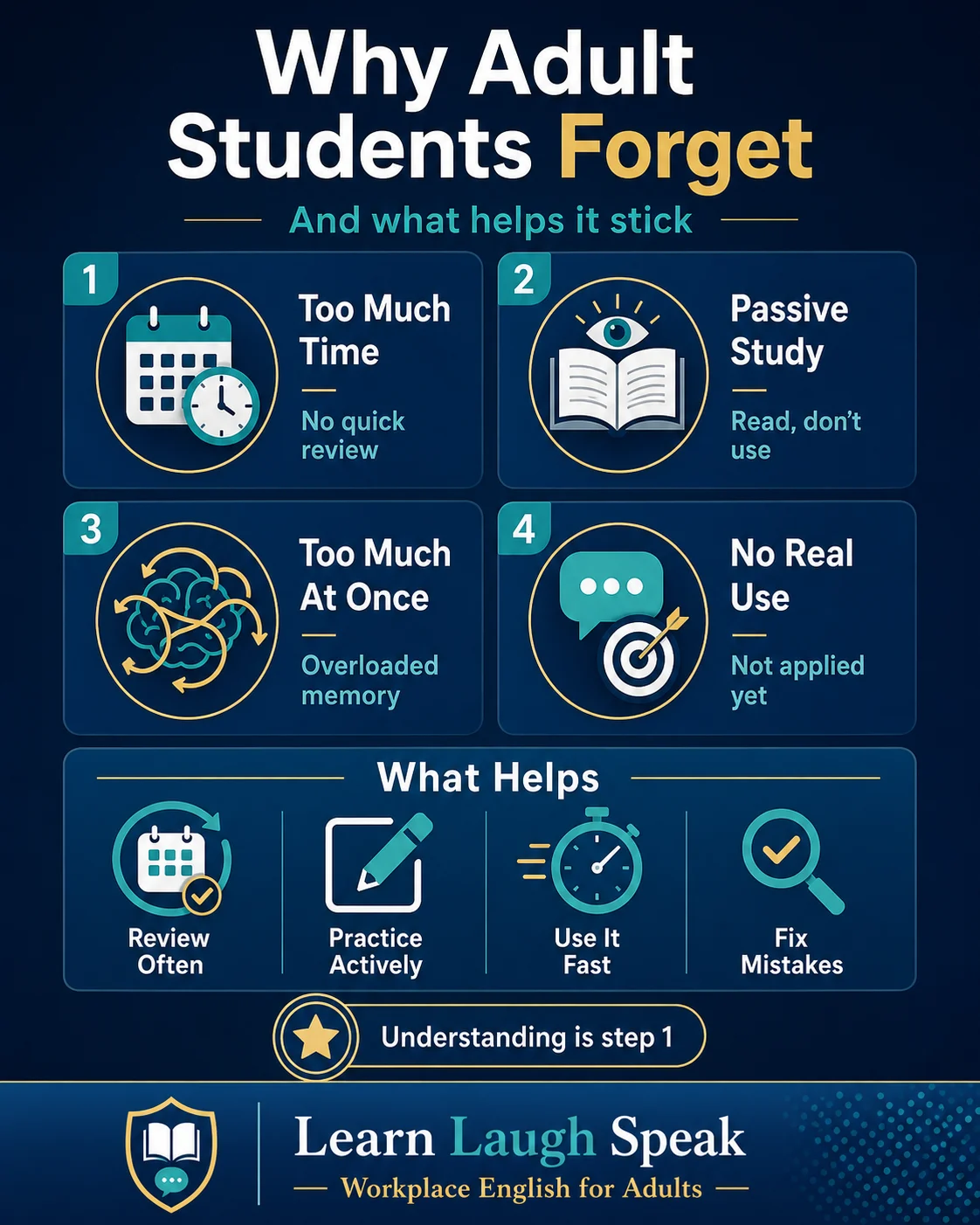
Why students forget what they learn is not usually about laziness, it is usually about how learning is designed.
They forget because learning is often designed in a way that makes forgetting almost predictable.
You sit through a lesson.
You understand it at the time.
Maybe you even feel confident.
Then a few days later, when you need to use it, it feels less clear.
A word disappears.
A rule feels familiar but hard to apply.
A sentence you understood perfectly in class becomes difficult in real conversation.
That moment can feel frustrating.
But it is not unusual.
It is one of the most common problems in adult learning.
The real question is not simply why students forget.
The better question is:
Why does learning feel clear during the lesson, but disappear when it matters?
Indeed have a awesome article with 26 techniques on memorization for adults! Well worth reading after this!
Why Students Forget: The Simple Answer
Adult students forget what they learn because understanding something once is not the same as being able to use it later.
Memory needs repetition.
Skills need practice.
Confidence needs real use.
If learning stops at “I understand,” forgetting becomes much more likely.
This is why adults can sit through training, complete lessons, or pass short tests — and still struggle when they need to apply the knowledge in real situations.
Personalized learning is another answer for why students forget.
Understanding Feels Like Learning, But It Is Only the First Step
This is where many students get caught.
During a lesson, something makes sense.
The teacher explains it clearly.
The examples are easy to follow.
The student thinks, “Yes, I understand this.”
And they probably do.
In that moment.
But understanding is not the same as retention.
And retention is not the same as skill.
That difference matters.
A student may understand a grammar rule when it is explained slowly. But that does not mean they can use it quickly in a meeting, email, or conversation.
That gap is one of the biggest reasons why students forget what they learn.
They understood it, but they never used it enough for it to become automatic.
What Happens After the Lesson Ends
A lot of learning fades quietly.
Not immediately.
At first, it feels like it is still there.
Then, slowly, details become weaker.
The learner remembers the topic, but not the structure.
They remember the explanation, but not the example.
They remember the rule, but not how to use it.
Research on retrieval practice shows that recalling information from memory strengthens learning more than simply reviewing it again. Washington University’s Center for Teaching and Learning explains that retrieval practice helps strengthen the memory connections that make future recall more likely.
That is important because most students do the opposite.
They reread.
They review passively.
They recognize the answer when they see it.
But they do not always practice pulling the answer out themselves.
And if they cannot retrieve it, they usually cannot use it.
The Forgetting Problem in Adult Learning
Adult students have a different challenge from younger learners.
They are usually learning around work, family, stress, and time pressure.
They may study after a long day.
They may miss practice days.
They may only use the skill occasionally.
That does not mean they are less capable.
It means the learning has to be more precise.
The OECD’s 2025 report on adult learning highlights how adult learning systems need to better support learners in a fast-changing labour market, including by understanding participation, delivery, and barriers that limit access.
For adult students, the problem is often not motivation.
It is design.
If the learning path is too general, too slow, or not connected to real use, the student forgets faster.
A Simple Breakdown: Why Learning Disappears
| What Happens | Why It Feels Like Learning | Why It Does Not Always Last |
|---|---|---|
| The student understands the lesson | The explanation makes sense | They have not used it enough |
| The student repeats examples | It feels familiar | Familiarity is not recall |
| The student passes a short test | It confirms short-term memory | It may not prove real use |
| The student studies many topics | It feels productive | Too much at once weakens retention |
| The student does not apply it | Nothing feels wrong immediately | The skill fades quietly |
This is why why students forget is not always about effort.
Often, the student did study.
They just studied in a way that did not create lasting use.
The Illusion of Knowing
One of the most frustrating parts of learning is the illusion of knowing.
You see something and think:
“I know this.”
But when you have to produce it without help, it disappears.
This happens because recognition is easier than recall.
Recognizing a correct answer is not the same as creating one.
This is especially obvious in English learning.
A student can recognize a word when reading.
They can understand it when listening.
But when speaking, they cannot find it quickly.
That is not because the word is gone.
It is because the student has not retrieved it enough in real conditions.
Does your mind go blank when speaking English sometimes you forget?
Why Passive Study Feels Good But Fails Later
Passive study feels comfortable.
Reading notes feels productive.
Watching videos feels useful.
Listening to explanations feels easy.
And those things can help.
But they are not enough.
Real learning usually requires a little discomfort.
You have to try to remember.
You have to make mistakes.
You have to use the skill before it feels perfect.
That effort is what strengthens learning.
Applied research on retrieval practice has shown that repeated retrieval can improve retention and transfer of learning, especially when practice happens over time rather than only immediately after learning.
That is one reason practice matters more than many students realize.
The harder part of learning is often the part that makes it stay.
What Helps Adults Remember More
| Weak Learning Habit | Stronger Learning Habit |
|---|---|
| Reading the same notes again | Trying to recall without looking |
| Memorizing lists | Using words in real sentences |
| Studying once for a long time | Reviewing in shorter repeated sessions |
| Waiting until test day | Practicing soon after learning |
| Learning everything equally | Repeating weak areas more often |
The goal is not to study more.
The goal is to study in a way that creates recall.
That is the difference.
Why Adult Students Forget More When Learning Is Too General
A lot of adult education still follows a general path.
Everyone gets the same lesson.
Everyone moves through the same content.
Everyone receives similar practice.
But adult learners do not arrive with the same background.
Some already have experience.
Some have gaps from years ago.
Some understand theory but struggle with real use.
Some move quickly in one area and slowly in another.
When learning does not adapt, students waste energy.
They repeat what they already know.
Or they miss what they actually need.
Both situations create forgetting.
One causes boredom.
The other causes confusion.
Neither is ideal.
The Real Reason Adult Students Forget
Here is the honest answer.
Adult students forget because learning often stops too early.
It stops at understanding.
But it should continue into:
practice
retrieval
feedback
correction
real use
That is where learning becomes stronger.
If a student only hears a lesson once, the knowledge is fragile.
If they use it repeatedly, correct mistakes, and apply it in context, the learning becomes harder to lose.
This is the real reason why students forget.
They do not always get enough chances to turn knowledge into usable skill.
What Modern Learning Should Do Differently
Modern education needs to move beyond content delivery.
Information alone is not enough.
A strong learning system should know:
what the student understands
what the student forgets
what mistakes repeat
what needs to be practiced again
when the learner is ready to move forward
That is the shift.
Education should not only ask:
Did the student complete the lesson?
It should ask:
Can the student still use this later?
Why Feedback Matters So Much
Feedback is where learning becomes personal.
Without feedback, students may repeat the same mistake for months.
They may think they are practicing, but they are reinforcing the wrong pattern.
Good feedback does not simply say:
“That is wrong.”
It shows the learner:
what happened
why it happened
what to change next
For adult students, this is essential.
They usually do not have time to waste repeating errors blindly.
They need focused correction.
The Difference Between Memorizing and Building a Skill
Memorizing is useful for getting started.
But skill comes from use.
For example, in English:
Memorizing vocabulary helps.
But using vocabulary in conversation builds fluency.
Studying grammar helps.
But applying grammar in writing and speaking builds control.
Watching lessons helps.
But responding, practicing, and correcting mistakes builds confidence.
That is why skill based learning matters.
It does not reject knowledge.
It gives knowledge a purpose.
A Better Learning Cycle for Adult Students
| Stage | What Should Happen |
|---|---|
| Learn | Understand the concept |
| Practice | Try using it actively |
| Retrieve | Recall it without help |
| Apply | Use it in a real situation |
| Correct | Fix mistakes quickly |
| Repeat | Strengthen the weak area |
This is how learning becomes durable.
Not by seeing something once.
By meeting it again in the right way.
Why regular exercise for adults can help the learning cycle according to Harvard Health.
How Learn Laugh Speak Helps: Why Students Forget
At Learn Laugh Speak, we focus on building learning journeys that match the student.
Every learner starts with a level assessment so they begin from the right place.
Then the application tracks mistakes, progress, and gaps as the student works through lessons.
That means the journey is not random.
It is based on what the student needs.
If a learner already has prior experience, they may progress faster through certain areas.
If another learner struggles with a specific skill, they get the repetition and support needed to strengthen it.
This matters because adult students do not all forget the same things.
They do not all struggle in the same places.
And they should not all follow the same learning path.
The goal is simple:
help students build English they can actually use, not just English they recognize during a lesson.

Students Should Remember instead of Why Students Forget
Forgetting does not mean you are failing.
It means your brain needs more chances to use what it learned.
That should be encouraging.
Because it means progress is not about being perfect.
It is about building the right loop:
learn
use
correct
repeat
Adult students do not need more pressure.
They need better learning design.
Final Thought on Why Students Forget
The real reason adult students forget what they learn is not because they are incapable.
It is because too much learning is still built around short-term understanding instead of long-term use.
A lesson that makes sense today can still disappear tomorrow if it is never practiced, retrieved, corrected, or applied.
That is why modern learning has to change.
It has to become more personal.
More practical.
More connected to real use.
Because students do not need to remember everything once.
Once learning becomes active, repeated, and connected to real use, the answer to why students forget becomes much easier to fix.