
 English
 Arabic
 Chinese (Simplified)
 Dutch
Dutch French
 German
 Italian
 Portuguese
 Russian
 Spanish
For adults using English as a second language, learning how to give instructions professionally can feel uncomfortable. You may worry about sounding too direct, too soft, or unclear.
Giving instructions at work is not just about telling someone what to do. It’s about being clear, respectful, and effective — especially in international teams where tone and cultural expectations can easily be misunderstood.
This guide focuses on how professionals actually communicate instructions in real workplaces — not on textbook language.
A Practical Guide for Adults Using English at Work
How To Write a Letter of Instruction in 6 Steps (Plus Example)

Why It’s Important to Give Instructions Professionally
In professional environments, unclear instructions often lead to:
mistakes
delays
frustration
repeated work
People rarely fail because they don’t want to do the task. They fail because they don’t fully understand what’s expected.
When you give instructions professionally, you help others:
understand priorities
meet deadlines
work independently
feel confident about their role
This builds trust and efficiency across teams.
What Professional Instructions Really Sound Like
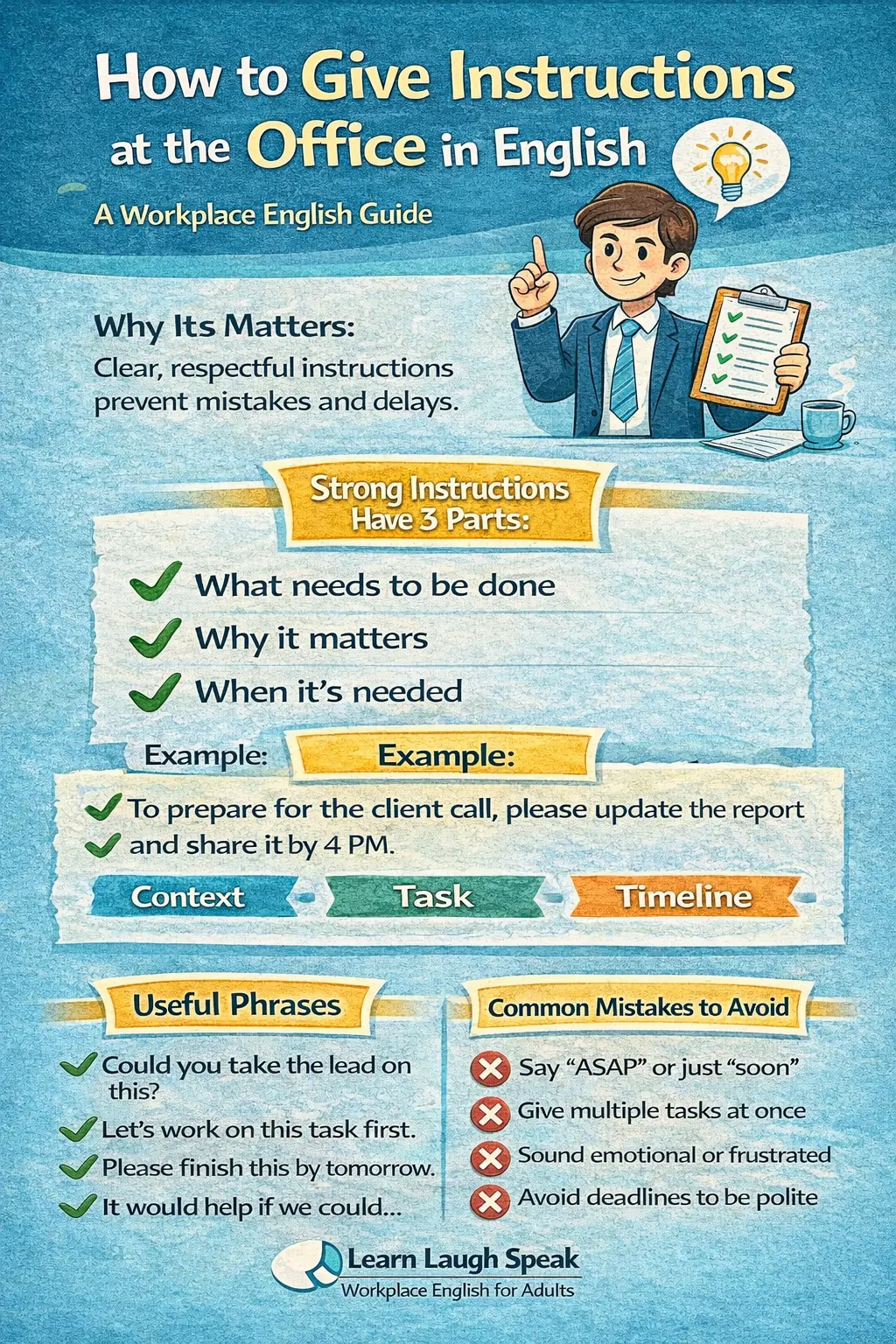
Strong instructions usually include three elements:
What needs to be done
Why it matters
When it’s needed
If one of these is missing, confusion often follows.
Professionals don’t rely on authority alone. They rely on clarity and structure.
8 Steps To Help You Create a How-To Guide
Common Challenges Adult Learners Face When Giving Instructions
From working with international professionals, these patterns appear often:
Being too direct and sounding demanding
Being too soft and sounding unsure
Giving too much information at once
Using vague language like “ASAP” or “when you can”
Avoiding deadlines to sound polite
These habits usually come from cultural differences — not poor English.
How to Give Instructions Professionally Using Clear Structure
A simple, professional structure that works in most situations is:
Context → Task → Timeline
Example:
“To prepare for the client meeting, please update the sales figures and send them by 3 PM.”
This sounds:
polite
clear
purposeful
This structure helps you give instructions professionally without sounding aggressive.
How to Give Instructions Professionally in Meetings
Meetings move quickly, so clarity matters.
Useful phrases:
“Could you take the lead on this?”
“Let’s focus on this task first.”
“Please share the draft by tomorrow morning.”
“Can you walk us through the next step?”
These phrases sound collaborative — not commanding.
How to Give Instructions Professionally in Emails
Emails need extra clarity because tone is easy to misread.
Professional email example:
“Could you please review the attached document and share your feedback by Thursday?
This will help us finalize the proposal for the client meeting.”
This format:
explains the task
explains the reason
sets a deadline
How to Give Instructions Professionally to Senior Colleagues
Giving instructions “upward” requires softer phrasing.
Try:
“Would it be possible to review this before Friday?”
“It would help us stay on schedule if this could be approved today.”
“May I ask you to take a look at this?”
These phrases show respect while still moving work forward.
How to Give Instructions Without Sounding Rude or Weak
Avoid these extremes:
❌ Too direct:
“You need to finish this today.”
❌ Too soft:
“Maybe you could look at this sometime?”
✔ Professional:
“Could you please complete this by end of day?”
This balance is key when you give instructions professionally.
How to Master Soft Skills in English
Cultural Differences in Giving Instructions
In some cultures:
Directness shows leadership
Authority is expected
In many English-speaking workplaces:
Politeness shows professionalism
Collaboration is valued
Explanation builds trust
Understanding this helps adult learners adjust their communication style for global teams.
How to Check If Your Instructions Are Clear
Ask yourself:
Can this be misunderstood?
Is the deadline clear?
Is the responsibility clear?
Does the person know why this matters?
If the answer is “no” to any of these, revise your message.
How to Practice Giving Instructions Alone
You don’t need a team to improve this skill.
Try:
Writing short instructions for daily tasks
Recording yourself giving instructions out loud
Practicing one-sentence and three-sentence versions
Rewriting casual requests into professional ones
Consistency builds confidence.
How to Say I Need to Leave Work Early Professionally
Common Mistakes to Avoid
❌ Giving multiple tasks in one long sentence
❌ Using vague time words (soon, later, ASAP)
❌ Avoiding deadlines to sound polite
❌ Sounding emotional or frustrated
❌ Assuming understanding without confirmation
Professional instructions focus on clarity, not control.
Final Thought
To give instructions professionally in English is not about sounding powerful.
It’s about being:
clear
respectful
purposeful
easy to understand
When people understand you, they work better — and so do you.
How to Professionally Say Sorry for a Mistake at Work
Learn Laugh Speak — Workplace English for Adults
At Learn Laugh Speak, we help adult professionals build confidence in real communication — from giving instructions and running meetings to writing emails and managing workplace challenges.
With 33,000+ CEFR-aligned lessons, learners practice English as it’s actually used at work, not in textbooks.
2 thoughts on “How to Give Instructions Professionally in English”
Pingback: Immigrant's Rights in California Personal Injury Claims - Learn Laugh Speak
Pingback: Why Golden Bird Jewels Is Becoming a Trusted Choice for Fine Jewelry Lovers - Learn Laugh Speak