
 English
 Arabic
 Chinese (Simplified)
 Dutch
Dutch French
 German
 Italian
 Portuguese
 Russian
 Spanish
For adults using English as a second language, learning how to professionally say sorry for a mistake can feel especially difficult. You’re managing not just the situation, but also tone, clarity, and cultural expectations — often under pressure.
Mistakes happen in every workplace — even in high-performing teams. What often separates trusted professionals from struggling ones is not whether they make mistakes, but how they respond when something goes wrong.
This guide focuses on real workplace behavior, not textbook language. It’s built around what managers, clients, and colleagues actually listen for when someone takes responsibility in professional English.
150 Helpful Conversation Starters for Networking Professionals

What Professionals Really Listen For in an Apology
In professional settings, people rarely listen for “perfect English.”
They listen for three signals:
Ownership — Do you clearly accept responsibility?
Awareness — Do you understand the impact of the mistake?
Action — Do you have a plan to fix or prevent it?
If those three elements are present, your apology will usually be received well — even if your English isn’t perfect.
Learning how to professionally say sorry for a mistake means structuring your response around these signals, not around emotion.
Why Adult Learners Often Struggle With Workplace Apologies
From working with international professionals, a few patterns appear again and again:
Some learners over-apologize, hoping to sound polite
Others avoid responsibility to protect themselves
Many explain too much, which weakens the message
Some stay vague because they fear using the wrong words
These habits often come from cultural norms — not poor communication skills.
In many English-speaking professional environments, however, clear responsibility and practical next steps are valued more than emotional reassurance.
Professionally Say Sorry for a Mistake at Work: The Framework to Follow
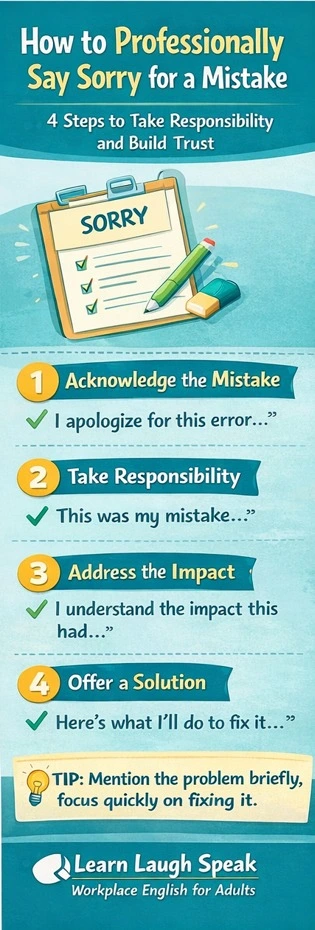
Most effective workplace apologies follow this structure:
1. Acknowledge the Mistake
Name it clearly and calmly.
2. Take Responsibility
Use “I” instead of passive language.
3. Address the Impact
Show you understand what changed because of the mistake.
4. Offer a Solution
Explain what you will do next.
This framework helps you professionally say sorry for a mistake without sounding defensive, emotional, or uncertain.
14 Helpful Topics for Team Meetings at Work (With Tips)
How to Professionally Say Sorry for a Mistake in a Meeting
Speaking in front of others raises the pressure. The goal is to be brief, clear, and steady.
Professional examples:
“I’d like to acknowledge an error in the data I shared earlier.”
“That was my mistake — I used the wrong version of the file.”
“Thanks for pointing that out. I’ll correct it after the meeting.”
Why these work:
They don’t blame others
They don’t over-explain
They move the meeting forward
In professional environments, this style signals confidence and reliability.
How to Ask for More Time in English Professionally
How to Professionally Say Sorry for a Mistake in an Email
Written apologies need even more structure because tone is harder to read.
Strong professional format:
1. Acknowledge
“I apologize for the error in the report.”
2. Correct
“I’ve attached the revised version with the updated figures.”
3. Move forward
“Please let me know if any further changes are needed.”
This structure keeps the focus on solutions, not emotions.
How to Professionally Say Sorry for a Mistake to a Client or Manager
When speaking upward or externally, clarity matters more than politeness.
Useful phrases:
“I take responsibility for this oversight.”
“This was an error on my part, and I appreciate you bringing it to my attention.”
“Here’s how I’ll ensure this doesn’t happen again.”
These phrases show professional maturity, which often matters more than perfect language.
Professionally Say Sorry for a Mistake at Work: What to Say
This is one of the hardest situations for adult learners.
Instead of blaming:
❌ “The system didn’t work.”
❌ “They didn’t send me the file.”
Try:
✔ “There was a gap in the process that I should have clarified earlier.”
✔ “I should have confirmed the information before moving forward.”
This keeps responsibility professional — even in complex situations.
Emotional vs Professional Language: The Key Difference
Avoid phrases that focus on feelings:
“I feel terrible about this.”
“I’m really embarrassed.”
“I hope you’re not upset.”
Professional English focuses on actions and outcomes, not emotions.
A better approach:
“I understand the impact this had on the timeline.”
“I’ll make sure this is resolved today.”
Cultural Differences in Workplace Apologies
In some cultures:
Strong emotion shows sincerity
Long explanations show respect
In many English-speaking professional environments:
Neutral tone shows control
Short explanations show confidence
Solutions show competence
Understanding this difference helps adult learners professionally say sorry for a mistake in a way that fits international workplace norms.
Professionally Say Sorry for a Mistake at Work: How to Practice
You don’t need a partner to improve this skill.
Practical solo methods:
Write short apology emails for common work mistakes
Record yourself saying one-sentence and four-sentence versions
Practice under time pressure (30 seconds to respond)
Review whether you sounded calm, clear, and focused
Confidence grows when your response becomes automatic.
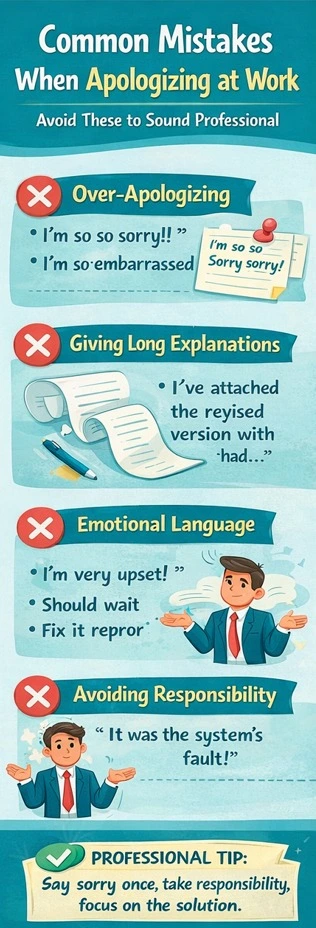
Common Mistakes That Reduce Professional Impact
❌ Over-apologizing repeatedly
❌ Avoiding responsibility with passive language
❌ Giving long personal explanations
❌ Blaming systems or people
❌ Sounding emotional instead of neutral
Professional communication values clarity, accountability, and progress.
Final Thought: Professionally Say Sorry for a Mistake at Work
Handled well, a mistake can actually improve your professional reputation.
When you professionally say sorry for a mistake, you show:
Responsibility
Maturity
Reliability
Leadership — even without a title
You don’t need perfect English.
You need clear structure and calm delivery.
How to Professionally Clarify When Someone Misunderstood You
Professionally Say Sorry for a Mistake at Work: How We Can Help
At Learn Laugh Speak, we help adult professionals build confidence in real situations — not textbook examples.
With 33,000+ CEFR-aligned lessons, learners practice:
Professional apologies
Meeting communication
Business emails
Workplace problem-solving
All designed for how English is actually used at work.
3 thoughts on “How to Professionally Say Sorry for a Mistake at Work”
Pingback: Learn a New Language: Your Ultimate Guide to Speaking Like a Native - Learn Laugh Speak
Pingback: Best Ways to Master English Fluency: Speak Confidently Fast - Learn Laugh Speak
Pingback: Unlocking Agentforce 2.0: Why Salesforce Marketing Cloud Agencies Lead 2026 Campaigns - Learn Laugh Speak