
 English
 Arabic
 Chinese (Simplified)
 Dutch
Dutch French
 German
 Italian
 Portuguese
 Russian
 Spanish
English is the global language of business, but speaking English fluently is not the same as communicating effectively. Around the world, people use English differently depending on their culture, work environment, and social expectations. Understanding cultural difference in English is essential for avoiding misunderstandings, building trust, and communicating confidently with international colleagues.
Whether you work with teams in the U.S., Europe, India, the Middle East, or Latin America, cultural awareness can make the difference between smooth collaboration and unexpected confusion.
This article explores the key cultural differences in English, how they affect workplace communication, and how adult learners can adapt their communication style to international environments.
5 Errors To Avoid When Managing Multi-cultural Teams

1. What “Cultural Difference in English” Really Means
Cultural differences in English are not about grammar or vocabulary — they are about:
tone
expectations
politeness
formality
communication style
body language
indirect vs. direct speech
how decisions are communicated
how disagreement is expressed
how feedback is delivered
Two people can speak perfect English, yet misunderstand each other completely because they come from different cultural communication styles.
2. Direct vs. Indirect Communication
One of the biggest cultural differences in English is how directly people speak.
Direct cultures (U.S., Germany, Netherlands, Denmark)
Value:
clear statements
straightforward opinions
quick decision-making
Example:
“I disagree with this idea.”
Indirect cultures (Japan, India, Mexico, Philippines, Middle East)
Value:
politeness
harmony
avoiding conflict
Example: “I’m not sure this is the best option. Maybe we could consider another approach?”
Both answers mean the same thing — but the tone changes dramatically.
Cultural Curiosity: What It Is and Tips for Improving Yours
3. Differences in How People Say “Yes” and “No”
“Yes” and “No” are often misunderstood across cultures.
In direct cultures:
“Yes” = Yes
“No” = No
In indirect cultures:
“Yes” might mean:
yes
maybe
I understand
I heard you
I don’t want to say no directly
Example: “I’ll try my best.”
Often means: This may not be possible.
Understanding these subtleties prevents confusion in global teams.
How to Say I’m Going on Vacation Professionally in English
4. Tone & Politeness: Cultural Difference in English Emails
Email tone is another major area of cultural variation.
U.S. or Canada
Friendly, concise, and slightly informal.
“Hi Sarah,
Hope you’re doing well.”
U.K.
Polite, indirect, softening language.
“I was wondering if you might have a moment to look at this.”
Germany or Northern Europe
Very direct, brief, focused on facts.
“Please send the report by Friday.”
Asia & Latin America
Warm, respectful, relational.
“Good morning, Mr. Luis. I hope your week is going well.”
These differences explain why one email may feel “too direct” or “too long” depending on the receiver.
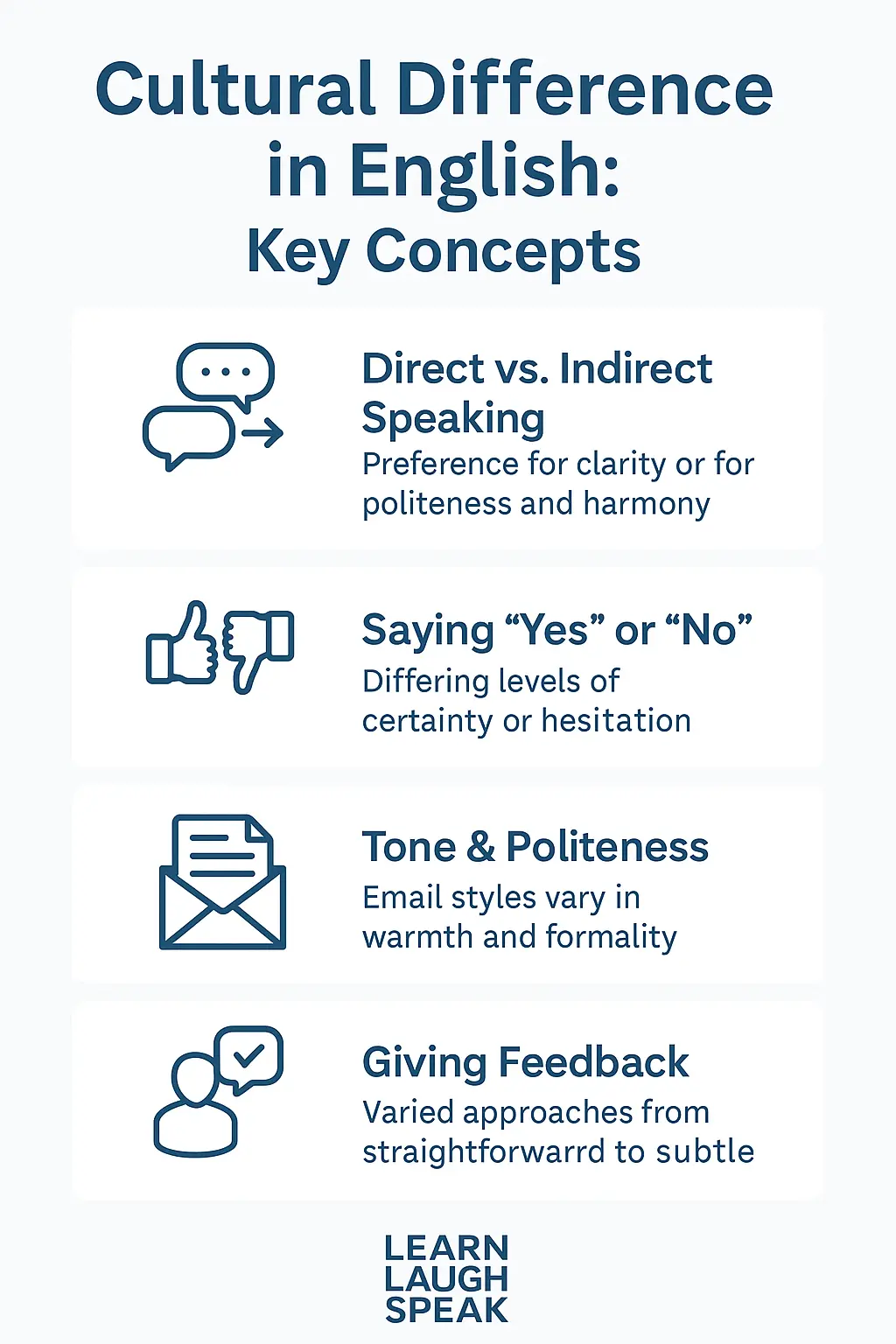
5. Cultural Difference in English When Giving Feedback
Feedback style changes dramatically across cultures.
Direct feedback cultures
Clear criticism
Honest assessment
Task-focused
Example: “This needs improvement.”
Indirect feedback cultures
Soft language
Positive-first structure
Relationship-focused
Example: “You did a great job. One small suggestion that might help is…”
Understanding this helps global teams avoid tension or misinterpretation.
6. Small Talk Expectations Vary Globally
Small talk is a small detail — but a huge cultural difference in English.
Countries where small talk is expected:
U.S., U.K., Canada, Australia, New Zealand
Common topics:
weekend plans
weather
sports
general life updates
Countries where small talk is minimal:
Germany, Finland, China
Going directly to the point is normal and not considered rude.
Countries where small talk is warm and personal:
Mexico, Brazil, Colombia, Italy
Talking about family or daily life is common before business.
Misunderstanding small talk expectations can make conversations feel “cold” or “too personal.”
Business English and Culture Training for Global Teams
7. Differences in Meeting Communication
Meetings reflect cultural norms:
U.S., Australia, U.K.:
Open discussion, informal tone, quick decisions.
Japan, South Korea:
Longer decision processes, emphasis on consensus, silence as a communication tool.
Middle East & Latin America:
Strong relational style; meetings begin with personal connection.
Northern Europe:
Structured, punctual, minimal small talk, direct questions.
Recognizing these patterns helps global teams communicate smoothly.
8. Why Cultural Differences Matter More in English Than Other Languages
English is used by more non-native speakers than native speakers.
This creates unique challenges:
English must work as a bridge between cultures
Communication styles vary even when the language is shared
Misunderstandings come from culture, not grammar
Global companies need consistent standards
Understanding cultural difference in English helps professionals adjust to diverse teams.

9. How to Improve Cross-Cultural Communication in English
Here are practical strategies for adult learners:
✔ Learn polite variations
(suggestions, indirect requests, softening language)
✔ Practice active listening
Focus on tone, pauses, hesitation.
✔ Ask clarifying questions
“Just to confirm, do you mean…?”
✔ Observe communication norms
Notice how colleagues speak, email, and collaborate.
✔ Learn culturally neutral English phrases
For meetings, emails, disagreements, and feedback.
✔ Use CEFR-based learning resources
Structured pathways build clarity and confidence.
10. How Learn Laugh Speak Helps Global Teams
Learn Laugh Speak supports professionals with:
33,000 CEFR-aligned lessons
Real workplace scenarios
Cultural communication modules
Email + meeting English practice
Speaking, listening, and clarity tools
Personalized feedback for tone and phrasing
Microlearning for busy adults
Teams communicate better when they understand not only what to say, but also how to say it culturally.
Still unsure on the culture difference in English? Send us a message or start learning English with us today!