
 English
 Arabic
 Chinese (Simplified)
 Dutch
Dutch French
 German
 Italian
 Portuguese
 Russian
 Spanish
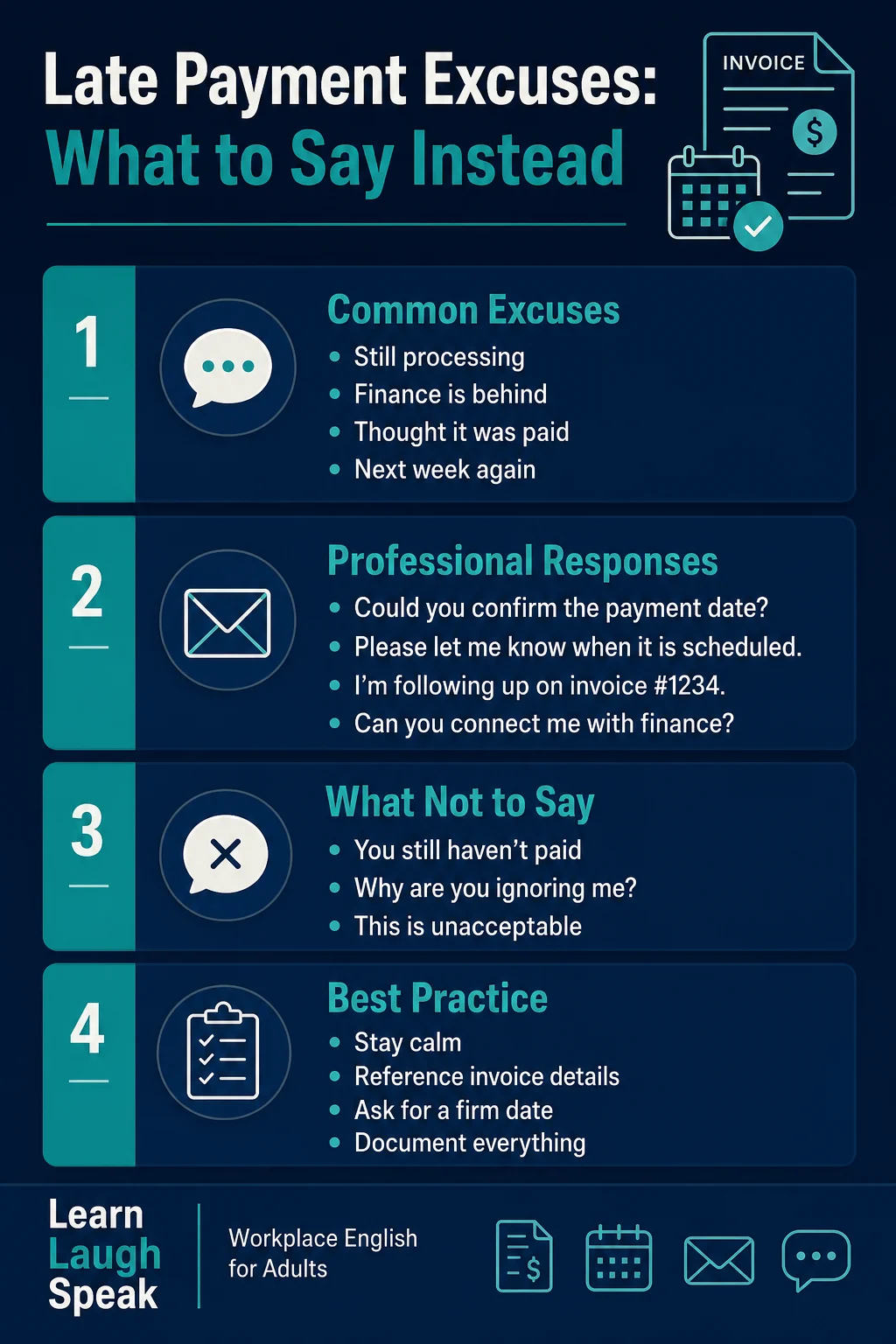
Late payments are one of the most common frustrations for freelancers, consultants, and small businesses. While most clients mean well, excuses like “We’re still processing it” or “Our finance team is behind” can become regular delays. Knowing how to respond professionally to late payment excuses helps you stay calm, protect your business, and get paid — without damaging the client relationship. This article gives you real examples, practical phrases, and strategies for dealing with common payment excuses professionally.
How To Write a Past Due Invoice Email (With Templates)
Why Clients Use Late Payment Excuses
Late payment excuses do not always mean a client is trying to avoid paying. Sometimes payments are delayed because of internal approvals, finance department schedules, missing invoice details, or simple disorganization. However, when excuses repeat, they can become a serious problem for freelancers, consultants, and small businesses.
That is why it is important to respond professionally to late payment excuses with calm but clear language. The goal is not to accuse the client. The goal is to confirm the situation, ask for a clear payment date, and protect your business. A professional response helps you stay respectful while still showing that payment terms matter.
Common reasons payments get delayed
- the invoice was sent to the wrong person
- the finance team has not approved it yet
- the client missed the due date
- payment details were unclear
- the company only processes payments on certain days
- the client is avoiding the conversation
- there is no clear payment process in place
Respond Professionally to Late Payment Excuses: Why it Matters
According to QuickBooks, 64% of small business owners experience late payments, and nearly 1 in 5 say clients are consistently late.
Late payments hurt more than cash flow. They strain trust, waste your time, and make it harder to plan your business.
Responding professionally does three things:
Reinforces your boundaries
Keeps the tone respectful
Increases your chances of getting paid
Politely Tell Someone You’re Sick in English
What Not to Say When Payment Is Late
When a payment is late, it is normal to feel frustrated. But emotional or aggressive language can make the situation worse. Professional English should stay calm, factual, and focused on the invoice.
| Avoid Saying | Say This Instead |
|---|---|
| “You still haven’t paid me.” | “I’m following up on invoice #[number], which is now overdue.” |
| “You promised to pay.” | “I understand payment was expected last week. Could you confirm the updated payment date?” |
| “This is unacceptable.” | “I’d like to resolve this as soon as possible.” |
| “Why are you ignoring me?” | “I wanted to check whether you received my previous follow-up.” |
| “I need the money now.” | “Could you confirm when the payment is scheduled to be processed?” |
| “I won’t work until you pay.” | “I’ll need to pause further work until the outstanding invoice is resolved.” |
Using clear and respectful language keeps the conversation professional while still protecting your time and income.
Common Late Payment Excuses (and How to Respond)
Let’s break down the most frequent excuses — and what you can say in return.
1. “I thought the invoice was already paid.”
Your response:
“Thanks for the update! I just checked, and the payment hasn’t come through on my end yet. Would you mind confirming with your finance team and letting me know when it’s been processed?”
✅ Friendly, direct, and clear.
2. “We’re still processing it.”
Your response:
“No problem — just let me know when it’s scheduled to go out so I can update my records. Is there a payment date I can expect?”
✅ Keeps things professional and gives you a timeline.
3. “We had some unexpected issues come up.”
Your response:
“Totally understand — these things happen. Could you let me know a realistic timeframe for the payment so I can plan accordingly?”
✅ Acknowledges their situation, but still holds the boundary.
4. “Our finance team handles that.”
Your response:
“Thanks for the heads-up. Would you mind connecting me with someone from your finance team so I can follow up directly?”
✅ Shifts the responsibility without sounding aggressive.
5. “We’ll send it next week.” (For the third time…)
Your response:
“Thanks — I’ve noticed this is the third time the payment has been pushed. Could you confirm a firm date this time so we can both stay on track?”
✅ Calm, but firm. Reminds them you’re keeping track without being rude.
Words to Use When You’re Running Late

Respond Professionally to Late Payment Excuses: Professional Follow-Up Email Structure
If you’re following up by email, here’s a simple structure to stay polite but clear:
Subject: Friendly Follow-Up: Invoice #1234
Body:
Hi [Client],
I hope you’re well. Just following up again on invoice #1234, which was due on [date]. Please let me know when the payment is expected to be processed.
If there are any issues or questions, I’m happy to discuss them.
Thanks so much,
[Your Name]
Tips for Staying Professional When You’re Frustrated
It’s normal to feel annoyed when payments are late — especially if it’s a repeat issue. Here’s how to stay calm:
Don’t make it personal.
Keep the focus on the invoice, not the person.Use neutral language.
Avoid words like “you promised” or “you failed”.Stick to facts.
Reference invoice numbers, due dates, and previous follow-ups.Document your communication.
Keep written records in case you need to escalate later.
Online Invoicing: Benefits, How-To Guide and Example

Tools That Help Prevent Late Payments
Using the right tools can make late payments easier to manage and reduce uncomfortable follow-up conversations. Many freelancers and small businesses now use invoicing platforms, payment links, automated reminders, and digital contracts to make payment terms clear from the beginning.
These tools help you stay professional because the payment process becomes part of your business system, not a personal argument with the client.
Useful payment tools for small businesses
- QuickBooks — creates invoices, tracks payments, and sends reminders
- FreshBooks — manages client billing and overdue invoices
- Stripe — accepts card payments and online deposits
- PayPal — sends payment links and international invoices
- Wise — useful for international business payments
- Wave — offers simple invoicing for small businesses
- Digital contracts — make payment terms clear before work begins
- Automated reminders — follow up on overdue invoices without sounding personal
Clear systems make payment communication easier, more professional, and less stressful.
Respond Professionally to Late Payment Excuses: When to Escalate
If you’ve followed up several times and still haven’t been paid, it may be time to escalate. Here’s how to do that professionally:
Step 1: Set a final payment deadline
“If I don’t receive payment by [new date], I’ll need to pause all work until this is resolved.”
Step 2: Mention late fees (if applicable)
“As outlined in our agreement, a late fee of [amount or %] may apply after [date].”
Step 3: Mention next steps
“If payment isn’t received, I’ll need to refer the matter to collections or legal support.”
⚠️ Use escalation language only when you’re truly ready to follow through — otherwise it loses power.
Final Thoughts: Respond Professionally to Late Payment Excuses
You don’t have to accept late payments as normal. When you respond professionally to late payment excuses, you protect your business, set better expectations, and keep the relationship respectful.
Stay calm. Stick to the facts. Don’t be afraid to follow up — your work deserves to be paid for on time.
Key Takeaways: How to Respond Professionally to Late Payment Excuses
- Stay polite and factual, even when frustrated.
- Reference the invoice number, amount, and due date.
- Ask for a clear payment date, not a vague promise.
- Keep written records of all follow-ups.
- Use neutral language instead of emotional language.
- Pause work if payment delays continue.
- Respond professionally to late payment excuses to protect your income and reputation.
2 thoughts on “How to Respond Professionally to Late Payment Excuses”
Pingback: How to Show Frustration Professionally at Work - Learn Laugh Speak
Pingback: How to Think Clearly in English During Meetings (No Translating)