
 English
 Arabic
 Chinese (Simplified)
 Dutch
Dutch French
 German
 Italian
 Portuguese
 Russian
 Spanish
Customer service English is not only about grammar and polite phrases.
In real workplaces, native English speakers often use idioms to explain problems, encourage teammates, describe pressure, or talk about difficult customer situations.
That is why learning business English idioms for customer service can help you understand conversations faster and respond with more confidence.
In this guide, you will learn 16 useful idioms, what they mean, and how they may appear in customer service situations.
You will also see when an idiom is useful — and when it is better to use simpler, clearer English with customers.
So why are idioms used? We use them to make more colorful conversations.
Quick Answer: What Are Business English Idioms for Customer Service?
Business English idioms for customer service are common expressions used in workplace conversations, team communication, customer support, hospitality, retail, call centers, and service roles.
Examples include on the ball, back to the drawing board, the ball is in your court, hang in there, and pull out all the stops.
These idioms help workers understand natural English, but they should be used carefully.
Some idioms are useful with coworkers, while simpler phrases are often better when speaking directly with customers.
16 Business English Idioms for Customer Service at a Glance
| Idiom | Simple Meaning | Best Used With |
|---|---|---|
| On the ball | Organized, alert, and prepared | Coworkers / managers |
| Under the weather | Feeling sick or unwell | Coworkers |
| Back to the drawing board | Start again with a new plan | Team discussions |
| The ball is in your court | It is your turn to decide or act | Customers / coworkers |
| Bite the bullet | Accept something difficult | Coworkers / managers |
| Cost an arm and a leg | Be very expensive | Informal conversations |
| Get my ducks in a row | Get organized | Coworkers / managers |
| Hang in there | Stay positive during difficulty | Coworkers / sometimes customers |
| Hit the ground running | Start quickly and effectively | Managers / new employees |
| Keep your chin up | Stay positive | Coworkers |
| Let sleeping dogs lie | Avoid causing unnecessary problems | Coworkers / managers |
| On top of the world | Feel extremely happy | Informal conversations |
| Pull out all the stops | Do everything possible | Team/customer service situations |
| That’ll be the day | That is unlikely | Informal / use carefully |
| Throw in the towel | Give up or stop trying | Coworkers |
| Stay on the ball | Stay focused and alert | Coworkers / managers |
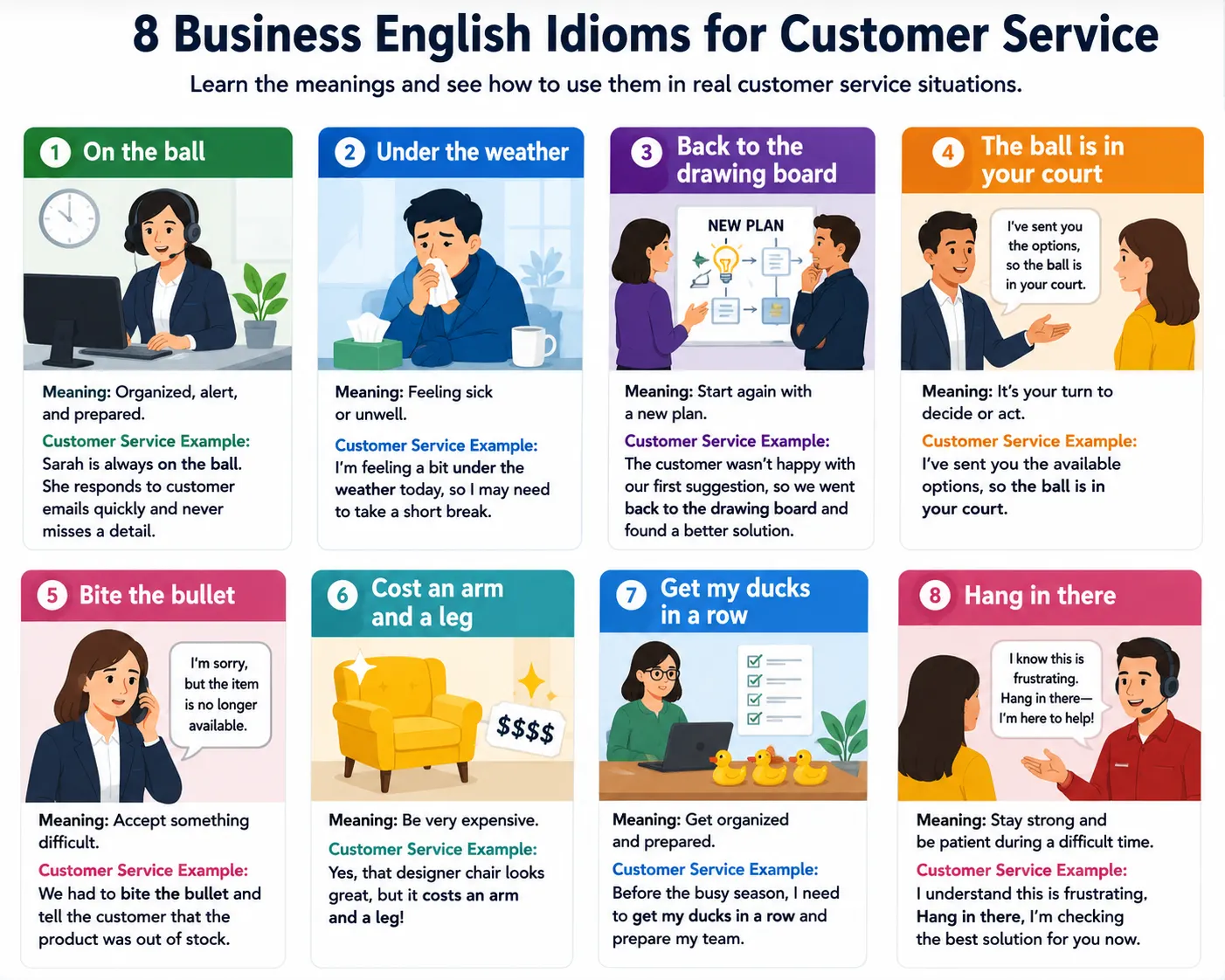
1. On the Ball
On the ball means to be alert, prepared, organized, and ready to act.
In customer service, this is an important idiom because workers often need to respond quickly, remember details, and solve problems under pressure.
For example:
“Maria is always on the ball. She answers customer questions quickly and keeps track of every request.”
You may also hear a manager say:
“Good job. You were really on the ball with that customer issue.”
This idiom is positive and professional.
It can be used with coworkers, managers, or team members.
2. Under the Weather
Under the weather means feeling sick or unwell.
For example:
“I’m feeling a bit under the weather today, so I may need to take a short break.”
This idiom is common in everyday English and workplace conversations.
In customer service, you may hear a coworker use this phrase when they are not feeling well.
Use this idiom when talking about yourself or a coworker.
Be careful using it about customers. Saying a customer “looks under the weather” can feel too personal unless they have already told you they are sick.
3. Back to the Drawing Board
Back to the drawing board means to start again with a new plan because the first idea did not work.
In customer service, this idiom is useful when a solution does not satisfy the customer or the team needs a different approach.
For example:
“The customer was not happy with the first solution, so we went back to the drawing board and found another option.”
This is a helpful idiom for team discussions because it focuses on problem-solving, not blame.
It does not mean failure.
It means you are willing to rethink the approach and try again.
4. The Ball Is in Your Court
The ball is in your court means it is now someone else’s turn to decide or act.
For example:
“I’ve sent you the available options, so the ball is in your court.”
This idiom can be useful in customer service, but it can sometimes sound a little direct.
A softer version for customers would be:
“I’ve sent you the available options, so please take your time and let us know what works best.”
Both phrases mean the customer now has the information they need to make a decision.
Use the idiom when the tone is friendly.
Use the simpler version when you want to sound more formal or polite.
5. Bite the Bullet
Bite the bullet means to accept a difficult situation or make a difficult decision.
In customer service, this idiom is usually better for internal conversations with coworkers or managers.
For example:
“We had to bite the bullet and tell the customer that the item was no longer available.”
This phrase can be useful when something uncomfortable needs to be done, such as giving bad news or accepting a difficult policy decision.
Avoid using it in formal customer emails.
With customers, a clearer phrase is usually better:
“Unfortunately, we need to let you know that this option is no longer available.”
6. Cost an Arm and a Leg
Cost an arm and a leg means something is very expensive.
For example:
“That repair would cost an arm and a leg.”
This idiom is common in casual English, but it is informal.
In customer service, it may be okay in relaxed conversations, but it is usually better to use more professional wording with customers.
Instead of saying:
“That option costs an arm and a leg.”
You can say:
“That option is more expensive.”
or:
“This is a higher-priced option.”
This sounds more professional and respectful.
7. Get My Ducks in a Row
Get my ducks in a row means to get organized and prepared.
This idiom is useful in business English because customer service often requires preparation before speaking with customers or starting a busy shift.
For example:
“Before the store opens, I need to get my ducks in a row and make sure the team has everything ready.”
You might also say:
“Let me get my ducks in a row before I call the client back.”
This means you want to organize the information first so you can respond clearly.
8. Hang in There
Hang in there means to stay strong, patient, or positive during a difficult situation.
This is a common phrase in customer service because workers often deal with stress, delays, or frustrated customers.
For example:
“I know this has been frustrating. Hang in there — I’m checking the best solution for you now.”
This can sound warm and friendly, but use it carefully.
In formal customer service, a safer phrase is:
“Thank you for your patience.”
With coworkers, hang in there is usually fine.
For example:
“Hang in there. The rush will be over soon.”
9. Hit the Ground Running
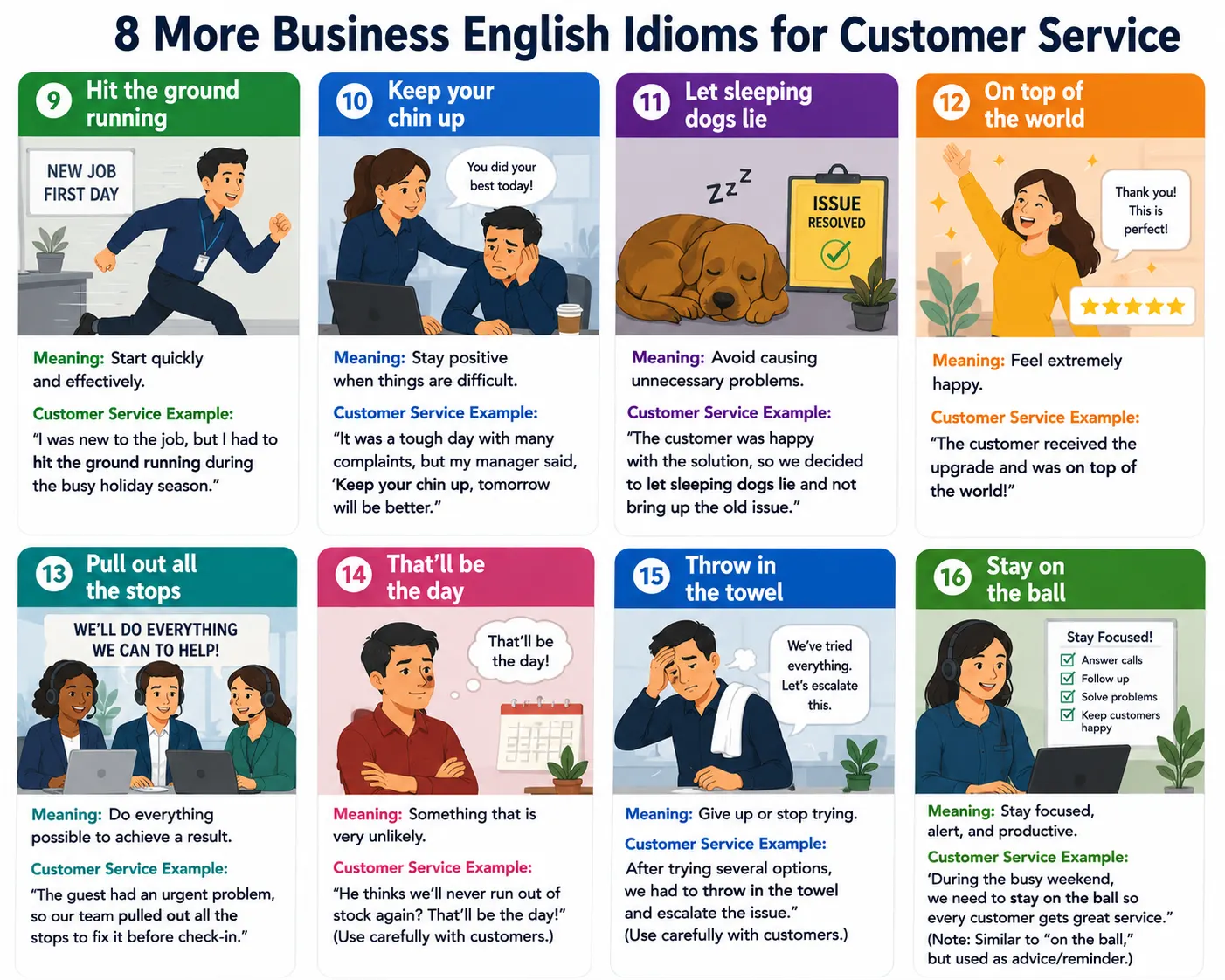
Hit the ground running means to start quickly and effectively.
This phrase is often used when someone begins a new job, project, or busy work period and needs to perform well immediately.
For example:
“New team members need to hit the ground running during the holiday season because the store gets very busy.”
In customer service roles, this idiom is useful because many jobs require quick learning.
A manager might say:
“We need someone who can hit the ground running.”
This means they need someone who can start working confidently without needing too much time to adjust.
10. Keep Your Chin Up
Keep your chin up means to stay positive, even when things are difficult.
In customer service, this phrase is usually best used with coworkers, not upset customers.
For example:
“I know today has been difficult, but keep your chin up. You handled that customer very professionally.”
This idiom is meant to encourage someone.
However, avoid using it with a customer who is angry or upset because it may sound dismissive.
A better customer-facing phrase would be:
“I understand this has been frustrating, and I appreciate your patience.”
11. Let Sleeping Dogs Lie
Let sleeping dogs lie means to avoid bringing up a problem again if doing so may create unnecessary conflict.
In customer service, this idiom can be useful in internal team conversations.
For example:
“The issue has already been resolved, so it may be better to let sleeping dogs lie and focus on the current request.”
This does not mean ignoring serious complaints.
If a customer has a real issue, it should still be handled properly.
Use this idiom only when reopening the topic would create unnecessary tension and the issue has already been resolved.
12. On Top of the World
On top of the world means feeling extremely happy or successful.
For example:
“After the customer received the replacement earlier than expected, she felt on top of the world.”
This idiom is more common in casual or positive conversations.
In customer service, it can be used to describe a very happy customer or a successful outcome.
For example:
“The guest was on top of the world after we upgraded their room.”
It is a positive idiom, but it is more conversational than formal.
13. Pull Out All the Stops
Pull out all the stops means to do everything possible to achieve a result.
This is one of the most useful business English idioms for customer service because it fits situations where a team works hard to solve a problem.
For example:
“The guest had an urgent problem, so the team pulled out all the stops to fix it before check-in.”
You might also hear:
“Let’s pull out all the stops to make sure this customer leaves happy.”
This idiom shows effort, urgency, and strong customer care.
14. That’ll Be the Day
That’ll be the day means something is very unlikely to happen.
This idiom is informal and can sound sarcastic, so it should be used carefully.
For example:
“He said the system will never crash again? That’ll be the day.”
In customer service, this phrase is usually better for informal conversations with coworkers, not serious customer interactions.
Avoid saying this to a customer who is making a request, because it can sound rude or dismissive.
Instead of saying:
“That’ll be the day.”
Use:
“Unfortunately, we’re not able to offer that option at the moment.”
This sounds much more professional.
15. Throw in the Towel
Throw in the towel means to give up or stop trying.
For example:
“After trying several options, we had to throw in the towel and escalate the issue to a manager.”
This phrase can be useful in internal workplace conversations, but be careful using it with customers.
If you say this directly to a customer, it may sound like you are giving up on them.
A better customer-facing phrase is:
“We may need to look at another solution.”
or:
“I’m going to escalate this so we can find the best next step.”
16. Stay on the Ball
Stay on the ball means to stay focused, alert, and productive.
It is often used as advice or a reminder.
For example:
“We need to stay on the ball during the lunch rush so every customer gets served quickly.”
This phrase is similar to on the ball, but there is a small difference.
On the ball describes someone who is already alert and prepared.
Stay on the ball is a reminder to keep being alert and prepared.
For example:
“You’re really on the ball today.”
means the person is doing well.
“Stay on the ball today.”
means the person needs to remain focused.
Customer Service Idioms: When to Use Simple English Instead
Idioms can make English sound natural, but customer service requires clarity.
Some idioms are better for talking with coworkers than speaking directly to customers.
| Idiom | Customer-Safe Alternative |
|---|---|
| “Throw in the towel” | “We may need to look at another solution.” |
| “That’ll be the day” | “Unfortunately, we’re not able to offer that option.” |
| “Bite the bullet” | “We need to make a difficult decision.” |
| “Cost an arm and a leg” | “This option is more expensive.” |
| “Let sleeping dogs lie” | “It may be better not to reopen the issue.” |
| “Hang in there” | “Thank you for your patience.” |
The most important thing is not only knowing the idiom.
It is knowing when to use it.
In customer service, clear and respectful English is always more important than sounding clever or informal.
How to Learn Business English Idioms Correctly
Do not try to memorize every idiom at once.
Instead, learn idioms in real situations.
For customer service, focus on:
- what the idiom means
- who you can use it with
- whether it sounds formal or informal
- whether it is safe to use with customers
- what simple alternative you can use instead
For example, hang in there is warm and friendly, but thank you for your patience is usually safer in formal customer service.
This helps learners use idioms naturally without sounding too casual or confusing.
Learn Customer Service English with Learn Laugh Speak
Learn Laugh Speak helps adults use English clearly in real workplace situations.
That includes:
- customer service English
- business English idioms
- professional phrases
- listening and speaking practice
- workplace communication
- polite customer responses
Every student starts with a level assessment from A1 to C2. From there, learners follow a structured path based on their level, mistakes, goals, and progress.
If you work in customer service or want to improve your professional English, Learn Laugh Speak helps you practise useful language step by step.

Summary of Business English Idioms for Customer Service
Being able to communicate effectively in English is essential for any customer service job.
Knowing common idioms used by native English speakers can help you communicate better with customers and colleagues.
Here are the 16 business English idioms for customer service from this guide:
- On the ball — organized, alert, and prepared.
- Under the weather — feeling sick or unwell.
- Back to the drawing board — starting again with a new plan.
- The ball is in your court — it is your turn to act or decide.
- Bite the bullet — accept something difficult.
- Cost an arm and a leg — be very expensive.
- Get my ducks in a row — get organized and prepared.
- Hang in there — stay positive during difficulty.
- Hit the ground running — start quickly and effectively.
- Keep your chin up — stay positive.
- Let sleeping dogs lie — avoid reopening an issue unnecessarily.
- On top of the world — feel extremely happy.
- Pull out all the stops — do everything possible.
- That’ll be the day — that is unlikely.
- Throw in the towel — give up or stop trying.
- Stay on the ball — stay focused and alert.
By learning these idioms, customer service students can understand workplace conversations more easily and communicate with more confidence.
But remember, idioms are not always the best choice with customers.
Use them when they sound natural, and choose simpler English when clarity matters most.
3 thoughts on “16 Business English Idioms for Customer Service”
Pingback: How to Respond with a No Professionally in English
Pingback: How to Build Real Confidence When Speaking English
Pingback: Can Online Video Gaming Improve My English?