
 English
 Arabic
 Chinese (Simplified)
 Dutch
Dutch French
 German
 Italian
 Portuguese
 Russian
 Spanish
Direct Answer: What Are Subject Pronouns?
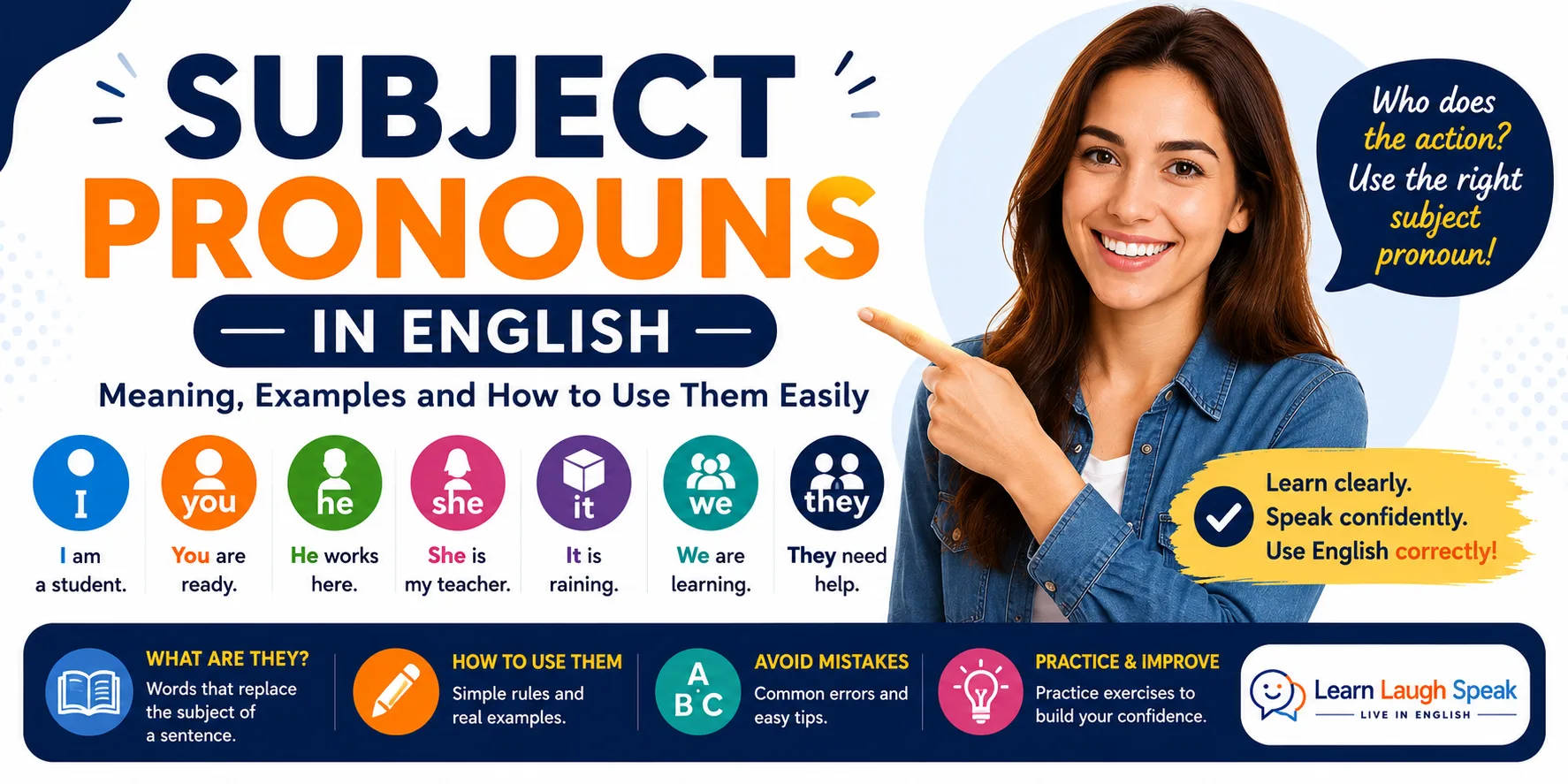
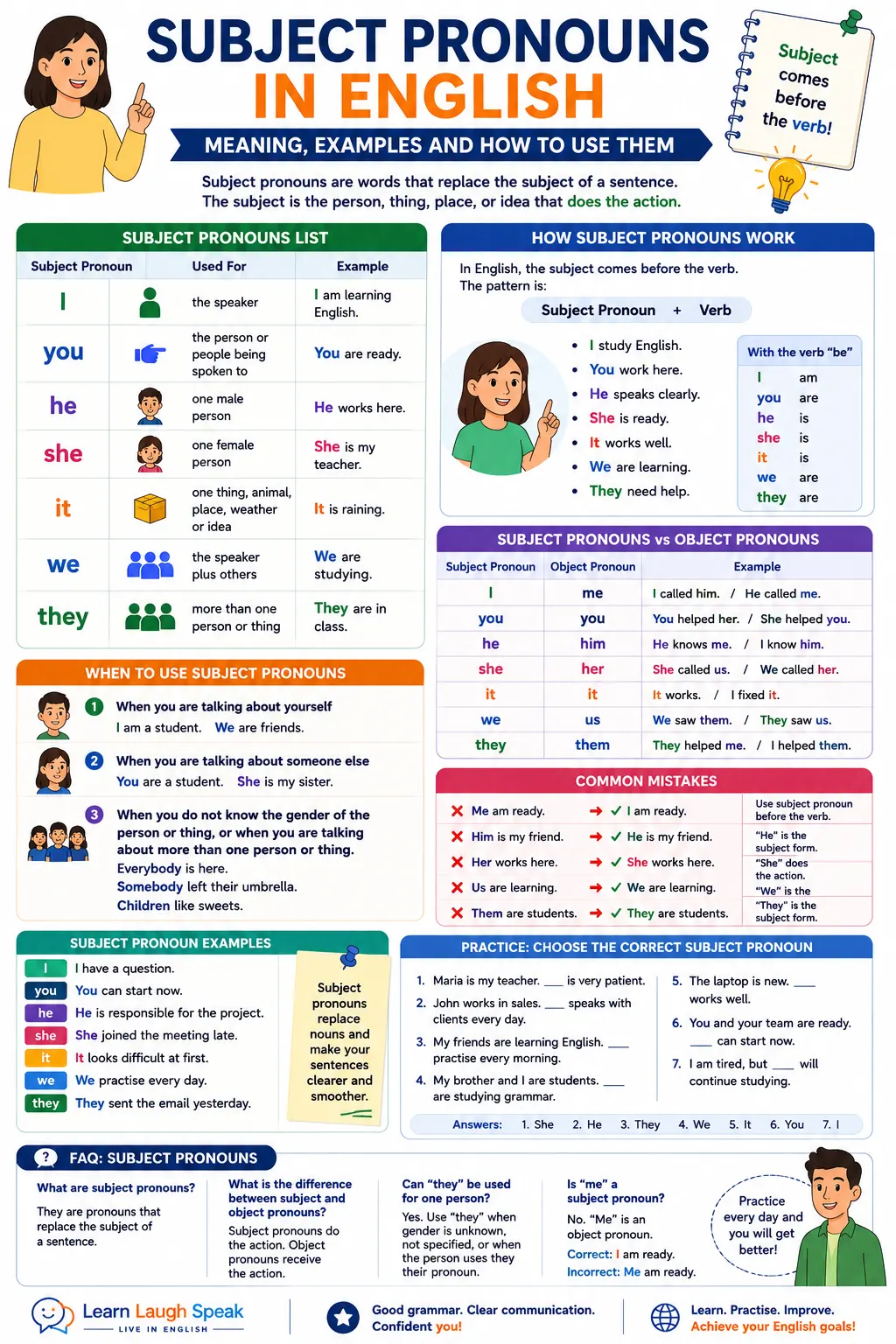
Subject pronouns are words that replace the subject of a sentence.
The subject is the person, thing, place, or idea that does the action.
The main subject pronouns in English are:
I, you, he, she, it, we, they
Example:
Maria is learning English.
We can replace Maria with she:
She is learning English.
In this sentence, she is the subject pronoun because she is doing the action.
Subject pronouns usually come before the verb in English.
Examples:
I study English.
You work here.
He speaks clearly.
She is ready.
It works well.
We are learning.
They need help.
5 Basic Writing Skills: How to Improve and Apply Them
Why Subject Pronouns Matter in English
Subject pronouns are important because they help you avoid repeating the same noun again and again.
Without subject pronouns, English sounds unnatural.
Example:
Maria is a teacher. Maria works in Mexico. Maria teaches adults.
This is correct, but it sounds repetitive.
A better version is:
Maria is a teacher. She works in Mexico. She teaches adults.
The meaning is the same, but the writing sounds smoother.
Subject pronouns also help you build clear sentences because they show who or what is doing the action.
Subject Pronouns List in English
Here is the full list of common English subject pronouns.
| Subject Pronoun | Used For | Example |
|---|---|---|
| I | the speaker | I am learning English. |
| you | the person or people being spoken to | You are ready. |
| he | one male person | He works here. |
| she | one female person | She is my teacher. |
| it | one thing, animal, place, weather, or idea | It is raining. |
| we | the speaker plus other people | We are studying. |
| they | more than one person or thing, or one person when gender is unknown or not specified | They are in class. |
These are the subject pronouns you need most in everyday English.
How Subject Pronouns Work in a Sentence
In English, the subject usually comes before the verb.
The pattern is:
subject pronoun + verb
Examples:
I work.
You listen.
He speaks.
She studies.
It rains.
We practise.
They understand.
You can also use subject pronouns with longer sentences.
Examples:
I work in sales.
You speak English well.
He needs more practice.
She joined the meeting late.
It looks difficult at first.
We study every day.
They are improving quickly.
The subject pronoun tells us who or what the sentence is about.
Subject Pronouns With the Verb “Be”
The verb be changes depending on the subject pronoun.
This is one of the most important grammar patterns in English.
| Subject Pronoun | Verb “Be” | Example |
| I | am | I am ready. |
| you | are | You are correct. |
| he | is | He is here. |
| she | is | She is busy. |
| it | is | It is finished. |
| we | are | We are students. |
| they | are | They are happy. |
This is why we say:
I am
not
I is
And:
They are
not
They is
Subject Pronouns vs Object Pronouns
Many English learners confuse subject pronouns and object pronouns.
A subject pronoun does the action.
An object pronoun receives the action.
Look at this example:
She called him.
She is the subject because she does the action.
Him is the object because he receives the action.
Here is a simple table.
| Subject Pronoun | Object Pronoun | Example |
| I | me | I called him. / He called me. |
| you | you | You helped her. / She helped you. |
| he | him | He knows me. / I know him. |
| she | her | She called us. / We called her. |
| it | it | It works. / I fixed it. |
| we | us | We saw them. / They saw us. |
| they | them | They helped me. / I helped them. |
The position in the sentence helps you choose the correct pronoun.
Before the verb, you often need a subject pronoun.
After the verb or preposition, you often need an object pronoun.
When to Use Subject Pronouns
Use subject pronouns when the pronoun is doing the action in the sentence.
Examples:
I am a student.
You are learning English.
He is my brother.
She works in marketing.
It is raining.
We are friends.
They live nearby.
You also use subject pronouns when answering questions.
Example:
Who is calling?
I am.
Example:
Who finished the report?
She did.
Example:
Who is joining the meeting?
They are.
Subject pronouns are also used in short answers.
Examples:
Yes, I do.
No, she doesn’t.
Yes, we are.
No, they didn’t.
When Not to Use Subject Pronouns
Do not use subject pronouns when the pronoun is receiving the action.
Incorrect:
He called I.
Correct:
He called me.
Incorrect:
I helped they.
Correct:
I helped them.
Incorrect:
She spoke to we.
Correct:
She spoke to us.
You should also avoid overusing I in formal writing when the focus should be on the topic, not the writer.
For example, in an academic essay, this may sound too personal:
I think this research is important.
A more formal version is:
This research is important because it shows clear results.
This does not mean subject pronouns are wrong in formal English. It means you should choose them carefully depending on the situation.
Common Mistakes With Subject Pronouns
Here are common mistakes learners make with subject pronouns.
| Mistake | Better English | Why |
| Me am ready. | I am ready. | Use subject pronoun before the verb |
| Him is my friend. | He is my friend. | “He” is the subject form |
| Her works here. | She works here. | “She” does the action |
| Us are learning. | We are learning. | “We” is the subject form |
| Them are students. | They are students. | “They” is the subject form |
| It are difficult. | It is difficult. | “It” uses “is” |
| They is ready. | They are ready. | “They” uses “are” |
The easiest way to avoid these mistakes is to ask:
Who is doing the action?
Then choose the subject pronoun.
Subject Pronoun Examples in Real Sentences
Here are more examples of subject pronouns in natural English.
I
I am learning English.
I need more practice.
I have a question.
Use I when speaking about yourself.
You
You are doing well.
You can join the meeting now.
You need to send the file today.
Use you for one person or more than one person.
He
He works in finance.
He is speaking with the client.
He needs help with the report.
Use he for one male person.
She
She is my manager.
She speaks English clearly.
She is preparing the presentation.
Use she for one female person.
It
It is raining.
It works now.
It looks good.
Use it for things, animals when gender is not important, weather, places, situations, or ideas.
We
We are studying together.
We need to practise every day.
We finished the project.
Use we when speaking about yourself and one or more other people.
They
They are my classmates.
They work in the same company.
They sent the email yesterday.
Use they for more than one person or thing.
You can also use they for one person when gender is unknown or not specified.
Example:
Someone left their notebook. They may come back for it.
Subject Pronouns in Questions
Subject pronouns are also used in questions.
Examples:
Are you ready?
Is he coming?
Is she available?
Does it work?
Are we late?
Do they understand?
When using the verb be, the verb often comes before the subject pronoun.
Example:
You are ready.
Question:
Are you ready?
With many other verbs, we use do or does.
Example:
They understand.
Question:
Do they understand?
Example:
She works here.
Question:
Does she work here?
Subject Pronouns in Business English
Subject pronouns are used constantly in professional English.
Examples:
I will send the report today.
You can review the document before Friday.
He is responsible for the client account.
She will lead the meeting.
It is attached to this email.
We need to confirm the details.
They asked for an updated proposal.
In business emails, meetings, and presentations, subject pronouns help your message sound clear and direct.
Compare:
The team finished the report. The team sent the report to the client.
Better:
The team finished the report. They sent it to the client.
The second version is smoother and easier to read.
Practice: Choose the Correct Subject Pronoun
Choose the correct subject pronoun for each sentence.
- Maria is my teacher. ___ is very patient.
Answer: She
- John works in sales. ___ speaks with clients every day.
Answer: He
- My friends are learning English. ___ practise every morning.
Answer: They
- My brother and I are students. ___ are studying grammar.
Answer: We
- The laptop is new. ___ works well.
Answer: It
- You and your team are ready. ___ can start now.
Answer: You
- I am tired, but ___ will continue studying.
Answer: I
Practising with real sentences helps you understand how subject pronouns work naturally.
Subject Pronouns and Clear Writing
Subject pronouns make your writing clearer when they replace a noun that has already been mentioned.
Example:
Learn Laugh Speak helps adult learners. It gives students lessons at the correct level.
Here, it refers to Learn Laugh Speak.
Example:
The students completed the test. They started their lessons after that.
Here, they refers to the students.
Be careful that your pronoun clearly refers to the correct noun.
Unclear:
Maria spoke to Ana after she finished the report.
Who finished the report? Maria or Ana?
Clearer:
After Maria finished the report, she spoke to Ana.
or
After Ana finished the report, Maria spoke to her.
Good pronoun use helps your reader understand your meaning.
FAQ: Subject Pronouns
What are subject pronouns?
Subject pronouns are pronouns that replace the subject of a sentence.
The main subject pronouns in English are:
I, you, he, she, it, we, they
What is an example of a subject pronoun?
In the sentence:
She is learning English.
She is the subject pronoun because she is doing the action.
What is the difference between subject and object pronouns?
Subject pronouns do the action.
Object pronouns receive the action.
Example:
He called me.
He is the subject pronoun.
Me is the object pronoun.
Is “me” a subject pronoun?
No. Me is an object pronoun.
Correct:
I am ready.
Incorrect:
Me am ready.
Can “they” be used for one person?
Yes. They can be used for one person when gender is unknown, not specified, or when the person uses they as their pronoun.
Example:
Someone called. They left a message.
Final Thoughts on Subject Pronouns
Subject pronouns are a basic but important part of English grammar.
They tell us who or what is doing the action.
Remember the main subject pronouns:
I, you, he, she, it, we, they
Use them before verbs.
Use them to avoid repeating names and nouns too often.
Use them to make your writing and speaking clearer.
Once you understand subject pronouns, your English sentences will become easier to build and easier to understand.

Learn English Grammar With Learn Laugh Speak
Learn Laugh Speak helps adult English learners improve grammar, pronunciation, speaking, listening, reading, writing, and vocabulary at the correct level.
Grammar does not need to feel confusing or disconnected from real life.
With Learn Laugh Speak, students complete a full level assessment and begin learning from the exact point that matches their ability.
You can practise grammar in real sentences, receive corrections, and improve step by step with structured lessons designed for real communication.
If you want to understand subject pronouns, improve sentence structure, write better emails, and speak with more confidence, Learn Laugh Speak can help you make progress every day.