
 English
 Arabic
 Chinese (Simplified)
 Dutch
Dutch French
 German
 Italian
 Portuguese
 Russian
 Spanish
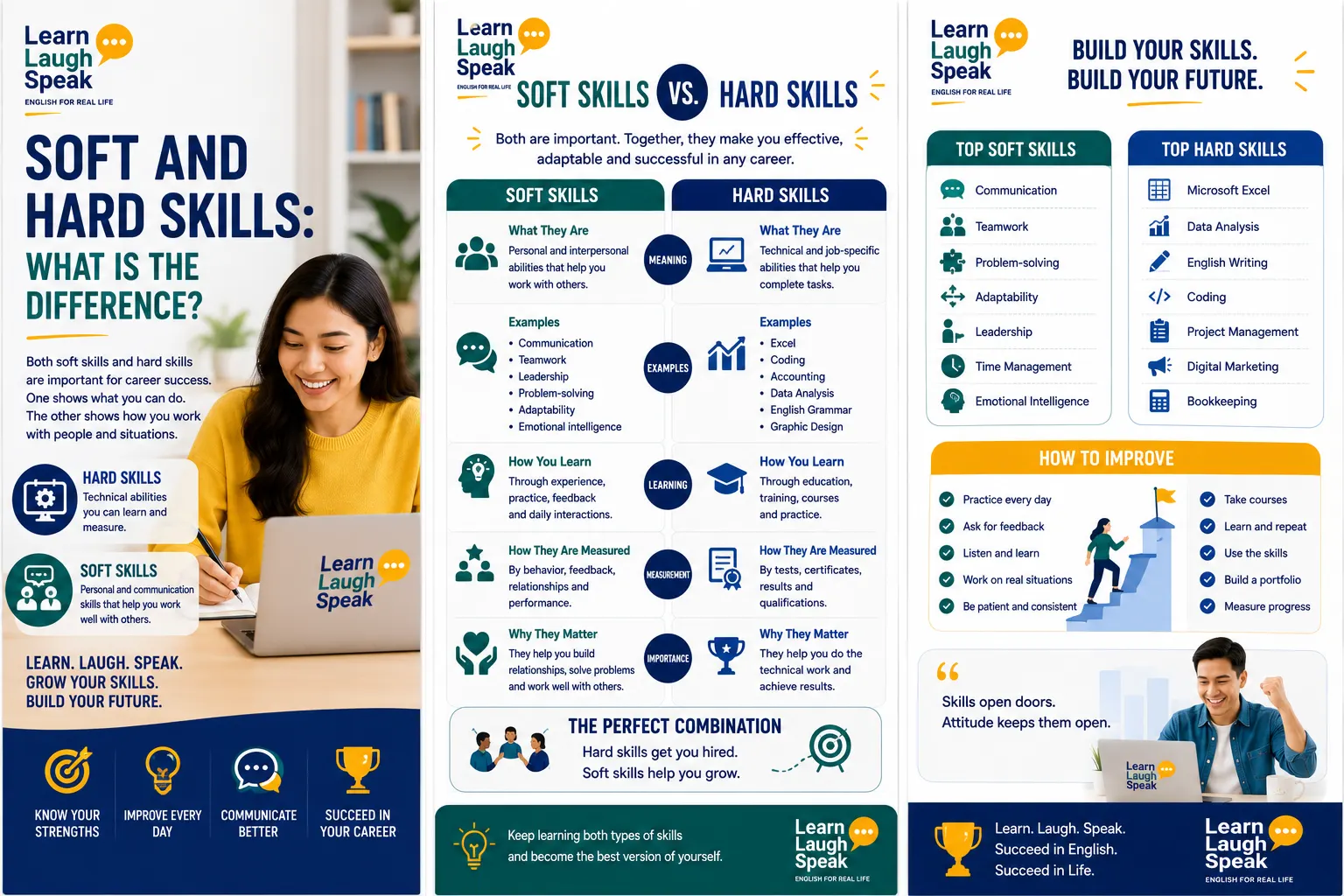
Soft and hard skills are both important for work and career success. Hard skills are technical abilities you can learn, measure, and prove, such as using software, speaking English, coding, accounting, or operating equipment. Soft skills are personal and communication abilities, such as teamwork, leadership, problem-solving, adaptability, and emotional intelligence.
Understanding the difference between soft and hard skills helps English learners talk about their abilities more clearly in job interviews, resumes, workplace conversations, and professional development.
Many people think hard skills are the most important because they are easier to measure. But in real workplaces, soft skills are just as important. You may know how to do a task, but if you cannot communicate, collaborate, solve problems, or manage pressure, it can be difficult to succeed.
This guide explains what soft and hard skills are, how they are different, and how English learners can describe them professionally.

What Are Soft and Hard Skills?
Soft and hard skills describe two different types of abilities people use at work.
Hard skills are practical, technical, or job-specific skills. They are usually learned through training, education, courses, or experience.
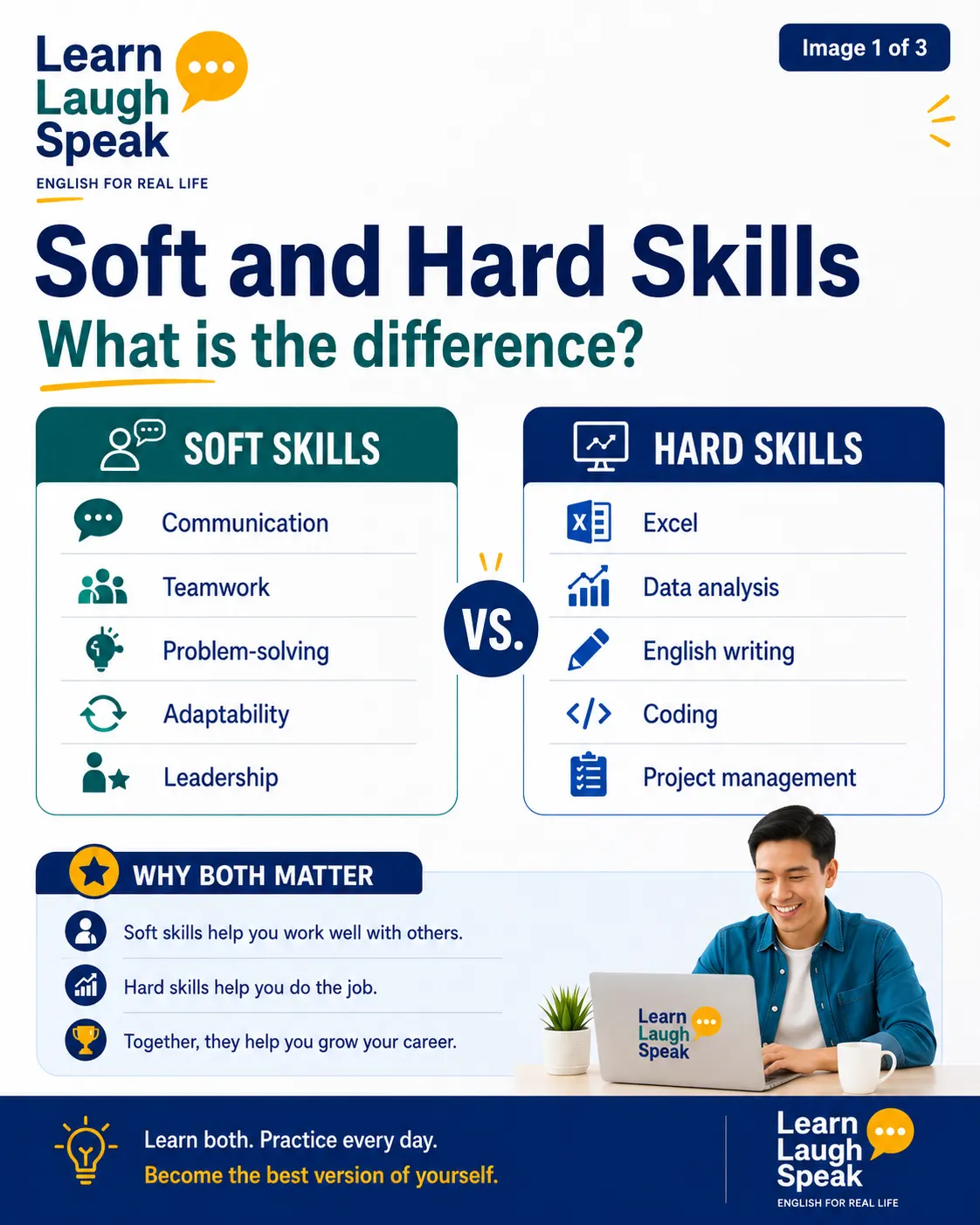
Examples of hard skills include:
- English grammar
- data analysis
- coding
- accounting
- graphic design
- using Excel
- project management software
- machine operation
- writing reports
- speaking a second language
- digital marketing
- customer service systems
Soft skills are personal, social, and communication skills. They help you work well with other people and handle different situations.
Examples of soft skills include:
- communication
- teamwork
- leadership
- problem-solving
- adaptability
- patience
- time management
- active listening
- resilience
- emotional intelligence
- creativity
- conflict resolution
Both types of skills matter. A strong employee usually needs a mix of both.
Soft and Hard Skills: Simple Difference
The easiest way to understand the difference is this:
Hard skills show what you can do.
Soft skills show how you work with people and situations.
For example:
A chef needs hard skills like cooking techniques, food safety, and menu preparation.
But a chef also needs soft skills like teamwork, communication, pressure management, and leadership in the kitchen.
A customer service agent needs hard skills like using CRM software, writing emails, and following company procedures.
But they also need soft skills like empathy, patience, listening, and problem-solving.
Soft and Hard Skills Table
| Skill type | Meaning | Examples |
|---|---|---|
| Hard skills | Technical or job-specific abilities | Coding, accounting, Excel, English grammar, design, data entry |
| Soft skills | Personal and communication abilities | Teamwork, leadership, adaptability, problem-solving, listening |
| How you learn them | Courses, training, practice, work experience | Experience, feedback, reflection, communication practice |
| How they are measured | Tests, certificates, portfolios, results | Behaviour, performance, feedback, workplace relationships |
| Resume use | Shows technical ability | Shows how you work with others |
| Interview use | Proves you can do the job tasks | Proves you can fit the team and handle challenges |
What Are Soft Skills?
Soft skills are the personal and interpersonal abilities that help people communicate, collaborate, lead, solve problems, and work effectively with others.
They are called “soft” skills, but that does not mean they are weak or easy. In many jobs, soft skills are the difference between someone who can do the work and someone who can grow, lead, and succeed long term.
Important soft skills include:
- communication
- teamwork
- active listening
- problem-solving
- adaptability
- emotional intelligence
- leadership
- organisation
- time management
- resilience
- creativity
- professionalism
For English learners, soft skills are especially important because communication in another language requires patience, clarity, confidence, and cultural awareness.
Examples of Soft Skills at Work
Here are soft skills in real workplace situations.
| Soft skill | Workplace example |
| Communication | Explaining a problem clearly to your manager |
| Teamwork | Helping colleagues complete a shared project |
| Leadership | Guiding a team through a difficult deadline |
| Problem-solving | Finding a solution when a customer is unhappy |
| Adaptability | Learning a new process or system quickly |
| Time management | Finishing tasks before the deadline |
| Active listening | Understanding a customer’s concern before replying |
| Emotional intelligence | Staying calm during a stressful conversation |
| Resilience | Continuing after receiving difficult feedback |
| Conflict resolution | Helping two colleagues find a fair solution |
Soft skills help you work better with people. They are useful in almost every job.
What Are Hard Skills?
Hard skills are specific abilities that help you complete job tasks. They are often easier to teach, practise, and measure than soft skills.
Hard skills can come from:
- school
- university
- online courses
- job training
- certificates
- work experience
- technical practice
- apprenticeships
- professional qualifications
Examples of hard skills include:
- using Microsoft Excel
- writing business emails
- coding in Python
- speaking English at B2 level
- using accounting software
- graphic design
- video editing
- operating machinery
- data analysis
- creating reports
- using booking systems
- managing paid ads
- understanding safety procedures
Hard skills are usually connected to the specific job you want.
Examples of Hard Skills at Work
Here are hard skills in real workplace situations.
| Hard skill | Workplace example |
| Excel | Creating a sales report |
| English writing | Sending a professional email |
| Coding | Building a website feature |
| Accounting | Preparing financial records |
| Data analysis | Reviewing customer trends |
| Design | Creating a marketing flyer |
| CRM software | Updating customer information |
| Project management tools | Tracking tasks in Asana or Trello |
| Presentation software | Building slides for a meeting |
| Language skills | Speaking English with international clients |
Hard skills help you complete the technical part of your job.
Soft and Hard Skills in English Learning
English learning includes both soft and hard skills.
Hard skills in English include:
- grammar
- vocabulary
- pronunciation
- spelling
- reading
- writing
- listening
- speaking structures
- sentence formation
- email writing
- presentation phrases
Soft skills in English include:
- confidence
- active listening
- asking for clarification
- speaking politely
- adapting your tone
- handling mistakes
- joining conversations
- giving feedback
- disagreeing respectfully
- communicating under pressure
For example, knowing grammar is a hard skill. Using English confidently in a meeting is a mix of hard and soft skills.
This is why adult learners need more than grammar rules. They also need real communication practice.
Soft and Hard Skills for Resumes
When writing a resume, you should include both soft and hard skills.
Hard skills show employers that you can do the technical work.
Soft skills show employers that you can work well with people, solve problems, and fit into a team.
Hard skills resume examples
- Microsoft Excel
- Business English writing
- Customer service software
- Data analysis
- Social media marketing
- Project coordination
- Spanish-English communication
- Inventory management
- Sales reporting
- CRM management
Soft skills resume examples
- Strong communication
- Team collaboration
- Problem-solving
- Adaptability
- Leadership
- Time management
- Conflict resolution
- Attention to detail
- Customer-focused mindset
- Ability to work under pressure
A good resume should not only list skills. It should show how you used them.
Weak resume example:
Good communication skills
Stronger resume example:
Communicated daily with international clients and resolved customer questions in English.
The stronger version gives proof.
Soft and Hard Skills in Job Interviews
In job interviews, employers often ask about both soft and hard skills.
They may ask:
“What technical skills do you have?”
This is usually about hard skills.
They may also ask:
“How do you handle pressure?”
This is usually about soft skills.
Example answer using hard skills
“I have experience using Excel to organise sales data, create weekly reports, and track customer activity.”
Example answer using soft skills
“I stay calm under pressure by focusing on priorities, communicating early, and asking for support when needed.”
Example answer using both
“In my last role, I used our CRM system to manage customer requests. I also used communication and problem-solving skills to handle difficult conversations professionally.”
This answer is strong because it combines technical ability with workplace behaviour.
How to Improve Soft Skills
Soft skills improve through practice, feedback, and reflection. You cannot usually master them by reading one book or watching one video.
Ways to improve soft skills:
- practise active listening
- ask for feedback
- observe strong communicators
- join group discussions
- role-play workplace situations
- practise giving and receiving feedback
- reflect after difficult conversations
- learn professional phrases
- practise speaking clearly
- work on emotional control under pressure
Example:
If you want to improve communication, practise explaining one idea in three clear sentences.
“The main issue is the deadline. We need more time to finish the report properly. I suggest we ask for an extension until Friday.”
This is clear, calm, and professional.
How to Improve Hard Skills
Hard skills improve through study, practice, training, and repetition.
Ways to improve hard skills:
- take a course
- practise with real tasks
- earn certificates
- follow tutorials
- complete exercises
- ask a mentor for help
- build a portfolio
- use the skill at work
- test your progress
- review mistakes
Example:
If you want to improve business English writing, practise writing:
- emails
- summaries
- reports
- meeting notes
- customer replies
- professional messages
Then check your grammar, tone, clarity, and structure.
Soft and Hard Skills in Management
Managers and leaders need both soft and hard skills.
Hard skills for managers may include:
- budgeting
- reporting
- scheduling
- project management
- data analysis
- performance tracking
- using management software
Soft skills for managers may include:
- leadership
- coaching
- feedback
- conflict resolution
- clear communication
- decision-making
- empathy
- delegation
- motivation
A manager may understand the numbers, but they also need to explain the plan clearly, support the team, and handle problems professionally.
Example:
Hard skill: creating a project timeline
Soft skill: helping the team understand deadlines and stay motivated
Both are needed.
Soft and Hard Skills in Customer Service
Customer service is a good example of a job where both skill types matter.
Hard skills may include:
- using a booking system
- writing customer emails
- processing payments
- following company procedures
- using product knowledge
- updating customer records
Soft skills may include:
- patience
- empathy
- listening
- calm communication
- problem-solving
- polite language
- emotional control
Example:
A hotel receptionist needs to know the reservation system. That is a hard skill.
But when a guest is upset, the receptionist needs empathy, patience, and calm communication. Those are soft skills.
What Not to Say and What to Say Instead
Here are better ways to talk about soft and hard skills in English.
| What not to say | What to say instead |
| “I have many skills.” | “I have both technical skills and strong communication skills.” |
| “I am good with people.” | “I communicate clearly and work well with different teams.” |
| “I know computers.” | “I have experience using Excel, CRM systems, and project management tools.” |
| “I am a leader.” | “I have experience leading small teams and supporting colleagues.” |
| “I solve problems.” | “I identify problems quickly and suggest practical solutions.” |
| “My English is good.” | “I can communicate professionally in English with clients and colleagues.” |
| “I work hard.” | “I manage my time well and stay focused under pressure.” |
| “I am flexible.” | “I adapt quickly when priorities or tasks change.” |
These phrases sound more specific and professional.
Common Mistakes with Soft and Hard Skills
1. Thinking hard skills are enough
Technical ability is important, but employers also care about communication, teamwork, and attitude.
2. Listing soft skills without proof
Anyone can say “I am a good communicator.” It is better to give an example.
3. Forgetting job-specific hard skills
Each job needs different hard skills. Match your resume and interview answers to the role.
4. Using vague words
Avoid vague phrases like “good skills” or “hard worker.” Be specific.
5. Ignoring English communication
For international jobs, English can be both a hard skill and a soft skill. You need language knowledge and communication confidence.
Practice: Identify Soft and Hard Skills
Look at each skill and decide if it is a soft skill or a hard skill.
- Microsoft Excel
- Teamwork
- Public speaking
- Coding
- Problem-solving
- Accounting
- Leadership
- Email writing
- Emotional intelligence
- Data analysis
Suggested answers:
- Hard skill
- Soft skill
- Soft skill and hard skill
- Hard skill
- Soft skill
- Hard skill
- Soft skill
- Hard skill and soft skill
- Soft skill
- Hard skill
Some skills can be both. For example, public speaking includes technique, structure, and language, but it also requires confidence and audience awareness.
Learn Professional English with Learn Laugh Speak
Learn Laugh Speak helps adult English learners build both language skills and real communication skills for work, study, and daily life.
Understanding soft and hard skills is useful when you write a resume, prepare for an interview, talk about your experience, or improve your professional English.
With Learn Laugh Speak, students practise reading, writing, speaking, listening, grammar, vocabulary, pronunciation, and workplace communication at the right level. The goal is to help learners use English confidently in real situations.

FAQs About Soft and Hard Skills
What are soft and hard skills?
Soft and hard skills are two types of abilities used at work. Hard skills are technical and job-specific, while soft skills are personal and communication-based.
What are examples of hard skills?
Examples of hard skills include coding, Excel, accounting, writing reports, graphic design, data analysis, and speaking a second language.
What are examples of soft skills?
Examples of soft skills include communication, teamwork, leadership, problem-solving, adaptability, emotional intelligence, and time management.
Which is more important, soft skills or hard skills?
Both are important. Hard skills help you do the technical work. Soft skills help you communicate, collaborate, solve problems, and succeed with people.
Is English a soft skill or a hard skill?
English can be both. Grammar, vocabulary, and writing are hard skills. Speaking confidently, listening actively, and adapting tone are soft skills.
How do I describe soft skills in an interview?
Use clear examples. Instead of saying “I have good communication skills,” say “I communicate clearly with customers and explain problems in a calm, professional way.”
Final Thoughts on Soft and Hard Skills
Understanding soft and hard skills helps you explain your abilities more clearly in English. Hard skills show what you can do. Soft skills show how you work with people, pressure, and problems.
For career success, you need both. Technical knowledge helps you complete tasks, but communication, teamwork, leadership, and problem-solving help you grow.
Start by identifying your strongest soft skills and hard skills. Then practise explaining them with real examples, especially in resumes, interviews, and workplace conversations.
3 thoughts on “Soft and Hard Skills: What is the difference?”
I want to learn soft skills and hard skills
That is great mate. Contact us and we can line you up with one of our teachers.
Pingback: Mastering Soft Skills in a Tech-Driven World | Learn Laugh Speak