
 English
 Arabic
 Chinese (Simplified)
 Dutch
Dutch French
 German
 Italian
 Portuguese
 Russian
 Spanish
Saying thank you is one of the first polite phrases English learners usually learn.
But knowing when you can use thank you is just as important as knowing the words.
In English, thank you can be used in everyday conversations, professional emails, meetings, customer service, hospitality, and workplace communication.
It is a simple phrase, but it carries a lot of meaning.
It shows respect.
It shows appreciation.
It shows that you noticed someone’s time, help, effort, or kindness.
What is the meaning of thank you formally?

Quick Answer: When Can You Use Thank You?
You can use thank you when someone helps you, gives you information, answers a question, offers support, sends something, explains something, waits for you, or does something kind.
For example: “Thank you for your help.”
You can use thank you in everyday English, professional emails, meetings, customer service, hospitality, and formal situations.
Use thanks in more casual situations.
Use I appreciate it when you want to sound warmer or more professional.
The most important thing is to match your phrase to the situation.
Why Thank You Matters in English
Thank you is more than a polite phrase.
It helps people feel respected and appreciated.
In English-speaking workplaces, schools, hotels, restaurants, customer service roles, and social situations, saying thank you at the right moment can make your communication sound warmer and more natural.
For example, if someone explains a task to you, you can say:
“Thank you for explaining that.”
If someone gives you their time, you can say:
“Thank you for your time.”
If someone waits while you check something, you can say:
“Thank you for your patience.”
These small phrases help create better conversations.
They also show that you are paying attention to the other person’s effort.
When You Can Use Thank You in Everyday English
You can use thank you in many everyday situations.
Use it when someone helps you, answers a question, gives you directions, holds a door, offers something, or does something thoughtful.
Examples:
“Thank you for helping me.”
“Thank you for explaining that.”
“Thank you for waiting.”
“Thank you for the directions.”
“Thank you for letting me know.”
“Thank you for your time.”
You can also use thanks in casual conversations.
For example:
“Thanks for your help.”
“Thanks for coming.”
“Thanks for the message.”
“Thanks for letting me know.”
Both thank you and thanks are correct.
The difference is tone.
Thank you sounds a little more polite or complete.
Thanks sounds more casual and friendly.
When You Can Use Thank You at Work
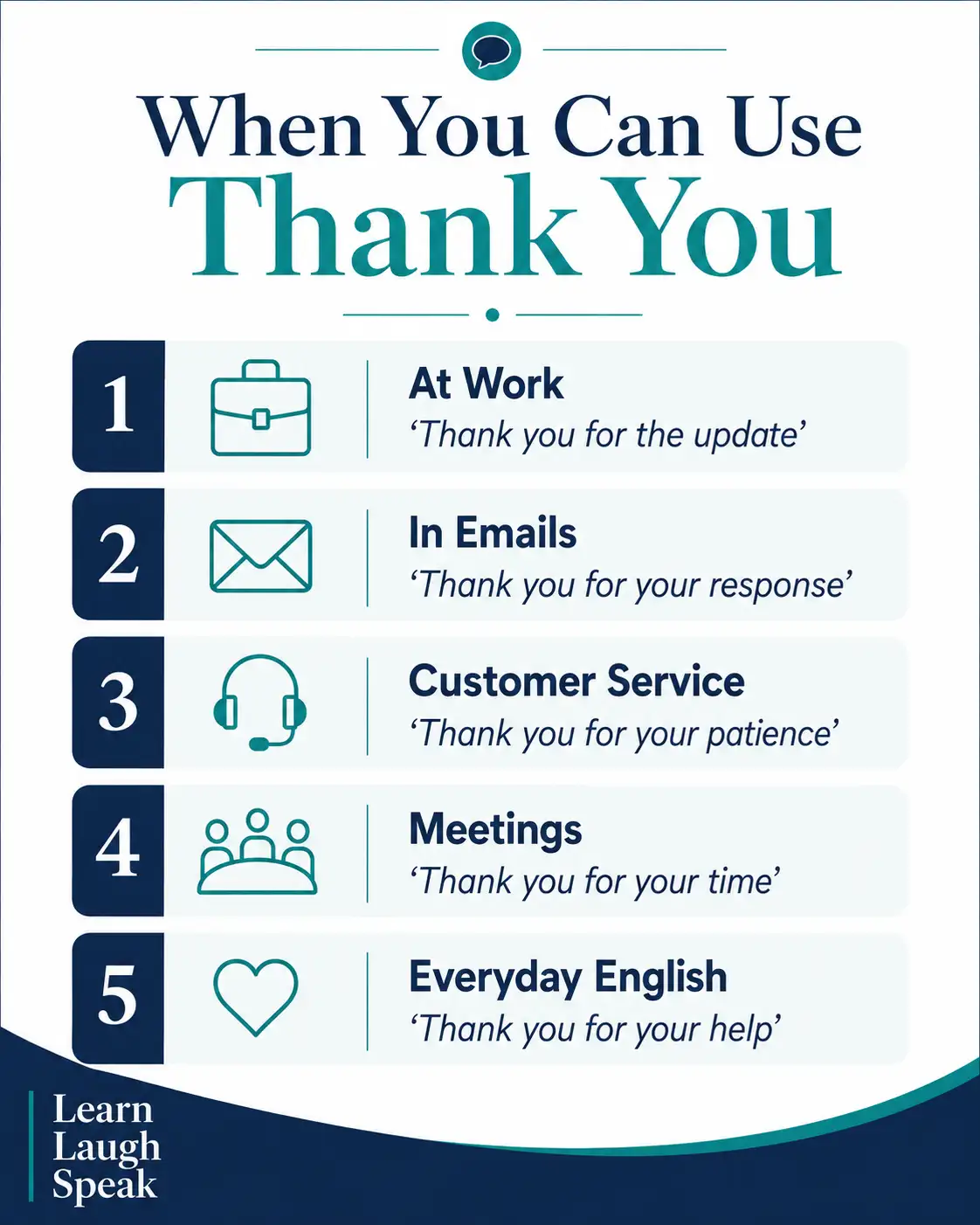
Knowing when you can use thank you at work helps you sound professional and respectful.
You can use thank you after meetings, updates, feedback, support, explanations, documents, or help from coworkers and managers.
Useful workplace examples:
“Thank you for the update.”
“Thank you for your time today.”
“Thank you for sending this through.”
“Thank you for clarifying that.”
“Thank you for your support on this project.”
“Thank you for your feedback.”
“Thank you for getting back to me.”
“Thank you for your quick response.”
In professional English, these phrases are useful because they are short, clear, and respectful.
For example, after a meeting, you can say:
“Thank you for your time today. I’ll follow up with the next steps.”
After receiving feedback, you can say:
“Thank you for your feedback. I’ll make the changes and send the updated version.”
This sounds professional because it shows appreciation and action.
When You Can Use Thank You in Emails
Email is one of the most common places to use thank you in professional English.
You can use it at the beginning of an email, in the middle of a message, or near the end.
Common email phrases include:
“Thank you for your email.”
“Thank you for getting back to me.”
“Thank you for the information.”
“Thank you for your patience.”
“Thank you for your help with this.”
“Thank you for confirming.”
“Thank you for your quick reply.”
“Thank you for bringing this to my attention.”
You can also use thank you in advance, but be careful.
“Thank you in advance” is common, but it can sometimes sound like you expect the person to help.
A softer version is:
“I’d really appreciate your help with this.”
or:
“Thank you for any help you can provide.”
These phrases sound polite without putting too much pressure on the other person.
When You Can Use Thank You in Customer Service or Hospitality
In customer service and hospitality, thank you is essential.
It helps guests, customers, and clients feel respected.
You can use thank you when someone waits, shares information, chooses your service, gives feedback, or brings a problem to your attention.
Useful examples:
“Thank you for waiting.”
“Thank you for your patience.”
“Thank you for staying with us.”
“Thank you for choosing us.”
“Thank you for letting us know.”
“Thank you for bringing this to our attention.”
“Thank you for your feedback.”
“Thank you for calling.”
In hospitality, you might say:
“Thank you for staying with us. We hope you enjoyed your visit.”
In customer service, you might say:
“Thank you for bringing this to our attention. Let me check what happened.”
When a customer is upset, thank you can help keep the tone calm.
For example:
“Thank you for your patience while we look into this.”
This sounds much better than:
“Please wait.”
or:
“You need to wait.”
Thank You vs Thanks vs I Appreciate It
English has many ways to show gratitude.
Here is a simple guide.
| Phrase | Tone | Best Used For |
|---|---|---|
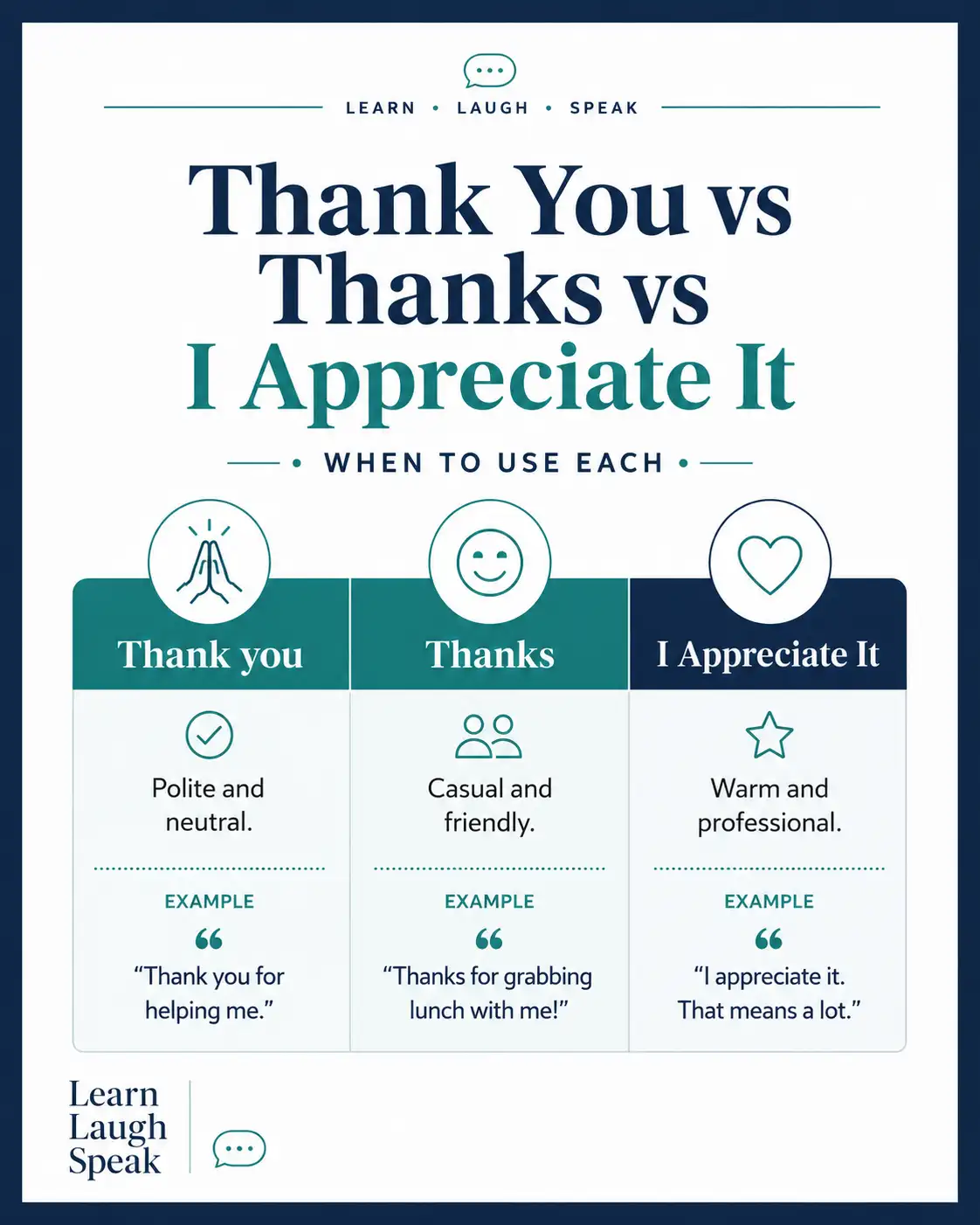
| Thank you | Polite and neutral | Most situations |
| Thanks | Casual and friendly | Coworkers, friends, quick messages |
| Thank you very much | More formal or stronger | Extra appreciation |
| Thanks a lot | Casual and warm | Friendly situations |
| I appreciate it | Warm and professional | Work, support, effort |
| I really appreciate your help | Stronger and sincere | When someone did something useful |
Use thank you when you want to be safe and polite.
Use thanks when the situation is casual.
Use I appreciate it when you want to sound more sincere or professional.
For example:
“Thanks for the update.”
is fine for a quick message to a coworker.
But in a professional email, you might write:
“Thank you for the update. I appreciate your help.”
Professional Ways to Say Thank You
Sometimes, you need more than a simple thank you.
In professional situations, you can use longer phrases to sound more specific.
Examples:
“Thank you for your time.”
“Thank you for your help with this.”
“I appreciate your support.”
“Thank you for your quick response.”
“Thank you for your feedback.”
“I appreciate you taking the time to explain this.”
“Thank you for your patience while we reviewed the details.”
“Thank you for confirming the next steps.”
“Thank you for sharing this information with me.”
“I really appreciate your help on this project.”
These phrases are useful because they explain what you are thankful for.
That makes your message sound more thoughtful and professional.
What Not to Say Instead of Thank You
Sometimes learners use very short replies that can sound cold or unclear.
A better phrase can make your English sound more polite.
| Avoid Saying | Say This Instead |
|---|---|
| “Okay.” | “Thank you for letting me know.” |
| “Got it.” | “Thank you for clarifying.” |
| “Finally.” | “Thank you for your patience.” |
| “You should have told me earlier.” | “Thank you for bringing this to my attention.” |
| “Whatever.” | “Thank you for explaining.” |
| “Fine.” | “Thank you for the update.” |
| “Sure.” | “Thank you, I’ll take care of it.” |
This does not mean words like okay or got it are always wrong.
They can be fine in casual messages.
But in professional English, adding thank you often makes your message sound more respectful.
Can You Say Thank You Too Much?
Yes, sometimes you can say thank you too much.
Too many thank you phrases in one message can sound unnatural.
For example:
“Thank you for your email. Thank you for the update. Thank you for your time. Thank you again.”
This sounds repetitive.
A better version is:
“Thank you for the update. I appreciate your time.”
This is shorter and more natural.
In most emails, one or two thank you phrases are enough.
Use them where they matter most.
Email Examples Using Thank You
Here are simple email examples you can use in professional situations.
Example 1: Thank You for an Update
Subject: Re: Project Update
Hi [Name],
Thank you for the update.
I appreciate you sending this through. I’ll review the details and get back to you if I have any questions.
Best regards,
[Your Name]
Example 2: Thank You for Help
Subject: Thank You for Your Help
Hi [Name],
Thank you for your help with this.
I really appreciate you taking the time to explain the process clearly.
Best regards,
[Your Name]
Example 3: Thank You for Patience
Subject: Update on [Topic]
Hi [Name],
Thank you for your patience.
I apologize for the delay and appreciate your understanding while we review the details.
Best regards,
[Your Name]
Example 4: Thank You After a Meeting
Subject: Thank You for Your Time
Hi [Name],
Thank you for your time today.
I appreciate the discussion and will follow up with the next steps shortly.
Best regards,
[Your Name]
Common Situations When You Can Use Thank You
Here are some simple situations where thank you is useful.
| Situation | Example Phrase |
|---|---|
| Someone helps you | “Thank you for your help.” |
| Someone explains something | “Thank you for explaining that.” |
| Someone replies to your email | “Thank you for getting back to me.” |
| Someone waits | “Thank you for your patience.” |
| Someone gives feedback | “Thank you for your feedback.” |
| Someone sends a file | “Thank you for sending this through.” |
| Someone confirms information | “Thank you for confirming.” |
| Someone tells you about a problem | “Thank you for bringing this to my attention.” |
| Someone joins a meeting | “Thank you for your time today.” |
| A customer chooses your service | “Thank you for choosing us.” |
This table is useful because it shows that thank you is not only one phrase.
You can change the words after thank you for depending on the situation.
Learn Natural English Phrases with Learn Laugh Speak
Learn Laugh Speak helps adults understand how English phrases are used in real situations.
That includes:
- when you can use thank you
- how to sound polite in English
- professional email phrases
- customer service English
- hospitality English
- workplace communication
- speaking and writing with confidence
Every student starts with a level assessment from A1 to C2.
From there, learners follow a structured path based on their level, goals, mistakes, and progress.
If you want to use English more naturally at work or in daily life, Learn Laugh Speak helps you practise useful phrases step by step.

Final Thoughts on When You Can Use Thank You
Knowing when you can use thank you helps you sound polite, natural, and professional in English.
You can use thank you when someone helps, explains, waits, replies, sends information, gives feedback, or supports you.
Use thanks for casual situations.
Use I appreciate it when you want to sound warmer or more professional.
The phrase is simple, but it is powerful.
Used well, thank you helps you build better relationships, communicate clearly, and show respect in English.