
 English
 Arabic
 Chinese (Simplified)
 Dutch
Dutch French
 German
 Italian
 Portuguese
 Russian
 Spanish
Learning professional business email communication phrases is important for workplace English.
Emails are one of the most common ways professionals communicate at work.
Whether you are writing to a manager, coworker, client, or customer, the right phrases help your emails sound:
- clear
- professional
- polite
- confident
For many English learners, writing business emails can feel stressful.
The good news is that you do not need complicated English.
You do need good business English communication.
You simply need the right professional phrases for the right situation.
Why Business Email Communication Matters
Professional emails help you:
- communicate clearly
- avoid misunderstandings
- build better workplace relationships
- sound more confident in English
- create stronger first impressions
Small wording changes can completely change the tone of an email.
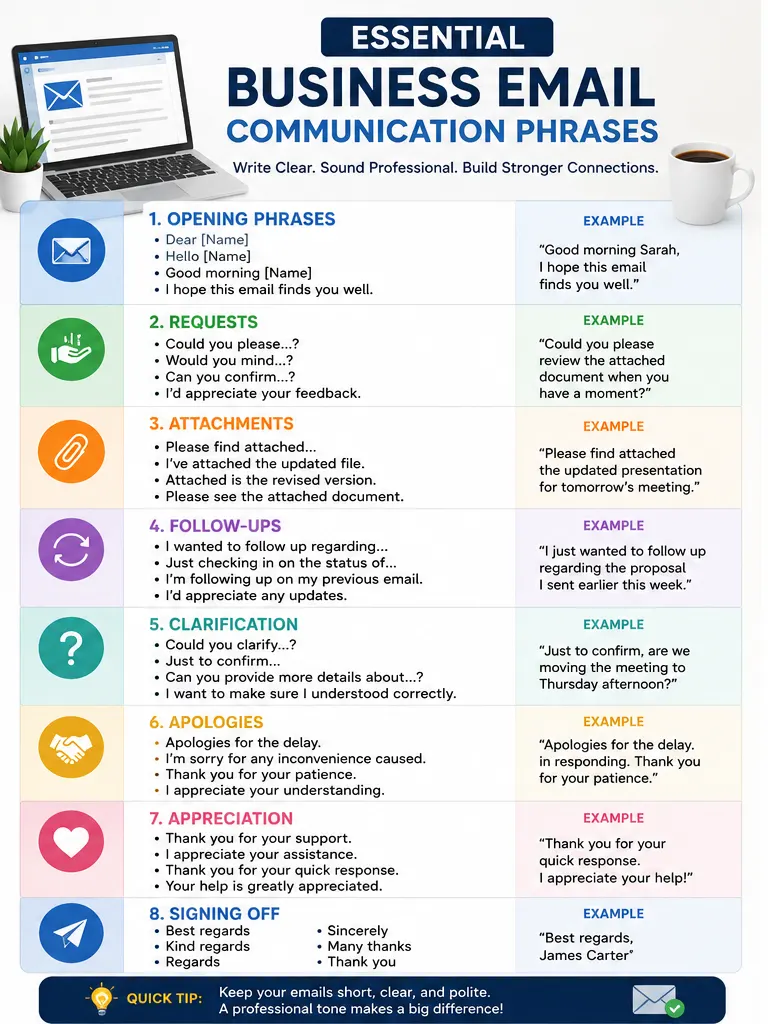
Opening Phrases for Business Emails
The opening of an email sets the tone.
Choose a greeting that matches the situation and relationship.
Professional opening phrases
- “Dear [Name]”
- “Hello [Name]”
- “Hi [Name]”
- “Good morning [Name]”
- “I hope this email finds you well.”
- “Thank you for your message.”
- “It was great meeting you at [event].”
✅ Example:
“Good morning Sarah, I hope this email finds you well.”
Quick tip
Use:
- Dear for more formal communication
- Hi or Hello for everyday workplace communication
Business Email Communication Phrases for Requests
Requests should sound polite and professional.
Professional request phrases
- “Could you please…”
- “Would you mind…”
- “Can you confirm…”
- “I’d appreciate your feedback.”
- “Please let me know your thoughts.”
- “When you have a moment, could you…”
✅ Example:
“When you have a moment, could you please review the attached document?”
Business Email Communication Phrases for Attachments
These phrases help explain attached files clearly.
Professional attachment phrases
- “Please find attached…”
- “I’ve attached the updated file.”
- “Attached is the revised version.”
- “Please see the attached document for reference.”
- “I’ve included the report below.”
✅ Example:
“Please find attached the updated presentation for tomorrow’s meeting.”
Business Email Communication Phrases for Follow-Ups
Follow-up emails are common in workplace English.
The key is to sound polite, not demanding.
Professional follow-up phrases
- “I wanted to follow up regarding…”
- “Just checking in on the status of…”
- “I’m following up on my previous email.”
- “Have you had a chance to review…”
- “I’d appreciate any updates when possible.”
✅ Example:
“I just wanted to follow up regarding the proposal I sent earlier this week.”
Business Email Communication Phrases for Clarification
Sometimes you need more information before moving forward.
Professional clarification phrases
- “Could you clarify…”
- “I’d appreciate some clarification regarding…”
- “Just to confirm…”
- “Can you provide more details about…”
- “I want to make sure I understood correctly.”
✅ Example:
“Just to confirm, are we moving the meeting to Thursday afternoon?”
Business Email Communication Phrases for Apologizing
Professional apologies should sound calm and respectful.
Professional apology phrases
- “Apologies for the delay.”
- “I’m sorry for any inconvenience caused.”
- “Thank you for your patience.”
- “Please accept my apologies.”
- “I appreciate your understanding.”
✅ Example:
“Apologies for the delay in responding. Thank you for your patience.”
Business Email Communication Phrases for Showing Appreciation
Professional gratitude improves workplace communication.
Professional appreciation phrases
- “Thank you for your support.”
- “I appreciate your assistance.”
- “Thank you for your quick response.”
- “Your help is greatly appreciated.”
- “Thank you for your time.”
✅ Example:
“Thank you for your quick response. I appreciate your support with this project.”
Signing Off Business Emails Professionally
The ending of your email leaves the final impression.
Professional sign-offs
- “Best regards”
- “Kind regards”
- “Regards”
- “Sincerely”
- “Many thanks”
- “Thank you”
✅ Example:
“Best regards,
James Carter”
Quick tip
Avoid overly casual endings like:
- “Later”
- “Cheers” (unless you know the person well)
- “Bye”
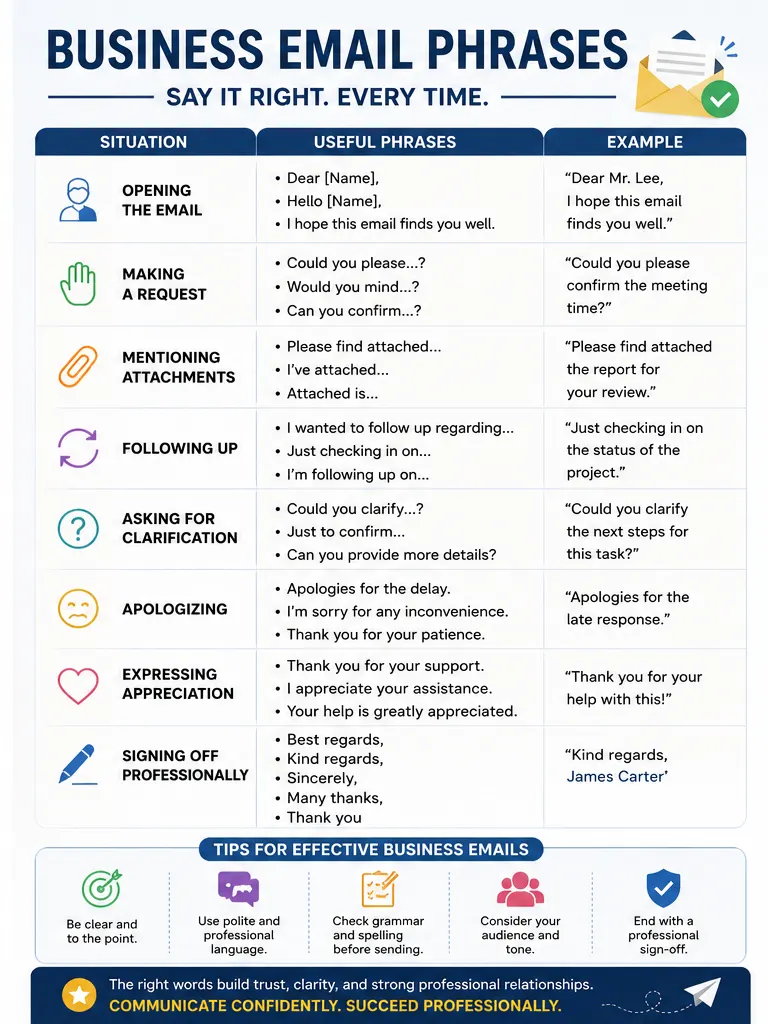
Business Email Communication Phrases to Avoid
Some phrases sound too direct or informal in workplace English.
| Avoid Using | Better Alternative |
|---|---|
| Send me this now | Could you send this when possible? |
| I need this ASAP | Could you prioritize this if possible? |
| What? | Could you clarify that point? |
| You are wrong | I think there may be a misunderstanding |
| Fix this | Could we review this together? |
Professional English sounds calm and solution-focused.
Tips for Better Business Emails
- keep emails short and clear
- use polite professional phrases
- avoid overly emotional wording
- check grammar before sending
- confirm details clearly
- use professional sign-offs
- keep the tone respectful
Clear communication is more important than complicated vocabulary.
Benefits of Learning Business Email Communication Phrases
When you learn professional business email communication phrases, you can:
- communicate more confidently
- improve workplace relationships
- sound more professional in English
- write clearer emails
- avoid misunderstandings
- improve business communication skills
Professional email communication is one of the most valuable workplace English skills.
Improve Workplace English with Learn Laugh Speak
At Learn Laugh Speak, adults learn practical English for real workplace situations.
That includes:
- business emails
- meetings
- presentations
- customer service
- workplace communication
- professional English phrases
Every student starts with a level assessment from A1 to C2.
From there, learners follow a personalized path based on their level, goals, and progress.
Learn Laugh Speak helps adults build real confidence using English at work.
Final Thought
Learning professional business email communication phrases helps you write emails that sound clear, respectful, and confident.
Simple phrases like:
- “Please find attached…”
- “I wanted to follow up regarding…”
- “Thank you for your support.”
- “Could you clarify…”
- “Best regards”
can make a big difference in workplace communication.
Because strong business English is not about using difficult words.
It is about communicating clearly and professionally.
One thought on “Your Go To Essential Business Email Communication Phrases”
Pingback: Subject Pronouns in English: Meaning, Examples and Usage - Learn Laugh Speak