
 English
 Arabic
 Chinese (Simplified)
 Dutch
Dutch French
 German
 Italian
 Portuguese
 Russian
 Spanish
This guide shows you how professionals interrupt politely in a meeting, using language that native speakers actually use at work.
Interrupting someone in a meeting is one of the hardest skills for adult English learners to master — not because of grammar, but because of fear.
Fear of:
sounding rude
sounding emotional
breaking hierarchy
interrupting at the “wrong” time
After working with thousands of adult professionals, one thing is clear: most people don’t struggle with English — they struggle with timing and tone.
10 Different Types of Working Meetings
Interrupt Politely in a Meeting & Why it Still Matters
In professional environments, silence is often misunderstood.
If you stay silent when:
instructions are unclear
deadlines are vague
responsibilities are confusing
you risk:
mistakes
missed expectations
unnecessary stress
Professionals interrupt not to challenge — but to clarify, align, and move forward.
Being able to interrupt politely shows:
confidence
engagement
professionalism
Not weakness.
Politely Apologize When You Can’t Make it to the Meeting
How Native Speakers Interrupt Politely (What Really Happens)
Native speakers rarely say:
“Excuse me, I am interrupting you now.”
Instead, they soften the interruption with structure, not emotion.
They:
Signal respect
Ask one clear question
Stop talking
This is the key difference adult learners often miss.
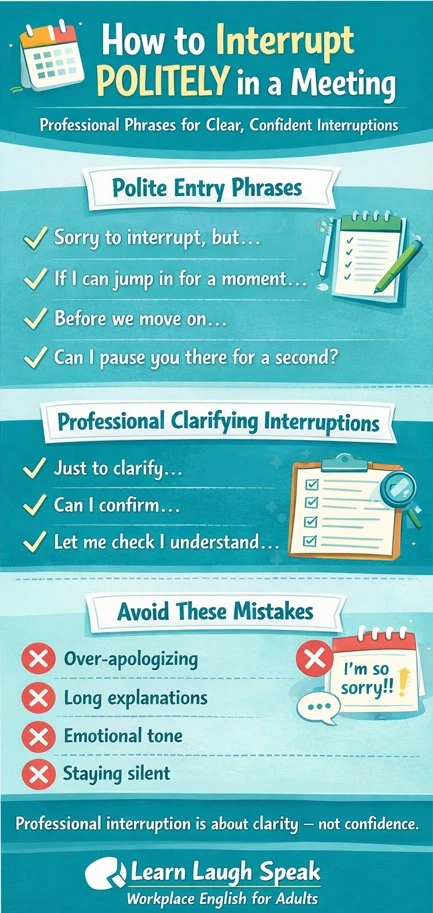
Polite Entry Phrases (Low Risk, High Professionalism)
These phrases gently signal that you’re about to speak:
“Sorry to interrupt, but may I clarify something?”
“If I can jump in for a moment…”
“Before we move on, could I ask one quick question?”
“Can I pause you there for a second?”
Why these work:
They respect the speaker
They sound natural in meetings
They give you permission to speak
💡 Tip: Say them calmly and don’t rush.
How to Ask for More Time in English Professionally
Neutral Professional Interruptions (Most Used at Work)
When meetings move quickly, professionals interrupt with neutral clarification phrases:
“Just to clarify…”
“Let me make sure I understand…”
“Can I confirm something?”
“One quick question on that point…”
These phrases:
are not emotional
don’t require an apology
sound confident without being aggressive
They are extremely common in business meetings.
Interrupting When You Are Confused (The Right Way)
Many adult learners wait too long when they are confused — then feel lost.
Instead, use:
“I may have missed something — could you repeat that?”
“Can you walk me through that again?”
“How does this affect our timeline?”
“What’s the next step after this?”
Professionals prefer early clarification over late mistakes.
Interrupting Senior Colleagues or Managers
This is where tone matters most.
Use:
“Just to confirm I’m aligned…”
“Before we move forward, could I clarify…”
“Can I check one detail to make sure I understood correctly?”
These phrases show:
respect
attention
responsibility
They are not rude — they are professional.
Common Mistakes Adult Learners Make
❌ Apologizing too much
❌ Asking very long questions
❌ Sounding emotional (“I’m worried that…”)
❌ Interrupting without a signal phrase
❌ Staying silent and guessing later
Professional English values clarity over politeness extremes.
Meeting Tips To Get You Working More Efficiently

Interrupt Politely in a Meeting: Our Method
We teach this simple structure:
Signal → Ask → Stop
Example:
“Just to clarify — who owns this task?”
That’s enough.
No long explanation.
No extra apologies.
No emotional language.
Interrupt Politely in a Meeting: Why it Works
This method is:
realistic for workplace meetings
easy to remember under pressure
used by native professionals
suitable for all industries
You don’t need advanced vocabulary.
You need repeatable structure.
Final Thought on How to Interrupt Politely in a Meeting
Interrupting politely is not about being perfect in English.
It’s about being clear, calm, and timely.
If you can interrupt well, you:
sound more professional
avoid misunderstandings
participate with confidence
And most importantly — you stop feeling invisible in meetings.
Still unsure on how to interrupt politely in a meeting? Send us a message or sign up below to learn English with us today.
