
 English
 Arabic
 Chinese (Simplified)
 Dutch
 French
 German
 Italian
 Portuguese
 Russian
 Spanish
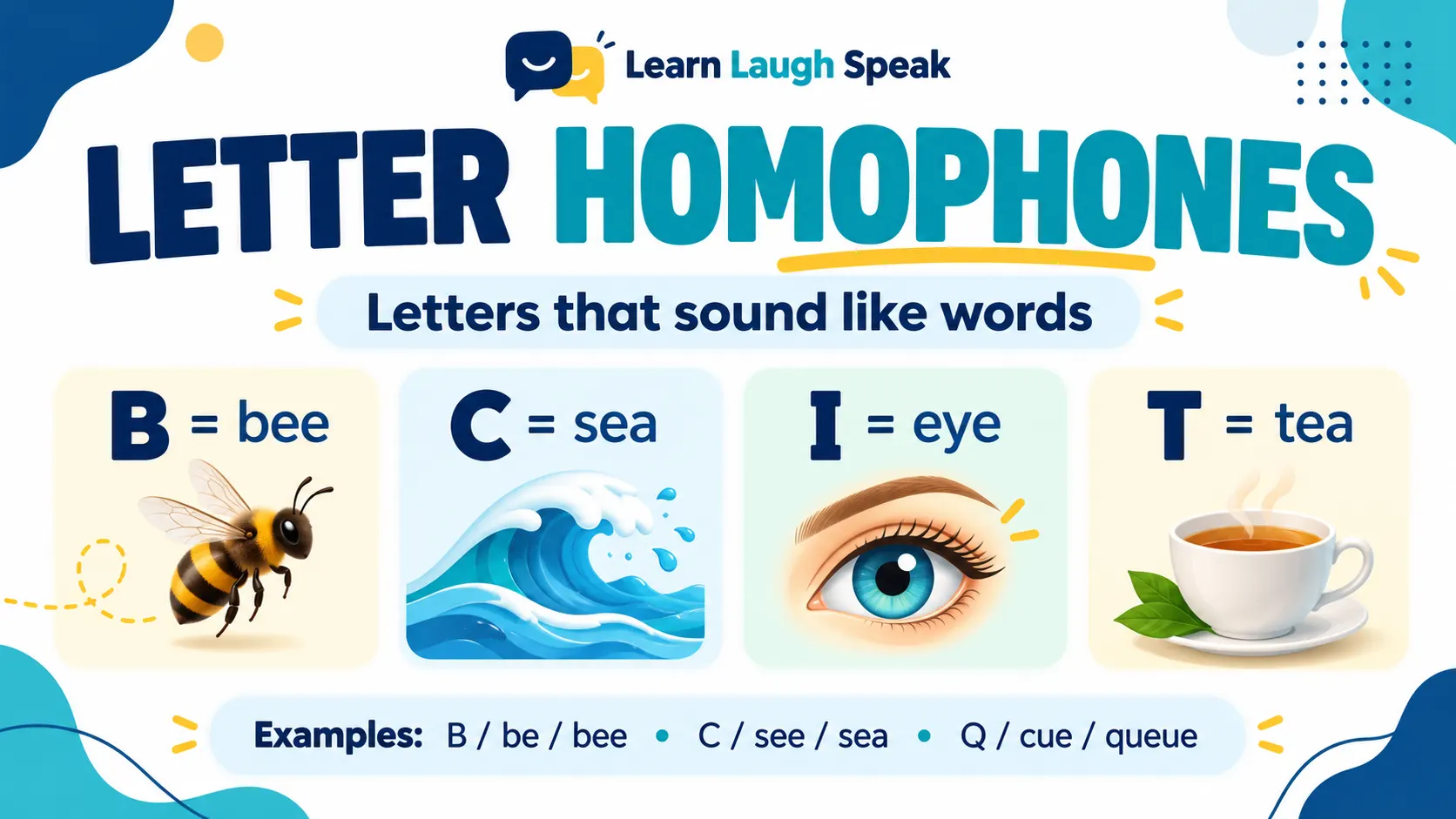
Some English letters sound exactly like complete English words.
The letter B sounds like be and bee.
C sounds like see and sea.
I sounds like eye.
Q sounds like cue and queue.
These are commonly called letter homophones.
Learning them can improve your English pronunciation, listening, spelling and vocabulary because the same sound can represent several completely different meanings.
But there is an important detail.
Not every list of letter homophones online is completely accurate.
A word containing the same sound as a letter is not necessarily a true homophone. For two forms to be homophones, the complete pronunciation should be the same.
In this guide, we will separate true letter homophones from words that simply contain similar sounds, explain their meanings and pronunciation, and give you examples you can actually remember.
Table of Contents
- Quick Answer: What Are Letter Homophones?
- What Is a Homophone?
- Common Letter Homophones in English
- Less Common Letter Homophones
- Complete Letter Homophones Chart
- Which Letters Do Not Have Common Homophones?
- Why Are Letter Homophones Difficult for English Learners?
- The Most Confusing Letter Homophones
- How to Practise Letter Homophones
- Letter Homophones Quiz
- Letter Homophones Practice for English Teachers
- Frequently Asked Questions About Letter Homophones
- Final Thoughts on Letter Homophones
Quick Answer: What Are Letter Homophones?
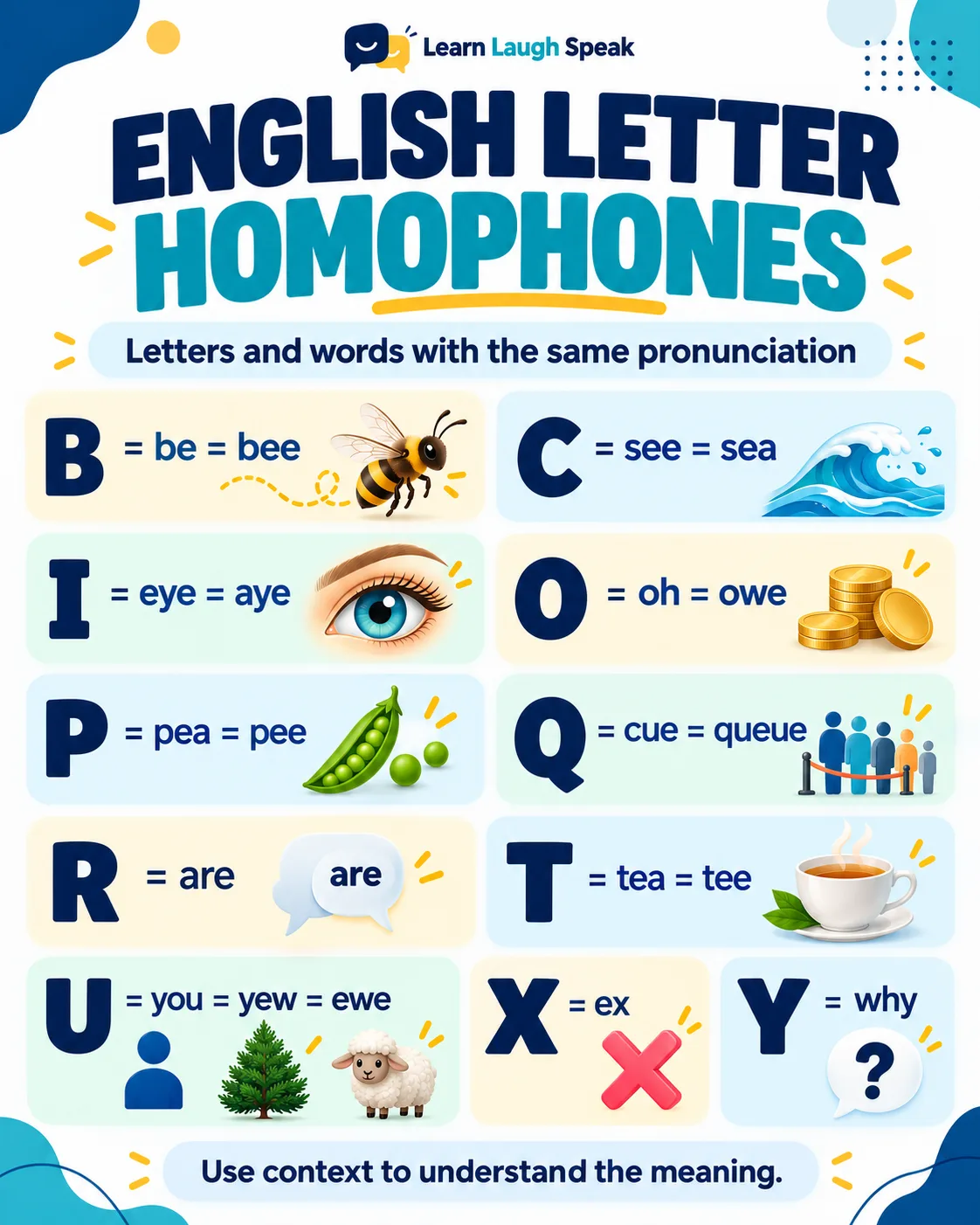
When people talk about letter homophones, they normally mean English letter names that sound exactly like independent English words.
Some of the clearest examples are:
| Letter | Homophones | Pronunciation |
|---|---|---|
| B | be, bee | /biː/ |
| C | see, sea | /siː/ |
| I | eye, aye | /aɪ/ |
| O | oh, owe | /oʊ/ |
| P | pea, pee | /piː/ |
| Q | cue, queue | /kjuː/ |
| R | are | /ɑːr/ |
| T | tea, tee | /tiː/ |
| U | you, yew, ewe | /juː/ |
| X | ex | /eks/ |
| Y | why | /waɪ/ |
There are also a few additional examples such as G/gee and J/jay, plus some much less common dictionary words that sound like L, M and N.
The important point is that not every letter has a useful everyday word homophone.
What Is a Homophone?
A homophone is a word that has the same pronunciation as another word but a different meaning, spelling, or both.
For example:
see = use your eyes
sea = a large area of salt water
They are spelled differently and have completely different meanings, but they sound the same.
You can check the formal definition and pronunciation examples in the Cambridge Dictionary definition of homophone.
English contains many confusing sound relationships like these.
We have discussed some of the reasons English can feel confusing in our Learn Laugh Speak guide Simple Steps to Stop Thoughts of “English Is Bad”, which also explains common problems with homophones.
Letter homophones are a particularly interesting example because a single letter name can sound exactly like a complete word.
Common Letter Homophones in English
These are the most useful letter homophones for English learners.
B, Be and Bee
The letter B is pronounced:
/biː/
Be is one of the most important verbs in English.
Examples:
“I want to be a teacher.”
“Please be careful.”
“It will be ready tomorrow.”
A bee is the flying insect that produces honey.
Example:
“There is a bee near the flowers.”
So:
B = be = bee
Try this sentence:
“There might be a bee beside the letter B.”
You can hear the same /biː/ sound three times, but each one has a different meaning.
C, See and Sea
This is probably the best-known example of letter homophones.
The letter C is pronounced:
/siː/
See means to use your eyes or notice something visually.
Example:
“I can see the hotel from here.”
The sea is a large area of salt water.
Example:
“We could see the sea from our room.”
So:
C = see = sea
Try saying:
“I can see the sea.”
The two words sound identical.
The meaning comes from the sentence and the spelling.
This is why context is so important when listening to English.
G and Gee
The letter G is pronounced:
/dʒiː/
The word gee has the same pronunciation.
Gee is an informal exclamation used to express surprise, enthusiasm or emphasis.
Example:
“Gee, that was fast!”
So:
G = gee
You will probably see gee much less frequently than words such as see, be or you, but it is still a genuine English word.
I, Eye and Aye
This group is particularly useful because all three have very different meanings.
I is the first-person subject pronoun.
Example:
“I speak English every day.”
An eye is the part of your body used for seeing.
Example:
“Something went into my eye.”
Aye means yes in certain contexts and varieties of English.
You may hear:
“Aye, that’s correct.”
It is also commonly used in voting and nautical language.
All three are pronounced:
/aɪ/
So:
I = eye = aye
Example:
“I hurt my eye.”
The first two words sound the same even though their spelling and meaning are completely different.
J and Jay
The letter J is pronounced:
/dʒeɪ/
A jay is a type of bird.
Example:
“We saw a blue jay in the tree.”
So:
J = jay
This is a good example of why spelling cannot always tell you how an English word will sound.
O, Oh and Owe
The letter O is commonly pronounced /oʊ/ in American English and /əʊ/ in standard British English.
Oh is an exclamation.
Examples:
“Oh, I understand now.”
“Oh no!”
Owe means that you need to give or repay something, usually money.
Example:
“I owe you ten dollars.”
So for speakers using these pronunciations:
O = oh = owe
Example:
“Oh, I owe you some money.”
The words oh and owe sound the same.
P, Pea and Pee
The letter P is pronounced:
/piː/
A pea is a small round green vegetable.
Example:
“There are peas in the soup.”
Pee is an informal English word meaning to urinate.
It is common in everyday spoken English but is informal.
So:
P = pea = pee
This is a good example of why learners need context.
Hearing /piː/ alone is not enough to know what someone means.
The sentence tells you.
Q, Cue and Queue
This is one of the most useful groups for English learners because cue and queue look completely different.
All three are pronounced:
/kjuː/
A cue is a signal telling someone that something should happen.
Example:
“That was my cue to start speaking.”
Cue can also mean the long stick used in games such as pool and snooker.
A queue is a line of people waiting for something.
Example:
“We waited in a queue for the tickets.”
In American English, people often simply say line.
So:
Q = cue = queue
Try:
“I joined the queue when I heard my cue.”
The words queue and cue sound identical even though their spelling and meanings are completely different.
R and Are
The letter R and the verb are have matching pronunciations within the same accent.
In American English, they are usually pronounced:
/ɑːr/
Are is a form of the verb be.
Examples:
“You are ready.”
“They are outside.”
“We are learning English.”
So:
R = are
Text messages sometimes take advantage of this:
How R U?
means:
How are you?
That is informal writing, not standard professional English, but it demonstrates how letter sounds can replace entire words.
T, Tea and Tee
All three are pronounced:
/tiː/
Tea is the drink.
Example:
“Would you like some tea?”
A tee can be the small object used to support a golf ball.
Example:
“He placed the golf ball on the tee.”
Tee can also refer to something shaped like the letter T.
So:
T = tea = tee
Example:
“He drank tea beside the first tee.”
U, You, Yew and Ewe
This is one of the best groups of letter homophones because four different spellings can share the same pronunciation:
/juː/
You is one of the most common pronouns in English.
Example:
“Are you ready?”
A yew is a type of tree.
Example:
“There is an old yew tree in the garden.”
A ewe is an adult female sheep.
Example:
“The farmer has one ewe and two lambs.”
So:
U = you = yew = ewe
Try:
“You can see a ewe near the yew tree.”
That sentence contains three words pronounced /juː/.
This type of sentence is extremely useful for pronunciation and listening practice.
X and Ex
The letter X is pronounced:
/eks/
The word ex has the same pronunciation.
An ex is a former romantic partner, spouse or sometimes another former relationship or role.
Example:
“I met my ex at the restaurant.”
So:
X = ex
The word is extremely common in informal modern English.
Y and Why
The letter Y is pronounced:
/waɪ/
Why is the question word used to ask for a reason.
Examples:
“Why are you late?”
“Why are you learning English?”
So:
Y = why
This is another reason letters frequently appear in informal messages.
Someone might write:
Y not?
to mean:
Why not?
Again, this is informal shorthand rather than standard written English.
Less Common Letter Homophones
Some letter names have homophones that are real English words but are much less useful in everyday conversation.
L and Ell
The letter L is pronounced:
/el/
Ell is an old unit of measurement.
It is a real English word, but most learners will almost never need to use it.
So:
L = ell
Technically useful, but practically uncommon.
M and Em
The letter M is pronounced:
/em/
An em is a unit used in typography and typesetting.
If you work in graphic design, publishing, websites or typography, you may see terms such as:
em space
or CSS measurements such as:
1em
So:
M = em
N and En
The letter N is pronounced:
/en/
An en is another typographic measurement and is commonly seen in the term:
en dash
So:
N = en
Again, this is technically a genuine example but far less useful in everyday conversation than B/be/bee or C/see/sea.
Complete Letter Homophones Chart
Here is the useful list in one place.
| Letter | Word Homophone(s) | Simple Meaning |
|---|---|---|
| B | be, bee | exist / insect |
| C | see, sea | look / ocean |
| G | gee | expression of surprise |
| I | eye, aye | body part / yes |
| J | jay | type of bird |
| O | oh, owe | exclamation / need to repay |
| P | pea, pee | vegetable / informal bodily action |
| Q | cue, queue | signal / line of people |
| R | are | form of be |
| T | tea, tee | drink / golf support |
| U | you, yew, ewe | pronoun / tree / female sheep |
| X | ex | former partner |
| Y | why | asks for a reason |
| L | ell | old measurement |
| M | em | typography measurement |
| N | en | typography measurement |
For most English learners, concentrate first on:
B, C, I, O, P, Q, R, T, U, X and Y.
Those are much more likely to appear in normal conversations, reading and writing.
Which Letters Do Not Have Common Homophones?
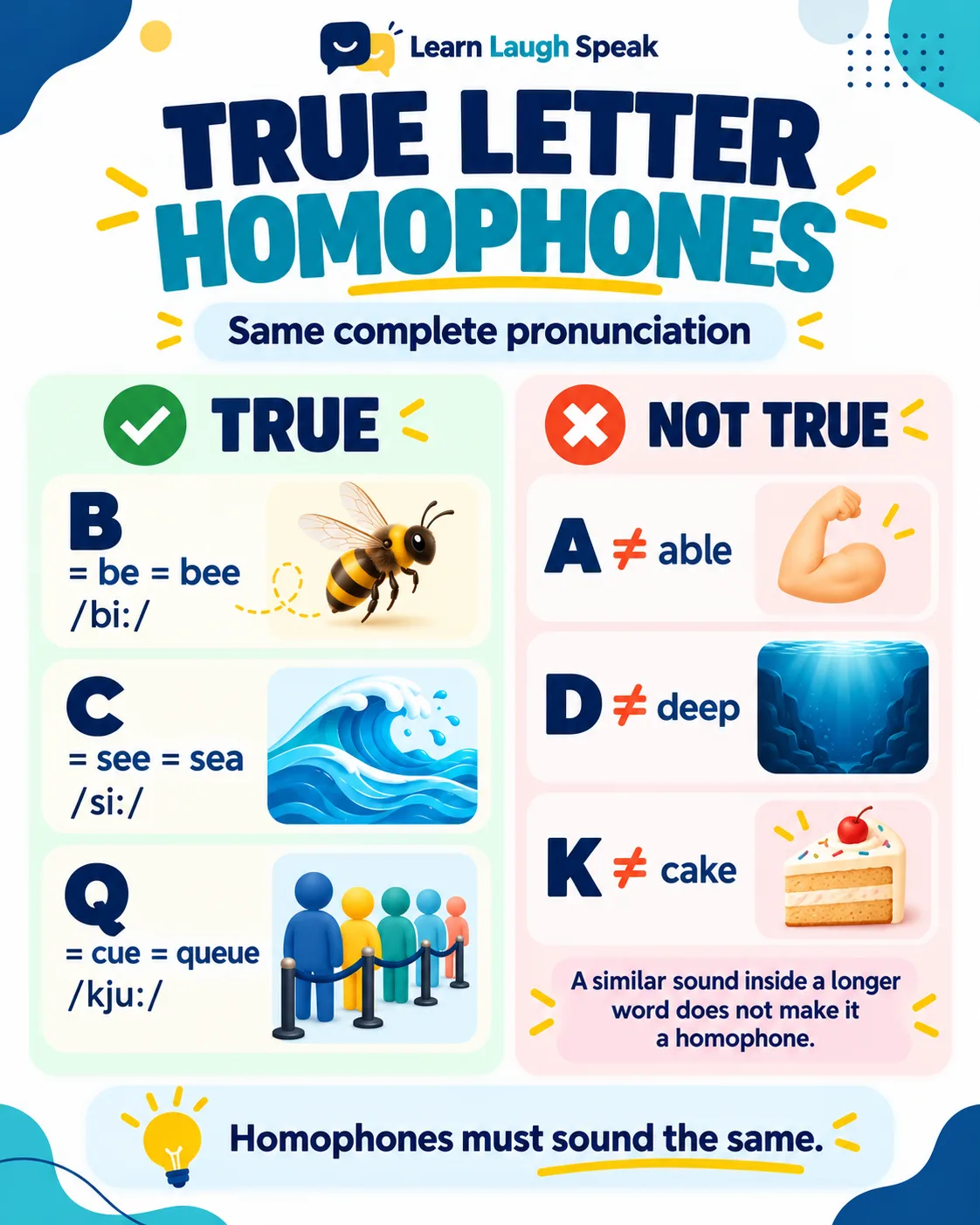
Not every English letter has a common independent word that sounds exactly the same.
This is where some online lists become confusing.
For example, someone may connect:
A → able
because able begins with the name of the letter A.
But:
A is pronounced /eɪ/
while:
able is pronounced /ˈeɪ.bəl/
They are not homophones.
One sound appears inside the longer word, but the complete pronunciations are different.
The same problem occurs with examples such as:
D → deep
F → free
K → cake
Those words may contain sounds associated with the letters, but they do not have exactly the same complete pronunciation.
That means they should not be treated as true letter homophones.
Is the Letter A a Homophone of the Word “A”?
This deserves a special explanation.
The letter name A is pronounced:
/eɪ/
The English article a, as in:
“I need a taxi.”
is usually pronounced with a weak sound:
/ə/
in normal connected speech.
However, the article can sometimes be pronounced /eɪ/ when it is stressed or spoken in isolation.
For that reason, A/a is not as clean and useful an example as B/be/bee or C/see/sea.
For English learners, it is better to remember that the article a normally has a weak pronunciation in everyday speech.
Letter Homophones vs Words That Contain the Letter Sound
This distinction is simple.
A true homophone has the same complete pronunciation.
For example:
B / be / bee
All are pronounced:
/biː/
But consider:
B / before
The word before begins with a similar sound, but the entire word does not sound like the letter B.
Therefore they are not homophones.
The same applies to:
A / able
D / deep
K / cake
The letter sound may appear somewhere inside the word, but that does not make the complete forms homophones.
Why Are Letter Homophones Difficult for English Learners?
The main problem is that listening gives you sound, not spelling.
Imagine someone says:
/siː/
Did they mean:
C
see
or:
sea?
You cannot know from the sound alone.
You need context.
Compare:
“Press C on the keyboard.”
“I can see the building.”
“The boat is on the sea.”
The pronunciation remains the same.
The surrounding words give you the meaning.
This is one reason learning pronunciation and vocabulary together is so important.
Our guide on how to pronounce words clearly and speak fluently in English explains practical ways to connect listening and speaking practice.
Pronunciation Can Change With Accent
English does not have one single accent.
A speaker from London, Sydney, New York, Texas, Dublin or Scotland may pronounce certain words differently.
That means two words can be perfect homophones in one accent but slightly different in another.
The common examples in this guide, including:
B / be / bee
C / see / sea
I / eye
Q / cue / queue
T / tea / tee
and:
U / you / yew / ewe
work across a very wide range of English accents.
Some pronunciation relationships, however, can vary.
The best approach is not to try to remove your own accent.
Learn to recognize common pronunciations and focus on speaking clearly.
If accents make listening difficult, see our guide to understanding different English accents and our practical guide on how to adjust your accent and speak more clearly.
You can also use the Cambridge English pronunciation dictionary to hear UK and US pronunciation examples.
Why Do People Write U Instead of “You”?
Letter homophones are frequently used in texting, advertising, song titles and informal messages.
For example:
U = you
R = are
B = be
C = see
Y = why
Someone might text:
C U later.
This means:
See you later.
Or:
R U coming?
means:
Are you coming?
And:
Y not?
means:
Why not?
These shortcuts work because the names of the letters sound like complete words.
However, avoid them in formal writing.
Do not write:
“R U available for the meeting?”
in a professional email.
Write:
“Are you available for the meeting?”
Understanding informal English is useful.
Knowing when not to use it is equally important.
Letter Homophones in Rebus Puzzles
Letter sounds are also common in rebus puzzles.
A rebus represents words or phrases using letters, numbers, symbols or pictures.
For example:
U R GR8
means:
You are great.
Or:
I C U
can be read:
I see you.
These puzzles depend on your ability to hear the name of the letter as a word.
That makes them a surprisingly useful pronunciation exercise for English learners.
The Most Confusing Letter Homophones
Some groups cause more problems than others.
C / See / Sea
Remember:
see = use your eyes
sea = large body of salt water
Practice:
“I can see the sea.”
Q / Cue / Queue
Remember:
cue = signal
queue = line of people
Practice:
“That was my cue to join the queue.”
U / You / Yew / Ewe
Remember:
you = person being spoken to
yew = tree
ewe = female sheep
Practice:
“You can see a ewe beside the yew tree.”
O / Oh / Owe
Remember:
oh = exclamation
owe = need to repay
Practice:
“Oh, I owe you twenty dollars.”
P / Pea / Pee
Remember:
pea = vegetable
pee = informal verb or noun
Practice:
“The child dropped a pea.”
These short sentences make the vocabulary easier to remember because you connect the sound with meaning.
Watch: Understanding English Pronunciation
English spelling and pronunciation do not always match. Watch this short Learn Laugh Speak lesson to see why English pronunciation can be confusing, then practise the letter homophones below.
How to Practise Letter Homophones
Do not simply read the chart.
Say the words aloud.
Start with:
B – be – bee
Repeat:
“B, be, bee.”
Then use a sentence:
“There will be a bee.”
Next:
C – see – sea
Say:
“I can see the sea.”
Then:
Q – cue – queue
Say:
“That was my cue to join the queue.”
The goal is to hear that the pronunciation remains the same while the spelling and meaning change.
Another useful exercise is to record yourself.
Say:
B – be – bee
Listen.
Do they sound identical?
Then repeat with:
C – see – sea
I – eye – aye
Q – cue – queue
T – tea – tee
U – you – yew – ewe
Recording yourself is also one of the techniques we recommend in our Learn Laugh Speak guide to clearer English pronunciation.
This would also be a good place to add a relevant Learn Laugh Speak YouTube video about pronunciation, grammar, listening or confusing English words.
Letter Homophones Quiz
Test yourself before checking the answers.
1. Which word sounds like the letter B?
A. bay
B. bee
C. buy
Answer: B — bee
2. Which two words sound like C?
A. see and sea
B. say and see
C. sea and say
Answer: A — see and sea
3. Which word sounds like I?
A. ear
B. eye
C. air
Answer: B — eye
4. Which two words sound like Q?
A. cue and queue
B. queen and cue
C. queue and quiet
Answer: A — cue and queue
5. Which group all has the same pronunciation?
A. T / tea / tee
B. T / tea / tie
C. T / tee / toy
Answer: A — T / tea / tee
6. Which three words sound like U?
A. you / yew / ewe
B. use / yew / ewe
C. you / your / yew
Answer: A — you / yew / ewe
7. Which word sounds like X?
A. axe
B. ex
C. eggs
Answer: B — ex
Eggs may sound similar when spoken quickly in some accents, but it is not normally an exact homophone of X.
8. Which word sounds like Y?
A. way
B. yes
C. why
Answer: C — why
9. Is A / able a true homophone pair?
No.
The letter A is /eɪ/, while able contains additional sounds.
10. Which sentence contains two homophones?
A. “I see the sea.”
B. “I like the beach.”
C. “The water is cold.”
Answer: A — see / sea
Letter Homophones Practice for English Teachers
Teachers can turn this topic into a simple listening activity.
Read one word aloud without showing students the spelling.
For example:
/siː/
Ask students to write as many possible meanings as they can.
Possible answers:
C
see
sea
Then try:
/kjuː/
Students could write:
Q
cue
queue
Next, put the words into sentences and ask students to identify the correct spelling.
For example:
“I waited in a ______ for twenty minutes.”
Answer:
queue
Or:
“That was my ______ to begin.”
Answer:
cue
Another option is to ask students to create one sentence containing two homophones.
For example:
“I can see the sea.”
This teaches listening, spelling, vocabulary and context at the same time.
Frequently Asked Questions About Letter Homophones
What are letter homophones?
Letter homophones are letter names that sound the same as independent English words.
Examples include B/be/bee, C/see/sea, I/eye, Q/cue/queue and T/tea/tee.
What letters sound like words?
Common examples include B, C, G, I, J, O, P, Q, R, T, U, X and Y.
There are also less common dictionary examples involving L, M and N.
Is B a homophone of bee?
Yes.
The letter B, the verb be and the noun bee are all pronounced /biː/.
Is C a homophone of sea?
Yes.
C, see and sea are pronounced /siː/.
Is Q a homophone?
Yes.
The letter Q sounds the same as both cue and queue.
All are pronounced /kjuː/.
Is U a homophone of you?
Yes.
U and you are both pronounced /juː/.
The words ewe and yew are also normally pronounced the same way.
Does every English letter have a homophone?
No.
Some letter names do not have a common independent English word with exactly the same pronunciation.
Be careful with lists that use longer words simply because they begin with a letter’s sound.
Is X pronounced like “eggs”?
Not exactly in standard pronunciation.
X is pronounced /eks/.
The word eggs may sound somewhat similar in rapid speech or particular accents, but it should not normally be taught as a true homophone.
The much clearer homophone is:
X = ex
Are letter homophones the same in British and American English?
Many common examples are the same, but accents can affect whether two particular words sound identical.
English pronunciation varies considerably between regions, so some marginal examples depend on the speaker.
Why are homophones difficult for English learners?
Because listeners hear pronunciation rather than spelling.
If you hear /siː/, context must tell you whether someone means C, see or sea.
That is why practising homophones inside complete sentences is more useful than memorizing word pairs alone.
Final Thoughts on Letter Homophones
Letter homophones show one of the most interesting things about English:
the same sound can carry several completely different meanings.
Start with the easiest groups:
B → be → bee
C → see → sea
I → eye
Q → cue → queue
T → tea → tee
U → you → yew → ewe
Then add:
O → oh → owe
P → pea → pee
R → are
X → ex
Y → why
Do not worry about memorizing every unusual dictionary example.
The goal is to recognize the common letter homophones when you hear them and use context to understand which meaning is correct.
When you hear:
/siː/
ask yourself:
Is it C, see or sea?
When you hear:
/kjuː/
is it Q, cue or queue?
And when you hear:
/juː/
is it U, you, yew or ewe?
Once you begin noticing these patterns, English listening becomes easier.
More importantly, you stop trying to understand English only through spelling and begin hearing the language as it is actually spoken.