
 English
 Arabic
 Chinese (Simplified)
 Dutch
Dutch French
 German
 Italian
 Portuguese
 Russian
 Spanish
Language used in Memes is often short, informal, funny, exaggerated, sarcastic, and full of slang. To understand memes in English, you need more than vocabulary. You need to understand tone, context, culture, irony, and why the image and words work together.
Memes are everywhere online. You see them on Instagram, TikTok, X, Reddit, WhatsApp, Facebook, LinkedIn, and even in workplace group chats.
Sometimes they are simple and easy to understand. Other times, they feel confusing, even for strong English learners. You may understand every word in the meme but still not understand the joke.
That is because memes do not work like normal English sentences.
A meme often depends on:
- slang
- sarcasm
- exaggeration
- cultural references
- informal grammar
- shared experiences
- facial expressions
- images
- tone
- timing
For English learners, memes can be both useful and confusing. They show how people really use English online, but they also break grammar rules, use strange phrases, and depend heavily on context.
This article explains the language used in memes, why it sounds different from formal English, and how learners can understand meme language without copying it in the wrong situation.
Now, lets dive in and check out how we can understand the language used in Memes easier and quicker.
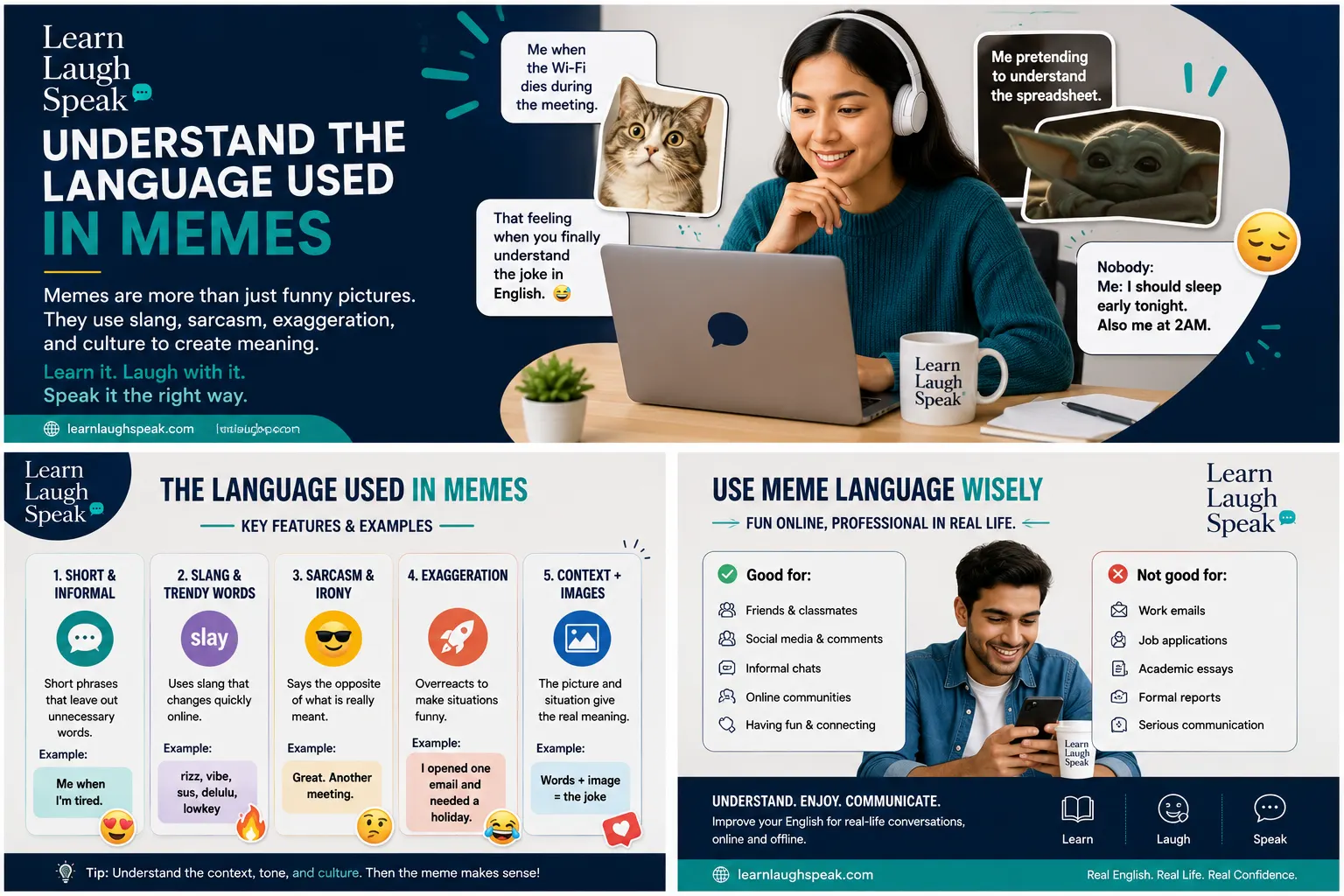
Language Used in Memes Why it Differs
Normal English is usually written to be clear.
Meme English is often written to be funny, fast, emotional, or exaggerated.
A normal sentence might say:
“I am very tired today.”
A meme might say:
“Me trying to function after 3 hours of sleep.”
The meaning is similar, but the style is different.
The meme version is more casual. It sounds like someone is joking about a shared experience. It also creates a picture in your mind.
Meme language often feels unfinished, dramatic, or grammatically strange on purpose.
For example:
“Me when the meeting could have been an email.”
This is not a full formal sentence, but most people understand it. It means:
“This is how I feel when I am in a meeting that was unnecessary.”
The grammar is not the important part. The feeling is.
What Makes the Language Used in Memes Hard to Understand?
Many English learners feel frustrated by memes because they are not built like textbook English.
Here are the main reasons.
1. Memes use short phrases
Memes often leave out words.
Example:
“Me after one email.”
Full meaning:
“This is how I feel after sending or receiving only one email.”
The meme expects you to understand the missing meaning.
2. Memes use slang
Words like rizz, delulu, lowkey, vibe, sus, slay, and main character energy can appear in memes.
Some slang becomes popular for a short time, then disappears. Other slang stays longer and becomes part of wider informal English.
3. Memes use sarcasm
Sarcasm means the words say one thing, but the real meaning is different.
Example:
“Great. Another meeting.”
This may not mean the person is happy. It may mean they are annoyed.
4. Memes depend on images
The words alone may not be enough. The image gives the emotion.
A serious-looking face with funny text can create contrast. A confused face can show that the speaker does not understand something. A tired face can make the sentence funnier.
5. Memes rely on shared experience
Many memes are funny because people recognize the situation.
Example:
“When you say ‘quick question’ and the meeting lasts 45 minutes.”
This is funny for people who have experienced long work conversations that started casually.
Common Types of Meme Language
Meme language has patterns. Once you learn the patterns, memes become easier to understand.
1. “Me when…” Memes
This is one of the most common meme structures.
Example:
“Me when I finally understand the grammar rule.”
Meaning:
“This is how I react when I finally understand the grammar rule.”
The image usually shows a strong emotion, such as happiness, shock, relief, or confusion.
More examples:
“Me when the Wi-Fi stops working during class.”
“Me when I remember the word after the conversation ends.”
“Me when the teacher says there is no homework.”
This structure is useful because it connects a situation with an emotional reaction.
2. “That feeling when…” Memes
This phrase introduces a relatable moment.
Example:
“That feeling when you understand a joke in English without translating.”
Meaning:
“This is the feeling you have when you understand the joke naturally.”
This style is often used for small wins, awkward moments, or everyday frustrations.
Examples:
“That feeling when you send the email and immediately see a mistake.”
“That feeling when someone speaks too fast and you just smile.”
“That feeling when you finally pronounce a difficult word correctly.”
3. “Nobody:” Memes
This meme format is confusing at first.
Example:
“Nobody:
Me: I should reorganize my entire desk at midnight.”
The meaning is:
“No one asked me to do this, but I am doing it anyway.”
The “Nobody:” line means there was no reason or pressure. The second line shows a sudden or unnecessary action.
Another example:
“Nobody:
English spelling: Let’s make this word impossible to pronounce.”
This makes fun of English spelling.
4. Overdramatic Meme Language
Memes often exaggerate.
A normal sentence:
“I was embarrassed.”
Meme version:
“I will now think about this moment for the next seven years.”
This does not literally mean seven years. It means the person feels very embarrassed and will remember the moment for a long time.
More examples:
“I opened one email and needed a holiday.”
“This sentence aged me five years.”
“My brain left the meeting after minute three.”
Exaggeration makes the situation funnier.
5. Lowercase and No Punctuation
Many memes use lowercase letters and no punctuation to sound casual, tired, awkward, or emotionally flat.
Example:
“i am once again asking for a clear explanation”
This style can make the meme sound informal or dramatic in a quiet way.
Another example:
“just trying to understand native speakers at full speed”
This is not formal writing, but it creates a casual internet tone.
English learners should understand this style, but avoid using it in professional emails.
6. Intentional Bad Grammar
Some meme language uses incorrect grammar on purpose.
Example:
“I can has coffee?”
This style comes from older internet humour where grammar mistakes became part of the joke.
Another example:
“Why English do this?”
A correct version would be:
“Why does English do this?”
But the incorrect version sounds funnier because it expresses frustration in a simple, exaggerated way.
Important note: do not copy incorrect meme grammar in formal writing. Understand it as humour.
7. Reaction Words and Internet Slang
Memes often use short reaction words.
| Meme word or phrase | Simple meaning |
|---|---|
| LOL | laughing out loud |
| LMAO | laughing a lot |
| bruh | surprise, frustration, disbelief |
| mood | I relate to this |
| relatable | I understand this feeling |
| same | I feel the same way |
| sus | suspicious |
| lowkey | a little, secretly, quietly |
| highkey | very clearly, strongly |
| vibe | feeling, atmosphere, energy |
| slay | do something very well |
| delulu | jokingly unrealistic or delusional |
| rizz | charm or flirting confidence |
| main character energy | acting confident like the main person in a story |
These words are informal. Some are common. Some are trendy. Some may become old quickly.
8. Meme Phrases Used in Work Situations
Meme language also appears in workplace humour.
Examples:
“This meeting could have been an email.”
Meaning: The meeting was unnecessary.
“Me pretending to understand the spreadsheet.”
Meaning: The person is joking that they are confused.
“When the client says ‘small change’ and it changes the whole project.”
Meaning: Small client requests are sometimes not small.
“POV: You opened your inbox after one day off.”
Meaning: The inbox is full, and the person feels overwhelmed.
“My brain during the 4 p.m. meeting.”
Meaning: The person is tired and cannot focus.
These memes are funny because many workers understand the feeling.

What Does “POV” Mean in Memes?
POV means point of view.
In memes, it usually means:
“Imagine you are in this situation.”
Example:
“POV: You are trying to speak English and someone uses five idioms in one sentence.”
This means:
“Imagine you are in this situation. Someone is speaking English with many idioms, and you feel confused.”
POV memes are popular because they put the reader inside the moment.
Why Memes Are Useful for English Learners
Memes can help English learners understand real informal English.
They can teach:
- slang
- humour
- tone
- everyday reactions
- cultural references
- short informal phrases
- common frustrations
- online communication style
Memes also show how English changes. Internet language moves quickly, and memes often spread new words faster than formal media.
However, memes should be used carefully. They are useful for understanding informal culture, but they are not always good examples for professional English.
Language Used in Memes And What to Lookout For
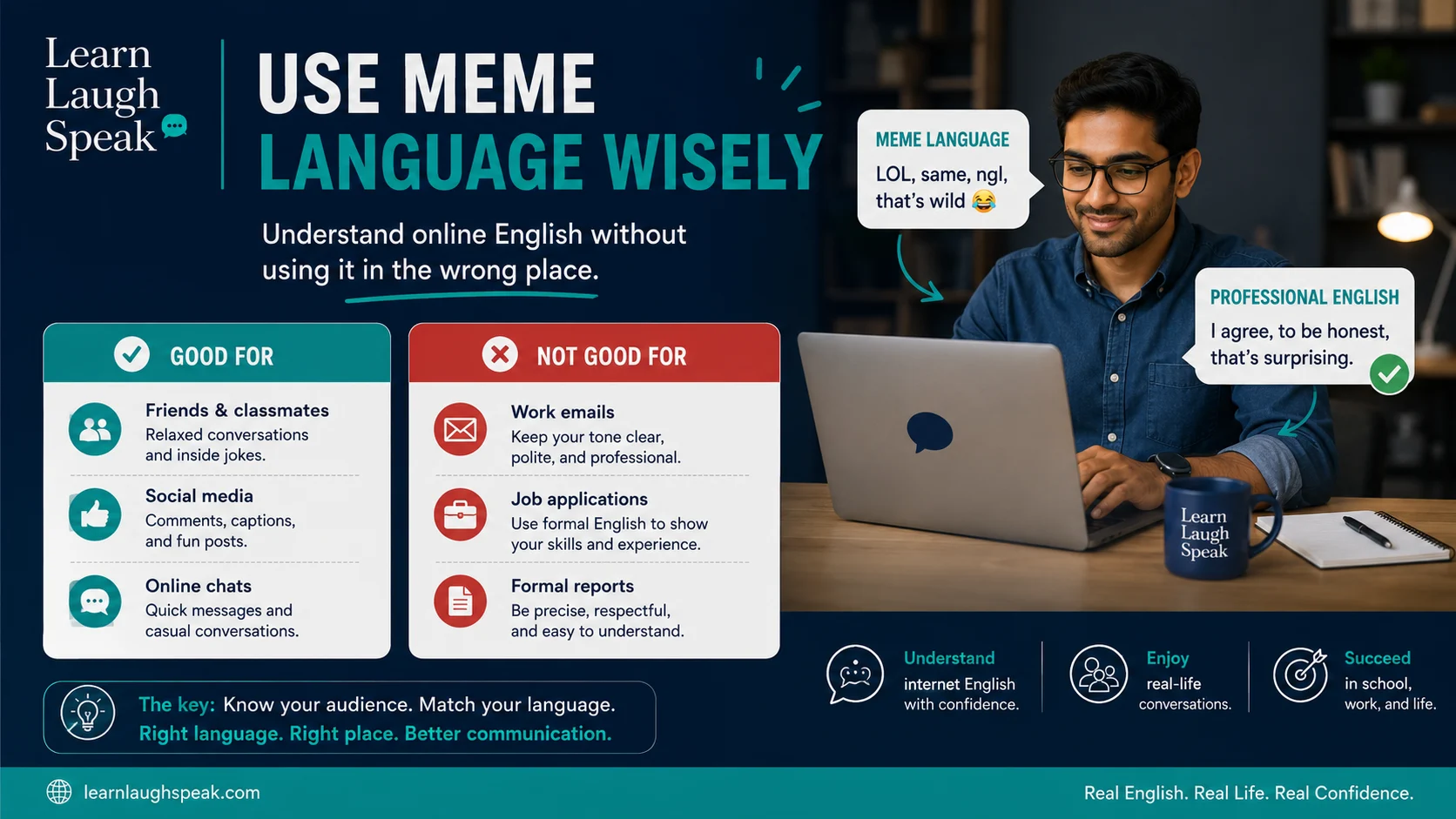
Meme language can be fun, but it is easy to use it in the wrong place.
Do not use meme language in:
- formal emails
- job applications
- academic essays
- serious customer complaints
- legal or medical communication
- professional reports
- first messages to clients
For example, do not write this in a work email:
“Me when the deadline changes again lol.”
Instead, write:
“I noticed the deadline has changed. Could you please confirm the new timeline?”
Meme language belongs in informal spaces.
Meme English vs Professional English
| Meme English | Professional English |
| This meeting could have been an email. | I think this topic could be handled by email. |
| Me trying to understand this report. | I need a little more time to review this report. |
| Lowkey confused. | I am not fully clear on this point yet. |
| My brain has left the chat. | I may need a short break before continuing. |
| That deadline is not it. | That deadline may be difficult to meet. |
| POV: too many tasks. | I am currently managing several priorities. |
| I am once again asking for clear instructions. | Could you please clarify the instructions? |
This table is useful because it shows how to understand memes without copying them into formal situations.
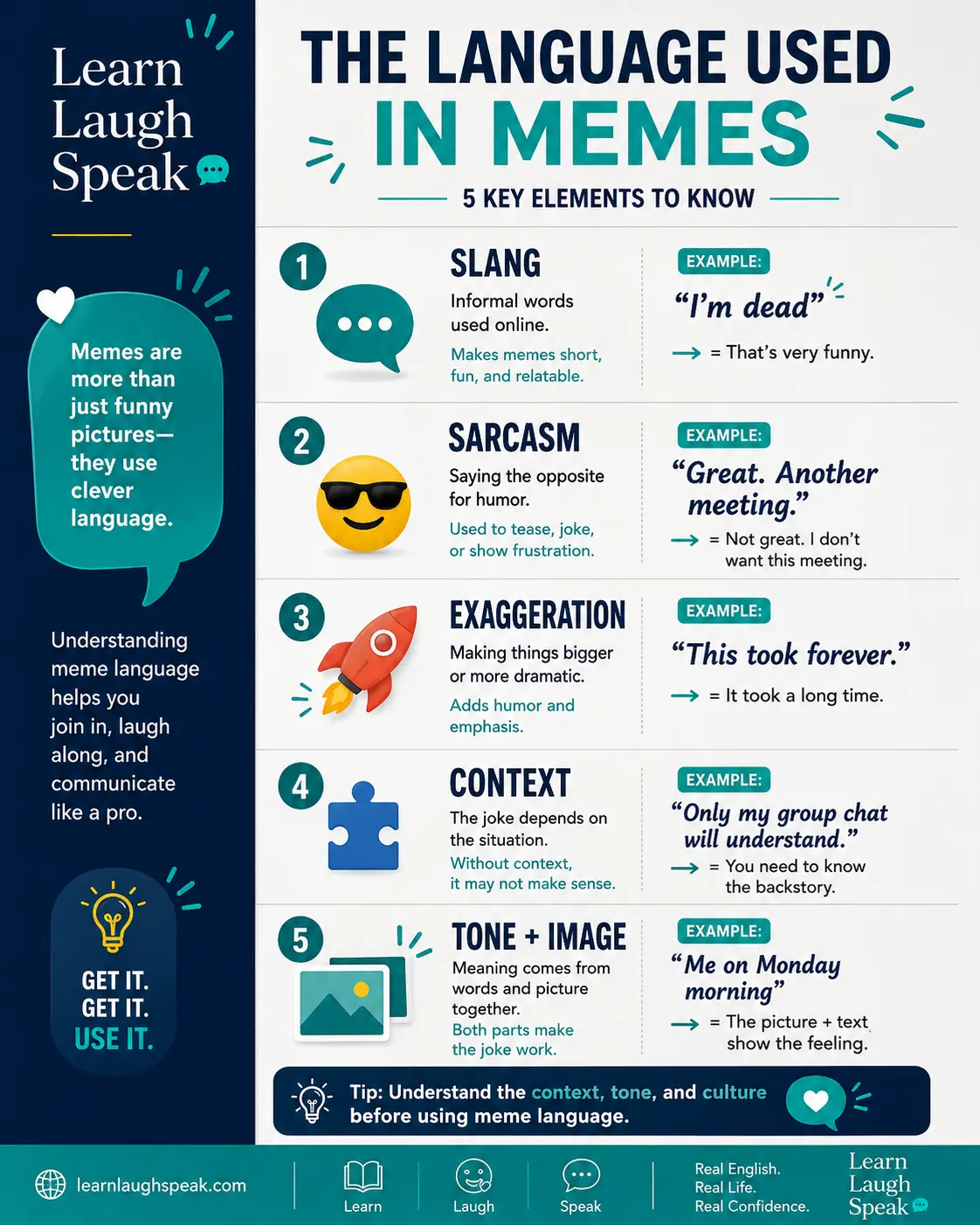
Language Used in Memes & How to Understand
When you see a meme you do not understand, do not translate word by word immediately.
Use this process.
Step 1: Look at the image
Ask:
What emotion does the image show?
Is the person tired, confused, excited, angry, embarrassed, or proud?
Step 2: Identify the situation
Ask:
What is happening?
Is it about work, school, relationships, money, English learning, stress, or technology?
Step 3: Look for slang
Ask:
Are there informal words I need to check?
Words like sus, vibe, delulu, or rizz may carry the joke.
Step 4: Check if it is sarcastic
Ask:
Does the writer really mean this, or are they joking?
For example:
“Love when my laptop crashes before a meeting.”
They do not love it. They are being sarcastic.
Step 5: Find the shared experience
Ask:
Why would many people relate to this?
Most memes are funny because they describe a feeling many people recognize.
Example: Breaking Down a Meme
Meme text:
“Me when I understand every word but not the joke.”
Simple meaning
The person understands the vocabulary, but they do not understand why it is funny.
Why it works
Many English learners experience this. Knowing words is not the same as understanding humour, tone, or cultural context.
Useful lesson
Language learning is not only grammar and vocabulary. It also includes culture and context.
Common Words & Language Used in Memes
Here are useful words connected to memes.
| Word | Meaning |
| meme | a funny or meaningful image, video, phrase, or idea shared online |
| template | the repeated image or format used for different jokes |
| caption | the text added to an image or video |
| reaction meme | a meme used to show an emotion or response |
| viral | spreading quickly online |
| trend | something popular for a short time |
| context | the situation that helps explain meaning |
| irony | when the real meaning is different from the literal meaning |
| sarcasm | saying the opposite of what you mean, often humorously |
| relatable | easy to understand because you have felt the same thing |
| captioned image | an image with text added |
| inside joke | a joke understood by a specific group |
Useful English Phrases for Talking About Memes
Here are phrases English learners can use.
“I understand the words, but I don’t understand the joke.”
“What does this meme mean?”
“Is this phrase slang?”
“Is this sarcastic?”
“Why is this funny?”
“I think the joke is about work stress.”
“This meme is very relatable.”
“I would not use this phrase in a professional email.”
“This sounds informal.”
“This phrase is common online, but not in formal English.”
These phrases help you ask questions naturally.
Should English Learners Use Meme Language?
Yes, but carefully.
You can use meme language with:
- friends
- close classmates
- informal chats
- social media comments
- casual online communities
Be careful using it with:
- managers
- clients
- teachers
- new colleagues
- formal groups
- professional emails
The best approach is:
Understand meme language first. Use it only when the situation feels casual and safe.
Practice Activity: Language Used in Memes Translate to Pro English
Rewrite these meme-style sentences into professional English.
1. Meme English
“Me trying to understand this email.”
Professional English:
“I need a little more clarification on this email.”
2. Meme English
“This deadline is not it.”
Professional English:
“This deadline may be difficult to meet.”
3. Meme English
“Lowkey confused about the next step.”
Professional English:
“I am not fully clear on the next step.”
4. Meme English
“My brain after three meetings.”
Professional English:
“I may need a short break before the next meeting.”
5. Meme English
“POV: the instructions changed again.”
Professional English:
“It looks like the instructions have changed again. Could you please confirm the latest version?”
Mini Quiz: Do You Understand Meme Language?
Choose the best meaning.
1. “That meeting could have been an email.”
A. The person loves meetings.
B. The person thinks the meeting was unnecessary.
C. The person wants more meetings.
Answer: B
2. “Lowkey stressed.”
A. A little stressed, quietly or secretly.
B. Very relaxed.
C. Angry at everyone.
Answer: A
3. “Me when the Wi-Fi stops during class.”
A. The person is describing a reaction.
B. The person is asking for Wi-Fi advice.
C. The person is writing a formal complaint.
Answer: A
4. “This is so relatable.”
A. I understand this feeling.
B. I disagree completely.
C. I do not know what this means.
Answer: A
5. “POV: You forgot your homework.”
A. Imagine you are in this situation.
B. This is a formal report.
C. This is a dictionary definition.
Answer: A
Language Used in Memes With Learn Laugh Speak
Learn Laugh Speak helps adult English learners understand English for real life, work, and daily communication.
The language used in memes is part of modern English because people communicate online every day. Memes can help learners notice humour, slang, tone, and informal phrases that do not always appear in textbooks.
But English learners also need to know when meme language is appropriate and when professional English is better.
With Learn Laugh Speak, students practise reading, writing, speaking, listening, vocabulary, grammar, and pronunciation at the right level. This helps learners build the confidence to understand real English in different situations, from work emails to online conversations.
The goal is not only to understand English words.
The goal is to understand how English is really used.
FAQs About Language Used in Memes
What is the language used in memes?
The language used in memes is usually informal, short, funny, emotional, and full of slang, sarcasm, exaggeration, and cultural references.
Why are memes hard to understand in English?
Memes are hard to understand because the joke often depends on context, image, tone, slang, and shared experience, not only the words.
Are memes good for learning English?
Yes, memes can help English learners understand informal English, humour, online culture, and slang. However, they should not replace structured English learning.
Should I use meme language at work?
Usually no, unless the workplace is very casual and you know the people well. For professional communication, use clear and polite English instead.
What does “POV” mean in memes?
POV means point of view. In memes, it usually means “imagine you are in this situation.”
What does “relatable” mean?
Relatable means easy to understand because you have felt the same thing or experienced a similar situation.
What does “lowkey” mean?
Lowkey means a little, quietly, secretly, or not too strongly. For example, “I’m lowkey nervous” means “I am a little nervous.”
Why do memes use bad grammar?
Some memes use bad grammar on purpose to sound funny, dramatic, casual, or exaggerated.
Final Thoughts on Language Used in Memes
The language used in Memes can be funny, confusing, creative, and very different from formal English.
For English learners, memes are useful because they show how people communicate online. They teach slang, humour, tone, and culture. They also show that understanding English is not only about knowing vocabulary. It is also about understanding context.
But meme English is not always professional English.
Use memes to learn, laugh, and notice how language changes. Then choose the right English for the right situation.
That is how you build real confidence in modern communication.