
 English
 Arabic
 Chinese (Simplified)
 Dutch
Dutch French
 German
 Italian
 Portuguese
 Russian
 Spanish
Professional Story Telling is used to explain ideas, build trust, lead teams, sell products, teach lessons, and make business communication clearer. Personal Story telling is used to share experiences, connect with people, show emotion, and make your message feel more human. Both are useful, but they should be used differently depending on the audience, purpose, and situation.
Some people think storytelling only belongs in books, movies, or speeches. But stories are part of everyday communication.
You use stories when you explain why a project failed. You use stories when you describe how you solved a customer problem. You use stories when you tell a colleague what happened in a meeting. You use stories when you share a mistake, a lesson, or a moment that changed how you think.
For English learners, storytelling is especially useful because it helps you speak in a more natural way. Instead of only memorizing phrases, you learn how to connect ideas, explain context, and guide the listener from one point to the next.
But not every story belongs in every situation.
A story you tell to a friend is different from a story you tell to a manager, client, interviewer, or investor. This is why it is useful to understand the difference between Professional Story Telling and Personal Story telling.
One helps people understand your work. The other helps people understand you.
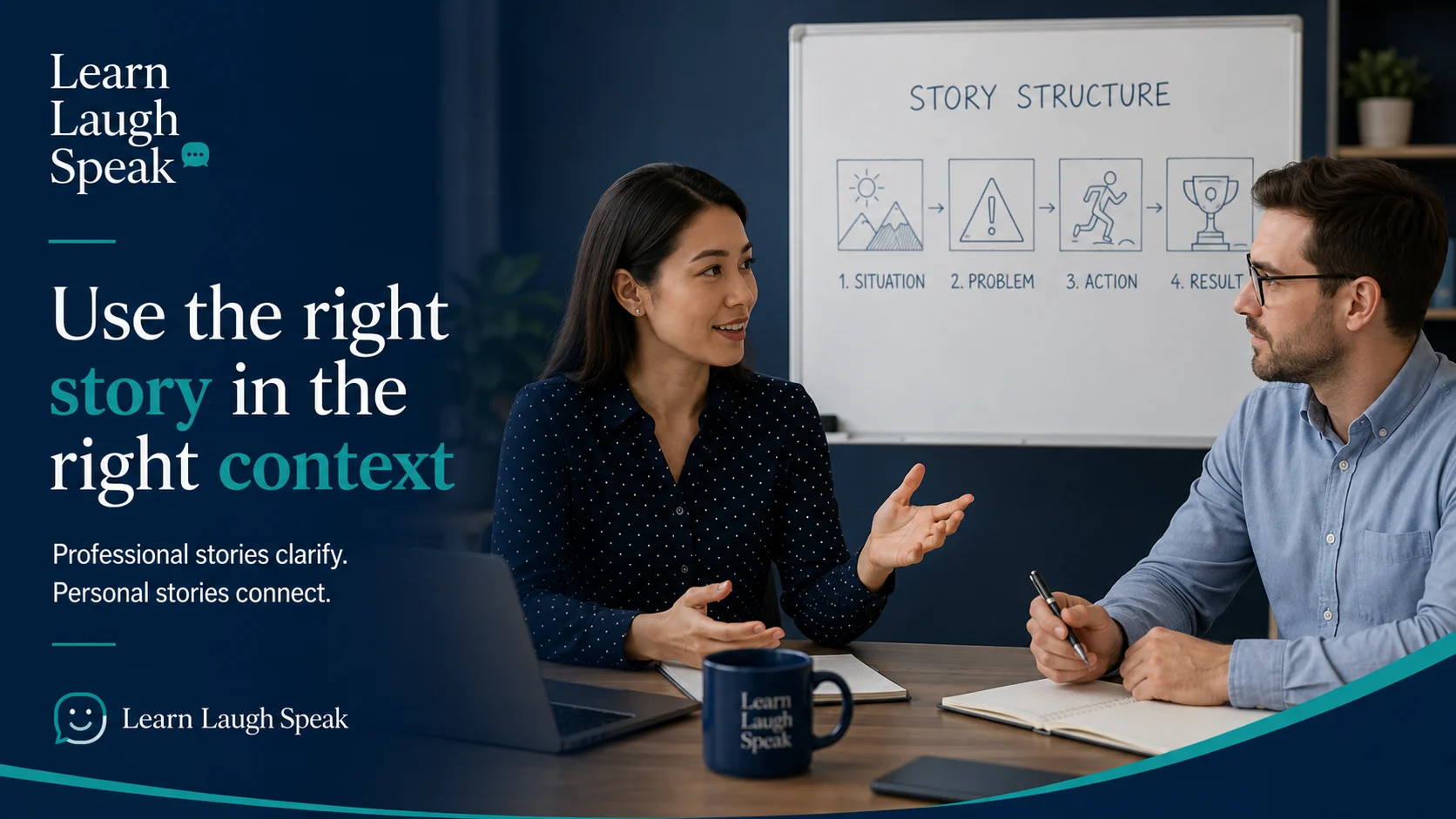
What Is Professional Story Telling?
Professional Story Telling means using a clear, structured story in a work or business situation.
The goal is not to entertain people for no reason. The goal is to help them understand something important.
You may use professional stories when you:
- explain a business idea
- present a product
- share a customer example
- lead a meeting
- train a team
- answer an interview question
- explain a mistake and what changed
- persuade someone to support a decision
- describe a result
- make a complex topic easier to follow
A professional story usually has a clear purpose.
For example:
“A customer was struggling with onboarding. They were confused, using only one feature, and close to cancelling. We changed the training process, gave them a simpler first-week plan, and within a month their team was using the product confidently.”
That is a professional story.
It has a problem, action, and result.
It is not too emotional. It is not too long. It helps the listener understand the value of the work.
What Is Personal Story telling?
Personal Story telling means sharing a story from your own life, feelings, background, mistakes, challenges, or growth.
The goal is usually connection.
You may use personal stories when you want to:
- introduce yourself
- explain what motivates you
- share a lesson you learned
- build trust
- show vulnerability
- connect with a team
- make a speech feel more human
- describe your journey
- explain why something matters to you
For example:
“When I first started learning English, I avoided meetings because I was afraid of making mistakes. One day, my manager asked me a simple question and I froze. That moment made me realize I needed to practise speaking, not just grammar.”
That is a personal story.
It shows a real experience. It helps people understand the speaker. It creates empathy.
The Main Difference Between Professional and Personal Stories
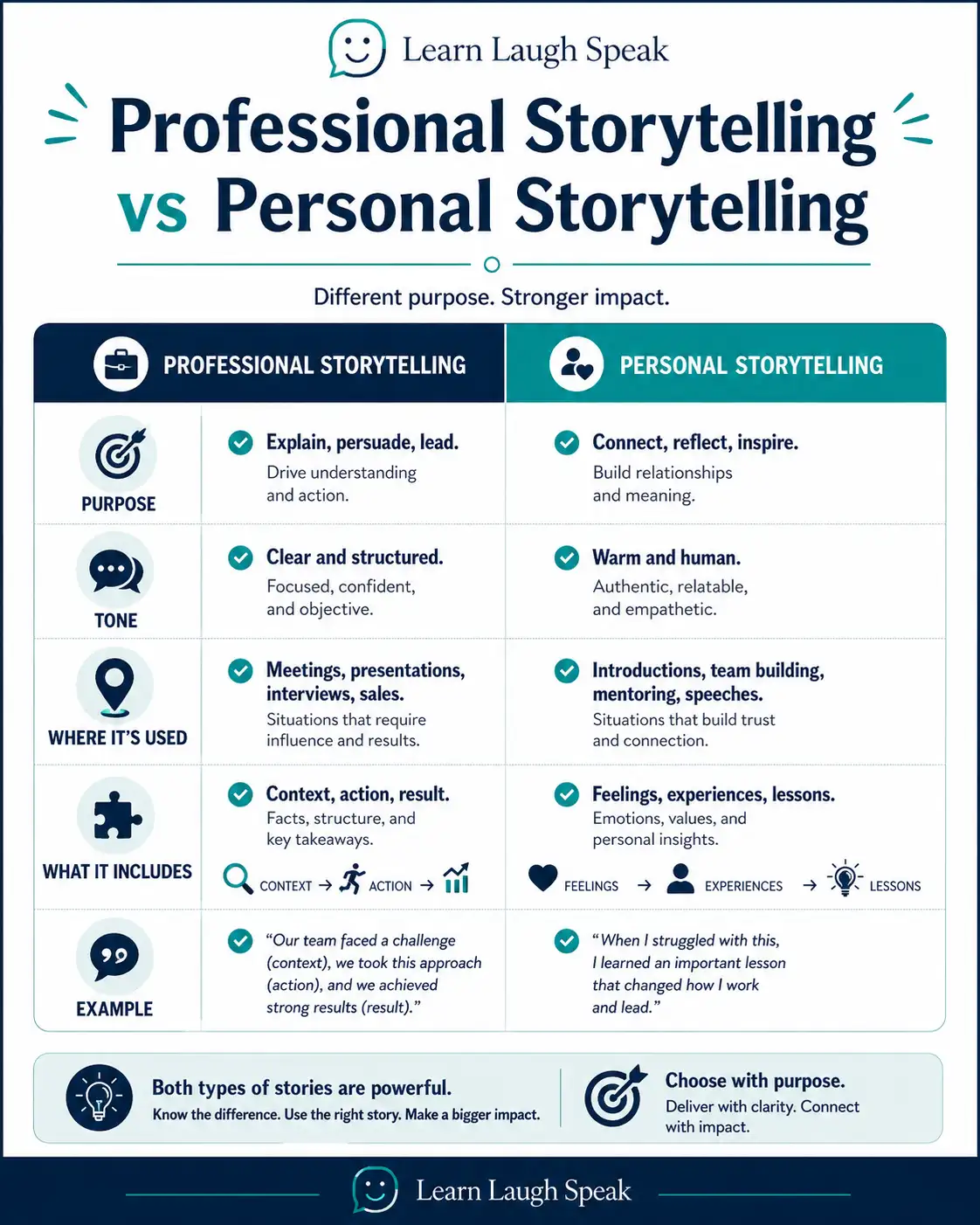
The biggest difference is the purpose.
Professional stories are usually about the work.
Personal stories are usually about the person.
That does not mean professional stories cannot feel human. They should. And it does not mean personal stories cannot teach a professional lesson. They often do.
But the focus is different.
| Type of story | Main purpose | Best used for |
|---|---|---|
| Professional Story Telling | Explain, teach, persuade, lead, or clarify | Meetings, sales, interviews, presentations, training |
| Personal Story telling | Connect, reflect, inspire, or show experience | Introductions, speeches, leadership, personal branding |
A simple way to remember it:
Professional stories help people understand your idea.
Personal stories help people understand your experience.
Why This Difference Matters in English
English learners often know the facts they want to explain, but they may not know how to organize them into a clear story.
This can make communication sound flat or confusing.
For example, a learner might say:
“The project was difficult. The client was not happy. We changed many things. Now it is better.”
This is understandable, but it does not guide the listener.
A stronger version would be:
“At first, the client was unhappy because the project updates were not clear. We changed the process by sending a short summary every Friday. After three weeks, the client said they felt more informed and the project became easier to manage.”
Now the story is clearer.
It has:
- a situation
- a problem
- an action
- a result
This is the heart of good Professional Story Telling.
When to Use Professional Story Telling at Work
Professional stories are useful when facts alone are not enough.
A number may show progress, but a story explains what changed. A report may show results, but a story helps people understand why the results matter.
Use professional storytelling in situations like these.
1. In meetings
Instead of saying:
“The new process is better.”
Say:
“Before we changed the process, the team was spending too much time answering the same customer questions. After we added a weekly FAQ update, those questions dropped and the team had more time for complex support issues.”
This gives people a reason to care.
2. In sales calls
Instead of listing features, tell a simple customer story.
“One client came to us because their team was spending too much time manually tracking requests. After using the system for two months, they reduced admin time and improved response speed.”
This sounds more real than a feature list.
3. In job interviews
Interviewers often ask questions like:
“Can you tell me about a time you solved a problem?”
This is a storytelling question.
A good answer should include:
- what happened
- what you did
- what changed
- what you learned
Example:
“In my last role, we had a problem with late customer responses. I created a simple tracking sheet so the team could see urgent requests first. Within a few weeks, response times improved and customers were less frustrated.”
4. In presentations
A presentation is easier to follow when it has a story structure.
Instead of starting with data, start with the problem.
“Three months ago, our onboarding process was too slow. Customers were asking the same questions, and our support team was repeating the same answers. We needed a simpler way to guide people through the first week.”
Now the audience understands why the data matters.
When to Use Personal Story telling
Personal stories are useful when people need to understand your reason, your journey, or your point of view.
They work well in:
- introductions
- leadership talks
- personal branding
- LinkedIn posts
- speeches
- training sessions
- mentoring conversations
- team-building moments
- interviews, when appropriate
But personal stories need balance.
Too much personal detail can distract from the message. The story should still have a point.
For example:
“When I moved to a new country, I realized that knowing English grammar was not enough. I needed the confidence to speak in real situations. That is why I believe language learning should always connect to real life.”
This personal story works because it connects experience to a lesson.
Professional Story Telling vs Personal Story telling: Examples
Here is the same topic explained in two different ways.
Topic: Learning English for work
Professional Story Telling example:
“One hospitality team struggled with guest complaints because employees understood English but did not feel confident replying politely. After practising short service phrases and role-play situations, the team became faster and more confident when helping guests.”
This story focuses on a workplace problem and result.
Personal Story telling example:
“I remember the first time I had to answer a customer complaint in English. I knew what I wanted to say, but I was afraid of sounding rude. That moment showed me how important polite phrases are in real workplace conversations.”
This story focuses on a personal experience and lesson.
Both stories are useful. They simply do different jobs.
A Simple Structure for Professional Stories
A professional story does not need to be long.
Use this structure:
1. Situation
What was happening?
“The team was receiving too many support tickets.”
2. Problem
What was difficult?
“Customers were confused because the instructions were too technical.”
3. Action
What did you do?
“We rewrote the onboarding emails in simpler English and added examples.”
4. Result
What changed?
“Customers needed less support, and the team saved time every week.”
Full example:
“The team was receiving too many support tickets because customers found the instructions too technical. We rewrote the onboarding emails in simpler English and added examples. After that, customers needed less support, and the team saved time every week.”
This is clear, short, and professional.
A Simple Structure for Personal Stories
Personal stories also need structure.
Use this:
1. Moment
What happened?
“I was asked to speak in a meeting.”
2. Feeling
How did you feel?
“I felt nervous because I was worried about making mistakes.”
3. Lesson
What did you learn?
“I learned that preparation helps, but practice gives confidence.”
4. Connection
Why does it matter now?
“That is why I encourage learners to practise real speaking situations, not only grammar exercises.”
Full example:
“I was once asked to speak in a meeting and felt nervous because I was worried about making mistakes. I prepared my notes, but I still struggled to speak naturally. That experience taught me that preparation helps, but practice gives confidence. That is why I encourage learners to practise real speaking situations, not only grammar exercises.”
This is personal, but it still has a clear point.
What Makes Professional Story Telling Effective?
Good Professional Story Telling is not about being dramatic. It is about being useful.
A strong professional story should be:
- clear
- relevant
- short enough
- connected to a business point
- easy to repeat
- focused on the audience
- supported by facts or results
- respectful and appropriate
A weak professional story is usually:
- too long
- too detailed
- full of jargon
- unclear in purpose
- focused only on the speaker
- missing the result
- difficult to follow
A professional story should help the listener think:
“I understand the problem.”
“I understand why this matters.”
“I understand what changed.”
What Makes Personal Story telling Effective?
Good Personal Story telling is honest, but it still needs control.
A strong personal story should be:
- relevant to the topic
- simple to follow
- honest but not too private
- connected to a lesson
- appropriate for the audience
- respectful of other people
- short enough to keep attention
A weak personal story may be:
- too emotional for the situation
- too long
- unrelated to the point
- too focused on the speaker
- uncomfortable for the audience
- missing a lesson
A personal story should help the listener think:
“I understand why this matters to you.”
“I can relate to that.”
“There is a useful lesson here.”
What Not to Do When Telling Stories at Work
Storytelling can help communication, but only when it is used carefully.
Avoid these mistakes.
| Mistake | Better approach |
| Telling a story with no point | Know the lesson before you begin |
| Sharing too much personal detail | Keep the story appropriate for the audience |
| Making yourself the hero every time | Focus on the lesson, not your ego |
| Using too much drama | Stay natural and professional |
| Adding too many facts | Choose the details that matter |
| Speaking for too long | Keep the story focused |
| Using private customer or employee details | Protect confidentiality |
| Ending without a clear message | Connect the story to the purpose |
A story should make communication easier, not heavier.
Useful English Phrases for Professional Stories
Here are phrases you can use at work.
Starting the story
“Let me give you a quick example.”
“This reminds me of a situation we had recently.”
“A useful example is…”
“Here is what happened.”
Explaining the problem
“The challenge was…”
“At first, the main issue was…”
“The team was struggling with…”
“The customer needed…”
Explaining the action
“We decided to…”
“The first thing we changed was…”
“To solve this, we…”
“Our approach was simple.”
Explaining the result
“As a result…”
“This helped us…”
“The outcome was…”
“What changed was…”
Ending the story
“The lesson was…”
“That is why this matters.”
“This is a good example of…”
“That experience taught us…”
These phrases make Professional Story Telling easier because they guide your listener.
Useful English Phrases for Personal Stories
Here are phrases for Personal Story telling.
Starting the story
“I remember when…”
“There was a time when…”
“One experience that taught me a lot was…”
“When I first started…”
Describing feelings
“I felt nervous because…”
“I was unsure how to…”
“At the time, I did not realize…”
“It was difficult because…”
Sharing the lesson
“That experience taught me…”
“What I learned was…”
“Looking back, I understand that…”
“That moment changed how I think about…”
Connecting to the audience
“You may have experienced something similar.”
“This is why I believe…”
“That is why this topic matters.”
“The same idea applies at work.”
These phrases help you sound natural when sharing personal experiences in English.
How to Choose the Right Type of Story
Before you tell a story, ask yourself three questions.
1. Who is listening?
A client, manager, investor, student, friend, or team member may need a different story.
2. What is the purpose?
Do you want to explain, persuade, teach, inspire, or connect?
3. What should they remember?
If the listener remembers only one thing, what should it be?
If your goal is to explain a result, use a professional story.
If your goal is to build connection, use a personal story.
If your goal is to lead people through change, you may use both.
How Leaders Use Both Types of Storytelling
Good leaders often combine both types.
They use professional stories to explain the direction.
They use personal stories to explain why the direction matters.
For example:
Professional story:
“Last quarter, our customers told us the onboarding process was too confusing. We simplified the first-week experience, and support tickets dropped.”
Personal story:
“I care about this because I remember how frustrating it feels to use a tool when nobody explains the first step clearly.”
Together, these stories are stronger.
One gives evidence. The other gives meaning.
How English Learners Can Practise Storytelling
You do not need advanced English to tell a good story.
Start with simple sentences.
Try this practice method:
Step 1: Choose one work situation
Example:
A customer complaint, a team problem, a project delay, or a successful result.
Step 2: Write four short answers
- What happened?
- What was the problem?
- What did you do?
- What changed?
Step 3: Turn the answers into a short story
“A customer was confused about the booking process. The problem was that our instructions were too long. We made the message shorter and added clear steps. After that, customers asked fewer questions.”
Step 4: Say it out loud
Speaking the story helps you practise fluency.
Step 5: Make it shorter
A good story is often shorter than you think.
Practice Activity: Professional or Personal?
Read each example and decide whether it is a professional story or a personal story.
- “A client was unhappy with the delivery time, so we changed our update process and reduced complaints.”
- “When I first started speaking English at work, I felt nervous about answering phone calls.”
- “Our team tested two approaches and found that the shorter email got more replies.”
- “I learned the importance of clear communication after misunderstanding a manager’s instructions.”
- “The customer needed faster support, so we created a new response template.”
Answers:
- Professional
- Personal
- Professional
- Personal
- Professional
Mini Templates You Can Use
Professional Story Telling template
“The situation was [context]. The problem was [challenge]. We decided to [action]. As a result, [outcome]. The lesson was [lesson].”
Example:
“The situation was that customers were confused after signing up. The problem was that our instructions were too technical. We decided to rewrite the first email in simpler English. As a result, customers needed less support. The lesson was that clear language saves time.”
Personal Story telling template
“I remember when [moment]. I felt [feeling] because [reason]. What I learned was [lesson]. That is why [connection to topic].”
Example:
“I remember when I had to give my first presentation in English. I felt nervous because I did not want to make mistakes. What I learned was that clear structure matters more than perfect grammar. That is why I always prepare the main message first.”
Professional Story Telling vs Personal Story telling in Interviews
Interviews are a great place to use both.
Use professional stories to show your skills.
Use personal stories to show motivation and growth.
Professional interview example
“In my last role, we had a problem with slow customer replies. I helped create a priority system so urgent messages were answered first. This improved response times and reduced complaints.”
Personal interview example
“I used to feel nervous speaking English with customers, but I practised common phrases every day. Over time, I became more confident and started handling conversations more independently.”
Both answers are useful. One shows results. The other shows growth.
Professional Story Telling vs Personal Story telling in Presentations
In presentations, professional stories usually do most of the work.
They explain:
- the problem
- the evidence
- the change
- the result
Personal stories can be useful at the beginning or end if they connect to the message.
For example, a speaker might begin with:
“I first understood the value of clear communication when I watched a great idea fail because nobody could explain it simply.”
Then the speaker can move into a professional example.
This mix keeps the presentation human and useful.
How Learn Laugh Speak Helps You Build Storytelling Confidence
Learn Laugh Speak helps adult English learners improve practical communication for real work and daily life.
Storytelling is part of communication because it helps you organize your ideas, explain experiences, and speak with more confidence.
When learners practise workplace English, they do not only need vocabulary. They need to explain what happened, why it mattered, what they did, and what changed.
That is why both Professional Story Telling and Personal Story telling are useful for English learners.
They help you:
- answer interview questions
- explain work problems
- speak in meetings
- share lessons
- build trust
- communicate clearly
- sound more natural in English
The goal is not to sound perfect. The goal is to be understood.
FAQs About Professional Story Telling and Personal Story telling
What is Professional Story Telling?
Professional Story Telling is using a clear story in a business or workplace situation to explain an idea, show a result, teach a lesson, or help people make a decision.
What is Personal Story telling?
Personal Story telling is sharing a personal experience, feeling, challenge, or lesson to connect with people and make your message more human.
What is the difference between professional and personal storytelling?
Professional storytelling focuses more on work, results, and business lessons. Personal storytelling focuses more on experience, emotion, identity, and connection.
Can I use personal stories at work?
Yes, but they should be relevant, appropriate, and connected to a clear lesson. Avoid sharing too much private detail in professional situations.
Can I use professional stories in job interviews?
Yes. Professional stories are very useful in job interviews because they help you explain your skills with real examples.
How long should a workplace story be?
Most workplace stories should be short. A strong story can often be told in 30 to 90 seconds.
Why is storytelling useful for English learners?
Storytelling helps English learners organize ideas, connect sentences naturally, explain experiences, and speak more confidently in real situations.
Should I use Professional Story Telling or Personal Story telling in presentations?
Use professional stories to explain the main idea and results. Use personal stories carefully when you want to build connection or explain why the topic matters.
Final Thoughts
Professional Story Telling and Personal Story telling are both powerful, but they are not the same.
Professional stories help people understand your work, your ideas, and your results.
Personal stories help people understand your experience, your motivation, and your point of view.
The best communicators know how to use both.
At work, you do not need to tell long or dramatic stories. You simply need to explain what happened, why it mattered, what changed, and what people can learn from it.
For English learners, this is a valuable skill. When you can tell a clear story, you sound more natural, more confident, and easier to understand.
That is what strong communication is really about.