
 English
 Arabic
 Chinese (Simplified)
 Dutch
Dutch French
 German
 Italian
 Portuguese
 Russian
 Spanish
Interrupt politely in English is one of the most useful workplace skills for adults who speak English at work.
Not because interrupting is always good.
It is not.
But sometimes you need to speak before the conversation moves on.
You may need to ask a question.
You may need to correct a small misunderstanding.
You may need to add important information.
You may need to stop a meeting from going in the wrong direction.
You may need to join a conversation when people are speaking quickly.
The problem is that interrupting can easily sound rude if the words are too direct.
For example:
Wait.
Stop.
Let me talk.
You are wrong.
I want to say something.
These are clear, but they can sound too strong in a professional conversation.
At work, the goal is not only to speak.
The goal is to enter the conversation in a way that sounds respectful, useful, and natural.
That is why learning how to interrupt politely in English matters.
Especially in business English communication!
It helps adult English learners participate without sounding aggressive, nervous, or unsure.

Why Interrupting Politely Matters at Work
Work conversations move quickly.
Meetings do not always wait for you.
Calls can shift topic before you are ready.
A manager may explain something and move straight to the next point.
A colleague may misunderstand a detail, and you need to correct it before the mistake becomes bigger.
In these moments, staying silent can create problems.
But interrupting badly can create a different problem.
The right phrase helps you step in without breaking the tone of the conversation.
For example, compare these:
Rude or too direct: Stop, that is wrong.
Polite and professional: Sorry to jump in, but I think there may be one small correction there.
The meaning is almost the same.
But the tone is completely different.
That is the skill.
Polite interruption is not about being weak.
It is about controlling the tone.
The Simple Formula for Polite Interruptions
Most polite interruptions in English follow a simple pattern:
1. Apologize lightly.
2. Ask to enter the conversation.
3. Say why you are interrupting.
For example:
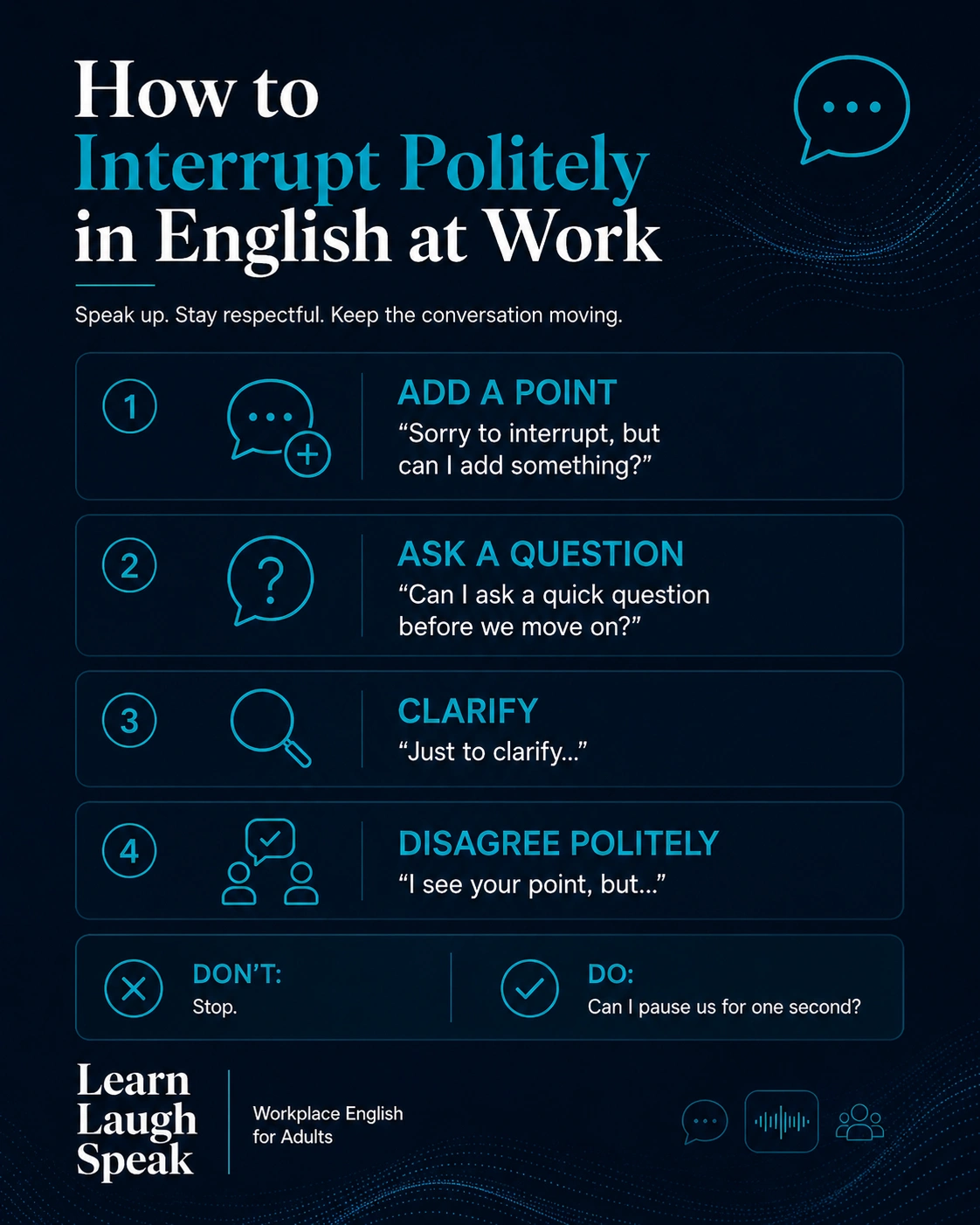
Sorry to interrupt, but can I add one quick point?
This works because it does three things.
Sorry to interrupt softens the interruption.
Can I add one quick point? asks for space.
One quick point tells people you will not take over the whole conversation.
That is why this kind of phrase sounds natural in meetings.
You are not forcing your way in.
You are asking for a small opening.
The Best Phrases to Interrupt Politely in English
Here are useful phrases adults can use in meetings, calls, or workplace conversations.
| Situation | Polite phrase |
|---|---|
| You need to add something | Sorry to interrupt, but can I add something here? |
| You need to ask a question | Sorry, can I quickly ask a question before we move on? |
| You need to clarify | Just to clarify, do you mean that the deadline is Friday? |
| You need to correct something | Sorry to jump in, but I think there may be one small correction. |
| You need to stop confusion | Can I pause us for one second? I want to make sure I understood correctly. |
| You need to join the discussion | Can I come in here for a moment? |
| You need to respond before the topic changes | Before we move on, could I add one thing? |
| You need to disagree politely | I see your point, but can I offer another perspective? |
These phrases are short, practical, and easy to remember.
They also work because they do not sound like classroom English.
They sound like real workplace English.
Do Not Say This: Better Ways to Interrupt
Many adult English learners use direct phrases because they translate from their first language.
The phrase may be normal in their language, but in English it can sound too strong.
Here are better options.
| Do not say | Say this instead |
|---|---|
| Stop. | Sorry to interrupt, but can I add something? |
| Wait. | Can I pause us for one second? |
| You are wrong. | I think there may be one small correction. |
| I want to speak. | Can I come in here for a moment? |
| Let me talk. | Could I add something quickly? |
| That is not true. | I understand your point, but I see it a little differently. |
| You did not understand. | Maybe I can clarify that point. |
| No, listen. | Sorry, just to clarify one thing. |
The better phrases do not hide your message.
They just make the message easier to hear.
That is important in English-speaking workplaces because tone can change how people receive your idea.
How to Interrupt Politely in English During a Meeting
Meetings are one of the most common places where adults need to interrupt.
The challenge is that meetings often have several speakers.
If you wait too long, the conversation may move on.
But if you jump in too strongly, you may sound rude.
Use these phrases when you need to enter a meeting conversation:
Sorry to interrupt, but can I add one thing here?
Before we move on, could I ask a quick question?
Can I pause us for a moment? I want to clarify something.
Just to make sure I understand, are we saying that the deadline has changed?
Could I come in here with one point from my side?
These phrases are useful because they show respect for the group.
They also make it clear that your interruption has a purpose.
You are not interrupting to take control.
You are interrupting to help the conversation.
Interrupting to Ask a Question
Sometimes you need to interrupt because you do not understand something.
This can feel embarrassing, especially for English learners.
But asking at the right moment can prevent bigger confusion later.
Instead of waiting until the end and feeling lost, use a short polite phrase.
Sorry, can I ask a quick question before we continue?
Could I clarify one thing?
Just so I understand correctly, are you saying that we need approval first?
Can I check one detail before we move forward?
Sorry, I missed one part. Could you repeat the deadline?
These phrases are professional because they show that you are paying attention.
They also show that you care about understanding the details correctly.
That is better than pretending to understand and making a mistake later.
Interrupting to Correct Information
Correcting someone can be difficult.
If you are too direct, it may sound rude.
If you are too soft, the correction may not be clear.
The best approach is to be polite but specific.
Use phrases like:
Sorry to jump in, but I think there may be one small correction.
Just to clarify, the report is due on Thursday, not Friday.
I may be wrong, but I believe the client asked for the updated version today.
Can I quickly correct one detail? The meeting starts at 3 p.m., not 2 p.m.
Just one small note: the final file has already been sent.
Notice the tone.
These phrases do not attack the person.
They focus on the detail.
That matters.
In professional English, correcting information is easier when you separate the mistake from the person.
Interrupting When You Disagree
Disagreeing is one of the hardest reasons to interrupt.
You may have a strong opinion, but you still need to sound professional.
Avoid saying:
No, I disagree.
This is not always wrong, but it can sound too direct if the conversation is sensitive.
Better options include:
I see your point, but can I offer another perspective?
That makes sense, although I see it slightly differently.
Can I add a different view here?
I understand the idea, but I have one concern.
I agree with part of that, but I think we may need to consider another option.
These phrases are useful because they soften the disagreement without removing it.
You still share your opinion.
You just do it in a way that keeps the conversation open.
Interrupting a Fast Speaker
Fast speakers can be difficult for English learners.
By the time you understand one point, the person has already moved to the next.
In this situation, it is okay to interrupt politely.
Use phrases like:
Sorry, could I stop you there for one second?
Can I quickly check I understood that correctly?
Sorry, that was a little fast for me. Could you repeat the last part?
Can we go back to the deadline for a moment?
Before we continue, could you explain that last point again?
This is not rude.
It is responsible communication.
If you need the information to do your job, asking for clarity is better than guessing.
How to Interrupt Politely in English on Video Call
Video calls make interruptions harder.
There can be delays.
People speak at the same time.
Someone may not see that you want to speak.
That is why you need clear, short phrases.
Use these:
Sorry, I think there may be a slight delay. Can I add something?
Can I jump in quickly before we move on?
Sorry, I did not want to speak over you. I just wanted to add one point.
Can I ask something about that last point?
I’ll be quick. I just want to clarify one detail.
These phrases help reduce awkwardness.
They also show that you are aware of the group conversation.
That is very useful in remote and hybrid work.

Interrupting Your Manager or Boss
Interrupting a manager can feel more serious.
The language needs to be polite, careful, and useful.
You do not need to sound afraid.
But you should sound respectful.
Use phrases like:
Sorry to interrupt, but I think this detail may be important.
Could I add one quick point before we move on?
Just to make sure I understand correctly, would you like this completed by today?
Can I quickly clarify the priority?
I do not want to interrupt, but I think there may be an update you should know.
These phrases are professional because they show that your interruption has value.
You are not interrupting because you want attention.
You are interrupting because the information matters.
How to Interrupt Politely in English with a Client
When speaking with clients or customers, tone is even more important.
You may need to interrupt to clarify, correct, or guide the conversation.
But you must sound helpful, not impatient.
Use phrases like:
Sorry to interrupt, but I just want to make sure I understand your request correctly.
Can I quickly clarify one detail so we can help you better?
Just to confirm, are you asking about the delivery date or the payment status?
I understand. May I pause you for one moment to check that information?
Before we continue, I want to make sure I have the correct details.
These phrases are useful in hospitality, customer service, sales, support, and account management.
They help you take control of the conversation without sounding rude.
Short Phrases for Natural Workplace English
Sometimes you do not need a full sentence.
A short polite phrase is enough.
Here are some natural options:
Sorry, one quick thing.
Can I add something?
Just to clarify.
Before we move on.
Can I jump in?
Quick question.
One small correction.
Can I pause us there?
I’ll be brief.
Just one point from my side.
These are useful because they are easy to remember.
They also sound natural in real conversations.
The key is your tone.
Say them calmly.
Do not speak too loudly.
Do not sound annoyed.
A polite phrase with a sharp tone can still sound rude.
What to Say After You Interrupt
Many learners know how to interrupt, but then they do not know what to say next.
A good interruption should move quickly into the reason.
For example:
Sorry to interrupt, but can I add one thing here? I think the client also asked for the updated pricing.
Before we move on, could I ask a quick question? Are we confirming this deadline for Friday or Monday?
Can I pause us for one second? I want to make sure we are using the latest version of the file.
This structure works well:
Polite interruption + reason + useful information
That keeps the conversation focused.
It also shows that your interruption was necessary.

How to Sound Polite When Interrupting
The words matter.
But delivery matters too.
To interrupt politely in English, try to:
speak calmly
use a soft opening
keep your point short
avoid blaming language
explain why you are interrupting
let the other person continue after your point
For example:
Sorry to interrupt, but I think this is important for the next step.
This sounds polite because it gives a reason.
It tells people the interruption is connected to the work.
That makes it easier to accept.
Common Mistakes English Learners Make When TInterrupt Politely in English
Many English learners make one of these mistakes:
They wait too long and miss the chance to speak.
They interrupt too directly because they are translating.
They apologize too much and sound unsure.
They speak over someone without using a phrase.
They correct the person instead of correcting the information.
They use strong words like wrong, stop, or listen.
The goal is balance.
You do not need to be silent.
You also do not need to be aggressive.
You need a phrase that opens the conversation politely.
That is why learning how to interrupt politely in English is such a useful skill for professional communication.
How Learn Laugh Speak Helps Adults Use English at Work
At Learn Laugh Speak, we help adults learn English for real situations, not just classroom exercises.
Workplace English is full of small moments that matter.
Interrupting politely is one of them.
Students need to know how to ask questions, clarify information, correct mistakes, join meetings, and speak professionally without sounding rude.
That is why each student starts with a level assessment from A1 to C2.
From there, they follow a personalized learning path based on their level, progress, mistakes, and needs.
Adults do not all need the same English.
Some need meetings.
Some need emails.
Some need customer service.
Some need presentations.
Some need confidence speaking.
Learn Laugh Speak helps adults learn what they need, when they need it, so they can use English more clearly in real work situations.

Final Thought on How to Interrupt Politely in English
Interrupting at work is not always rude.
Sometimes it is necessary.
The difference is how you do it.
If you use strong or direct language, the interruption can sound aggressive.
If you use polite workplace phrases, it can sound professional and helpful.
The best phrases are simple:
Sorry to interrupt, but can I add something?
Before we move on, could I ask a quick question?
Can I pause us for one second?
Just to clarify.
I see your point, but can I offer another perspective?
These phrases help adults participate in meetings, calls, and workplace conversations with more confidence.
That is why learning how to interrupt politely in English is not just about being polite.
It is about being clear, professional, and ready to speak when the moment matters.
2 thoughts on “How You Interrupt Politely in English Without Sounding Rude”
Pingback: Meeting Phrases English Professionals Need at Work Everyday
Pingback: How to Say No Professionally & Sound Respectful in English