
 English
 Arabic
 Chinese (Simplified)
 Dutch
Dutch French
 German
 Italian
 Portuguese
 Russian
 Spanish
Prior learning experience can be one of the biggest advantages adult students have, even when they feel like they are starting again.
That feeling is common.
An adult returns to English after years away from formal study and thinks:
“I’ve forgotten everything.”
But usually, that is not true.
They may feel rusty.
They may lack confidence.
They may remember parts of the language but not know how to use them quickly.
Still, the old learning is not gone.
Some of it is sitting there — familiar, weak, half-remembered, but still useful.
That matters because adult students are not empty pages.
They bring history with them.
Old lessons.
Work experience.
Travel experience.
English they heard years ago.
Skills they used once but stopped using.
Mistakes they never fully corrected.
The problem is that many learning systems ignore this.
They treat adult students like they are all starting from the same place.
That is where learning often becomes slower than it needs to be.
In a job interview explaining your previous experience correctly can be difficult so we linked in Indeed.
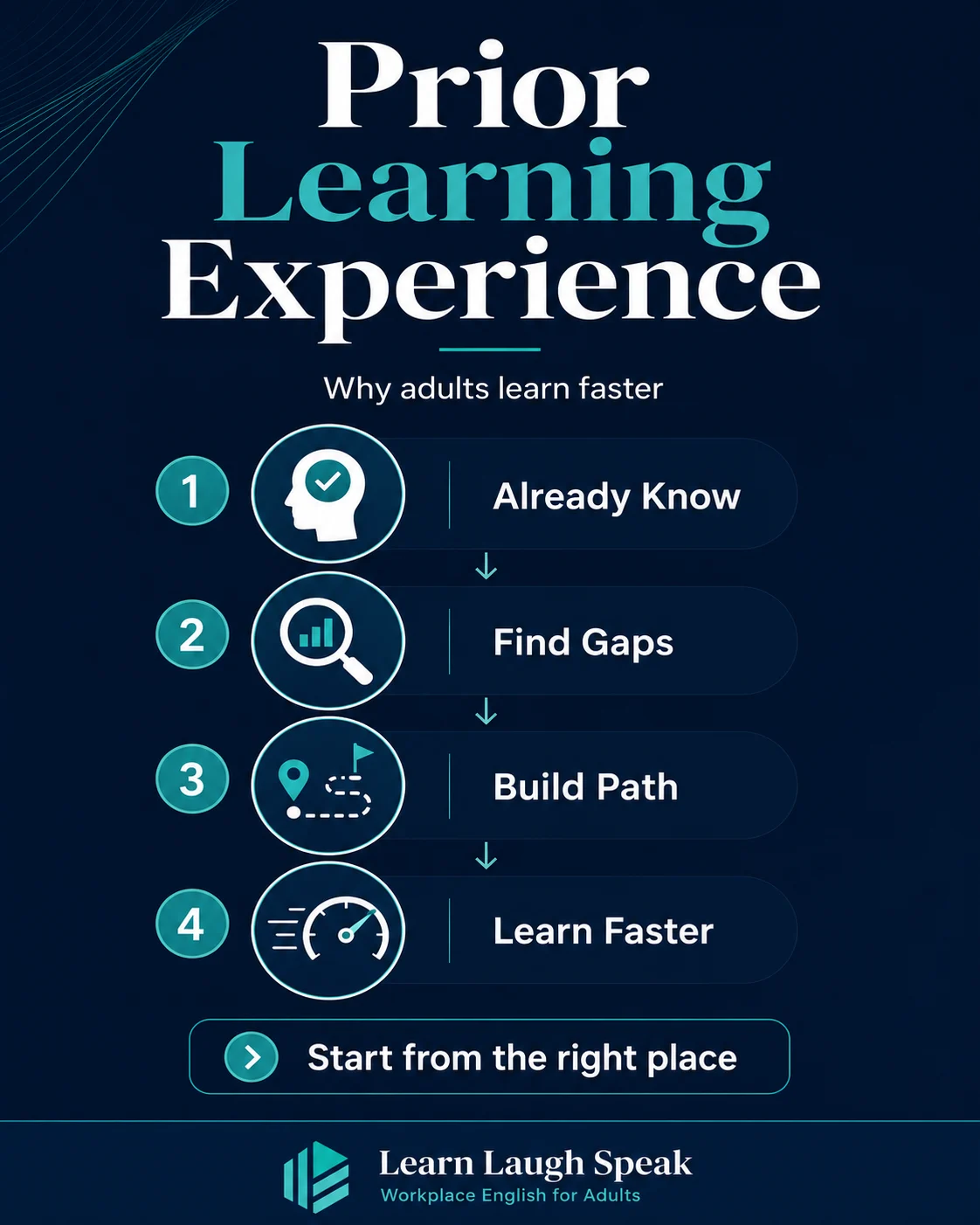
Adults Are Rarely Starting From Zero
One of the biggest mistakes in adult education is assuming that returning learners are beginners.
Sometimes they are.
But often, they are not.
An adult student may have studied English in school.
They may read emails in English at work.
They may understand more than they can say.
They may remember grammar rules but struggle to apply them naturally.
That is not zero.
That is prior knowledge.
It may be disorganized.
It may be inconsistent.
It may not feel strong yet.
But it is still a starting point.
A better learning system should find that starting point instead of guessing.
Personalized learning paths matter because adult students do not arrive at learning from the same place.
Why Prior Learning Experience Still Matters Years Later
Old learning can feel weak because it has not been used for a long time.
But weak does not mean useless.
Think about someone who studied English years ago and then stopped.
At first, they may struggle.
Then after a few lessons, things start coming back.
Words feel familiar.
Grammar starts making sense again.
Listening improves faster than expected.
That happens because the brain is not always learning from nothing.
It is reconnecting.
This is why prior learning experience matters so much for adults.
It can shorten the learning path.
Not by skipping important work.
But by avoiding unnecessary repetition.

The Difference Between Forgotten Learning and New Learning
There is a big difference between:
“I learned this before, but I forgot it.”
And:
“I have never learned this.”
They may look similar at first.
But they need different support.
A student who learned something before often needs reactivation.
A student seeing it for the first time needs foundation building.
If a learning system cannot tell the difference, the student can easily start in the wrong place.
Too low, and they waste time.
Too high, and they lose confidence.
That is why assessment matters before learning begins.
Not a general test for the sake of testing.
A real placement that helps answer:
What does this student already know?
What has been forgotten?
What is still weak?
What should come next?
Why students forget what they learn is not usually about laziness, it is usually about how learning is designed.
What Recognition of Prior Learning Shows Us
The idea of recognizing what adults already know is not new.
In education policy, it is often called recognition of prior learning.
The International labor Organization explains that recognition of prior learning can support adult upskilling and reskilling by shortening training time and helping adults focus on their remaining skill gaps through more personalized pathways.
That idea matters beyond formal qualifications.
It tells us something simple:
Adults should not always have to repeat learning they already have.
If they already know something, use it.
If they have gaps, find them.
If they are ready to move faster, let them.
That is not cutting corners.
That is better learning design.
Why Some Adults Move Faster Than Others
Some adult students progress quickly because they are not learning everything for the first time.
They are reconnecting with knowledge they already had.
That is a major difference.
A learner with strong prior learning experience may move faster through early lessons because the material is familiar.
They still need practice.
They still need correction.
But they may not need the same amount of explanation as someone seeing the topic for the first time.
This is why comparing adult students can be unfair.
Two students may begin at the same level, but one may have deeper learning history underneath the surface.
Once that experience is activated, progress can speed up.
This is also why credit for prior learning has become important in adult education. CAEL explains that credit for prior learning can recognize knowledge gained through work experience, professional training, military training, independent study, standardized exams, and other learning outside traditional classrooms.
For adult students, that matters.
Their learning history may not always be formal.
But it is still real.
Prior Learning Can Also Hide Gaps
Prior learning helps.
But it can also hide problems.
A student may know enough to pass simple exercises but still make repeated mistakes in real use.
They may have learned a rule incorrectly years ago.
They may understand written English but struggle to speak.
They may recognize vocabulary but not access it quickly in conversation.
So the goal is not only to celebrate prior learning.
The goal is to measure it clearly.
What is still useful?
What needs refreshing?
What needs correcting?
What was never fully learned?
That is where better learning design makes a difference.
Why Mistakes Are Useful for Adult Learners
Mistakes tell the truth.
They show what the student can actually use.
A learner may believe they understand something.
But their mistakes show where the skill is still weak.
That is not a bad thing.
It is useful information.
For adults, mistakes are not just errors.
They are signals.
They show where the learning path should go next.
Without feedback, adult students can keep repeating the same mistakes for years.
With feedback, the path becomes clearer.
That is why modern learning should not only track progress.
It should track patterns.
Because repeated mistakes often show the real learning need.

Why Digital Learning Should Be Smarter Than a Fixed Course
Digital learning should not only mean lessons on a screen.
A fixed course online is still a fixed course.
The real value of digital learning comes when it can respond to the learner.
A strong digital learning system should help answer:
Where should this student begin?
What does this student already know?
What do they keep getting wrong?
Which skills are strong?
Which skills need more practice?
When are they ready to move forward?
That is where digital learning becomes powerful.
Not because it is digital.
Because it can adapt.
The OECD also highlights flexible adult learning systems, including modular learning and recognition of prior learning, as ways to help adults build pathways that match their needs.
That is exactly the direction adult learning needs.
Less repetition for the sake of structure.
More learning based on actual need.
Why Prior Learning Experience Builds Confidence
There is an emotional side to this too.
Many adults feel embarrassed when they return to learning.
They think they should remember more.
They think they are behind.
They think starting again means they failed before.
But when they realize they are not starting from zero, something changes.
They feel more capable.
They see that old knowledge still has value.
They understand that forgetting is normal, and rebuilding is possible.
That matters because confidence affects consistency.
And consistency is where adult learning improves.
A student who feels early progress is more likely to continue.
A student who feels misplaced is more likely to stop.
The Problem With Starting in the Wrong Place
Starting too low can be frustrating.
Starting too high can be discouraging.
Both create problems.
If the level is too easy, the student feels bored.
If the level is too difficult, the student feels lost.
If the starting point is wrong, the whole learning experience becomes harder than it needs to be.
This is especially true for adults because they often have uneven skills.
They may read well but speak poorly.
They may understand grammar but write awkwardly.
They may listen well but lack confidence.
A simple level label does not always show the full picture.
That is why the starting point needs to be precise.
Not general.
Precise.
How Learn Laugh Speak Uses Prior Learning Experience
At Learn Laugh Speak, adult students do not begin from a generic starting point.
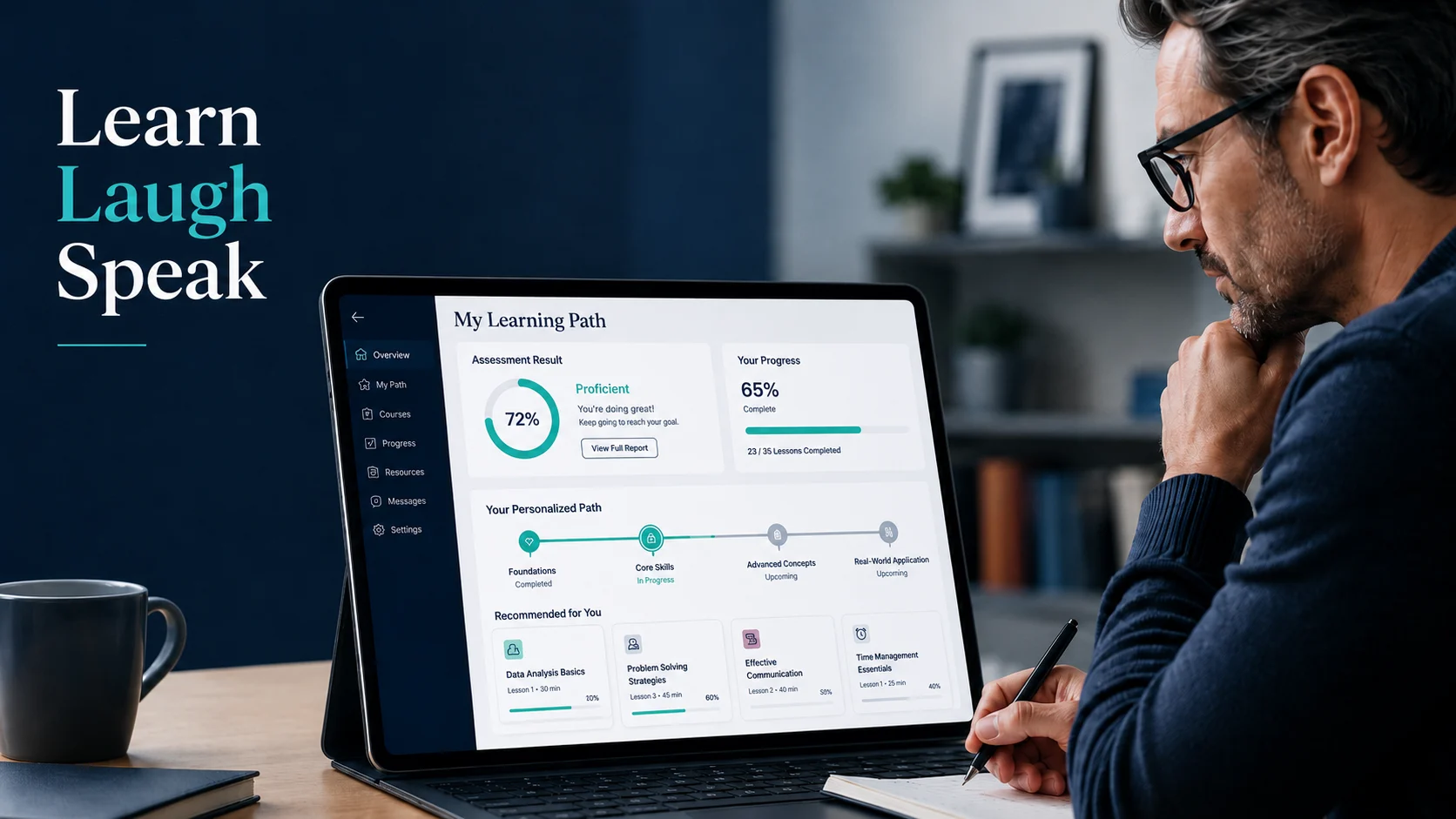
They complete a level assessment so the platform can understand where they are now.
That matters because many adults arrive with prior learning experience.
Some already know more than they think.
Some have strong skills in one area and weak skills in another.
Some can move faster because they studied before.
Others need more support because old gaps were never fixed properly.
From the assessment, each student follows a personalized learning path.
The application tracks mistakes, progress, and weak areas as they move through lessons.
That means students learn what they need, when they need it.
They do not waste time repeating everything they already know.
And they do not skip the areas where they still need support.
This is where prior learning becomes useful.
It is not ignored.
It is measured, respected, and used to build a better path forward.

Why This Matters for Workplace English
For adults learning English, the goal is rarely just academic.
They want to use English at work.
They want to write better emails.
Understand meetings.
Speak more clearly.
Avoid repeating the same mistakes.
Communicate with more confidence.
Prior learning can help with that, but only if the learning system connects it to real use.
Knowing old grammar rules is helpful.
But using them in an email is better.
Recognizing vocabulary is helpful.
But using it in a conversation is better.
Adult learning should not only ask:
What did you learn before?
It should ask:
What can you use now?
That is the real measure of progress.
Prior Learning Experience and Lifelong Learning
This also connects with the wider idea of lifelong learning.
UNESCO’s Institute for Lifelong Learning describes lifelong learning as learning that happens across formal, non-formal, and informal settings, including family, school, community, and the workplace.
That matters because adults keep learning long before they return to a course.
They learn through work.
Through travel.
Through mistakes.
Through exposure.
Through informal experience.
A good learning system should not ignore that.
It should use it.
Because adult learning does not begin when the course begins.
It begins with everything the student brings into it.
A Better Way to Think About Returning to Learning
Adult students should not think:
“I’m starting again.”
They should think:
“I’m rebuilding from what I already have.”
That is a healthier way to learn.
It removes shame.
It gives value to past effort.
It helps the student see progress faster.
And it makes the learning journey feel more personal.
Because it is.
No adult student arrives with the exact same history.
So no adult student should be forced into the exact same path.
What Modern Education Should Learn From This
Modern education is moving toward more flexible, personalized, and skill-focused learning.
That makes prior learning more important, not less.
The future of learning is not about treating everyone the same.
It is about understanding the learner clearly enough to help them move forward.
If an adult already has knowledge, use it.
If they have gaps, find them.
If they make repeated mistakes, correct them.
If they are ready to progress faster, allow it.
That is better learning.
Not because it is easier.
Because it is more accurate.
Final Thought on Prior Learning Experience
Prior learning experience should not be treated as something old or irrelevant.
For adult students, it can be the foundation for faster and smarter progress.
The key is knowing what to reuse, what to refresh, and what to correct.
That is what modern digital learning should do well.
It should not ask every adult to start again from zero.
It should help them build from what they already know.
Because when learning starts from the right place, progress becomes easier.
And for adults returning to English, the right path often begins with recognizing the value of their prior learning experience.
One thought on “How Prior Learning Experience Helps Adults Learn Faster in 2026”
Pingback: Why Flexible Learning for Adults Makes Education More Effective - Learn Laugh Speak