English
 Arabic
 Chinese (Simplified)
 Dutch
Dutch French
 German
 Italian
 Portuguese
 Russian
 Spanish
You can fix the leak. You can identify the no-heat call in 15 minutes flat. You know your trade inside and out.
But the customer who called you? They don’t know that yet.
To them, you’re a stranger standing at their front door. Your toolkit, your certifications, your years on the job, none of that matters until you open your mouth and make them feel like they can trust you.
The truth is, the words you use on a customer call can make or break the job. Say the right things, and you walk away with a booked appointment, a signed estimate, and a five-star review. Say the wrong things, and you lose the customer before you’ve even touched a wrench.
Here are the phrases that actually work, organized by the stages of a customer call.

1. When You Pick Up the Phone
The first 10 seconds set the tone for everything that follows. A flat, rushed greeting tells the customer they called a random number. A warm, confident one tells them they called the right company.
These phrases work:
- “Good morning, this is [Your Name] at [Company Name]. How can I help you today?” – Simple, Personal, Professional. The customer hears your name and your company’s name right away. That immediate connection builds trust before a single word about the job is spoken.
- “Thanks for calling [Company Name]. We’re glad you reached out.”- This one does a lot of work. Most customers calling about a broken furnace or clogged drain are already stressed. A warm response immediately lowers their anxiety.
- “You’ve reached [Company Name]. I’m here to help. What’s going on today?” – Open-ended and friendly. It invites the customer to explain the problem in their own words, which gives you better problem-solving information before you even schedule the visit.
Avoid: “Yep,” “Hold on,” or launching straight into “What’s your address?” Those responses sound cold and rushed. You’re building a relationship, not filling out a form.
Keeping Classrooms Healthy: Simple Steps for a Cleaner Learning Space
2. When You Need to Understand the Problem
Your job is to ask good questions. But the way you ask them matters.
Customers often don’t have the right words. They’ll say “the heat isn’t working” when they mean the pilot light is out. They’ll say “there’s water everywhere” when the issue is actually a slow drip from a supply line. Your questions need to pull out the details without making them feel dumb for not knowing the difference.
Try these:
- “Can you walk me through what you noticed first?”- This opens the conversation and gets them talking. You’ll often hear the real clue buried in their answer.
- “When did this start happening?”- Timeline matters. A furnace that stopped working overnight is a different problem than one that’s been gradually losing heat for a month.
- “Has anything changed recently, new appliances, any work done on the system?”- A lot of service calls trace back to something that was recently installed or serviced nearby. Asking this saves you troubleshooting time on-site.
- “On a scale of one to ten, how urgent does this feel to you?”- This one’s underused. It helps you figure out whether the customer needs same-day service or is fine with a next-week appointment, and it makes the customer feel like their situation is being taken seriously.
The goal here is to listen more than you talk. Let them describe the problem fully before you start offering solutions.
3. When You’re Setting Expectations Before the Visit
Customers hate surprises. A technician showing up at 4 pm when they expected 2 pm, without a heads-up, can turn a satisfied customer into an angry one even before the job starts.
Set expectations clearly and upfront:
- “We’ll have a technician at your place between [time window]. You’ll get a call or text when they’re about 30 minutes out.”- This is gold. Most customers just want to know when to expect you. A firm arrival window plus a heads-up call cuts down on a lot of frustration.
- “The technician will do a quick check when they arrive. Once they know what they’re dealing with, they’ll walk you through the options and pricing before any work starts.”-This phrase sets the right expectation from the start. Customers who know the process in advance are far less likely to feel surprised or pressured on-site.
- “Our standard service call fee is [$X], which goes toward the repair if you decide to move forward.”- Be upfront about money. Customers respect transparency. It also filters out people who aren’t serious, saving your technician’s time.
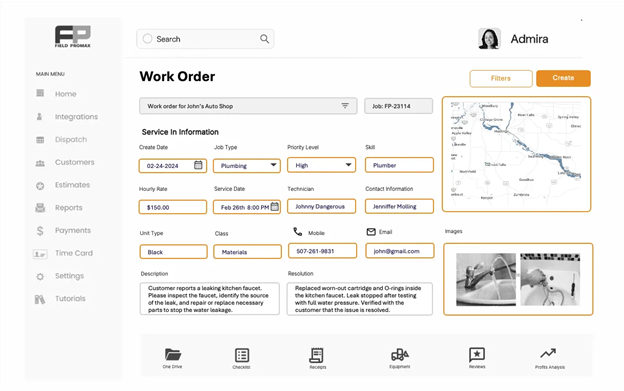
None of this works if your office team and your technician are working from different information. Field Promax builds the arrival window, job details, and customer history into one work order so the technician shows up knowing exactly what to say before the customer opens the door.
1. When You’re On-Site and Explaining the Problem
This is where most technicians lose the customer.
You know exactly what’s wrong. But if you say “your secondary heat exchanger has a small crack that lets harmful gases mix with the air your family breathes,” you’re going to get a blank stare followed by a polite “can I get a second opinion?”
Explain the problem in simple, everyday words. Here’s how:
- “Here’s what I found, and I’ll show you exactly what I’m looking at.”- Showing the customer the problem builds trust instantly. Even if they don’t fully understand it, the transparency signals that you’re not making things up.
- “Think of it like this: [simple analogy].”- Analogies are your best friend. “Your heat exchanger is like the wall between your furnace’s fire and the air your family breathes. When it cracks, those gases mix. That’s why we take it seriously.” That’s a sentence a homeowner will remember and repeat to their spouse.
- “You have a few options here, and I want you to feel good about whatever you decide.”- This phrase removes pressure. Customers who feel pressured often shut down or delay. Customers who feel informed and respected move forward faster.
- “I want to be honest with you about what this means for the long-term.”- Leading with honesty, especially for expensive repair-or-replace decisions, builds more loyalty than any sales script ever could.
Writing clear notes on the work order also protects you. When a customer disputes a charge three weeks later, a properly documented job record settles the argument fast. The businesses that keep good records tend to have this habit already built in.
5. When the Customer Pushes Back on Price
It happens on almost every bigger job. The customer hears the number and their first instinct is to hesitate, push back, or call a competitor.
Here’s the thing: that hesitation is almost never really about the money. It’s about not feeling confident that the price is fair. Your job is to restore that confidence.
- “I completely understand. Let me break this down so you can see exactly what you’re getting.”- Never get defensive. Acknowledging their concern and offering transparency is always the right move.
- “This price includes [list key items], so there won’t be any surprise costs at the end.” – Customers are afraid of extra charges popping up. Spelling out what is included removes that fear.
- “If budget is a concern, here’s a lower-cost option and here’s what the trade-off looks like.”- Give them a choice. A customer who chooses the mid-tier option themselves is far happier than one who feels they were talked into the top tier.
- “We stand behind our work. If anything isn’t right within [warranty period], we come back at no charge.”- Warranty language does a lot of heavy lifting. It signals confidence in your own work.
It’s worth remembering that HVAC and plumbing are the highest-paying skilled trades in the US and Canada, partly because of how much the job depends on trust. Customers pay premium rates for technicians who make them feel confident, not just technicians who fix things fast.
6. When You Need to Handle an Upset Customer
A furnace that stopped working at midnight in January. A burst pipe is flooding a finished basement. Customers in these situations are not calling you from a calm, rational state.
They’re scared. They’re frustrated. And they need to feel heard before they can hear anything else.
- “I hear you, and I understand why you’re frustrated. Let’s figure this out together.” -Empathy first. Always. Jumping to solutions before the customer feels heard only makes things worse.
- “That shouldn’t have happened, and I want to make it right.”- If there was a service failure, own it. Customers who feel their complaints are being dismissed go straight to online reviews. Customers who feel their concerns are being taken seriously give you a chance to fix it.
- “Here’s what I can do right now, and here’s what the next step looks like.”- Upset customers want a path forward. Give them one, specifically. Vague promises do not help.
Calming an upset customer is a skill. The technicians and office staff who do it well almost always describe the same approach: slow down, speak calmly, and repeat what the customer said back to them before responding. It sounds simple, but it works every time.
7. When You’re Wrapping Up the Call or Visit
The close of a call or visit is where a lot of good jobs get missed. The technician finishes the work, says, “You’re all set,” and walks out the door.
That’s fine. But these phrases turn a one-time visit into a long-term relationship:
- “Is there anything else in the house you’d like me to take a look at while I’m here?” – One question. Genuinely asked. This is not a pressure upsell. It’s an offer of value. Customers appreciate it, and it catches small issues before they become big ones.
- “Here’s what I recommend for your next maintenance visit and why.”- Proactive advice sets you up as a trusted resource, not just a repair person. Customers who understand why maintenance matters are far more likely to book recurring service.
- “You’ll get a summary of today’s work by email. Feel free to call us if you have any questions.”- Closing with follow-through sets you apart. Most customers never hear from a contractor after the job is done.
- “We’d really appreciate it if you mentioned us to anyone who could use our help.” – Word of mouth is still the best lead source in the trades. Asking for referrals at the end of a positive experience is natural, not pushy.
Seasonal maintenance reminders, follow-up texts, and recurring job scheduling are exactly the kind of tasks that fall through the cracks on busy days. A field service management app handles the routine follow-up automatically, so your wrap-up phrases actually get backed up by action.
The Words Behind the Work
Technical skill gets you the job. Communication keeps the customer.
Customers remember how you made them feel far longer than they remember the repair itself. A technician who explains things clearly, handles difficult moments calmly, and wraps up a visit with genuine care for the customer is the one who gets called back in six months.
The phrases in this article aren’t scripts you memorize word-for-word. They’re patterns you learn and practice until they become second nature.
Practice them. Try them on your next call. And pay attention to how customers respond when they feel heard.
The wrenches matter. The words matter just as much.

Frequently Asked Questions
How do HVAC technicians communicate professionally with difficult customers?
The most effective approach is to lead with empathy before jumping to solutions. Phrases like “I hear you, and I want to make this right” calm things down quickly. Speak slowly, stay calm, and repeat back what the customer said so they feel genuinely heard. From there, offer a clear, specific path forward rather than vague promises.
What should a technician say when quoting a price that a customer finds too high?
Avoid getting defensive. Address their concern first, then break the price down item by item so the customer understands exactly what they’re paying for. Offering a lower-cost alternative with a clear explanation of the trade-offs gives customers a choice and almost always results in a faster decision.
Why is the opening greeting so important on a service call?
The first 10 seconds of a call determine whether the customer feels they reached a trustworthy business or a random number. Using your name and your company’s name immediately creates trust. A warm tone tells an already-stressed customer that they’re in good hands before any details are exchanged.
What is the best way to explain a technical problem to a customer who doesn’t know HVAC or plumbing?
Use analogies. Comparing a heat exchanger crack to a wall between fire and breathable air, for example, makes an abstract technical issue easy to picture. Show the customer the problem in person when possible, and explain what it means for their safety or comfort in plain terms before presenting repair options.
Smart Lighting and Power Management for Learning Environments
Author Bio –
I’m Bhargavi Halthore, and I’ve spent a decade diving deep into the world of digital marketing and tech. Working closely with startups and tech wizards alike has kept me entertained. What excites me most is watching how software can completely transform a business! Breaking down complex technological concepts so everyone understands them is my specialty. When not exploring these latest business software trends I can usually be found sharing what I have learned at events around America or Canada.
My goal? To help you discover the perfect tech tools that’ll take your business to new heights.