
 English
 Arabic
 Chinese (Simplified)
 Dutch
Dutch French
 German
 Italian
 Portuguese
 Russian
 Spanish
The way we plan, visualize, and communicate outdoor projects is shifting quickly. Homeowners once relied on hand sketches, clip-out magazine pages, and long back-and-forth messages to describe a slope they could not quite put into words. Today, the same evolution that reshaped interior inspiration is arriving outside the front door: artificial intelligence can translate a real photograph of a yard into coherent landscape concepts, style explorations, and repeatable iterations—without forcing everyone through a drafting crash course.
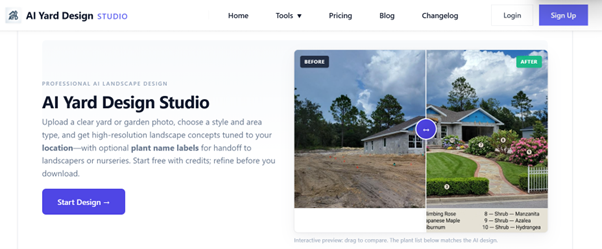
The change is not that AI replaces expertise. It reduces friction at the earliest stage—when uncertainty is expensive and enthusiasm is fragile. In that window, accessible visualization is not a gimmick; it is a planning tool. Platforms built for residential outdoor work—such as AI Yard Design Studio —treat the problem as practical: start from your lot, express a direction, and generate visuals you can critique, refine, and share.
Two phrases, one revolution: landscape design and “yard design”
AI landscape design usually refers to the broader discipline: planting composition, circulation, materials, outdoor rooms, and how spaces read across seasons. AI yard design narrows the lens to what most homeowners actually touch: front walks, side passages, back patios, dog paths, pool surroundings, and the small garden moments where daily life happens. The future of outdoor living is being written at the intersection of both—because people do not experience a “discipline” on Saturday morning; they experience their yard. AI accelerates three activities that used to be slow or unevenly distributed. First, translation. A family may agree on adjectives—modern, cottage, low-maintenance, private—while silently picturing four different outcomes. A concrete image creates a shared object to disagree with productively. Second, exploration. Swapping palettes, boundary treatments, or planting density is inexpensive when you are comparing concept images. It becomes expensive when you are reordering stone after stone. Third, handoff. Contractors and nurseries benefit from specificity. When higher-quality outputs include labeled plant candidates or a clear legend, the conversation moves from “something green along the fence” to named options that can be validated against climate, sun, and inventory.
What is changing in the homeowner experience
Historically, “design” sounded like a luxury service or a pro-only workflow. AI changes the entry point, not necessarily the final responsibility. A typical homeowner can now arrive at a first meeting with direction rather than a blank apology. That shift matters because outdoor projects fail in the gap between imagination and agreement—between what you think you want and what you can maintain, afford, or legally place on a lot. Critically, the best tools do not pretend the site is generic. Photographs anchor the model to real edges: existing trees, fences, the house’s relationship to grade, the awkward corner that every neighborhood seems to have. From that grounded starting point, style becomes a meaningful variable instead of a Pinterest mood board detached from your soil.
Climate, context, and the difference between pretty and plausible
Forward-looking AI landscape workflows increasingly incorporate location and context cues. That does not mean the software “knows” your yard better than a site visit. It means your brief can steer planting and materials toward regionally believable outcomes—so you spend less time on concepts that look beautiful online but feel wrong on your street. This is where professional judgment remains essential. Drainage, utilities, codes, mature plant sizes, and hardscape engineering still belong to human verification. AI’s role is to compress early iteration and clarify intent—so professionals spend their time on constraints that photos cannot fully capture.
A simple workflow that keeps projects grounded
If you are new to this category, a disciplined approach yields better outcomes:
- Capture the truth. Photograph enough context—property lines in frame, key vertical elements, and the areas you actually use. The model designs your space, not an idealized suburb from memory.
- Name the zone. Front yard priorities differ from pool surrounds or side passages. Area type is a lever for privacy, safety, circulation, and focal sequencing.
- Choose style, then add constraints. Short notes—“keep the oak,” “more screening,” “drought-tolerant bias,” “kid-friendly”—turn aesthetic words into a workable brief.
- Iterate in layers. Adjust one layer at a time: paving warmth, bed width, planting density, or the amount of lawn. Compare results before you fall in love with a single render.
Where this goes next
The near future likely looks less like “magic buttons” and more like tighter collaboration: homeowners bring clearer visuals; designers spend less time decoding vibes; municipalities still enforce real-world rules. The bottleneck moves from drawing the first credible picture to validating the last credible detail.
Conclusion
AI landscape design and AI yard design are not a replacement for outdoor expertise. They are a new common language for the earliest phase of a project—when people most need speed, options, and alignment. If your goal is to see your outdoor space as it could be, not only as it is, the smarter path is to start with a grounded photo, a honest brief, and tools that reward iteration.