
 English
 Arabic
 Chinese (Simplified)
 Dutch
Dutch French
 German
 Italian
 Portuguese
 Russian
 Spanish
You have probably already experienced the issue because you have recorded audio outside a commercial studio before: you can hear the sound of background noise everywhere. A single keyboard clicks, traffic, air conditioners, wind or even hum in the room can spoil a great recording so easily.
This is why the process of eliminating the background noise from audio has become a fundamental ability of creators, educators, and teams that are decentralized. Later on, in 2026, the question of clean audio is no longer something to have, but something to expect.
My personal experience of working with podcasts, online courses, and marketing videos shows that the background noise is the most common cause of people leaving audio content in the early stages of listening.
What Is Background Noise in Audio?
Background noise is any unwanted noise that is present with the main voice or signal. Common types include:
- Never-ending distractions such as hums, fans, or air condensers.
- The intermittent sounds like typing the keyboard or door slams.
- Noises around the environment such as traffic, wind or chatter of the crowd.
When done properly, the elimination of noise in audio by the listener makes him concentrate on the message and not the distractions.
Traditional Ways to Remove Background Noise from Audio
In the pre-AI era, the image processing of the audio was tedious.
Typical workflows included:
- subtraction profiling Noise profiling.
- Manual EQ adjustments
- Compression and gating
- Spectral editing
They are effective, though it takes technical expertise and hours of adjustment. This learning curve usually gives inconsistent results to the non-audio engineers.
This is why contemporary creators are turning more and more to AI in order to get rid of background noises in audio as efficiently as possible.
How AI Noise Reduction Works
Modern AI noise reduction tools use machine learning models trained on thousands of real-world recordings. Instead of simply filtering frequencies, they identify patterns that represent human speech versus noise.
In simple terms, AI learns to:
- Detect voice characteristics
- Separate speech from background sound
- Preserve clarity while removing noise
This approach produces cleaner results with less distortion, especially for spoken content like interviews, meetings, and voiceovers.
Real-World Situations Where Noise Removal Is Essential
From my perspective, the need to remove background noise from audio shows up everywhere:
Podcasts and Interviews
Even high-quality microphones capture room noise. AI cleanup makes episodes sound studio-ready.
Online Courses and E-learning
Clear audio improves comprehension and reduces listener fatigue.
Remote Meetings and Webinars
Noise-free audio improves professionalism and communication clarity.
Video Content and Social Media
Clean sound dramatically increases watch time and engagement.
No matter the format, poor audio quality lowers perceived value instantly.
Online Tools vs Desktop Software
Many people ask whether they should use desktop editors or online tools to remove background noise from audio.
Here’s my take:
- Desktop software offers control but requires skill and setup
- Online tools prioritize speed, accessibility, and consistency
For most users, online AI tools are the better choice. They remove background noise from audio directly in the browser without installation or configuration.
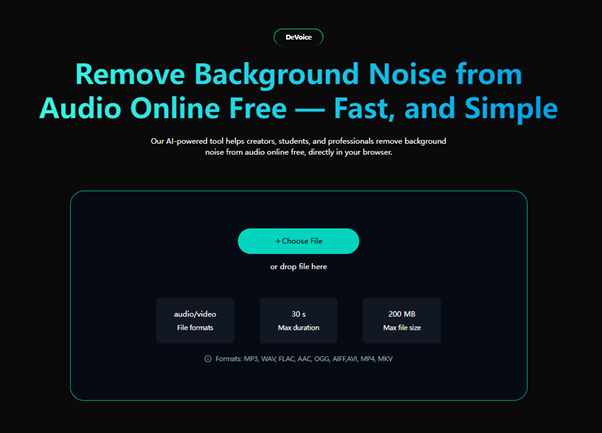
This is where platforms like DeVoice come in. The tool runs fully online and applies AI-based noise reduction without forcing users to learn complex audio workflows.
Key Benefits of Removing Background Noise with AI
Based on practical use, AI-powered noise removal offers clear advantages:
- Faster processing with minimal effort
- Consistent quality across recordings
- Less audio distortion compared to aggressive filtering
- Better results for real-world recordings
Instead of fighting with sliders and plugins, creators can focus on content.
Common Mistakes When Removing Background Noise
One thing I always tell people: more noise reduction is not always better.
Over-processing can lead to:
- Metallic or robotic voices
- Lost vocal warmth
- Unnatural silence gaps
The goal when you remove background noise from audio is balance. AI tools are effective because they reduce noise while keeping speech natural.
Choosing the Right Tool to Remove Background Noise from Audio
When evaluating a noise removal tool, I look for:
- Speech preservation quality
- Support for common audio formats
- Online processing speed
- Secure file handling
DeVoice performs well in these areas, especially for spoken audio like podcasts, lectures, and meetings. It’s designed for people who want results, not audio engineering complexity.
Best Practices for Cleaner Audio Results
Even with AI, good input matters. My personal advice:
- Record as close to the microphone as possible
- Avoid overly noisy environments when you can
- Use AI noise removal as enhancement, not a crutch
When combined with decent recording habits, AI tools can remove background noise from audio with impressive clarity.
Final Thoughts
Trust, credibility, and interaction are developed through clean audio. Regardless of whether you are creating content to be used in a professional or personal project, you have mastered the art of eliminating background noise in audio.
With the help of online AI-based software such as DeVoice, it is no longer necessary to use professional software or technical skills. Anyone can get hard-core straight sound, with no distractions – fast and consistently.
In case the sound quality is of relevance to your audience, silenting is no longer an option. It’s part of the standard.