
 English
 Arabic
 Chinese (Simplified)
 Dutch
Dutch French
 German
 Italian
 Portuguese
 Russian
 Spanish
Saying no at work isn’t easy — especially in writing. Whether you’re turning down extra work, rescheduling a meeting, or refusing a request from a colleague or client, your response needs to be clear, polite, and professional. This guide shows you exactly how to decline requests professionally, with real email examples you can use or adapt for your own communication. These templates help you set boundaries without sounding negative, unhelpful, or rude.
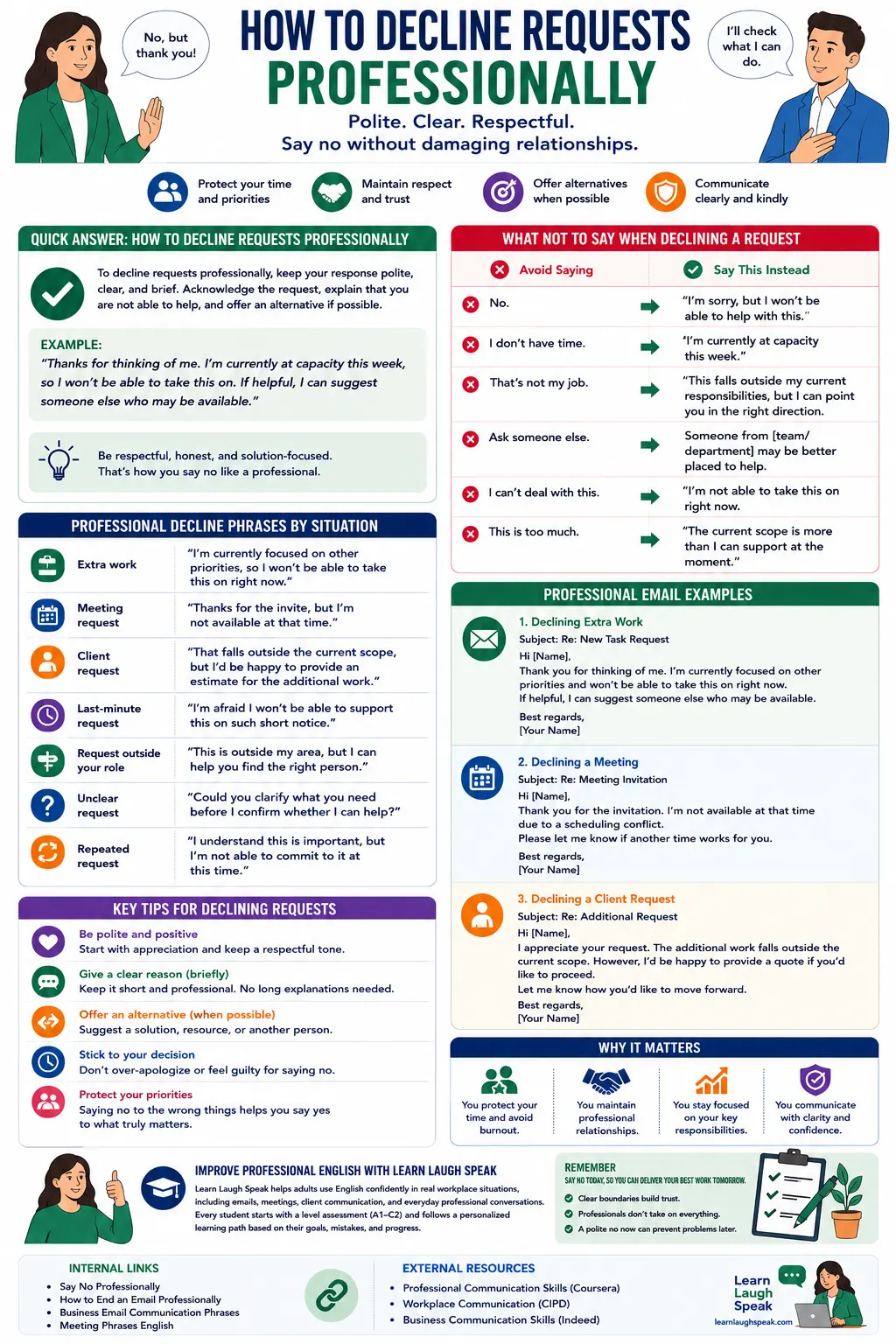
Quick Answer: How to Decline Requests Professionally
To decline requests professionally, keep your response polite, clear, and brief. Acknowledge the request, explain that you are not able to help, and offer an alternative if possible.
For example:
“Thanks for thinking of me. I’m currently at capacity this week, so I won’t be able to take this on. If helpful, I can suggest someone else who may be available.”
This works because it is respectful, honest, and solution-focused without sounding rude or overly apologetic.
How To Respectfully Decline a Reference Request (With Downloadable Templates)
What Not to Say When Declining a Request
Some phrases can sound too direct, cold, or unhelpful in professional English. A better response should still say no clearly, but with a polite and respectful tone.
| Avoid Saying | Say This Instead |
|---|---|
| “No.” | “I’m sorry, but I won’t be able to help with this.” |
| “I don’t have time.” | “I’m currently at capacity this week.” |
| “That’s not my job.” | “This falls outside my current responsibilities, but I can point you in the right direction.” |
| “Ask someone else.” | “Someone from [team/department] may be better placed to help.” |
| “I can’t deal with this.” | “I’m not able to take this on right now.” |
| “This is too much.” | “The current scope is more than I can support at the moment.” |
These small wording changes help you protect your time while keeping the relationship professional.
Professional Decline Phrases by Situation
Use these phrases when you need to decline a request clearly and respectfully.
- Extra work: “I’m currently focused on other priorities, so I won’t be able to take this on right now.”
- Meeting request: “Thanks for the invite, but I’m not available at that time.”
- Client request: “That falls outside the current scope, but I’d be happy to provide an estimate for the additional work.”
- Last-minute request: “I’m afraid I won’t be able to support this on such short notice.”
- Request outside your role: “This is outside my area, but I can help you find the right person.”
- Unclear request: “Could you clarify what you need before I confirm whether I can help?”
- Repeated request: “I understand this is important, but I’m not able to commit to it at this time.”
Why It’s Important to Decline Requests Professionally
In many workplaces, people feel pressure to say yes — even when they’re overbooked, out of scope, or not responsible. But saying yes too often can lead to burnout, missed deadlines, or poor-quality work.
Learning how to decline requests professionally:
Shows respect for your time and priorities
Sets clear expectations
Builds trust through honest, thoughtful communication
Helps others plan more realistically
When to Decline Requests Professionally
It’s appropriate to say no when:
The task is outside your role or responsibilities
You’re at capacity or handling other priorities
The request is last-minute or unreasonable
You don’t have the needed information, authority, or resources
The timeline or scope doesn’t align with current goals
How to Professionally Decline a Job Offer

Phrases to Use When You Decline Requests Professionally
You don’t need to say “no” directly. Instead, use polite, structured phrases like:
“Unfortunately, I won’t be able to take this on at the moment.”
“I appreciate the opportunity, but I need to focus on my current workload.”
“Thanks for thinking of me. However, I’m not available this week.”
“This falls outside my current responsibilities, but I’m happy to suggest someone who can help.”
These responses acknowledge the request while clearly setting a boundary.
How to Politely Follow Up After No Response at Work
Table 1: Tone Styles for Declining Requests by Situation
| Situation | Tone Style | Example Phrase |
|---|---|---|
| Internal team request | Polite, brief | “I’m at full capacity this week, but thanks for asking.” |
| Client request outside project scope | Clear, respectful | “That’s outside the original agreement. Would you like a quote for additional support?” |
| Last-minute meeting or call | Direct, kind | “Thanks for the invite, but I’m booked at that time.” |
| Senior-level request with a conflict | Professional, firm | “I’d like to help, but I’m currently focused on [Project X]. Can we look at timing?” |
Email Examples to Decline Requests Professionally
Example 1: Declining Additional Tasks Politely
Subject: Re: Help with Presentation Slides
Hi Maya,
Thanks for thinking of me. I’m currently fully booked with other deliverables this week and won’t be able to assist with the slides.
If you’re still looking for support, you might check with Daniel — he’s worked on similar projects before.
Appreciate your understanding,
Alex
Example 2: Declining a Meeting Due to Schedule Conflict
Subject: Re: Friday Planning Session
Hi Tom,
Thanks for the invite. Unfortunately, I’m committed to a client session at that time and won’t be able to join.
Please feel free to share any notes or next steps after the meeting — I’ll be happy to follow up as needed.
Best regards,
Vanessa
Example 3: Turning Down Work Outside Your Role
Subject: Re: Budget Review Support
Hello Sarah,
I wanted to follow up on your request. Since budget approvals fall under finance, I’d recommend looping in Mark from that team.
Let me know if you’d like an introduction or need help finding the right contact.
Best,
Jonas
Example 4: Declining a Client’s Out-of-Scope Request
Subject: Re: Last-Minute Changes to the Report
Dear Clara,
Thank you for your message. The changes you’ve requested go beyond the current scope of our agreement. I’d be happy to provide an estimate for the additional work if that’s helpful.
Let me know how you’d like to proceed.
Warm regards,
Leila
Table 2: Email Structure for Professional Decline
| Section | What to Include |
|---|---|
| Greeting | Use the recipient’s name (first or full name) |
| Acknowledge | Show appreciation or recognition of the request |
| Decline | Clearly and politely explain you can’t commit |
| Optional Help | Suggest an alternative, next step, or timeline |
| Closing | Sign off with thanks or a polite farewell |
Tips for Writing a Strong Decline
Be polite but direct — Avoid vague language that leaves people unsure
Keep it brief — Don’t over-explain or apologise too much
Offer alternatives when possible — It shows helpfulness, not rejection
Match your tone to the relationship — Friendly with peers, formal with clients
Final Thoughts on How to Decline Requests Professionally
Saying no doesn’t have to feel awkward or risky. With the right phrases and tone, you can decline requests professionally and still maintain strong working relationships.
Use these email examples as a guide when you’re unsure what to say. Over time, you’ll feel more confident setting boundaries — and people will respect you for it.
Improve Professional English with Learn Laugh Speak
Learn Laugh Speak helps adults use English confidently in real workplace situations.
That includes:
- declining requests professionally
- writing professional emails
- joining meetings
- handling client communication
- using polite workplace phrases
- setting boundaries clearly
Every student starts with a level assessment from A1 to C2. From there, learners follow a personalized path based on their level, goals, mistakes, and progress.
If you want to communicate more clearly and professionally at work, Learn Laugh Speak helps you practise the phrases you need for real conversations.

Key Takeaways: Decline Requests Professionally
It’s okay to say no at work — the key is in how you say it
Use clear, respectful phrases to decline professionally
Tailor your tone to the situation and person
Keep responses brief and solution-focused
Email templates can save time and reduce stress
3 thoughts on “Email Examples to Decline Requests Professionally”
Pingback: How Education in School Has Changed Over the Years
Pingback: 10 Smart Money Moves That Give You More Breathing Room - Learn Laugh Speak
Pingback: Polite Phrases for Online Business Chat in English - Learn Laugh Speak