
 English
 Arabic
 Chinese (Simplified)
 Dutch
Dutch French
 German
 Italian
 Portuguese
 Russian
 Spanish
Someone misunderstood you but not sure why? Clear communication is essential at work — but even when you speak carefully, misunderstandings still happen. Whether it’s a missed deadline, a confused task, or a misread email, knowing how to respond with clarity and calm is key.
This guide shows you how to professionally clarify when someone misunderstood you. It includes useful phrases, tone tips, and example situations — all designed for learners and professionals who use English at work.
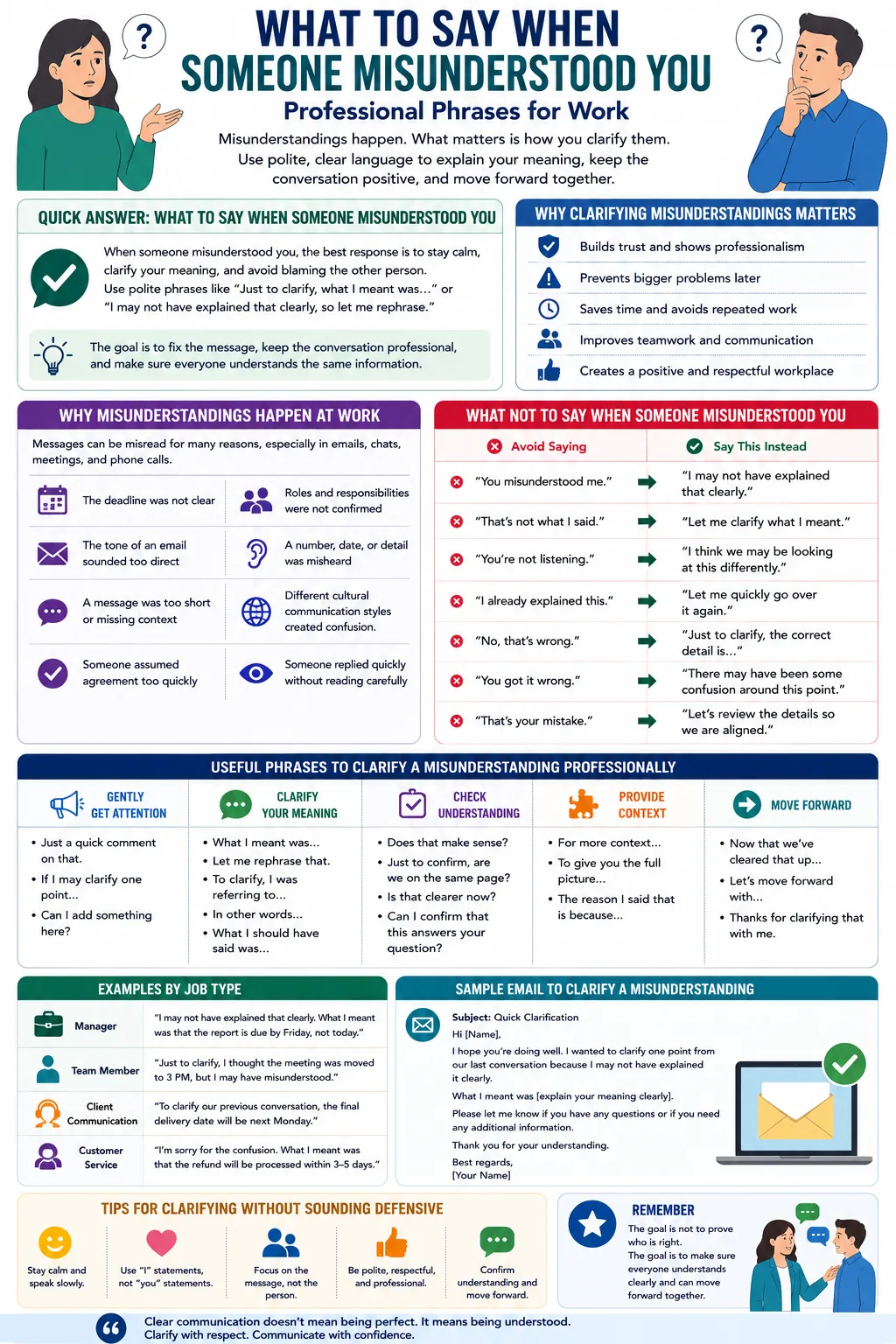
Quick Answer: What to Say When Someone Misunderstood You
When someone misunderstood you, the best response is to stay calm, clarify your meaning, and avoid blaming the other person. Use polite phrases like “Just to clarify, what I meant was…” or “I may not have explained that clearly, so let me rephrase.”
The goal is not to prove who was right. The goal is to fix the message, keep the conversation professional, and make sure everyone understands the same information before moving forward.

Why Clarifying Misunderstandings Matters
When someone misunderstands you, it can lead to delays, mistakes, or tension. Ignoring it only makes things worse. Fixing the confusion early shows you are:
Professional and responsible
A clear communicator
Focused on collaboration, not blame
A simple clarification — if done respectfully — protects relationships and results.
Tips to Boost Your English Level from B1 to C1
Why Misunderstandings Happen at Work
Misunderstandings happen often in professional communication because people are busy, messages are short, and many conversations happen quickly through email, chat, meetings, or phone calls. A simple sentence can be misread if the tone is unclear, the deadline is not specific, or the person reading the message does not have the full context.
This is especially common for English learners and international teams. A phrase that sounds clear to one person may sound too direct, too soft, or incomplete to someone else. That is why it helps to repeat key details, use simple language, and confirm meaning when something feels unclear.
Common reasons misunderstandings happen:
- the deadline was not clear
- the tone of an email sounded too direct
- a message was too short or missing context
- someone assumed agreement too quickly
- roles and responsibilities were not confirmed
- a number, date, or detail was misheard
- different cultural communication styles created confusion
- someone replied quickly without reading carefully
When to Clarify a Misunderstanding
You should clarify professionally when:
A coworker or client took your message the wrong way
Someone thought you agreed to something you didn’t
A deadline, number, or expectation was misunderstood
Your tone was read as rude or unclear in writing
A conversation led to wrong actions or confusion
Clarifying Questions: Definition, Types, and Helpful Tips
Table 1: Common Workplace Misunderstandings
| Situation | Misunderstanding | Clarification Example |
|---|---|---|
| Task deadline | They thought it was due Friday | “Just to clarify — I mentioned Friday, but the deadline is actually Monday.” |
| Agreement | They thought you approved a plan | “I may have been unclear — I meant we should review it first before confirming.” |
| Tone in writing | They felt your email was cold | “Apologies if that came across as too direct. I just wanted to keep it brief and clear.” |
| Role or responsibility | They thought it was your task | “Let me clarify — I was referring to your lead on that part, not mine.” |
Polite Phrases to Clarify When Someone Misunderstood You
Here are respectful, non-defensive phrases that help reset the message without causing tension.
For task or detail corrections:
“Sorry for the confusion — I think there was a misunderstanding about the timeline.”
“Just to clarify, what I meant was…”
“Let me rephrase what I said earlier to make sure it’s clear.”
For tone or email misreads:
“I hope my message didn’t come across the wrong way — that wasn’t my intention.”
“I realise my wording may have sounded too direct. What I meant was…”
“Please let me know if I caused any confusion. I want to make sure we’re aligned.”
For conversation misunderstandings:
“I think we might be on slightly different pages — let’s check in quickly to align.”
“Let me explain my point again just to be sure we’re clear.”
“When I said that, I was referring to [specific part], not [other part].”
How to Confirm What Someone Said Professionally in English

Table 2: By Job Type — How to Clarify Misunderstandings Professionally
| Role | Soft Clarification | Direct Clarification |
|---|---|---|
| Admin / Assistant | “I may not have been clear earlier — can I go over it again?” | “To confirm, my message was referring to the Thursday meeting, not today.” |
| Customer Service | “I’m sorry if that wasn’t clear — what I meant is…” | “Let me clarify the policy for you so there’s no confusion.” |
| Technical / IT | “Just to clarify, the issue is on the client side, not our system.” | “There’s been a misunderstanding — the update hasn’t been released yet.” |
| Management | “I think we may have interpreted that differently — let’s align.” | “I want to be clear that my comment was about the project scope, not the team’s performance.” |
Always adjust based on tone, context, and relationship. The more formal or serious the situation, the more careful your phrasing should be.
What Not to Say When Someone Misunderstood You
When someone misunderstands your message, it is important not to sound defensive or annoyed. Even if you explained clearly, blaming the other person can make the situation worse. Professional English focuses on correcting the message, not criticizing the person.
| Avoid Saying | Say This Instead |
|---|---|
| “You misunderstood me.” | “I may not have explained that clearly.” |
| “That’s not what I said.” | “Let me clarify what I meant.” |
| “You’re not listening.” | “I think we may be looking at this differently.” |
| “I already explained this.” | “Let me quickly go over it again.” |
| “No, that’s wrong.” | “Just to clarify, the correct detail is…” |
| “You got it wrong.” | “There may have been some confusion around this point.” |
| “That’s your mistake.” | “Let’s review the details so we are aligned.” |
These phrases help you correct the misunderstanding without creating tension.
Tips for Clarifying Misunderstandings Without Sounding Defensive
| Do | Don’t |
|---|---|
| Use calm, neutral language | Get emotional or sarcastic |
| Focus on facts, not blame | Say “You misunderstood me” |
| Rephrase your original point | Repeat the same sentence louder |
| Keep your tone professional | Don’t try to “win” the conversation |
Sample Email: Someone Misunderstood You
Subject: Quick Clarification on Timeline
Hi Angela,
I just wanted to clarify one small point from our call. When I mentioned Friday, I meant that we’ll send the draft for internal review, but the client delivery is still set for Monday.
Apologies if I wasn’t clear earlier — just wanted to make sure we’re aligned.
Best,
Ramon

Improve Professional English with Learn Laugh Speak
Learn Laugh Speak helps adults communicate clearly in real workplace situations.
That includes:
- clarifying misunderstandings
- confirming information
- writing professional emails
- joining meetings
- explaining ideas clearly
- using polite workplace phrases
Every student starts with a level assessment from A1 to C2. From there, learners follow a personalized path based on their level, goals, mistakes, and progress.
If you want to communicate more clearly in English at work, Learn Laugh Speak helps you practise the phrases and skills you need for real professional conversations.
Final Thoughts: Someone Misunderstood You
Misunderstandings are normal. What separates effective professionals is how they respond. If someone misreads your words or misunderstands your intent, your job isn’t to defend — it’s to clarify calmly and professionally.
Learning how to correct miscommunication without blame is a key part of strong English communication in any job.
Key Takeaways: Someone Misunderstood You
Clarifying a misunderstanding keeps teams aligned and projects on track
Use respectful, non-defensive phrases like “Just to clarify…” or “What I meant was…”
Avoid blaming language and focus on rephrasing
Match your tone to the context — stay calm and professional
Good communicators fix the message, not the person
2 thoughts on “How to Professionally Clarify When Someone Misunderstood You”
Pingback: Professional Speaking Strategies: Your Secret Weapon For Growth
Pingback: How LMS Platforms Are Changing English Learning for Students