
 English
 Arabic
 Chinese (Simplified)
 Dutch
Dutch French
 German
 Italian
 Portuguese
 Russian
 Spanish
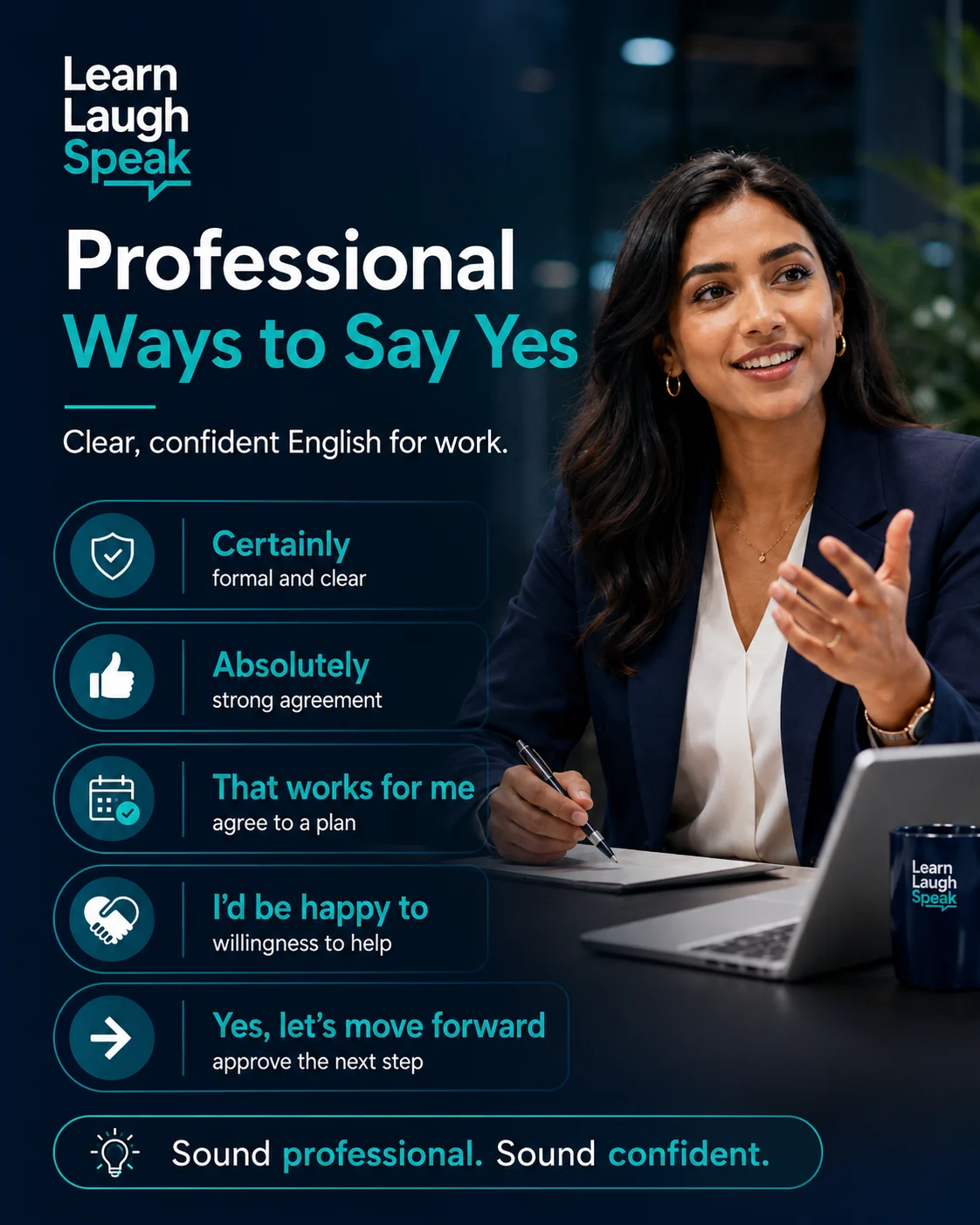
Professional ways to say yes include phrases like “Certainly,” “Absolutely,” “That works for me,” “I’d be happy to,” and “Yes, let’s move forward.” These phrases help you sound polite, confident, and clear in workplace English.
Learning professional ways to say yes in English helps you respond correctly in meetings, emails, customer service, hospitality, and daily business conversations. Saying “yes” may seem simple, but in professional situations, your tone matters. A casual “okay” or “sure” can work with friends, but at work, you often need a response that sounds more confident, respectful, and clear.
There are many professional ways to say yes in English. Some phrases show agreement. Others show willingness, approval, support, or confirmation. The best phrase depends on the situation, your relationship with the person, and how formal the conversation is.
If you are learning English for work, these phrases will help you answer requests, accept tasks, confirm plans, support ideas, and speak with more confidence.

Why Professional Ways to Say Yes Matter at Work
In business English, small words can create a big impression. When you say yes clearly and professionally, you show that you understand the request, respect the person, and are ready to move forward.
Using professional ways to say yes helps you:
- sound confident and respectful
- confirm that you understand the task
- show a positive attitude
- avoid sounding too casual
- respond clearly in emails and meetings
- build trust with colleagues, managers, clients, and customers
For example, if your manager asks:
“Can you send the report today?”
You could say:
“Yes, I can do that.”
That is correct. But you could sound more professional by saying:
“Certainly. I’ll send it by the end of the day.”
This response confirms the task and gives a clear timeframe.
Professional Ways to Say Yes in Simple Workplace English
You do not need complicated phrases to sound professional. Many strong workplace responses are simple, polite, and clear.
Here are useful professional ways to say yes:
| Phrase | Best situation |
|---|---|
| “Absolutely.” | Strong agreement or confident confirmation |
| “Certainly.” | Formal or polite response |
| “Yes, that works for me.” | Agreeing to a time, plan, or suggestion |
| “I’d be happy to.” | Showing willingness to help |
| “Yes, that sounds good.” | Agreeing naturally in a conversation |
| “I agree with that.” | Supporting an idea or opinion |
| “I’m on board with that.” | Supporting a plan or proposal |
| “Yes, let’s move forward.” | Approving a decision or next step |
| “That sounds like a good approach.” | Agreeing with a plan professionally |
| “I can take care of that.” | Accepting responsibility for a task |
Example:
Manager: “Can you prepare the client notes before the meeting?”
Employee: “Certainly. I’ll prepare them before 2 p.m.”
This sounds clear, responsible, and professional.
Professional Ways to Say Yes in Meetings
Meetings often require more than a simple “yes.” You may need to show agreement, support an idea, accept a task, or confirm a decision.
Useful phrases include:
- “I agree with that approach.”
- “That makes sense to me.”
- “Yes, I support that idea.”
- “Absolutely, I can take the lead on that.”
- “That works from my side.”
- “I’m comfortable moving forward with that.”
- “Yes, let’s schedule the follow-up for next week.”
- “I think that is the right direction.”
Example:
“Yes, I agree with that approach. It gives us enough time to prepare before the client meeting.”
This is better than only saying “yes” because it explains your reason and adds value to the discussion.
Workplace example:
If your team is deciding whether to move forward with a new process, you could say:
“Yes, I’m comfortable moving forward with this. I think it will make the process clearer for everyone.”
This shows agreement and gives a professional reason.
Professional Ways to Say Yes in Emails
Written communication should be polite, clear, and complete. When you say yes by email, it is helpful to confirm the request and include the next step.
Here are professional ways to say yes in emails:
- “Yes, I’m available and would be glad to participate.”
- “That timeline works for me. I’ll proceed as planned.”
- “Yes, I approve the proposal. Thank you for the update.”
- “Certainly. I’ll complete this by Friday.”
- “Yes, I can confirm that the meeting time works for me.”
- “I’d be happy to assist with this.”
- “Yes, please go ahead.”
- “That works well for me. Thank you for confirming.”
Email example: accepting a meeting
Subject: Re: Meeting Confirmation
Hi [Name],
Yes, that time works well for me. I’ll attend the meeting on Thursday at 10 a.m.
Thank you for organizing this.
Best regards,
[Your Name]
Email example: accepting a task
Subject: Re: Client Report
Hi [Name],
Certainly. I’ll review the client report and send my feedback by the end of the day.
Best regards,
[Your Name]
These examples sound professional because they do more than say yes. They confirm the action clearly.
Professional Ways to Say Yes When Accepting a Task
When someone asks you to complete a task, your response should show that you understand what needs to happen. If possible, include a timeframe.
Useful phrases include:
- “Yes, I can handle that.”
- “Certainly. I’ll take care of it.”
- “I can complete that by Thursday.”
- “Yes, I’ll get started on it today.”
- “I’d be happy to help with that.”
- “Absolutely. I’ll make sure it is completed on time.”
- “Yes, I can support you with that.”
- “I’ll move forward with this now.”
Example:
“Certainly. I’ll take care of the presentation and send you the first draft tomorrow.”
This response sounds responsible because it confirms the task and gives a clear next step.
Workplace example:
If a colleague asks, “Can you help me prepare for the client call?”, you can say:
“Yes, I’d be happy to help. I can review the notes with you before the call.”
This sounds supportive, clear, and professional.
Professional Ways to Say Yes When Agreeing to a Plan
Sometimes you are not accepting a task. You are agreeing to a plan, schedule, or decision.
Useful phrases include:
- “That works for me.”
- “That plan sounds good.”
- “Yes, I’m comfortable with that.”
- “I agree with the proposed timeline.”
- “That approach makes sense.”
- “Yes, let’s move forward with that.”
- “I think that is a good solution.”
- “That sounds like the best option.”
Example:
“That plan sounds good. I think it gives the team enough time to prepare properly.”
This sounds more engaged than simply saying “okay.”
Professional Ways to Say Yes to a Customer or Guest
In customer service, hospitality, retail, tourism, and support roles, saying yes professionally is very important. Customers and guests want to feel heard, respected, and helped.
Useful phrases include:
- “Yes, of course.”
- “Certainly, I can help you with that.”
- “Absolutely. Let me check that for you.”
- “Yes, we can arrange that.”
- “I’d be happy to assist you.”
- “Of course. Please give me a moment.”
- “Yes, that is available.”
- “Certainly. I’ll take care of that right away.”
Example:
Guest: “Can I have a late checkout?”
Staff: “Certainly. Let me check availability for you.”
This response is polite and professional because it does not promise before checking. It says yes to helping, while keeping the answer accurate.
Customer service example:
If a customer asks, “Can you send me the receipt by email?”, you can say:
“Yes, of course. I can send that to you now.”
This is simple, helpful, and professional.
Professional Ways to Say Yes With Enthusiasm
Sometimes you want to show that you are not only agreeing, but also positive about the opportunity.
Useful phrases include:
- “Absolutely, I’d be happy to.”
- “Yes, I’d love to be involved.”
- “That sounds great. I’m happy to help.”
- “I’d be glad to support this.”
- “Yes, I’m excited to contribute.”
- “That sounds like a great opportunity.”
- “I’m very happy to take part.”
Example:
“Yes, I’d be happy to join the project. It sounds like a great opportunity to contribute.”
This is useful when accepting a new project, joining a team, or agreeing to help with something important.
Professional Ways to Say Yes Without Overpromising
Sometimes you want to say yes, but you need to be careful. Maybe you need more details, more time, or approval from someone else.
In these situations, do not say yes too strongly if you are not sure. Use a professional phrase that shows willingness but also sets clear limits.
Useful phrases include:
- “Yes, I can help with that, but I’ll need a little more information first.”
- “I should be able to do that. Let me confirm the details.”
- “Yes, that should be possible. I’ll check and get back to you.”
- “I’m happy to help, but I may need until Friday to complete it.”
- “Yes, I can support this, depending on the final deadline.”
- “That should work, but I’ll confirm my availability first.”
Example:
“Yes, I can help with that, but I’ll need the final brief before I can start.”
This is professional because it says yes while protecting your time and responsibilities.
What Not to Say and Professional Ways to Say Yes Instead
“Okay” is not wrong, but it can sometimes sound too casual, too short, or unclear in professional communication. These alternatives sound better at work.
| What not to say | Professional way to say yes instead |
| “Okay.” | “Certainly.” |
| “Sure.” | “Of course.” |
| “Yep.” | “Yes, that works for me.” |
| “Fine.” | “That sounds good.” |
| “No problem.” | “I’d be happy to help.” |
| “Alright.” | “Yes, let’s move forward.” |
| “I guess so.” | “Yes, I can help with that.” |
| “If you want.” | “Yes, I’m happy to support this.” |
Example:
Too casual: “Okay, I’ll do it.”
Professional: “Certainly. I’ll take care of it today.”
The meaning is similar, but the professional version sounds more confident and respectful.
Common Mistakes with Professional Ways to Say Yes
English learners often know the word “yes,” but the challenge is using the right tone. Here are common mistakes to avoid.
1. Saying yes too casually
Too casual: “Yep, sure.”
Better: “Yes, of course.”
2. Saying yes without confirming the task
Unclear: “Yes.”
Better: “Yes, I’ll send the updated file by 3 p.m.”
3. Saying yes when you are not sure
Risky: “Yes, definitely.”
Better: “That should be possible. Let me confirm first.”
4. Sounding unwilling
Weak: “I guess so.”
Better: “Yes, I can help with that.”
5. Using the same phrase every time
If you always say “yes, sure,” your English may sound limited. Learn different professional ways to say yes so you can match the situation.
How to Practise Professional Ways to Say Yes
To make these phrases feel natural, practise them in real workplace situations.
Try this simple method:
- Choose five phrases from this article.
- Say them out loud.
- Practise with different situations.
- Record yourself and listen to your tone.
- Use one new phrase in an email or conversation this week.
Practice examples:
Situation: Your manager asks you to help with a report.
Response: “Certainly. I’ll take care of it this afternoon.”
Situation: A colleague suggests a meeting time.
Response: “That works for me. I’ll add it to my calendar.”
Situation: A customer asks for help.
Response: “Of course. I’d be happy to assist you.”
The more you practise, the easier it becomes to respond naturally and professionally.
Learn Professional Ways to Say Yes with Learn Laugh Speak
Learn Laugh Speak helps adult English learners build confidence for real workplace communication. Students practise English for emails, meetings, customer service, hospitality, business conversations, and daily professional situations.
If you want to use professional ways to say yes naturally, you need more than a list of phrases. You need practice with tone, context, pronunciation, listening, and real examples.
With Learn Laugh Speak, learners can improve step by step at the right level, from beginner to advanced. You can build practical English skills for work and daily life, with lessons designed to help you communicate clearly and confidently.
Internal link placement: Add a link here to What Is CEFR? What I Need to Know About CEFR using the anchor text learn English at the right level.

FAQs About Professional Ways to Say Yes
What are professional ways to say yes in English?
Professional ways to say yes include “Certainly,” “Absolutely,” “That works for me,” “I’d be happy to,” “Of course,” and “Yes, let’s move forward.” These phrases sound more polite and confident than simply saying “okay.”
How do you say yes politely in an email?
You can say “Yes, that works well for me,” “Certainly, I’ll complete this by Friday,” or “I’d be happy to assist with this.” In emails, it is best to confirm the request and include the next step.
Is “sure” professional?
“Sure” can be acceptable in relaxed workplaces, but it may sound too casual in formal emails, meetings, or customer service situations. Better professional options include “Certainly,” “Of course,” or “Yes, I’d be happy to.”
What is a formal way to say yes?
Formal ways to say yes include “Certainly,” “Absolutely,” “Yes, I agree,” “Yes, I can confirm,” and “I would be happy to assist.” These phrases are useful in business emails, meetings, and professional conversations.
How can I say yes without sounding too casual?
Use a phrase that confirms the action clearly. For example, instead of saying “Okay,” say “Certainly. I’ll take care of it today.” This sounds more professional and gives the person confidence that you understand the task.
Final Thoughts on Professional Ways to Say Yes
Using professional ways to say yes helps you sound confident, respectful, and prepared in English. You do not need difficult words. You need clear phrases that match the situation.
Instead of always saying “okay” or “sure,” try phrases like:
“Certainly.”
“That works for me.”
“I’d be happy to help.”
“Yes, let’s move forward.”
“Absolutely. I’ll take care of that.”
These small changes can make your English sound more professional in meetings, emails, customer conversations, and daily workplace communication.
If you want to improve your professional English, practise these phrases often and use them in real conversations. Over time, saying yes professionally will feel natural, confident, and easy.
One thought on “Professional Ways to Say Yes in English Easily and Correctly”
Pingback: Important Words About War You Need to Know in English - Learn Laugh Speak