
 English
 Arabic
 Chinese (Simplified)
 Dutch
Dutch French
 German
 Italian
 Portuguese
 Russian
 Spanish
Learning how to say you are disappointed professionally is important when something goes wrong at work, but you still need to stay calm, respectful, and clear. In English, disappointment can sound too emotional, too direct, or even rude if the words are not chosen carefully.
At work, you may feel disappointed because a project was delayed, a colleague did not follow through, a customer was treated badly, or a manager made a decision you did not expect. The goal is not to hide how you feel. The goal is to explain the problem in a way that helps people understand you and take action.
This article gives you practical phrases, email examples, and workplace situations so you can express disappointment clearly without damaging professional relationships.

Why It Matters to Say You Are Disappointed Professionally
Disappointment is normal in the workplace. People miss deadlines, communication breaks down, expectations are not met, and results are not always what you hoped for.
But how you express disappointment matters.
If you sound too emotional, people may focus on your tone instead of the issue. If you sound too weak, your concern may not be taken seriously. If you sound too aggressive, the conversation can quickly become defensive.
When you know how to say you are disappointed professionally, you can:
- explain your concern without creating unnecessary conflict
- protect your workplace relationships
- show that you are calm and serious
- focus on the problem instead of blaming someone
- increase the chance of finding a solution
- sound more confident in business English
For English learners, this is especially useful because direct translations from your first language may sound too strong in English.
For example, instead of saying:
“I am very angry with this.”
You could say:
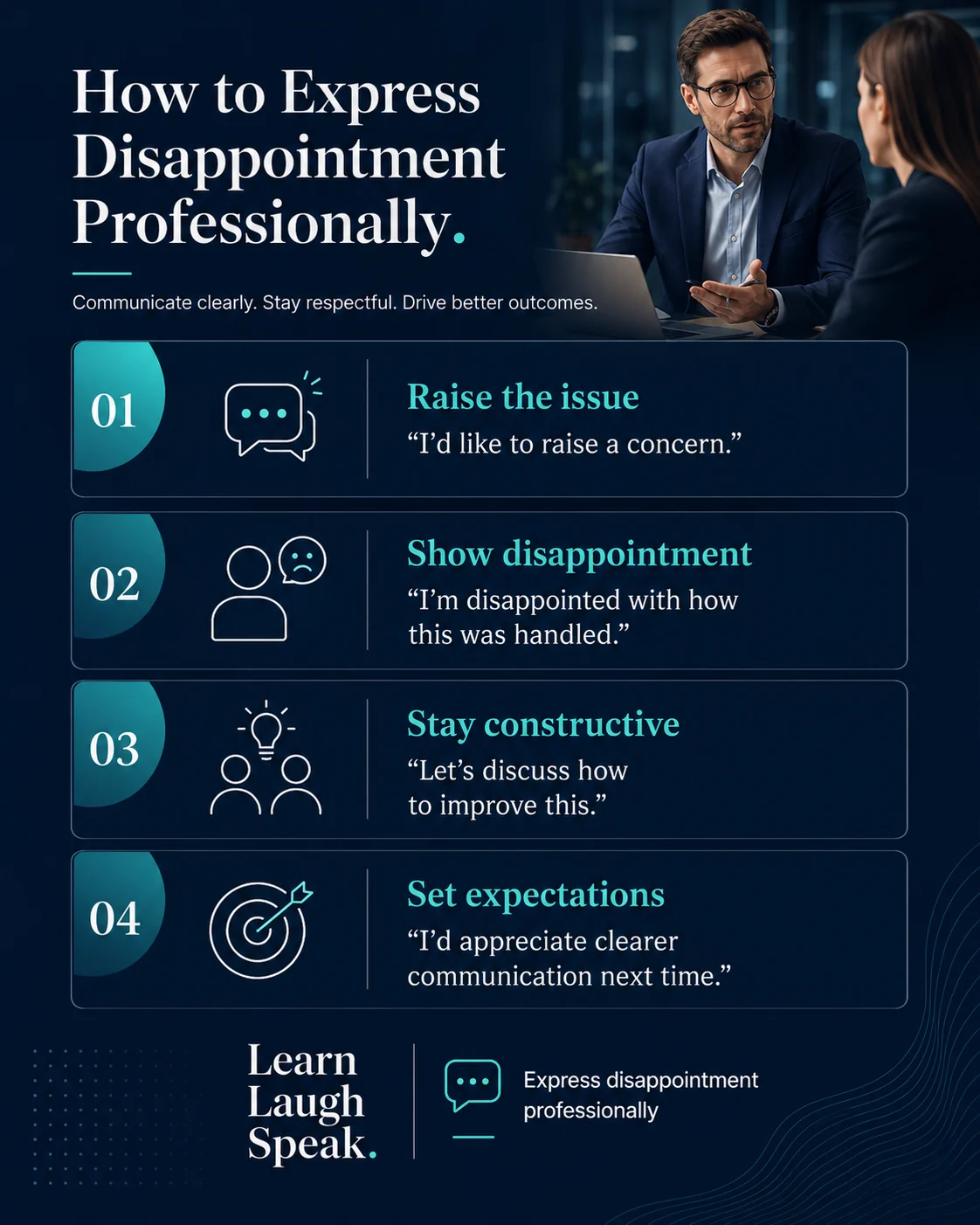
“I’m disappointed with how this was handled, and I’d like to understand what happened.”
This sounds calmer, clearer, and more professional.
Before You Say You Are Disappointed Professionally, Choose Your Message
Before you respond, take a moment to think. When you are disappointed, it is easy to speak too quickly and say something that sounds too emotional.
Ask yourself:
| Question | Why it helps |
|---|---|
| What exactly disappointed me? | Keeps the message focused |
| What did I expect instead? | Helps explain the problem clearly |
| Who needs to hear this? | Avoids unnecessary blame |
| What result do I want? | Moves the conversation toward action |
| Should I say this by email or in person? | Helps you choose the right tone |
If you feel too upset to answer immediately, use a calm phrase like:
“I’d like to take some time to review this properly before I respond.”
Or:
“I want to make sure I respond clearly, so I’ll come back to this shortly.”
This gives you time to calm down and prepare your message. It also shows emotional control, which is very important in professional communication.
Useful Phrases to Say You Are Disappointed Professionally
Sometimes, you need to be direct. You do not want to sound rude, but you also do not want to hide the problem. These phrases help you express disappointment in a professional way.
| Situation | Professional phrase |
| A situation was not handled well | “I’m disappointed with how this situation has been handled.” |
| The result was not what you expected | “I was expecting a different outcome, so this is disappointing.” |
| You are concerned about what happened | “I find this situation concerning and would like to understand it better.” |
| You are not happy with the result | “I have to admit, I’m not satisfied with the outcome.” |
| You want to discuss the issue calmly | “I’d like to talk through this because I have some concerns.” |
Example:
“I’m disappointed with how this project was managed. I expected a more structured approach, especially because the deadline was important for the client.”
This sentence works because it explains the feeling, the reason, and the impact. It does not attack the person.
How to Say You Are Disappointed Professionally Without Sounding Confrontational
When you are disappointed, avoid starting with blame. In English, it often sounds better to open the conversation with a calm phrase before explaining the issue.
You can say:
- “I need to raise a concern about this.”
- “I’d like to discuss something that has been bothering me.”
- “I want to bring up a concern about how this was handled.”
- “I’d appreciate some clarification on this, as I have concerns.”
- “Can we take a moment to review what happened here?”
Example:
“I need to raise a concern about the delayed response time. It is affecting our team’s ability to support the client properly.”
This is professional because it focuses on the issue and the impact.
Avoid saying:
“You never reply on time.”
Say instead:
“The delayed response time is creating challenges for the team.”
This small change makes your message easier to accept. It also helps the other person focus on solving the problem instead of defending themselves.
Email Examples to Say You Are Disappointed Professionally
Email can be a good way to express disappointment because you have time to choose your words carefully. However, written English can sound stronger than spoken English, so your tone should be calm and balanced.
Example 1: Disappointed with a delayed response
Subject: Follow-up on delayed response
Hi [Name],
I wanted to follow up because I’m disappointed that we have not received a response yet. This delay is affecting our ability to move forward with the next step.
Could you please let me know when we can expect an update?
Thank you,
[Your Name]
Example 2: Disappointed with a project outcome
Subject: Project outcome discussion
Hi [Name],
I wanted to share some feedback regarding the final outcome of the project. I was expecting a different result, so I have to admit that I’m disappointed with where things currently stand.
I’d like to understand what happened and discuss how we can avoid similar issues in the future.
Best,
[Your Name]
Example 3: Disappointed but solution-focused
Subject: Next steps for improvement
Hi [Name],
I understand that challenges can happen, but I’m disappointed with how this situation was handled. I think it would be useful for us to review the process and agree on clearer expectations moving forward.
Please let me know a suitable time to discuss this.
Kind regards,
[Your Name]
These examples are direct without being rude. They show that you are unhappy, but they also keep the conversation focused on improvement.
How to Say You Are Disappointed Professionally in a Meeting
In a meeting or face-to-face conversation, your tone of voice matters as much as your words. Speak slowly, stay calm, and avoid starting with a personal attack.
You can begin with:
“I’d like to speak honestly but professionally about this.”
Then explain the issue.
Example:
“I’m disappointed with how the situation developed. I felt that my concerns were not fully considered, and I’d like to understand how we can improve this moving forward.”
This works well because it is honest, but not aggressive.
You can also say:
- “I want to be honest. This outcome was disappointing.”
- “I was hoping for a better result.”
- “I feel this could have been handled more carefully.”
- “I’d like to understand what went wrong.”
- “Can we talk about how to prevent this happening again?”
These phrases are useful in team meetings, one-to-one conversations, client discussions, and management conversations.
Say You Are Disappointed Professionally and Stay Solution-Oriented
One of the best ways to sound professional is to move from the problem to the solution. This does not mean ignoring the disappointment. It means showing that you want to improve the situation.
You can say:
- “This is disappointing, but I’d like to focus on how we can fix it.”
- “I understand that mistakes happen, but we need a better process moving forward.”
- “I’m not satisfied with the current situation, so I’d like to explore some alternatives.”
- “I think we need to re-evaluate our approach.”
- “Let’s agree on the next steps so this does not happen again.”
Example:
“This is disappointing, but I’d like to focus on the solution. Can we review the timeline and agree on what needs to happen next?”
This kind of language is very useful in business English because it shows maturity, confidence, and leadership.
How to Say You Are Disappointed Professionally When Setting Boundaries
Sometimes disappointment is not only about one mistake. It may be about repeated poor communication, missed expectations, or a lack of respect. In these situations, you may need to set a clear boundary.
You can say:
- “I want to be clear that this cannot continue moving forward.”
- “I’d appreciate clearer communication next time.”
- “I feel my concerns were overlooked, and I would like that to change.”
- “I need us to agree on a more professional approach.”
- “In the future, I would expect this to be handled differently.”
Example:
“I’d appreciate clearer communication next time. When updates are delayed, it affects the whole team and creates unnecessary pressure.”
This sentence is firm, but still respectful.
Be careful with the phrase:
“This is unacceptable.”
This can be used when the situation is serious, but it is quite strong. In many workplace situations, a softer version sounds better:
“I don’t think this is acceptable moving forward.”
This still communicates a clear boundary, but it sounds more controlled.
How to Say You Are Disappointed Professionally When It Is Urgent
Some problems need immediate attention. You may be disappointed, but you also need quick action.
Useful phrases include:
- “This needs to be addressed as soon as possible.”
- “I’m concerned about the impact this is having.”
- “We need to prioritize resolving this matter.”
- “I’d like to understand how this will be fixed.”
- “Can we agree on a solution today?”
Example:
“I’m concerned about the impact this is having on the client. Can we agree on a solution today?”
This works well because it explains the urgency without sounding angry.
In customer service, hospitality, sales, and management, this type of phrase is very useful. Problems often need to be solved quickly, but the tone still needs to remain professional.
How to Say You Are Disappointed Professionally to Your Boss
Speaking to your boss can feel difficult because you may worry about sounding disrespectful. The key is to focus on the situation, not the person.
You can say:
“I wanted to share some feedback respectfully. I was disappointed with how this decision was communicated, and I would appreciate more context if possible.”
Or:
“I understand the decision, but I have to admit I was disappointed by the outcome. Could we discuss what I can do differently next time?”
If the issue affected your work, you can say:
“I wanted to raise this because it affected my ability to complete the task properly. I’d appreciate clearer expectations moving forward.”
These phrases are respectful but still honest. They help you express concern without sounding like you are challenging your manager in a rude way.
Common Mistakes When Expressing Disappointment in English
When you are disappointed, avoid language that sounds too personal, emotional, or accusatory.
| Avoid saying | Say this instead |
| “You failed to do this properly.” | “This was not handled as expected.” |
| “I’m angry with you.” | “I’m concerned about what happened.” |
| “This is your fault.” | “We need to understand where the process broke down.” |
| “You never listen.” | “I feel my concerns were not fully considered.” |
| “This is terrible.” | “This outcome is disappointing.” |
These changes help you stay professional while still being honest.
A useful rule is this:
Talk about the issue, the impact, and the next step. Do not attack the person.
For example:
“The late update caused confusion for the client, so we need a clearer process for next time.”
This is much stronger than simply saying:
“You caused a problem.”
Practise How to Say You Are Disappointed Professionally with Learn Laugh Speak
Knowing the right phrases is helpful, but real progress comes when you can use them naturally in conversation, emails, meetings, and workplace situations.
Learn Laugh Speak helps adult English learners improve practical communication for real professional moments. This includes giving feedback, handling difficult conversations, writing better emails, speaking with customers, and sounding more confident at work.
With Learn Laugh Speak, students can learn at the right level, practise useful workplace English, and build confidence step by step. Instead of only memorising vocabulary, you learn how to use English in real situations.
If you are learning English for work, phrases like these are important because they help you communicate clearly when conversations are not easy.

Final Thoughts on How to Say You Are Disappointed Professionally
Learning how to say you are disappointed professionally helps you communicate clearly without damaging workplace relationships. You do not need to sound angry to be taken seriously. You need calm, direct, respectful language that explains the problem and helps move the conversation toward a solution.
Use phrases like:
“I’m disappointed with how this was handled.”
“I’d like to understand what happened.”
“Can we discuss how to prevent this in the future?”
These phrases help you express your concerns in a professional way while protecting your confidence, your relationships, and your reputation at work.
If you want to improve your business English and feel more confident in difficult conversations, Learn Laugh Speak can help you practise the real English you need for work.
One thought on “How to Say You Are Disappointed Professionally in English”
Pingback: What Is Professional English? A Practical Guide for Work - Learn Laugh Speak