
 English
 Arabic
 Chinese (Simplified)
 Dutch
Dutch French
 German
 Italian
 Portuguese
 Russian
 Spanish
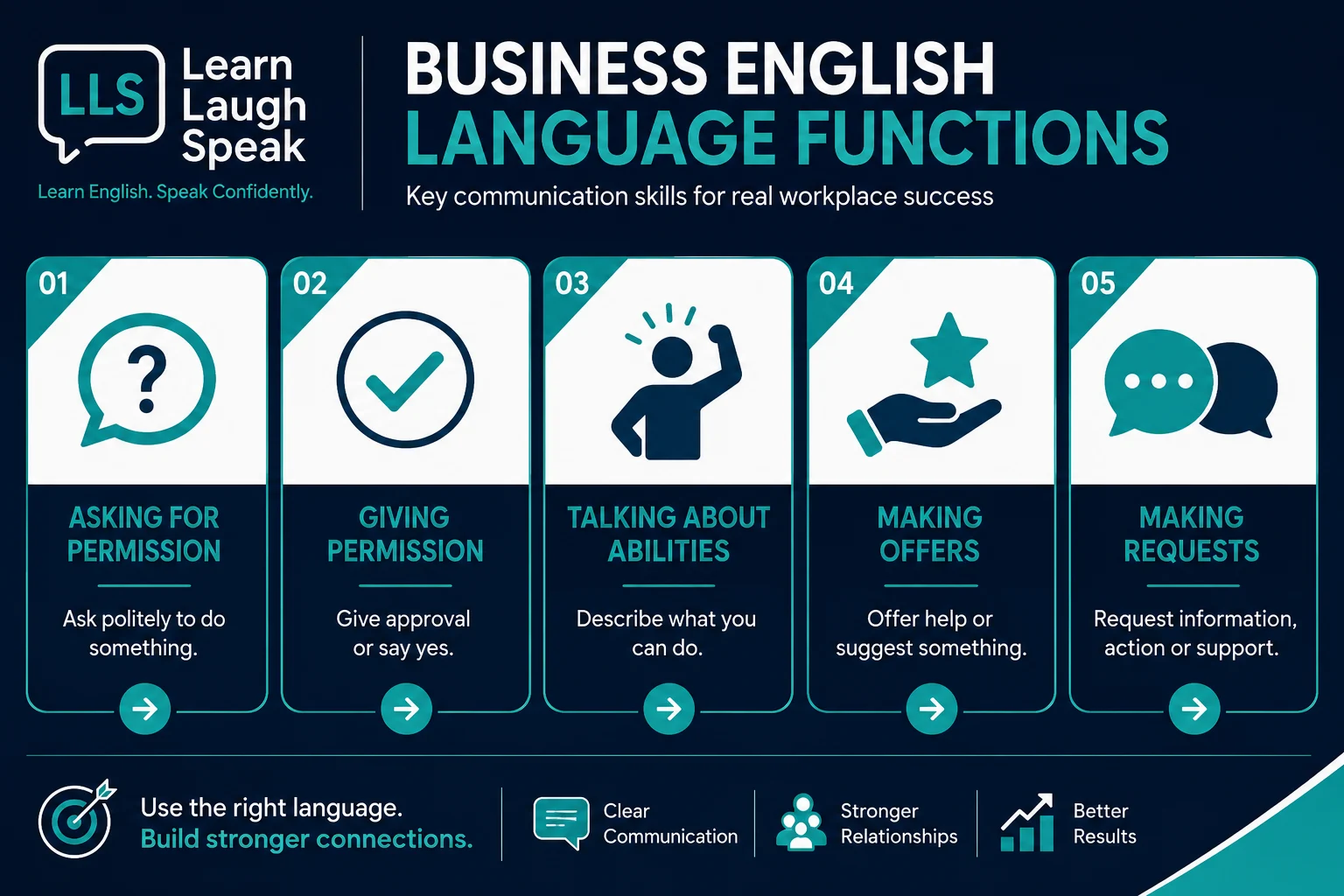
Business English language functions are the practical communication skills adults use at work, such as asking for permission, talking about abilities, making offers, and making requests. They help you use English clearly, politely, and professionally in real workplace situations.
When adults learn English for work, they need more than vocabulary and grammar. They need to know how to use English in practical situations. This is where business English language functions become important.
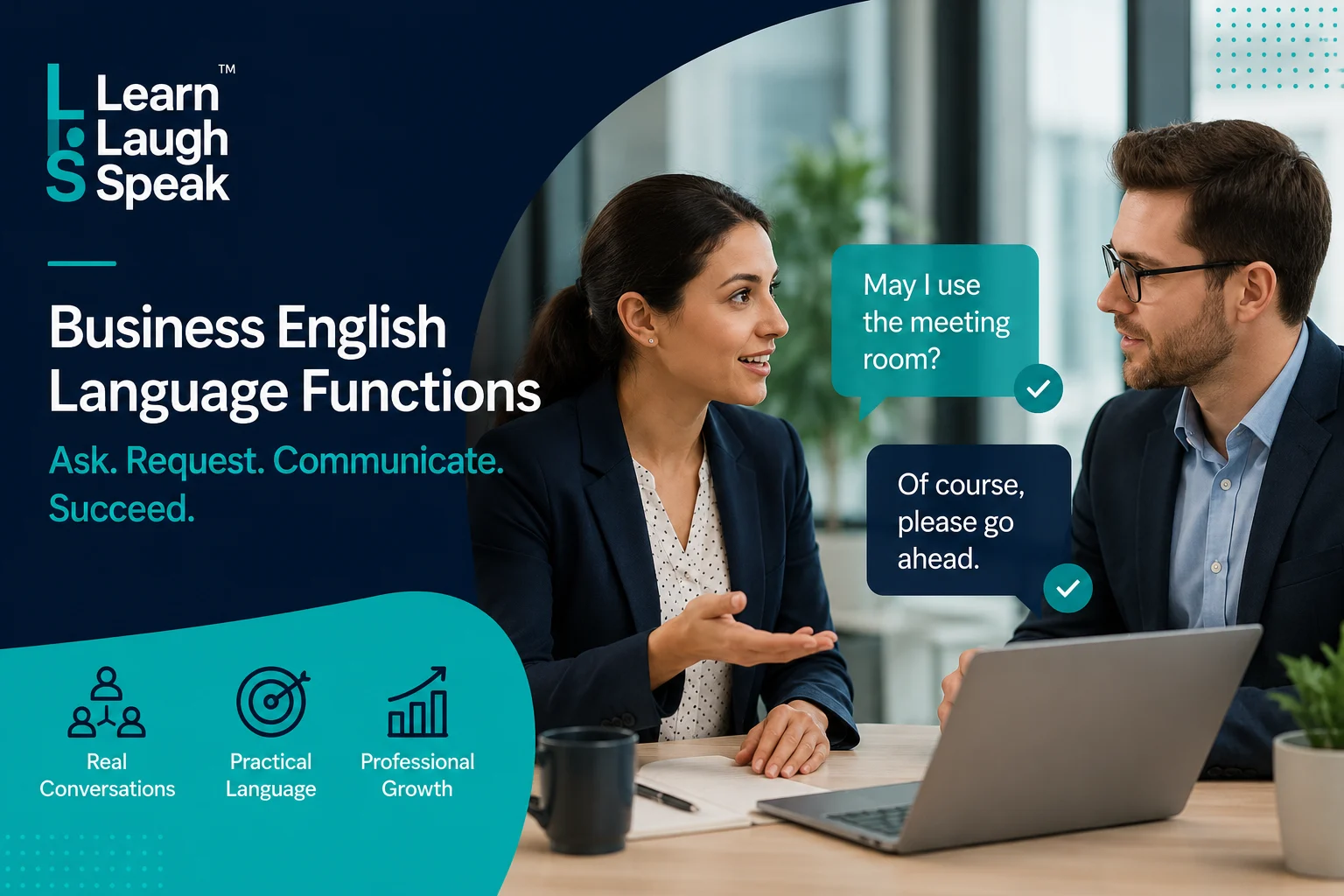
A language function is the purpose of what you say. For example, when you ask, “May I use the meeting room?” the function is asking for permission. When you say, “I can handle customer complaints,” the function is talking about abilities.
For adults learning business English, these small communication skills are essential. They help you speak with managers, colleagues, guests, clients, and customers in a clear and professional way.
In this article, we will refresh the key business English language functions adults need most: asking for permission, giving permission, talking about abilities, making offers, and making requests.

Why Business English Language Functions Matter at Work
In business English, it is not enough to know individual words. You also need to know how to use those words in the right situation.
At work, you may need to ask your manager for permission, explain what you can do, offer help to a customer, request information from another team, or say no politely. These are not just grammar points. They are real communication tasks.
When you master them, your English becomes more useful immediately. You can participate in meetings, manage customer conversations, write better emails, and handle daily workplace situations with more confidence.
For adults, this is especially important because you are often learning English for a real purpose. You may need English for your job, your business, your team, your clients, or your future career opportunities.
What Business English Language Functions Mean in Real Communication
A language function is the reason behind a sentence. It connects grammar with real communication.
| Sentence | Language function |
|---|---|
| “Can I leave early today?” | Asking for permission |
| “You may use the meeting room.” | Giving permission |
| “I can prepare the report.” | Talking about ability |
| “Would you like me to help?” | Making an offer |
| “Could you send me the file?” | Making a request |
This is why business English language functions are useful for adults. Instead of only studying rules, you learn how to use English to complete real workplace tasks.
For example, a hotel receptionist does not only need the word “permission.” They need phrases like, “May I see your passport?” or “You are welcome to leave your bags at reception.” A sales manager does not only need the word “request.” They need phrases like, “Could you please confirm the final price?”
Business English Language Functions for Asking Permission
Asking for permission is one of the most common language functions at work. You may need permission to use a resource, change a schedule, contact a client, enter a room, access a document, or make a decision.
The key is to sound polite and clear.
| Phrase | Best use |
| Can I…? | Neutral and common |
| Could I…? | More polite |
| May I…? | More formal |
| Is it okay if I…? | Friendly and natural |
| Would it be possible to…? | Polite and professional |
| Do you mind if I…? | Polite, often used when your action affects another person |
Examples:
- “Can I schedule a meeting with the client next week?”
- “Could I use the conference room at 3 PM?”
- “May I access the confidential documents?”
- “Is it okay if I send the proposal this afternoon?”
- “Would it be possible to move the meeting to Friday?”
- “Do you mind if I join the call five minutes late?”
These phrases help you ask without sounding too direct.
Useful Phrases for Asking Permission
In business English, small changes make a big difference. “Can I” is simple and common, but “Could I” and “May I” sound more polite.
Use “Can I” in everyday workplace situations:
- “Can I call you after lunch?”
- “Can I check this with my manager?”
Use “Could I” when you want to sound more respectful:
- “Could I take five minutes of your time?”
- “Could I send this to the client tomorrow?”
Use “May I” in formal situations:
- “May I begin the presentation?”
- “May I ask a question about the contract?”
The best phrase depends on the person, the situation, and how formal the workplace is.
Business English Language Functions for Giving Permission
Giving permission is also important, especially if you manage a team, support customers, or work in hospitality, sales, administration, or operations.
| Phrase | Meaning |
| Yes, of course. | Friendly and clear |
| Sure, that’s fine. | Natural and common |
| Please feel free to… | Polite and professional |
| You are welcome to… | Friendly and helpful |
| That should be okay. | Permission with some flexibility |
| Yes, you can go ahead. | Clear approval |
Examples:
- “Yes, of course. You can use the meeting room.”
- “Please feel free to contact me if you have questions.”
- “You are welcome to use the company car for the business trip.”
- “Sure, that’s fine. You can send the report tomorrow morning.”
- “Yes, you can go ahead and contact the supplier.”
Giving permission clearly helps avoid confusion and keeps work moving smoothly. It also makes your English sound more confident and professional.
Professional Ways to Refuse Permission
Sometimes you need to say no. In business English, the goal is to refuse clearly but politely.
| Too direct | Better professional version |
| “No, you can’t.” | “I’m sorry, but that won’t be possible today.” |
| “That’s not allowed.” | “Unfortunately, we are not able to approve that request.” |
| “I don’t want you to do that.” | “I think it would be better to wait before moving ahead.” |
| “No, ask someone else.” | “I’m not the best person to approve this, but I can help you find who is.” |
| “You can’t have more time.” | “I’m sorry, but we need to keep the original deadline.” |
Examples:
- “I’m sorry, but I cannot approve the deadline extension.”
- “Unfortunately, we are not able to share that information.”
- “I understand your request, but we need to follow the company policy.”
- “I’m afraid the meeting room is already booked.”
This type of language sounds professional because it is respectful, but still clear.
Business English Language Functions for Talking About Abilities
Talking about abilities is another essential workplace function. You may need to explain your skills in a meeting, job interview, performance review, email, or customer conversation.
This is especially useful for adults who work in hotels, restaurants, tourism, customer service, sales, management, or international business.
| Phrase | Example |
| I can… | “I can prepare the report by Friday.” |
| I am able to… | “I am able to manage guest complaints calmly.” |
| I have experience in… | “I have experience in handling reservations.” |
| I am confident with… | “I am confident with customer communication.” |
| I am skilled at… | “I am skilled at solving problems quickly.” |
| I am familiar with… | “I am familiar with Opera and Amadeus systems.” |
Examples:
- “I have excellent problem-solving skills, which help me handle guest complaints efficiently.”
- “My communication skills allow me to interact clearly with guests and team members.”
- “I am proficient in using reservation systems such as Opera and Amadeus.”
- “I can multitask during busy shifts and still provide high-quality service.”
- “I have strong attention to detail, which helps me check orders and avoid mistakes.”
- “I am able to support customers in English during check-in, complaints, and general questions.”
These phrases help you describe your ability without sounding arrogant.
Business English Language Functions for Making Offers
Making offers is important when you want to help a colleague, guest, client, or customer.
Offers are common in customer service, hospitality, sales, meetings, and daily workplace conversations.
| Phrase | Example |
| Can I help you with…? | “Can I help you with the booking?” |
| Would you like me to…? | “Would you like me to send the report?” |
| I can… if you like. | “I can call the client if you like.” |
| I’d be happy to… | “I’d be happy to assist you with that.” |
| Let me… | “Let me check that for you.” |
| I can take care of… | “I can take care of the reservation.” |
Examples:
- “Can I help you with anything before the meeting?”
- “Would you like me to contact the supplier?”
- “I’d be happy to assist you with the presentation.”
- “Let me check the availability for you.”
- “I can send the updated file this afternoon if you like.”
In professional English, offers should sound helpful but not pushy.
Business English Language Functions for Making Requests
Making requests is one of the most useful language functions in business English. You may need to ask for documents, information, support, approval, updates, or changes.
The most important thing is to sound polite and specific.
| Phrase | Example |
| Can you…? | “Can you send me the file?” |
| Could you please…? | “Could you please confirm the meeting time?” |
| Would you be able to…? | “Would you be able to review this today?” |
| I would appreciate it if you could… | “I would appreciate it if you could send the report.” |
| Could I ask you to…? | “Could I ask you to update the client list?” |
| Please could you…? | “Please could you check the invoice?” |
Examples:
- “Could you please provide more information about the client’s request?”
- “Would you be able to send me the updated schedule?”
- “I would appreciate it if you could review the report before Friday.”
- “Could I ask you to confirm the final price?”
- “Please could you share the meeting notes?”
Clear requests help reduce mistakes and save time at work.
Making Offers and Requests More Professional
The words you choose can change how your message sounds. In business English, small changes can make your communication more professional.
| Basic English | More professional English |
| “Send me the file.” | “Could you please send me the file?” |
| “I need this now.” | “Would you be able to send this as soon as possible?” |
| “Help me with this.” | “Could you help me with this when you have a moment?” |
| “I’ll do it.” | “I’d be happy to take care of that.” |
| “Do you want help?” | “Would you like me to help with that?” |
This is where business English language functions are powerful. You can use simple grammar, but still sound polite, professional, and clear.
Business English Language Functions in Workplace Dialogues
Short dialogues help you see how these phrases work in real conversations.
Asking for permission
Employee: “Could I leave early today for an appointment?”
Manager: “Yes, that’s fine. Please send me the project update before you go.”
Talking about ability
Manager: “Can you handle the client call tomorrow?”
Employee: “Yes, I can. I have experience with this client, and I’m familiar with the project details.”
Making an offer
Receptionist: “Would you like me to call a taxi for you?”
Guest: “Yes, please. That would be helpful.”
Making a request
Team member: “Could you please send me the final version of the presentation?”
Colleague: “Of course. I’ll send it this afternoon.”
These examples show how practical workplace phrases help adults communicate with more confidence.
Practice Tips for Adults Learning Business English
Improving your business English takes practice, but it does not need to be complicated. Focus on the functions you use most often at work.
Start with one function, such as asking for permission, and practice five useful phrases:
- “Can I…?”
- “Could I…?”
- “May I…?”
- “Is it okay if I…?”
- “Would it be possible to…?”
Once these feel natural, move to another function.
Adults often learn vocabulary lists, but phrases are more useful at work. Instead of only learning the word “permission,” learn full phrases like:
- “Could I use the meeting room?”
- “May I speak with the manager?”
- “Is it okay if I contact the client?”
Your English improves faster when the practice matches your real life. If you work in hospitality, practice guest situations. If you work in sales, practice client conversations. If you work in administration, practice emails and internal requests.
Practice Business English with Learn Laugh Speak
Learn Laugh Speak helps adults improve English with structured lessons, speaking practice, listening exercises, and instant corrections. This is useful for busy professionals because you can practice at your own level and improve step by step.
With 12 levels from beginner to advanced, thousands of lessons, and native-speaker recordings, Learn Laugh Speak helps adults build practical English for work, not just classroom English.
If you want to improve the way you ask questions, make requests, explain your abilities, and speak with confidence at work, Learn Laugh Speak gives you a clear path to practice every day.
Final Thoughts on Business English Language Functions
Mastering business English language functions gives adults a practical way to improve communication at work. You do not need complicated grammar to sound professional. You need the right phrases for the right situations.
When you can ask for permission, give permission, talk about your abilities, make offers, and make requests clearly, your English becomes more confident and useful.
Start with the phrases in this article, practice them in real workplace situations, and build your English step by step. With consistent practice and the right tools, you can improve your business English and communicate more professionally every day.
FAQs About Business English Language Functions
What are business English language functions?
Business English language functions are the practical purposes of communication at work. Examples include asking for permission, making requests, offering help, giving instructions, explaining abilities, and refusing politely.
Why are business English language functions important?
They help adults use English in real workplace situations. Instead of only learning grammar, you learn how to communicate clearly with colleagues, managers, clients, customers, and guests.
What are examples of business English language functions?
Common examples include asking for permission, giving permission, talking about abilities, making offers, making requests, asking for clarification, agreeing, disagreeing politely, and giving feedback.
How can adults practice business English language functions?
Adults can practice by learning useful phrases, speaking out loud, role-playing workplace situations, listening to professional English, and using structured tools like Learn Laugh Speak for guided practice.
What is a polite way to make a request in business English?
A polite request often starts with “Could you please…?” or “Would you be able to…?” For example, “Could you please send me the report before Friday?”
2 thoughts on “Business English Language Functions Adults Need at Work”
Pingback: How to Choose Contacts for Astigmatism - Learn Laugh Speak
Pingback: Professional Story Telling vs Personal Story telling: Explained Simply - Learn Laugh Speak