
 English
 Arabic
 Chinese (Simplified)
 Dutch
Dutch French
 German
 Italian
 Portuguese
 Russian
 Spanish
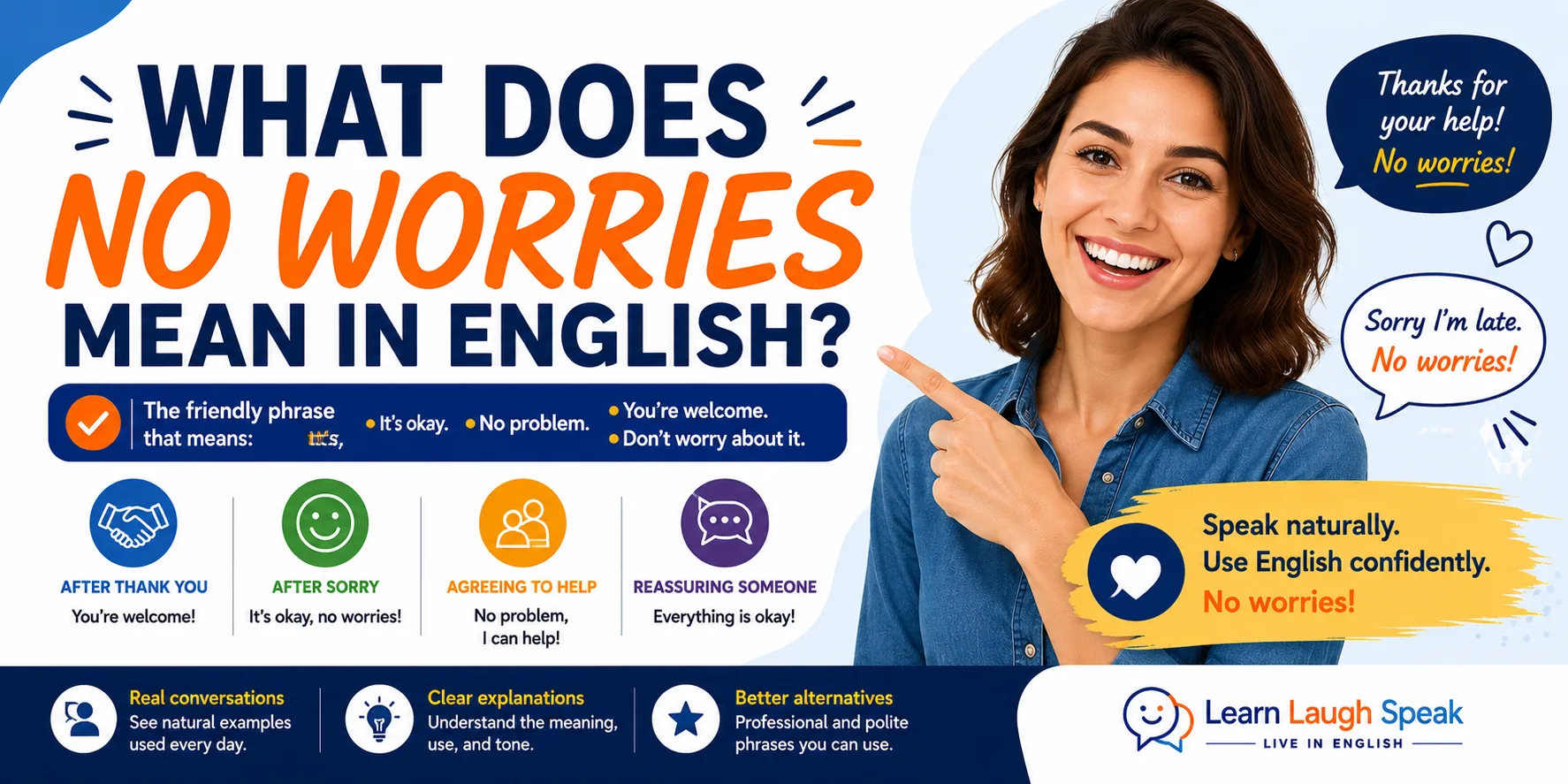
Direct Answer: What Does No Worries Mean?
No worries is a friendly English phrase that usually means:
It’s okay.
No problem.
You’re welcome.
Don’t worry about it.
English speakers often use no worries after someone says thank you, sorry, or asks for help.
Examples:
Thank you for helping me.
No worries.
Sorry I’m late.
No worries.
Can you send me the file?
No worries, I’ll send it now.
The phrase is informal, friendly, and relaxed. It is common in everyday English and is especially common in Australia, New Zealand, the UK, and many modern workplaces.
When English Speakers Use “No Worries”
English speakers use no worries in several common situations.
It can be used to respond to thanks.
Example:
Thanks for your help.
No worries.
This means:
You’re welcome.
It can also be used after someone apologizes.
Example:
Sorry for the delay.
No worries.
This means:
It’s okay. Don’t worry about it.
You can also use no worries when agreeing to help someone.
Example:
Can you check this for me?
No worries, I’ll take a look.
This means:
Yes, I can help.
So, if you are asking what does no worries mean, the answer depends slightly on the situation, but the general feeling is always relaxed and positive.
No Worries Meaning in Different Situations
Here is a simple guide.
| Situation | Meaning of “No Worries” | Example |
|---|---|---|
| After “thank you” | You’re welcome / no problem | “Thanks.” “No worries.” |
| After “sorry” | It’s okay / don’t worry | “Sorry I’m late.” “No worries.” |
| When agreeing to help | That’s fine / I can help | “Can you send it?” “No worries.” |
| When reassuring someone | Everything is okay | “Is this a problem?” “No worries.” |
| In casual messages | All good / no problem | “No worries, see you later.” |
The phrase is short, but it can carry several meanings depending on the conversation.
Is “No Worries” Polite?
Yes, no worries is usually polite.
However, it is also informal.
This means it is friendly and natural in casual conversations, text messages, and many workplace situations.
You can use it with:
friends
coworkers
classmates
customers in relaxed situations
people you already know
But in very formal writing, you may want to use a more professional phrase.
For example, instead of:
No worries.
You could say:
You’re welcome.
That’s not a problem.
It’s completely fine.
Of course.
I’m happy to help.
The phrase no worries is not rude, but the situation matters.
No Worries vs You’re Welcome
No worries and you’re welcome can both be used after someone says thank you.
Example:
Thank you for your help.
You’re welcome.
This is polite and standard.
Example:
Thank you for your help.
No worries.
This is friendly and relaxed.
Here is the difference:
| Phrase | Tone | Best Use |
| You’re welcome | polite and standard | formal or general situations |
| No worries | friendly and informal | casual or relaxed situations |
| My pleasure | warm and polite | customer service or professional situations |
| Happy to help | friendly and professional | workplace emails or support |
If you are not sure which one to use, you’re welcome is always safe.
If the situation is relaxed, no worries sounds natural.
No Worries vs Don’t Worry
These two phrases are similar, but they are not always used the same way.
No worries is often used as a response.
Example:
Sorry I forgot to reply.
No worries.
Don’t worry is often used as an instruction or reassurance.
Example:
Don’t worry about the meeting. I will help you prepare.
Compare:
No worries.
This means: It’s okay.
Don’t worry.
This means: Do not feel worried.
Both phrases can make someone feel calm, but no worries sounds more casual.
Examples of “No Worries” in Conversations
Here are some natural examples.
After Thank You
A: Thanks for sending the report.
B: No worries.
A: Thank you for waiting.
B: No worries at all.
A: Thanks for helping me with the form.
B: No worries. Happy to help.
After Sorry
A: Sorry I’m late.
B: No worries. We just started.
A: Sorry, I forgot to attach the file.
B: No worries. Please send it when you can.
A: Sorry for the confusion.
B: No worries. Let’s fix it now.
When Offering Help
A: Can you explain this word?
B: No worries, I can help.
A: Could you resend the email?
B: No worries, I’ll send it again.
A: Can we move the meeting to Friday?
B: No worries, Friday works for me.
These examples show how flexible the phrase can be.
Can You Use “No Worries” at Work?
Yes, you can use no worries at work, but it depends on the tone of the conversation.
It is common in casual workplace messages.
Examples:
No worries, I’ll update the file.
No worries, thanks for letting me know.
No worries, I can join at 3 PM.
No worries, I’ll check with the team.
However, in formal emails or important client communication, you may want to use a more professional option.
Instead of:
No worries.
You can write:
That’s not a problem.
Thank you for letting me know.
I’m happy to help.
Of course, I’ll take care of it.
That’s completely fine.
This helps your message sound polished and professional.
Common Mistakes With “No Worries”
Here are common mistakes English learners make with this phrase.
| Mistake | Better English | Why |
| No worry | No worries | The common phrase is plural |
| Don’t worries | Don’t worry / No worries | “Don’t worries” is incorrect |
| I have no worries to help you | No worries, I can help you | Use it as a response |
| No worries for your email | No problem, thanks for your email | More natural in work emails |
| No worries about you | Don’t worry about it | Different meaning |
| Using it in very formal emails | You’re welcome / That’s not a problem | More professional |
The most important thing to remember is that no worries is usually used as a short response.
It is not always a full sentence explanation.
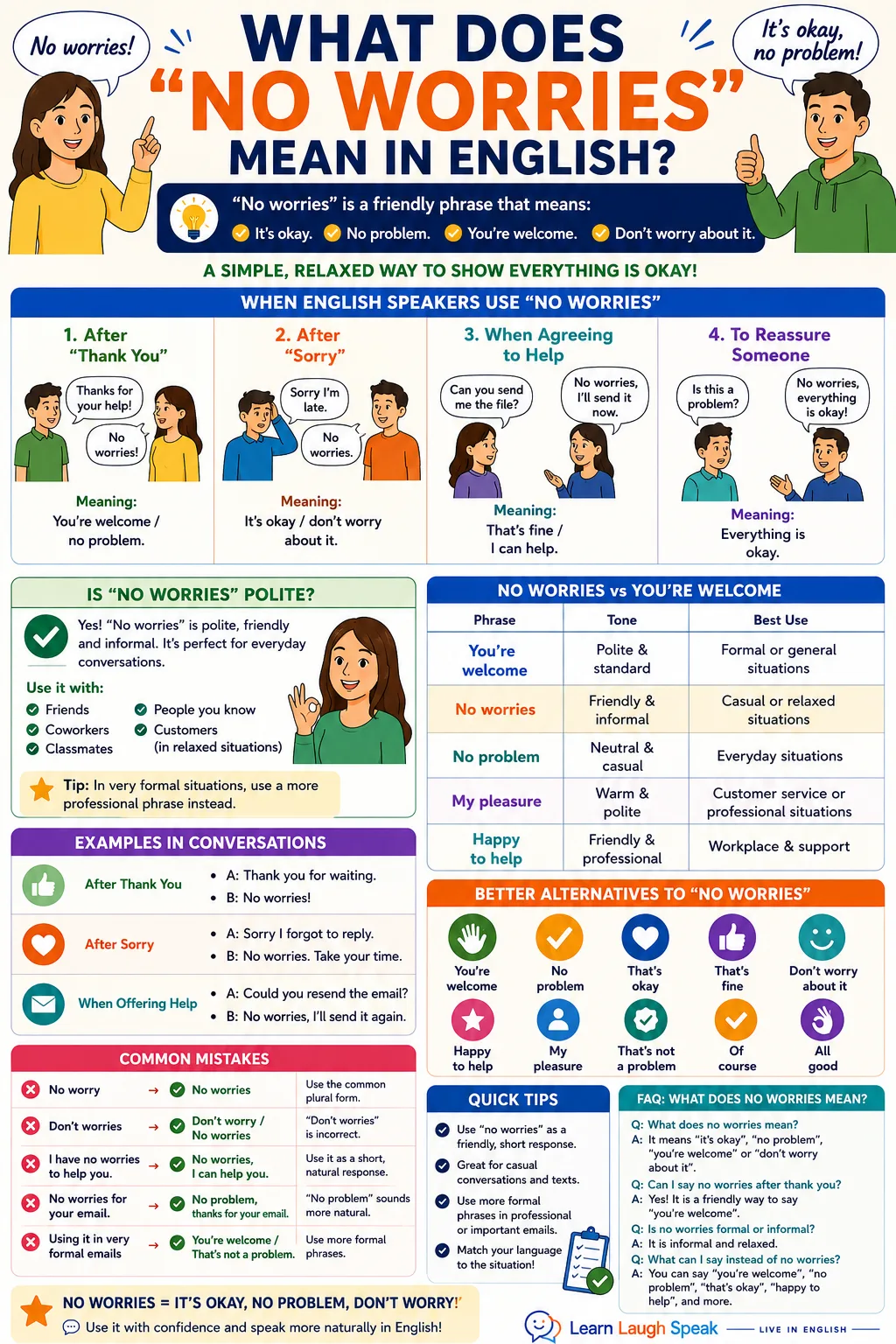
Better Alternatives to “No Worries”
Sometimes no worries is perfect.
But sometimes another phrase sounds better.
Here are useful alternatives.
| Phrase | Best Situation |
| You’re welcome | After someone says thank you |
| No problem | Casual response to thanks or apology |
| That’s okay | After an apology |
| That’s fine | To accept a change or delay |
| Don’t worry about it | To reassure someone |
| Happy to help | Friendly and professional |
| My pleasure | Polite and warm |
| That’s not a problem | Professional and clear |
| Of course | Helpful and positive |
| All good | Very casual |
Examples:
Thanks for helping me.
Happy to help.
Sorry for the delay.
That’s not a problem.
Can you check this for me?
Of course.
Learning alternatives helps you sound more natural because you will not repeat the same phrase every time.
Is “No Worries” Australian English?
No worries is strongly associated with Australian English.
In Australia, it is very common in everyday conversation.
People use it to mean:
It’s okay.
No problem.
You’re welcome.
All good.
Example:
Thanks, mate.
No worries.
However, the phrase is now common in many English-speaking places. You may hear it in the UK, New Zealand, Canada, the United States, and international workplaces.
So yes, it has a strong Australian connection, but it is not only used in Australia.
“No Worries” in Text Messages
In text messages, no worries is very common.
Examples:
No worries, see you soon.
No worries, I’ll call you later.
No worries, thanks for the update.
No worries at all.
No worries, take your time.
You may also see shorter casual versions, such as:
No worries!
No worries 🙂
All good.
For professional messages, keep the tone clean and simple.
Example:
No worries, thank you for letting me know.
This sounds friendly but still respectful.
Should You Say “No Worries” to a Client?
You can say no worries to a client if the relationship is friendly and the tone is relaxed.
Example:
Client: Sorry for the late reply.
You: No worries, thank you for getting back to me.
This is usually fine.
But if the client is formal, senior, upset, or discussing something important, choose a more professional phrase.
Better options:
That’s completely fine.
Thank you for letting me know.
That’s not a problem.
I understand.
I’m happy to help.
Example:
Client: Sorry for the delay.
You: That’s completely fine. Thank you for the update.
This sounds more polished.
How to Respond When Someone Says “No Worries”
If someone says no worries to you, you usually do not need to answer with anything long.
You can say:
Thanks.
Great, thank you.
I appreciate it.
Perfect, thanks.
Thanks for understanding.
Example:
A: Sorry I sent that late.
B: No worries.
A: Thanks for understanding.
Simple responses are best.
Practice: Choose the Best Response
Choose the best response for each situation.
- Someone says: Thank you for your help.
Best response:
No worries.
- Someone says: Sorry I’m late.
Best response:
No worries. We just started.
- Someone asks: Can you resend the document?
Best response:
No worries, I’ll send it now.
- A formal client says: Sorry for the delay.
Best response:
That’s completely fine. Thank you for the update.
- A friend says: Thanks for picking me up.
Best response:
No worries.
This practice helps you understand when the phrase sounds natural and when a more formal phrase may be better.
FAQ: What Does No Worries Mean?
What does no worries mean?
No worries means no problem, it’s okay, you’re welcome, or don’t worry about it, depending on the situation.
Is no worries rude?
No, no worries is usually not rude. It is friendly and informal. In very formal situations, use you’re welcome or that’s not a problem.
Can I say no worries after thank you?
Yes. If someone says thank you, you can respond with no worries. It means you’re welcome or no problem.
Can I say no worries after sorry?
Yes. If someone says sorry, you can respond with no worries. It means it’s okay or don’t worry about it.
Is no worries formal or informal?
No worries is informal. It is common in casual conversation, text messages, and relaxed workplace communication.
What can I say instead of no worries?
You can say:
You’re welcome.
No problem.
That’s okay.
That’s not a problem.
Happy to help.
Of course.
Final Thoughts on “No Worries”
So, what does no worries mean?
It means:
It’s okay.
No problem.
You’re welcome.
Don’t worry about it.
It is a friendly and relaxed phrase that English speakers use after thanks, apologies, requests, and small problems.
The phrase is useful, but it is also informal.
Use it with friends, coworkers, classmates, and relaxed clients.
In more formal situations, choose phrases like:
You’re welcome.
That’s not a problem.
I’m happy to help.
When you understand the tone of no worries, you can use it naturally and confidently in English.

Learn Natural English Phrases With Learn Laugh Speak
Learn Laugh Speak helps adult English learners understand real English phrases, grammar, pronunciation, speaking, listening, reading, and writing at the correct level.
English is not only about translating words.
You also need to understand tone, context, and when a phrase is polite, casual, formal, or professional.
With Learn Laugh Speak, students complete a full level assessment and begin learning from the exact point that matches their ability.
You can practise real phrases like no worries, receive corrections, and improve step by step with structured lessons designed for real communication.
If you want to speak more naturally, understand everyday English, and communicate with confidence, Learn Laugh Speak can help you make progress every day.