
 English
 Arabic
 Chinese (Simplified)
 Dutch
Dutch French
 German
 Italian
 Portuguese
 Russian
 Spanish
Have you ever looked at something in English and thought, “What is this called?”
Maybe you saw a symbol like @, a structure like Subject + Verb + Object, or an abbreviation like ASAP, and you knew it was important but did not know the English name for it.
This is common for English learners, especially when studying Business English.
English is full of sentence structures, symbols, abbreviations, punctuation marks, and short forms that appear in emails, documents, reports, messages, presentations, and workplace conversations.
In this guide, you will learn what is this called in English when looking at common grammar structures, symbols, and abbreviations. You will also learn how to ask this question naturally and how to use these language tools more confidently in business communication.
Why “What Is This Called?” Is an Important English Question
The question “What is this called?” is very useful for English learners.
You can use it when you do not know the English name of something.
For example:
“What is this called in English?”
“What is this symbol called?”
“What is this structure called?”
“What do you call this in English?”
“What does this abbreviation stand for?”
These questions help you keep learning in real situations.
Instead of stopping because you do not know a word, you can ask a simple question and continue the conversation.
This is especially useful at work, where you may need to understand documents, emails, forms, reports, instructions, or business terms quickly and correctly.
Quick Guide: What Is This Called in English?
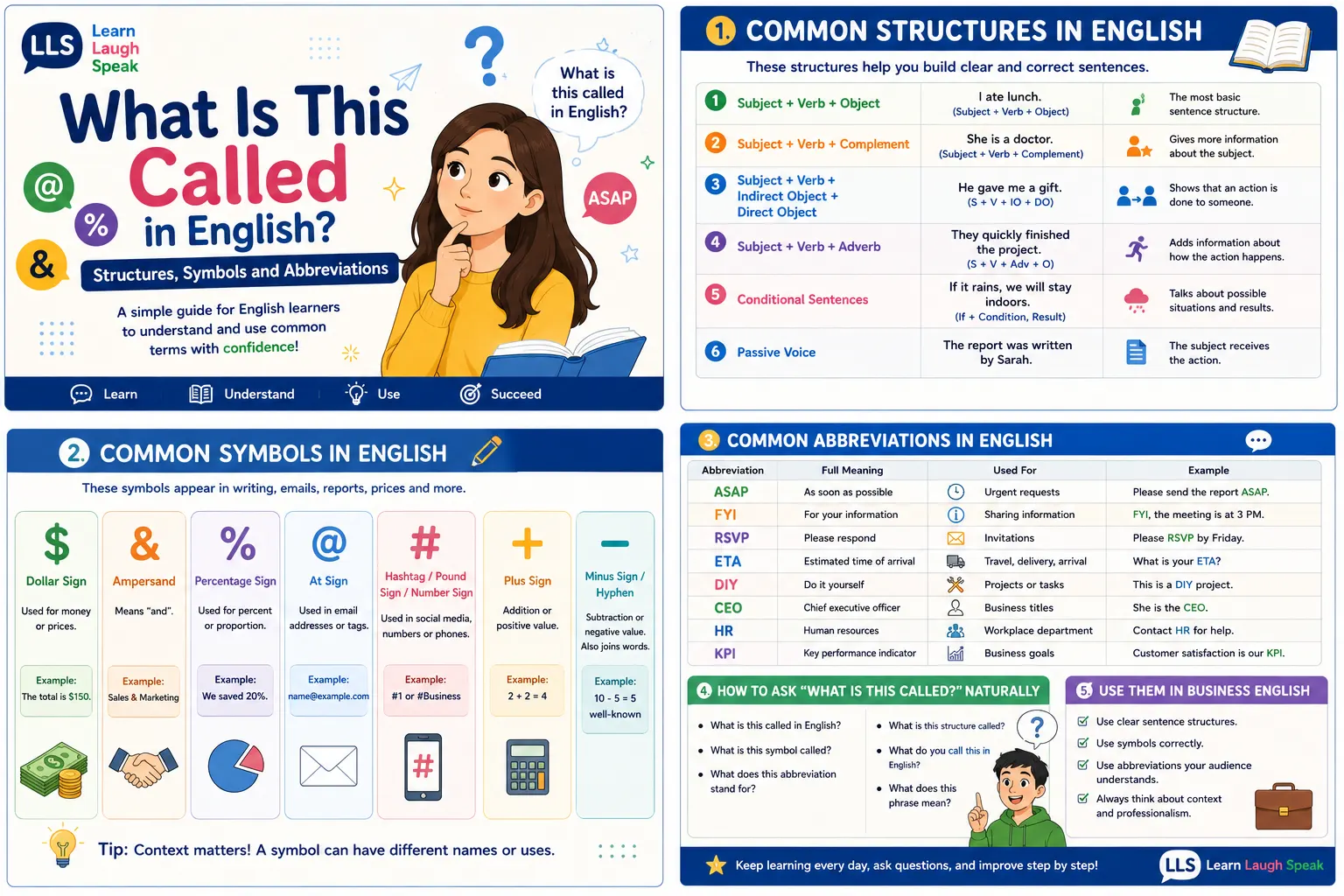
Here is a simple guide to help you understand common English structures, symbols, and abbreviations.
| Type | Example | What It Is Called |
|---|---|---|
| Sentence structure | “I ate lunch.” | Subject + verb + object |
| Grammar form | “The report was written.” | Passive voice |
| Symbol | & | Ampersand |
| Symbol | @ | At sign |
| Symbol | % | Percentage sign |
| Abbreviation | ASAP | As soon as possible |
| Abbreviation | FYI | For your information |
| Punctuation | “ ” | Quotation marks |
| Punctuation | ( ) | Parentheses |
This type of table is useful because many learners do not only want the meaning.
They also want to know the correct English name.
Common Structures in English
Learning common structures in English is important because structure helps you build clear sentences.
When you understand sentence patterns, it becomes easier to speak, write emails, explain ideas, and understand grammar.
Here are some common structures you should know if you often ask “what is this called?”
1. Subject + Verb + Object
This is one of the most basic sentence structures in English.
Example:
“I ate lunch.”
In this sentence:
I = subject
ate = verb
lunch = object
More examples:
“She wrote the email.”
“They finished the project.”
“We called the client.”
This structure is common in everyday English and business English because it is clear and direct.
2. Subject + Verb + Complement
This structure gives more information about the subject.
Example:
“She is a doctor.”
In this sentence:
She = subject
is = verb
a doctor = complement
The complement helps describe or identify the subject.
More examples:
“He is the manager.”
“The meeting was useful.”
“This report is important.”
This structure is useful when describing people, jobs, situations, and opinions.
3. Subject + Verb + Indirect Object + Direct Object
This structure is used when someone gives, sends, shows, or offers something to someone.
Example:
“He gave me a gift.”
In this sentence:
He = subject
gave = verb
me = indirect object
a gift = direct object
More examples:
“She sent the team an update.”
“They offered him a new role.”
“We gave the client a discount.”
This structure is common in business communication.
4. Subject + Verb + Adverb
This structure adds information about how an action happens.
Example:
“They quickly finished the project.”
In this sentence:
They = subject
finished = verb
quickly = adverb
the project = object
More examples:
“She spoke clearly.”
“He responded professionally.”
“We worked carefully.”
Adverbs help explain the manner, speed, or attitude of an action.
5. Conditional Sentences
Conditional sentences talk about possible situations and results.
They often use if.
Example:
“If it rains, we will stay indoors.”
This sentence has two parts:
If it rains = condition
we will stay indoors = result
More examples:
“If the client approves, we can start tomorrow.”
“If you need help, please let me know.”
“If sales increase, we may hire more staff.”
Conditionals are very useful in business English because they help you talk about plans, possibilities, and consequences.
6. Passive Voice
Passive voice is used when the subject receives the action.
Example:
“The report was written by Sarah.”
In active voice, we say:
“Sarah wrote the report.”
In passive voice, we say:
“The report was written by Sarah.”
Passive voice is common in formal writing, reports, processes, and business documents.
More examples:
“The email was sent yesterday.”
“The contract was signed.”
“The issue has been resolved.”
Passive voice is useful when the action is more important than the person who did it.
Common Symbols in English
Symbols are used in writing, math, emails, social media, business documents, prices, and reports.
If you see one and think “what is this called?”, here are the most common ones.
| Symbol | Name | Meaning or Use |
|---|---|---|
| $ | Dollar sign | Money or prices |
| & | Ampersand | Means “and” |
| % | Percentage sign | Percent or proportion |
| @ | At sign | Email addresses or social media tags |
| # | Hashtag / pound sign / number sign | Social media topics, numbers, or phone systems |
| + | Plus sign | Addition or positive value |
| – | Minus sign / hyphen | Subtraction, negative value, or joining words |
What is this Called: Dollar Sign ($)
The dollar sign is used to show money or prices.
Example:
“$25”
This means:
“twenty-five dollars”
You may see the dollar sign in invoices, menus, websites, reports, or financial documents.
Examples:
“The total cost is $150.”
“The price increased by $10.”
“The course costs $49 per month.”
What is this Called: Ampersand (&)
The ampersand means and.
Example:
“Sales & Marketing”
This means:
“Sales and Marketing”
You often see the ampersand in company names, titles, partnerships, and short headings.
Examples:
“Research & Development”
“Terms & Conditions”
“Learning & Development”
In formal writing, it is usually better to write and, unless the ampersand is part of a name or title.
Percentage Sign (%)
The percentage sign means percent or out of 100.
Example:
“50%”
This means:
“fifty percent”
Examples:
“Sales increased by 15%.”
“We are offering a 20% discount.”
“Only 5% of customers cancelled.”
This symbol is common in business, finance, marketing, reports, and statistics.
At Sign (@)
The at sign is used in email addresses and social media handles.
Example:
It separates the username from the domain.
You can also use it to tag someone online.
Example:
“Follow us @learnlaughspeak.”
If someone asks “what is this called?” and points to @, the answer is:
“It is called the at sign.”
Hashtag or Pound Sign (#)
The symbol # has different names depending on the context.
It can be called:
Hashtag
Pound sign
Number sign
On social media, it is usually called a hashtag.
Example:
“#EnglishLearning”
On a phone, especially in American English, it may be called the pound sign.
Example:
“Press the pound key.”
Before a number, it can mean number.
Example:
“#1”
This means:
“number one”
Plus Sign (+)
The plus sign usually means addition.
Example:
“2 + 2 = 4”
It can also mean something positive or extra.
Examples:
“Plus benefits”
“Free delivery + support”
“Experience is a plus”
In job descriptions, a plus means an advantage.
Example:
“Spanish is a plus.”
This means Spanish is helpful, but may not be required.
Minus Sign (-)
The minus sign is used in math to show subtraction or negative numbers.
Examples:
“10 – 5 = 5”
“-3 degrees”
It can also appear as a hyphen when joining words.
Example:
“part-time”
“well-known”
“English-speaking”
This is why context matters when learning symbols in English.
Common Abbreviations in English
Abbreviations are shortened forms of words or phrases.
They are common in emails, business documents, social media, schedules, invitations, and workplace messages.
Here are some common abbreviations you should know.
| Abbreviation | Full Meaning | Common Use |
|---|---|---|
| ASAP | As soon as possible | Urgent requests |
| FYI | For your information | Sharing information |
| RSVP | Please respond | Invitations |
| ETA | Estimated time of arrival | Travel, delivery, arrival time |
| DIY | Do it yourself | Projects or tasks |
| CEO | Chief executive officer | Business titles |
| HR | Human resources | Workplace departments |
| KPI | Key performance indicator | Business goals and measurement |
ASAP
ASAP means as soon as possible.
Example:
“Please send the report ASAP.”
This means the report is needed quickly.
Be careful with ASAP in professional emails because it can sound urgent or direct.
A softer version is:
“Could you please send the report as soon as possible?”
FYI
FYI means for your information.
Example:
“FYI, the meeting has been moved to 3 PM.”
It is used when sharing information that may be useful.
It does not always require a reply.
RSVP
RSVP means please respond.
It comes from French, but it is commonly used in English invitations.
Example:
“Please RSVP by Friday.”
This means the person should confirm whether they will attend.
ETA
ETA means estimated time of arrival.
Example:
“What is your ETA?”
This means:
“When do you expect to arrive?”
It is common in travel, delivery, transport, and workplace planning.
DIY
DIY means do it yourself.
Example:
“This is a DIY project.”
It means you can do the task without hiring someone else.
CEO
CEO means chief executive officer.
This is the highest-ranking executive in many companies.
Example:
“She is the CEO of the company.”
HR
HR means human resources.
This department usually manages hiring, employee support, policies, and workplace issues.
Example:
“Please contact HR about your contract.”
KPI
KPI means key performance indicator.
A KPI is a measurable goal or result used in business.
Example:
“One of our KPIs is customer satisfaction.”
This abbreviation is very common in business English.
How to Ask “What Is This Called?” Naturally
If you do not know the English name for something, you can ask in several ways.
| Situation | Natural English Question |
|---|---|
| You see an object | “What is this called in English?” |
| You see a symbol | “What is this symbol called?” |
| You hear a phrase | “What does this phrase mean?” |
| You see an abbreviation | “What does this abbreviation stand for?” |
| You see grammar you do not understand | “What is this structure called?” |
| You want a natural word | “What do native speakers usually call this?” |
| You want pronunciation help | “How do you say this?” |
These questions are very useful for ESL students.
They help you learn without stopping the conversation.
Examples:
“What is this called in English?”
“What do you call this in a business email?”
“What does KPI stand for?”
“What is this grammar structure called?”
“What is the English word for this?”
The more comfortable you become asking these questions, the faster you can learn new vocabulary and structures.
How to Use These Effectively in Business English
Now that you know some common structures, symbols, and abbreviations, it is important to use them correctly in business English.
1. Use Structures for Clear Communication
In business English, clear structure matters.
Use simple sentence patterns when you need to be direct.
Example:
“We sent the proposal.”
“The client approved the budget.”
“The team completed the task.”
Clear structures help avoid confusion.
This is especially important in emails, reports, meetings, and presentations.
2. Use Symbols Carefully
Symbols can save space, but they should be used correctly.
For example:
Use $ for prices.
Use % for percentages.
Use & in names, titles, or short headings.
Use @ in email addresses and social media handles.
In formal business writing, avoid using too many symbols if full words would be clearer.
For example, instead of:
“Sales & costs increased by 10% + delivery delays.”
Write:
“Sales and costs increased by 10%, and delivery delays also affected the project.”
Clarity is more important than saving space.
3. Use Abbreviations Only When the Reader Understands Them
Abbreviations are useful, but not everyone knows every abbreviation.
For example, ASAP, FYI, and ETA are common.
But industry-specific abbreviations may confuse readers.
If you are writing to someone outside your company or industry, write the full phrase first.
Example:
“Our key performance indicator (KPI) is customer satisfaction.”
After that, you can use KPI.
4. Think About Context and Audience
Before using a structure, symbol, or abbreviation, ask:
Will the reader understand this?
Is this too informal?
Is this clear enough?
Is this common in this industry?
Business English is not only about knowing words.
It is about choosing the right words for the right audience.
Tips for ESL Students to Remember These Terms
Learning structures, symbols, and abbreviations takes practice.
Here are some simple ways to remember them.
1. Practise Often
The more you use these terms, the easier they become.
Try using new structures, symbols, and abbreviations in your writing and speaking.
For example, write short sentences using:
ASAP
FYI
%
$
Subject + verb + object
Passive voice
2. Create Flashcards
Flashcards are useful for memory.
Write the symbol, structure, or abbreviation on one side.
Write the name and example on the other side.
Example:
Front:
@
Back:
At sign
Used in email addresses.
Example: name@example.com
3. Learn With Context
Do not only memorize definitions.
Look at how these terms appear in real emails, reports, websites, and conversations.
For example, if you see FYI in an email, notice how it is used.
If you see % in a report, look at what it is measuring.
Context helps you remember meaning and use.
4. Ask for Feedback
Practise with a teacher, native speaker, or confident English speaker.
You can ask:
“Am I using this abbreviation correctly?”
“Is this structure natural?”
“What is this called in English?”
“Would this sound professional in an email?”
Feedback helps you improve faster.
5. Stay Consistent
Language learning takes time.
Set aside a few minutes each day to review new terms.
Small daily practice is better than studying many things once and forgetting them later.
Common Mistakes When Asking What Something Is Called
Many English learners translate this question directly from their first language.
Here are some common mistakes and better versions.
| Mistake | Better English |
|---|---|
| How is called this? | What is this called? |
| How do you call this? | What do you call this? |
| What means ASAP? | What does ASAP mean? |
| What is called this symbol? | What is this symbol called? |
| How say this in English? | How do you say this in English? |
| What is the name from this? | What is the name of this? |
The most natural question is:
What is this called?
If you want to be more specific, say:
What is this called in English?
or
What is this symbol called?
Final Thoughts on What Is This Called in English
The question “what is this called?” is one of the most useful questions an English learner can ask.
It helps you learn new words, understand grammar, identify symbols, and remember abbreviations.
In English, many things have specific names.
A sentence pattern can be called a structure.
A mark like @ can be called the at sign.
A short form like ASAP can be called an abbreviation.
A grammar form like “The report was written” can be called passive voice.
When you know what something is called, it becomes easier to understand it, use it, and remember it.

What is this Called Learn Laugh Speak?
Learn Laugh Speak helps adult English learners improve speaking, reading, writing, listening, grammar, vocabulary, and pronunciation at the correct level.
If you often ask “what is this called?”, Learn Laugh Speak can help you understand English more clearly with structured lessons and real examples.
Students complete a full level assessment and begin learning from the exact point that matches their ability.
This means you do not waste time guessing what to study next.
You can practise useful English for work, emails, business communication, grammar, and everyday conversations.
With the right structure and support, English becomes easier to understand and easier to use with confidence.