
 English
 Arabic
 Chinese (Simplified)
 Dutch
Dutch French
 German
 Italian
 Portuguese
 Russian
 Spanish
The best reading tools for students learning English include graded readers, audiobooks, dictionaries, vocabulary apps, reading trackers, infographics, news articles, digital libraries, and read-aloud tools. The right tool depends on your English level, your goals, and how you prefer to learn.
Reading is one of the most important skills for English learners. It helps you build vocabulary, understand grammar in context, improve writing, and become more confident with real English. But many students struggle because they choose texts that are too hard, too boring, or not useful for their goals.
This guide explains the best reading tools for students learning English and how to use them properly so they actually help you improve.
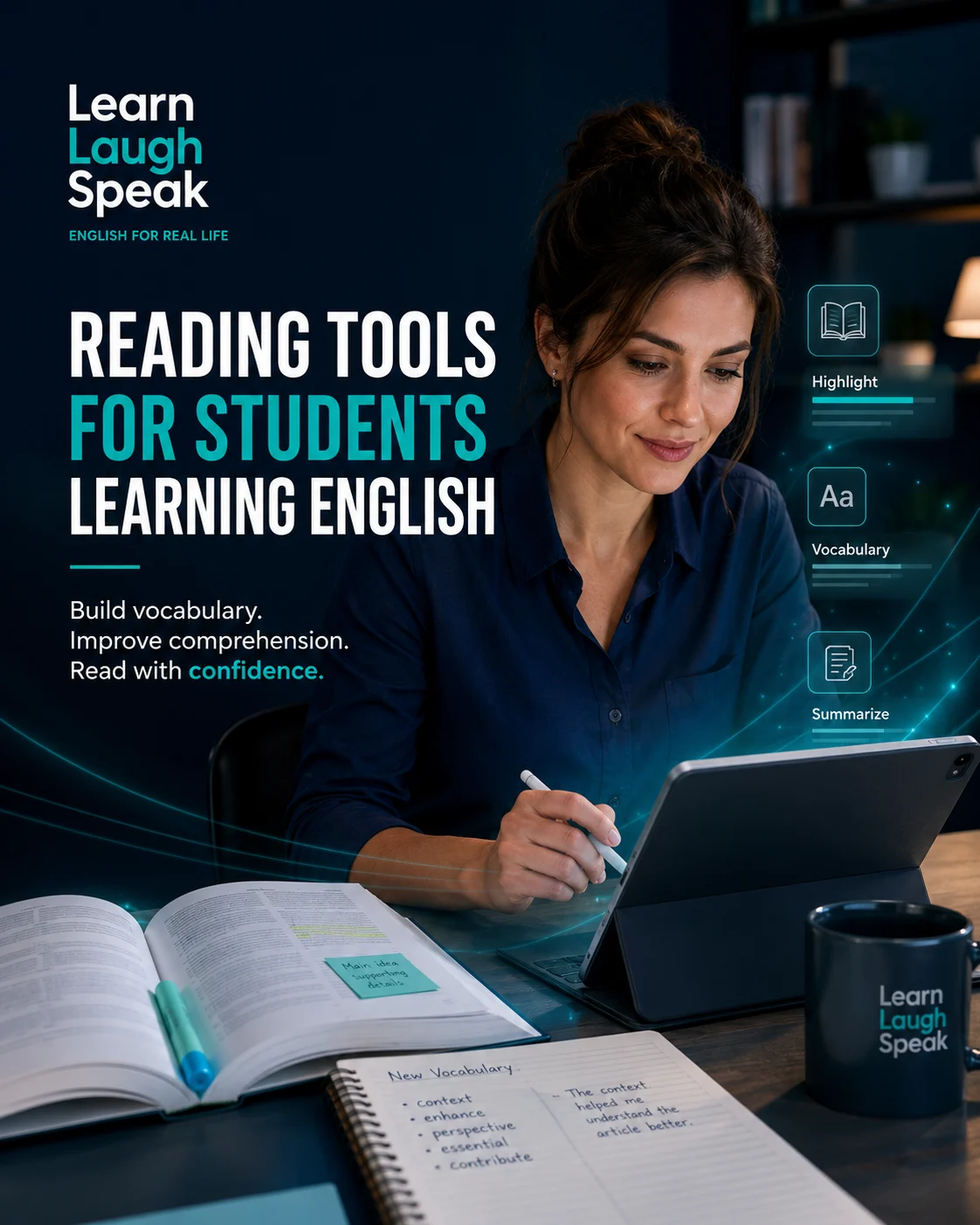
Why Reading Tools for Students Learning English Matter
Reading in English is not only about understanding words on a page. Good reading helps students improve many skills at the same time.
When you read regularly, you can:
- learn new vocabulary in context
- understand sentence structure
- improve grammar naturally
- build confidence with longer texts
- improve writing skills
- learn useful phrases
- understand professional and academic English
- practise pronunciation when reading aloud
- become more independent as a learner
The right reading tools make this process easier. They help you choose texts at the right level, check meanings, listen to pronunciation, review new words, and stay consistent.
For adult learners, reading tools are especially useful because many students need English for work, study, travel, customer service, emails, reports, and professional communication.
How to Choose Reading Tools for Students Learning English
Before choosing a tool, ask yourself three questions:
- What is my English level?
- Why do I need to improve reading?
- What kind of reading do I enjoy or need?
For example, an A2 learner may need short stories with simple vocabulary. A B2 learner may need articles, workplace texts, and graded novels. A C1 learner may need longer reports, essays, opinion articles, and professional material.
A good reading tool should be:
- suitable for your level
- easy to use
- useful for your goals
- clear and reliable
- not too difficult
- something you can use regularly
The best tool is not always the most advanced one. The best tool is the one you will actually use.
Reading Tools for Students Learning English: Graded Readers
Graded readers are books written or adapted for different English levels. They are one of the best reading tools for students learning English because they help you read without feeling overwhelmed.
A graded reader may be written for levels like A1, A2, B1, B2, or C1. This means the vocabulary, grammar, and sentence length are controlled so the text matches the learner’s level.
Why graded readers help
Graded readers help you:
- read longer texts with confidence
- learn vocabulary naturally
- enjoy stories without stopping every sentence
- improve reading speed
- build a reading habit
- move gradually to harder texts
How to use graded readers effectively
Choose a book where you understand most of the text. If you need to check every second word, the book is probably too difficult.
A good rule is:
If you understand around 80–90% of the text, it is usually a good level for reading practice.
Read one chapter, write down five useful words or phrases, and then summarise the chapter in your own words.
Example summary:
“In this chapter, the main character starts a new job and feels nervous because she needs to speak English with customers.”
This helps you practise reading, vocabulary, and writing together.
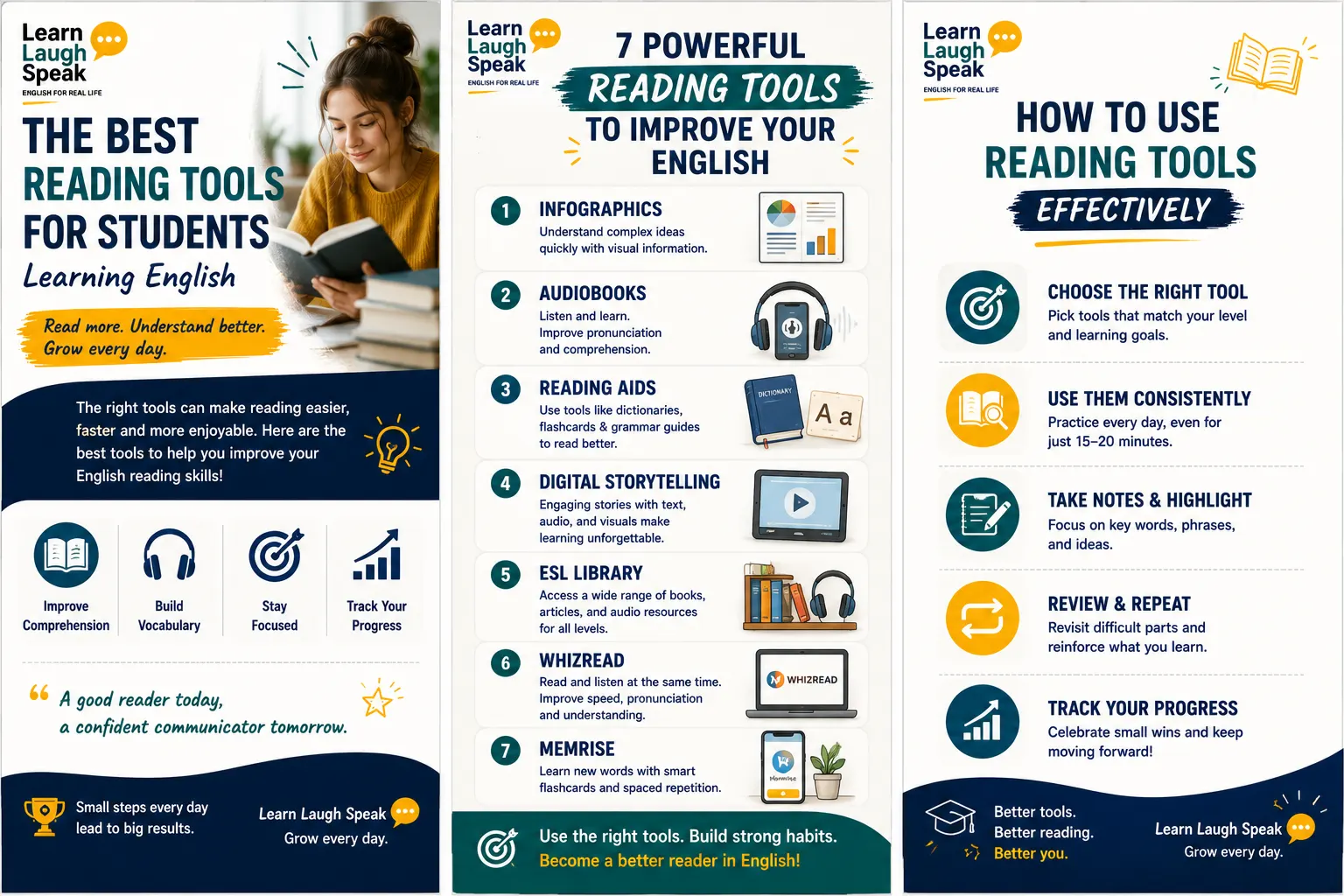
Reading Tools for Students Learning English: Audiobooks
Audiobooks are excellent because they connect reading and listening. Many learners can understand written English but struggle when they hear spoken English. Audiobooks help close this gap.
You can read the text while listening to the audio. This helps you notice pronunciation, rhythm, word stress, and natural sentence flow.
Why audiobooks help
Audiobooks help you:
- improve pronunciation
- connect written words to spoken sounds
- understand natural rhythm
- practise listening and reading together
- remember vocabulary better
- enjoy stories while learning
How to use audiobooks effectively
Choose an audiobook at or slightly below your reading level. Listen and read at the same time. Then listen again without looking at the text.
Try this method:
- Read one short section silently.
- Listen while reading.
- Listen again without reading.
- Read the same section out loud.
- Record yourself and compare your rhythm.
This is especially useful for students who want to improve speaking and pronunciation as well as reading.
Reading Tools for Students Learning English: Online Dictionaries
A good online dictionary is one of the most important reading tools for students learning English. But it is important not to overuse it.
If you stop to translate every word, reading becomes slow and frustrating. Instead, use the dictionary for words that are important to the main meaning.
What to look for in a good dictionary
A useful learner dictionary should include:
- simple English definitions
- example sentences
- pronunciation audio
- word forms
- common phrases
- level information when available
How to use dictionaries effectively
When you find a new word, do not only translate it. Look at the example sentence.
For example, if you learn the word deadline, do not only write:
deadline = fecha límite
Also write:
“The deadline for the report is Friday.”
This helps you understand how the word works in real English.
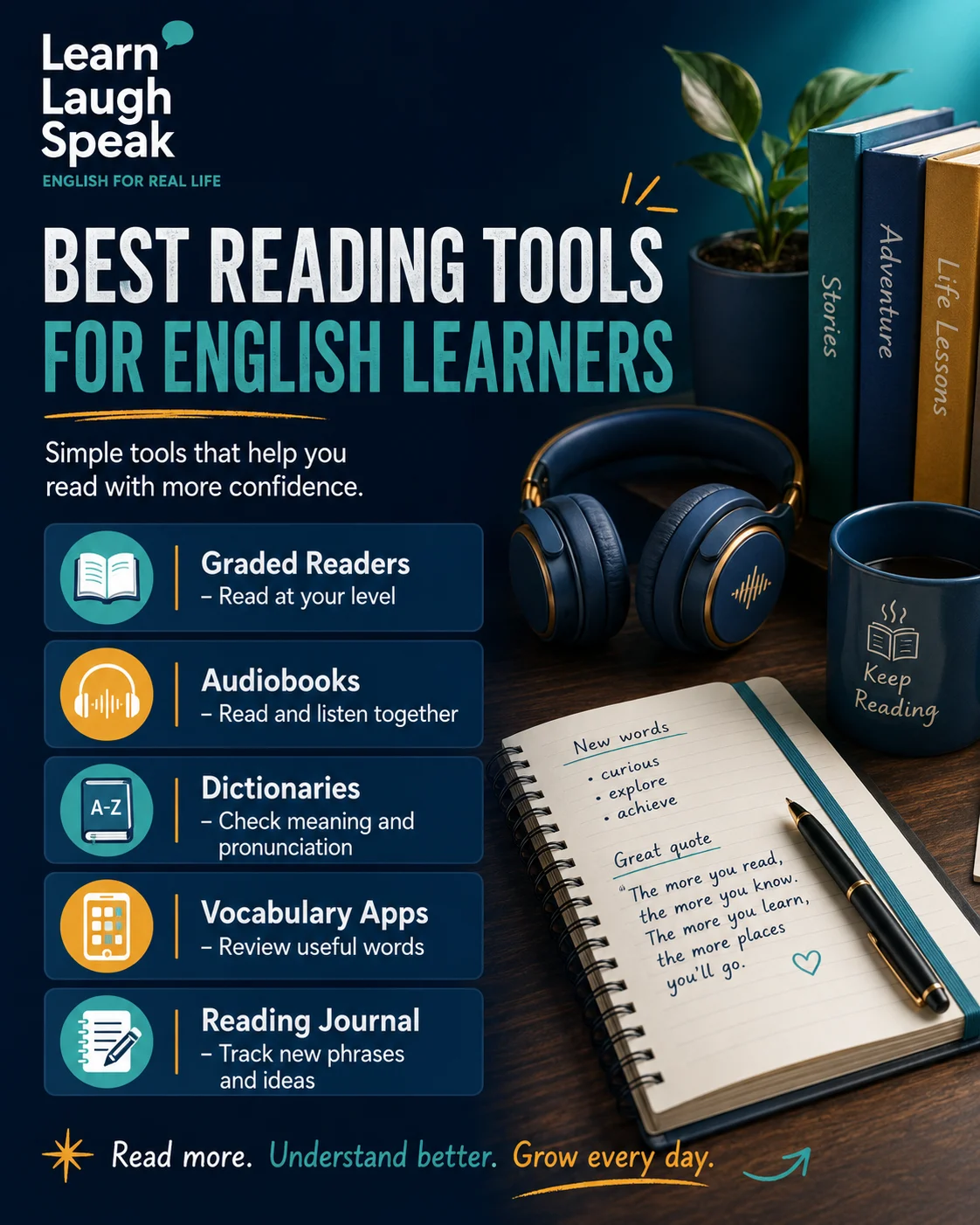
Reading Tools for Students Learning English: Vocabulary Apps
Vocabulary apps can help you remember new words from your reading. They are useful because repetition helps move words from short-term memory to long-term memory.
However, vocabulary apps work best when you add words from real texts you are reading, not only random word lists.
How vocabulary apps help
Vocabulary apps can help you:
- review new words
- practise spelling
- remember phrases
- test yourself
- build topic-based vocabulary
- track your progress
How to use vocabulary apps effectively
After reading, choose 5–10 useful words or phrases. Add them to your vocabulary app with a sentence.
For example:
Phrase: “take responsibility for”
Sentence: “Managers need to take responsibility for team communication.”
This is better than learning the word alone because you learn how to use it in context.
Reading Tools for Students Learning English: Infographics
Infographics explain information using images, icons, short text, and visual structure. They are useful for learners who need help understanding or remembering information.
Infographics are especially helpful for topics like:
- grammar rules
- vocabulary groups
- workplace phrases
- pronunciation tips
- learning strategies
- process explanations
Why infographics help
Infographics help students:
- understand ideas quickly
- remember key information
- connect words with images
- review topics faster
- learn visually
- make difficult topics easier
How to use infographics effectively
Do not just look at the image quickly. Read it actively.
Try this:
- Read the title.
- Look at the sections.
- Read each point slowly.
- Say the examples out loud.
- Write one sentence using the new vocabulary.
- Explain the infographic in your own words.
For example:
“This infographic explains five ways to ask for clarification politely in English.”
This turns visual reading into real language practice.
Reading Tools for Students Learning English: News Articles
News articles help learners understand real English and current topics. However, normal news can be difficult for lower-level students, so choose carefully.
Beginner and intermediate learners may need simplified news. Advanced learners can use regular news articles to build stronger vocabulary and reading stamina.
Why news articles help
News articles help you:
- learn real-world vocabulary
- understand current events
- practise formal English
- improve reading speed
- learn topic-based words
- prepare for workplace conversations
How to use news articles effectively
Choose one short article. Read the headline first and predict the topic. Then read the article and underline key words.
After reading, answer:
- What happened?
- Who was involved?
- Where did it happen?
- Why does it matter?
- What new words did I learn?
This method helps you understand the article instead of just reading passively.
Reading Tools for Students Learning English: Digital Libraries
Digital libraries give learners access to books, articles, stories, and learning materials online. They are useful because students can choose different topics and levels.
A digital library may include:
- short stories
- graded books
- academic texts
- articles
- audio-supported reading
- vocabulary activities
- comprehension questions
How to use digital libraries effectively
Start with a clear goal.
For example:
“This week, I want to read three short articles about workplace communication.”
Or:
“This month, I want to finish one graded reader at B1 level.”
A clear goal helps you avoid jumping between too many resources without finishing anything.
Reading Tools for Students Learning English: Read-Aloud Tools
Read-aloud tools can read text to you. These tools are useful when you want to hear pronunciation, rhythm, and sentence flow.
They can help learners who:
- struggle with pronunciation
- read slowly
- need listening support
- want to compare written and spoken English
- prefer audio learning
How to use read-aloud tools effectively
Paste a short text into the tool and listen while reading. Then pause and repeat each sentence.
Example sentence:
“Reading every day helps you build vocabulary and confidence.”
Listen to the sentence, repeat it, and focus on stress:
READing / EVERY day / BUILD vocabulary / CONFidence
This helps your reading support your speaking.
Reading Tools for Students Learning English: Flashcards
Flashcards are simple but powerful when used correctly. They help you review new vocabulary from your reading.
But flashcards should not only include single words. Include phrases, collocations, and example sentences.
Better flashcard style
Instead of:
improve = mejorar
Use:
improve your reading skills
Sentence: “Reading graded books can improve your reading skills.”
This gives you the word in a useful phrase.
How to use flashcards effectively
Review a few cards every day. Do not add too many at once. It is better to learn 5 words well than 30 words badly.
Reading Tools for Students Learning English: Reading Journals
A reading journal is a notebook or digital document where you record what you read and what you learned.
This is a strong tool for adult learners because it helps you reflect and track progress.
What to include in a reading journal
After reading, write:
- title of the text
- topic
- new words
- useful phrases
- one short summary
- one opinion
- one question
Example:
Title: How to Communicate Effectively in English
New phrase: “Just to confirm…”
Summary: The article explains how to speak clearly and check understanding at work.
Opinion: This is useful because I often need to clarify information in meetings.
This helps you move from reading to real communication.
Reading Tools for Students Learning English at Work
Adult learners often need reading skills for work. This means they may need to read emails, reports, policies, customer messages, instructions, and professional articles.
Useful workplace reading tools include:
| Tool | How it helps |
|---|---|
| Email templates | Help you understand professional tone |
| Business articles | Build workplace vocabulary |
| Industry blogs | Teach job-specific language |
| Reports | Improve formal reading skills |
| Customer messages | Help with service language |
| Meeting notes | Improve practical workplace comprehension |
| Glossaries | Help with technical vocabulary |
If you use English at work, practise reading texts that match your real job.
For example, if you work in hospitality, read hotel emails, guest reviews, booking messages, and customer service examples.
What Not to Do When Using Reading Tools
Reading tools are helpful, but they can be used badly. Here are common mistakes to avoid.
| What not to do | What to do instead |
| Translate every word | Focus on meaning first |
| Choose texts that are too hard | Choose level-appropriate material |
| Read without reviewing | Write down useful words and phrases |
| Use too many tools at once | Choose 2–3 tools and use them consistently |
| Only read silently | Read some sections out loud |
| Memorise isolated words | Learn words in sentences |
| Stop when you see unknown words | Guess from context first |
| Read randomly with no goal | Set a weekly reading goal |
The right method matters more than the number of tools.
Common Mistakes with Reading in English
Many learners struggle with reading because they use the wrong strategy.
1. Choosing texts that are too difficult
If every sentence has too many unknown words, you will feel frustrated.
Better: Choose texts where you understand most of the meaning.
2. Reading too slowly
Some learners stop at every unknown word.
Better: Read for general meaning first. Check important words later.
3. Not reviewing vocabulary
Reading once is not enough to remember new words.
Better: Review useful phrases after reading.
4. Only reading topics you do not enjoy
If the topic is boring, you will not continue.
Better: Choose useful topics that also interest you.
5. Not connecting reading to speaking or writing
Reading should help communication.
Better: Summarise the text, talk about it, or write a short opinion.
How to Build a Weekly Reading Routine
Here is a simple routine for English learners.
Day 1: Choose a text
Pick something at your level. It could be an article, graded reader, short story, or workplace text.
Day 2: Read for meaning
Read without stopping too much. Try to understand the main idea.
Day 3: Study vocabulary
Choose 5–10 useful words or phrases and write example sentences.
Day 4: Listen or read aloud
Use audio if available. Read one section out loud.
Day 5: Write a summary
Write 4–5 sentences about what you read.
Day 6: Speak about it
Explain the text out loud or discuss it with a teacher, friend, or colleague.
Day 7: Review
Review the vocabulary and choose your next text.
This routine helps you improve reading, writing, speaking, and listening together.
Learn Reading Skills with Learn Laugh Speak
Learn Laugh Speak helps adult English learners improve reading, writing, speaking, listening, vocabulary, grammar, and pronunciation in a structured way.
The best reading tools for students learning English are useful, but students also need the right level, clear feedback, and consistent practice. Learn Laugh Speak supports learners from beginner to advanced levels with lessons designed for real communication.
Students can practise English for:
- work
- study
- travel
- customer service
- hospitality
- daily conversations
- professional communication
- vocabulary development
- reading comprehension
The goal is to help learners read with more confidence and use English clearly in real situations.
FAQs About Reading Tools for Students Learning English
What are the best reading tools for students learning English?
The best tools include graded readers, audiobooks, learner dictionaries, vocabulary apps, infographics, digital libraries, read-aloud tools, flashcards, and reading journals.
How can I improve my English reading skills?
Read texts at the right level, review useful vocabulary, read regularly, listen while reading, and summarise what you read in your own words.
Are audiobooks good for English learners?
Yes. Audiobooks help learners connect written English with spoken English. They improve pronunciation, listening, rhythm, and vocabulary.
Should I translate every word when reading English?
No. Try to understand the general meaning first. Only check words that are important for understanding the text.
What should adult English learners read?
Adult learners should read material connected to their goals, such as workplace emails, graded readers, articles, customer service examples, news, and professional topics.
How often should I read in English?
It is better to read a little every day than to read a lot once a month. Even 10–20 minutes a day can help you make progress.
Final Thoughts on Reading Tools for Students Learning English
The best reading tools for students learning English are the tools that help you read more often, understand more clearly, and remember useful language. You do not need to use every tool at once.
Start with your level. Choose material you can understand. Use a dictionary carefully, listen when possible, record useful phrases, and review new vocabulary regularly.
Reading is not only a school skill. It helps you communicate better at work, understand real English, write more clearly, and build confidence in everyday life.