
 English
 Arabic
 Chinese (Simplified)
 Dutch
Dutch French
 German
 Italian
 Portuguese
 Russian
 Spanish
Speaking for a living means earning money by giving talks, workshops, presentations, training sessions, webinars, or keynote speeches. To get started, you need a clear topic, strong speaking skills, useful content, a simple speaker profile, proof that you can help an audience, and regular practice speaking in front of people.
Many people dream of becoming an international speaker. They imagine travelling, standing on a stage, sharing ideas, helping people, and getting paid to speak. That dream is possible, but it does not usually happen overnight.
Paid speaking is built step by step. You start with a message, practise your delivery, speak to small groups, collect feedback, build credibility, and then look for better opportunities.
If English is not your first language, this can feel even more challenging. But you do not need perfect English to begin. You need clear English, confidence, structure, and something useful to say.

What Does Speaking for a Living Really Mean?
Speaking for a living does not only mean giving big speeches at international conferences. Many paid speakers earn money in different ways.
You might get paid for:
- company training sessions
- business workshops
- online webinars
- industry presentations
- school or university talks
- coaching sessions
- event hosting
- conference panels
- motivational talks
- sales presentations
- leadership training
- language or communication workshops
Some speakers travel internationally. Others speak online from home. Some speak full time, while others use speaking as part of their business, teaching, consulting, coaching, or personal brand.
The most important thing to understand is this:
People do not pay you just to speak. They pay you to help an audience understand something, solve a problem, feel motivated, or take action.
Start with a Topic People Care About
Before you try to become a paid speaker, choose your main topic. This is where many beginners go wrong. They say, “I can speak about anything.”
That sounds flexible, but it is not strong.
A paid speaker needs a clear area of value.
Ask yourself:
- What do I know well?
- What problem can I help people solve?
- What experience do I have?
- What topic could I speak about for 30–60 minutes?
- Who would benefit from hearing this?
- Why would someone pay for this talk?
Examples of strong speaking topics:
How to communicate better with customers
How to lead a team through change
How to improve English confidence at work
How to build a business from zero
How to manage stress in high-pressure jobs
How to improve sales conversations
How to use AI tools at work
How to create better workplace communication
Your topic should connect your experience with the audience’s needs.
Develop Your Speaking Skills First
If you want to earn money from speaking, your speaking skills matter. You need to hold attention, explain ideas clearly, and make the audience feel that their time was worth it.
Focus on these skills:
- clear structure
- strong opening
- confident voice
- natural body language
- clear pronunciation
- useful examples
- audience interaction
- strong ending
- calm answers to questions
You do not need to be loud or dramatic. Some of the best speakers are calm, clear, and practical.
A useful opening might be:
“Today, I want to share three lessons that helped me communicate more confidently in English at work.”
This is simple and clear. The audience knows what to expect.
Speaking for a Living Starts Small
Most paid speakers do not begin on big stages. They begin by speaking wherever they can.
Start with:
- small workshops
- local business groups
- online sessions
- community events
- team meetings
- training sessions at work
- short presentations
- podcast interviews
- LinkedIn live sessions
- free talks for practice
This gives you experience and helps you improve.
Your first goal is not to get paid a lot. Your first goal is to prove that your message helps people.
After each talk, ask:
- What worked well?
- Where did people pay attention?
- What questions did they ask?
- What could I explain better?
- Would someone recommend this talk?
Good feedback helps you build a better paid offer later.

Build a Signature Talk
A signature talk is your main presentation. It is the talk people remember you for.
It should have:
- a clear title
- one main promise
- three to five key points
- stories or examples
- practical advice
- a strong ending
- a clear audience benefit
Example:
Title: Speak with Confidence: How Professionals Can Communicate Clearly in English
Promise: Help adult English learners speak more clearly in meetings, presentations, and customer conversations
Audience: International professionals and workplace English learners
Key points: confidence, structure, pronunciation, useful phrases, practice
A signature talk makes you easier to book because people understand what you offer.
Learn the Art of Speech Writing
A good speech is not the same as a written article. Spoken English needs to be easier to follow.
When writing a talk, use:
- short sentences
- clear sections
- stories
- examples
- repetition of key ideas
- simple transitions
- practical phrases
- a memorable final message
Avoid long paragraphs and complicated language.
Instead of saying:
“The implementation of communication strategies contributes significantly to enhanced professional development outcomes.”
Say:
“Better communication helps people work better, lead better, and grow faster.”
That is stronger because people can understand it immediately.
Speaking for a Living Requires Knowing Your Audience
Paid speakers are not paid to talk about themselves for an hour. They are paid to serve the audience.
Before every talk, ask:
- Who will be in the room?
- What do they already know?
- What problems do they have?
- What language level do they have?
- What result does the organiser want?
- What should the audience remember?
- What should they do after the talk?
For example, if you speak to business owners, they may want practical strategies. If you speak to English learners, they may need simple phrases, encouragement, and clear examples.
A strong speaker changes the talk for the audience, not the other way around.
Create a Simple Speaker Profile
If you want people to book you, they need to understand who you are and what you speak about.
A simple speaker profile should include:
- your name
- professional title
- short bio
- speaking topics
- audience types
- experience
- testimonials if available
- contact details
- one or two professional photos
- video sample if possible
Your profile does not need to be perfect at the beginning. It needs to be clear.
How to Find Paid Speaking Opportunities
Once you have a topic and some practice, start looking for opportunities.
You can find speaking opportunities through:
- business networking groups
- industry events
- local chambers of commerce
- schools and universities
- online summits
- podcasts
- webinars
- companies that need training
- professional associations
- conference websites
- HR and learning development teams
Do not only wait for people to find you. Reach out professionally.
A simple message could be:
Hi [Name], I saw that your organisation runs events for [audience]. I give practical talks on [topic] and help [audience] achieve [result]. I’d be happy to share a short outline if you are planning future sessions.
Keep it short, polite, and focused on value.
Should You Speak for Free at First?
This depends on the opportunity.
Speaking for free can be useful if it gives you:
- practice
- video footage
- testimonials
- access to your ideal audience
- strong networking
- future paid opportunities
- credibility in a new market
But do not speak for free forever.
A good rule is:
If the organiser is making money from the event, they should usually have a budget for speakers.
If you speak for free, be clear about what you want in return, such as a testimonial, recording, introduction, or permission to use photos from the event.
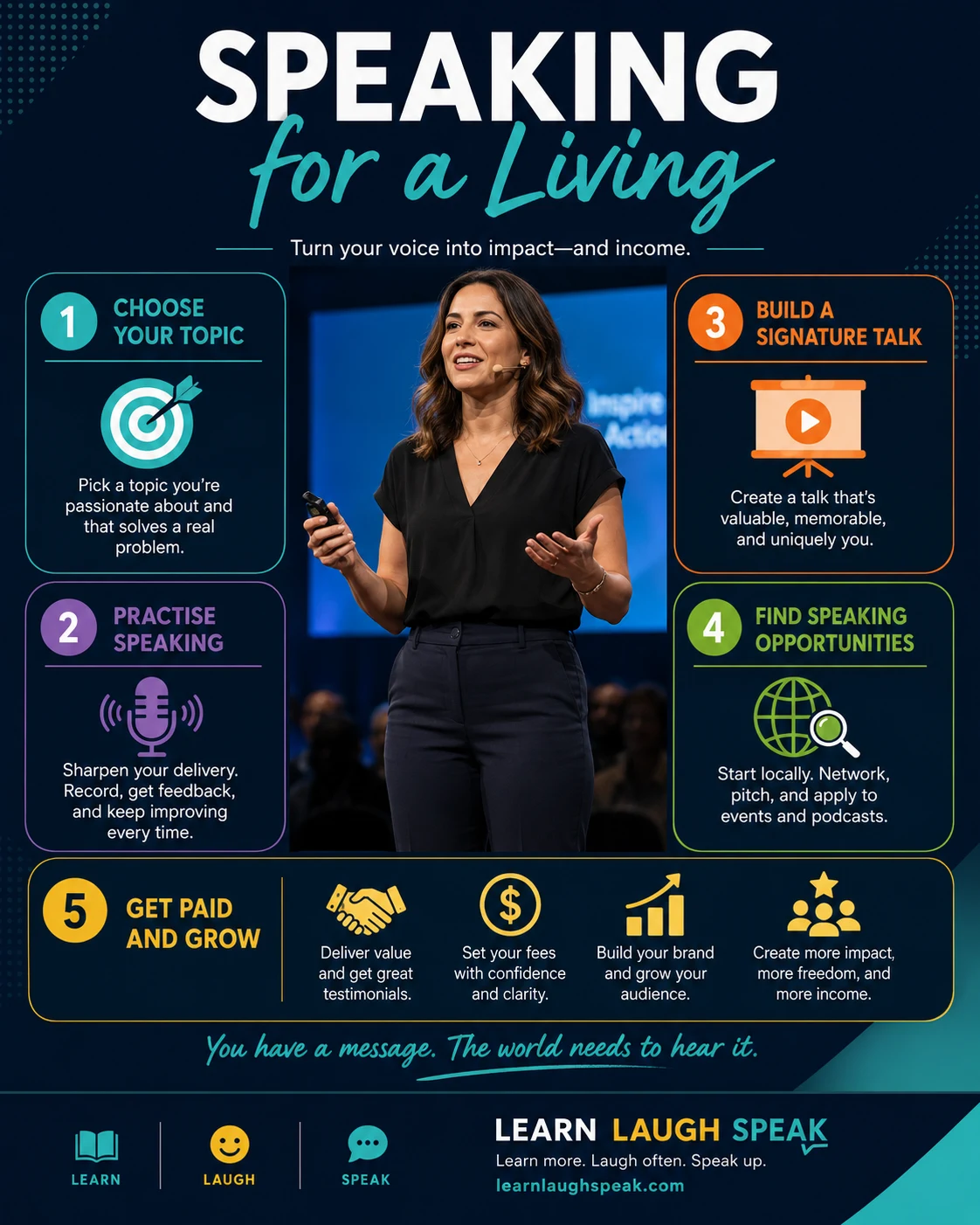
Speaking for a Living and How to Get Paid
There are different ways to earn money from speaking.
You can charge for:
- keynote speeches
- workshops
- company training
- webinars
- consulting packages
- coaching after the talk
- online courses
- event hosting
- panel moderation
- private group sessions
Many speakers make more money from what happens after the talk than from the talk itself.
For example, a speaker might give a workshop and then sell:
- a course
- coaching
- training packages
- consulting
- books
- online memberships
- company programmes
Speaking can become the front door to a larger business.
How Much Should You Charge?
Speaker fees vary a lot. They depend on your experience, topic, audience, location, and the value you provide.
At the beginning, you may charge a modest fee for small workshops. As you gain proof, testimonials, and stronger results, you can increase your price.
Think about:
- preparation time
- travel time
- delivery time
- audience size
- company budget
- your expertise
- the value of the outcome
- whether the talk leads to more work
Do not only charge for the hour on stage. You are also charging for your experience, preparation, and ability to help the audience.
Speaking for a Living in English as a Non-Native Speaker
If English is not your first language, you may worry about your accent, grammar, or confidence. This is normal.
But remember this:
You do not need perfect English to become a strong speaker. You need clear English and a valuable message.
Focus on:
- speaking slowly
- using clear structure
- practising your opening
- preparing key phrases
- improving pronunciation clarity
- avoiding over-complicated vocabulary
- using examples from real experience
- answering questions calmly
Useful phrases for speakers in English:
“Let me explain that another way.”
“The main point is this…”
“Here is a practical example.”
“That is a great question.”
“I’ll answer that in two parts.”
“To summarise…”
These phrases help you sound organised and confident.
Use Visual Aids Without Depending on Them
Slides can help your talk, but they should not carry the whole presentation.
Good slides are:
- simple
- visual
- easy to read
- not full of text
- connected to your key points
- useful for the audience
Avoid reading every word from your slides. The audience can read. Your job is to explain, connect, and guide.
A strong slide might include:
3 Ways to Speak More Clearly at Work
Then you explain each point with examples.
Prepare for Questions When Speaking for a Living
Questions are part of speaking. They show that people are listening.
Before your talk, write down 10 questions people might ask. Prepare simple answers.
If you do not know the answer, say so professionally.
You can say:
“I don’t have the exact answer right now, but I can follow up after the session.”
Or:
“That depends on the situation. Let me give you a practical example.”
Do not guess just to sound confident. Clear and honest answers build trust.
Promote Yourself When Speaking for a Living
If you want to build a speaking career, people need to know what you do.
You can promote yourself by:
- posting short speaking clips
- sharing useful advice online
- writing articles
- appearing on podcasts
- sharing audience feedback
- publishing speaker topics
- networking with event organisers
- creating a simple speaker page
- asking for introductions
- following up after events
Promotion does not need to be aggressive. It should show people how you help.
Example LinkedIn post:
Last week, I spoke with a group of professionals about communicating more clearly in English at work. One point we focused on was simple: confidence improves when learners stop trying to sound perfect and start practising useful phrases they can use immediately.
This type of content shows your expertise naturally.
What Not to Say and What to Say Instead
Here are better ways to speak about your speaking services in English.
| What not to say | What to say instead |
|---|---|
| “I can speak about anything.” | “I specialise in practical talks about workplace communication.” |
| “Please give me a chance.” | “I’d be happy to share a talk outline that could help your audience.” |
| “I am a great speaker.” | “I help professionals communicate more clearly and confidently.” |
| “I need paid events.” | “I’m currently available for workshops, webinars, and company sessions.” |
| “My English is not perfect.” | “I focus on clear, practical communication for international audiences.” |
| “I don’t know if this is useful.” | “This session gives your audience practical steps they can use immediately.” |
| “Can you promote me?” | “Would you be open to an introduction if you know someone planning events on this topic?” |
Clear positioning makes you sound more professional.
A 30-Day Plan to Start Speaking for a Living
Here is a simple plan to begin.
| Week | Focus | Action |
| Week 1 | Choose your topic | Decide your main audience, problem, and speaking topic |
| Week 2 | Build your talk | Create a 20-minute signature presentation |
| Week 3 | Practise and record | Practise out loud, record yourself, and improve your delivery |
| Week 4 | Reach out | Contact small events, online communities, schools, businesses, or podcasts |
By the end of 30 days, you may not be earning a full income yet, but you will have the foundation: topic, talk, practice, and outreach.
That is how speaking for a living begins.
Common Mistakes New Speakers Make
1. Waiting until they feel ready
You improve by speaking, not by waiting.
2. Trying to speak about too many topics
Choose one clear area first.
3. Making the talk too much about themselves
Your story matters, but the audience needs practical value.
4. Not practising out loud
Silent preparation is not enough. Speaking is a physical skill.
5. Avoiding feedback
Feedback helps you improve faster.
6. Giving up after rejection
Not every event will say yes. Rejection is part of the process.
Speaking for a Living with Learn Laugh Speak
Learn Laugh Speak helps adult English learners improve speaking, listening, pronunciation, grammar, vocabulary, reading, writing, and professional communication.
If your goal is speaking for a living, English confidence matters. You need to explain ideas clearly, answer questions, speak under pressure, and connect with different audiences.
Learn Laugh Speak supports learners from beginner to advanced levels with structured lessons and instant corrections. The goal is to help students communicate clearly in real situations, including presentations, meetings, interviews, customer conversations, and public speaking.
FAQs About Speaking for a Living
What does speaking for a living mean?
Speaking for a living means earning money by giving talks, workshops, webinars, training sessions, presentations, or keynote speeches.
How do I become a paid speaker?
Start with a clear topic, practise your speaking skills, create a signature talk, speak to small groups, collect feedback, build a speaker profile, and reach out to event organisers.
Do I need perfect English to become a speaker?
No. You need clear English, confidence, useful content, and strong preparation. Perfect grammar is less important than clear communication.
How can I find speaking opportunities?
Look for business groups, online events, webinars, schools, companies, conferences, podcasts, and industry associations. You can also contact organisers directly with a clear topic.
Should I speak for free at the beginning?
Sometimes, yes. Free talks can help you gain practice, video, testimonials, and contacts. But you should not speak for free forever.
How do speakers make money?
Speakers can earn money from keynote talks, workshops, training sessions, webinars, coaching, consulting, books, courses, and follow-up programmes.
What should I practise before giving a talk?
Practise your opening, main points, examples, transitions, ending, pronunciation, body language, and answers to likely questions.
Final Thoughts on Speaking for a Living
Speaking for a living is possible, but it takes more than confidence. You need a useful topic, a clear message, regular practice, professional communication, and the courage to start small.
Do not wait until everything is perfect. Build your skills, speak to real people, collect feedback, and improve your talk over time.
If you can help an audience understand something valuable, solve a problem, or feel ready to take action, you can begin building your path as a paid speaker.