
 English
 Arabic
 Chinese (Simplified)
 Dutch
Dutch French
 German
 Italian
 Portuguese
 Russian
 Spanish
Learning marketing advertising idioms is essential for business professionals.
Marketing, advertising, and presentations often use idioms because they make ideas easier to remember.
A simple phrase can make a product sound more exciting. A familiar expression can help an audience understand a message faster. A strong idiom can also make a presentation feel more natural, especially when speaking to clients, customers, or a team.
But there is one problem.
Idioms are not always easy for English learners.
The words may look simple, but the meaning is often different from the literal meaning. If someone says, “Let’s get the ball rolling,” they probably do not mean a real ball. They mean, “Let’s begin.”
That is why learning marketing advertising idioms can help you understand business English, create better presentations, and communicate more confidently at work.

Marketing Advertising Idioms: What Is an Idiom?
An idiom is a phrase that has a meaning different from the literal meaning of the words.
For example:
“Under the weather” means someone feels sick.
It does not mean they are standing under the sky or rain.
Another example:
“Think outside the box” means to think creatively.
It does not mean there is a real box.
Idioms are common in English. You can hear them in meetings, emails, sales calls, advertisements, presentations, interviews, and casual workplace conversations.
For English learners, idioms can feel confusing because translating word by word usually does not work.
To understand idioms, you need to learn the meaning of the full phrase.
Why Idioms Are Used in Marketing and Advertising
Marketing needs attention.
Advertising needs memory.
Presentations need connection.
Idioms help with all three.
A good idiom can make a message feel more human. It can make a brand sound friendly, confident, clever, or familiar.
For example, a company might say:
“Get more bang for your buck.”
This means the customer gets better value for their money.
A trainer might say:
“Let’s get the ball rolling.”
This means the group should begin.
A sales team might say:
“We need to stay ahead of the curve.”
This means they need to be prepared before the market changes.
These phrases are useful because they make communication shorter and more memorable.
Quick Guide: Common Marketing Advertising Idioms
Here are some common idioms you may hear in marketing, advertising, and business presentations.
| Idiom | Meaning | Example |
|---|---|---|
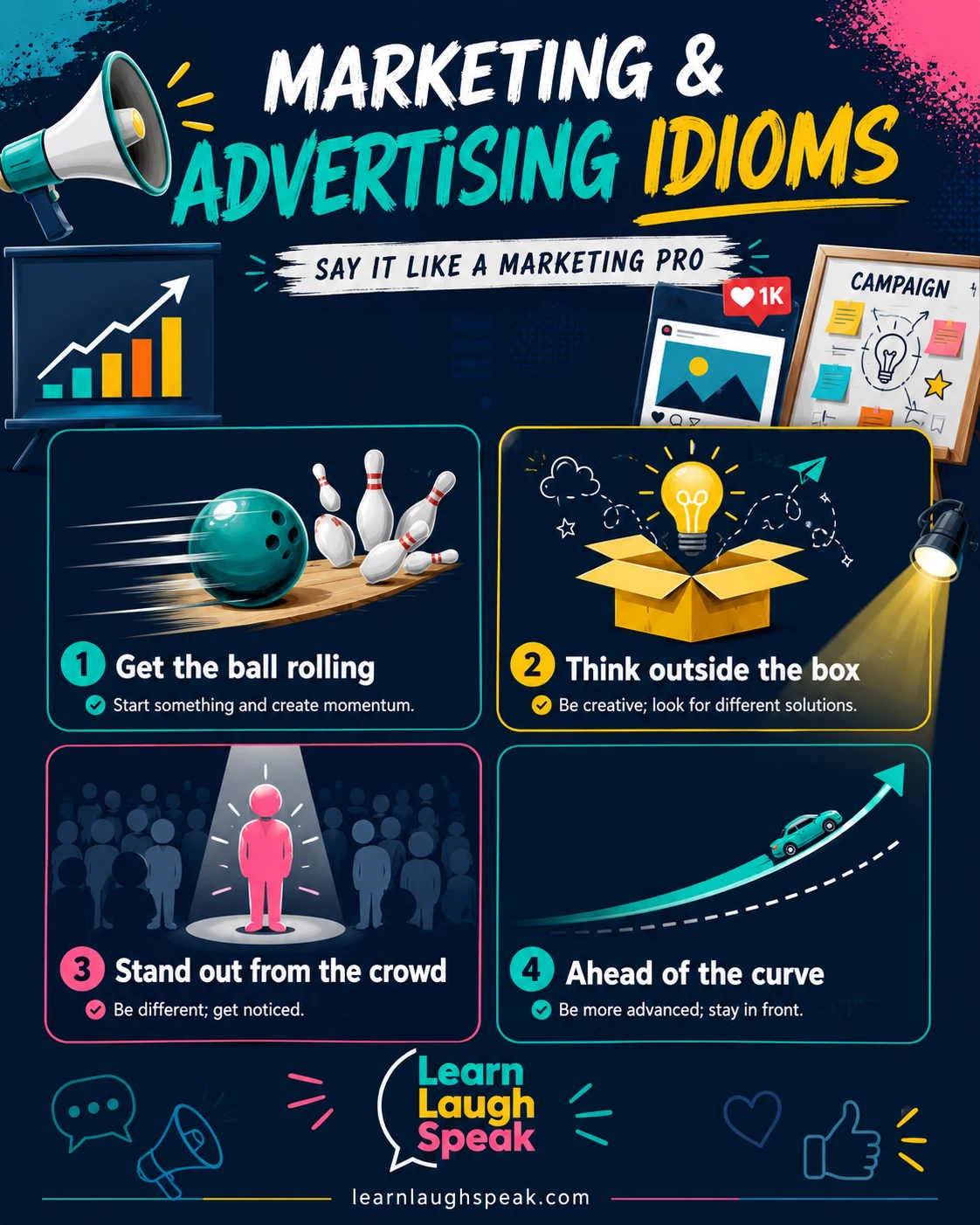
| Get the ball rolling | Start something | Let’s get the ball rolling on the campaign. |
| Think outside the box | Think creatively | We need to think outside the box for this ad. |
| Ahead of the curve | More advanced or prepared than others | This strategy keeps us ahead of the curve. |
| The proof is in the pudding | Results show if something works | The proof is in the pudding: sales increased. |
| Hit the nail on the head | Say or do exactly the right thing | That slogan hits the nail on the head. |
| A game changer | Something that creates a big improvement | This product could be a game changer. |
| Stand out from the crowd | Be different in a good way | Our brand needs to stand out from the crowd. |
| Get more bang for your buck | Get better value | This plan gives customers more bang for their buck. |
| Put your best foot forward | Make the best first impression | The launch page must put our best foot forward. |
| Seal the deal | Successfully complete an agreement | The final offer helped seal the deal. |
These phrases can help you understand business conversations and create stronger messages in English.
Idioms Used in Marketing Campaigns
Marketing campaigns often use idioms because they sound natural and persuasive.
A campaign might use:
“Make your money go further.”
This means the product helps customers save money or get better value.
A software company might say:
“Work smarter, not harder.”
This means the product helps people become more efficient.
A fitness brand might say:
“Take the first step.”
This encourages someone to begin a journey or make a change.
A travel company might say:
“The world is waiting.”
This creates emotion and encourages people to imagine travel.
Not every phrase is a traditional idiom, but many marketing phrases work like idioms. They create a clear meaning that is stronger than the literal words.
Idioms Used in Advertising
Advertising often uses short, familiar phrases because people remember them.
Here are useful idioms and phrase styles you may see in ads.
“Limited time offer”
This is not an idiom, but it is a common advertising phrase. It creates urgency.
Example:
Limited time offer: save 30% today.
“Don’t miss out”
This means the customer may lose an opportunity if they wait.
Example:
Don’t miss out on our summer sale.
“A fresh start”
This means a new beginning.
Example:
Give your business a fresh start this year.
“The next big thing”
This means something may become very popular or important.
Example:
Discover the next big thing in home technology.
“Worth every penny”
This means something is valuable and worth the money.
Example:
Premium comfort that is worth every penny.
These phrases work because they are easy to understand, emotional, and connected to action.
Idioms for Business Presentations
Idioms can also make presentations sound more natural.
However, you need to use them carefully. If you use too many, your message can become confusing.
Here are some useful idioms for presentations.
“Let’s get the ball rolling.”
Use this when you want to begin.
Example:
Let’s get the ball rolling with a quick overview of the campaign.
“The big picture”
Use this when talking about the main idea or full situation.
Example:
Before we look at the details, let’s focus on the big picture.
“A win-win situation”
Use this when both sides benefit.
Example:
This partnership creates a win-win situation for both brands.
“On the same page”
Use this when people understand or agree about the same thing.
Example:
Before we move forward, let’s make sure we are all on the same page.
“Raise the bar”
Use this when improving standards.
Example:
This campaign will raise the bar for customer experience.
“Back to the drawing board”
Use this when an idea needs to be changed or restarted.
Example:
The first concept did not work, so we went back to the drawing board.
These idioms are common in business English and can help your presentation sound more fluent.
How to Use Idioms Without Confusing People
Idioms can be powerful, but they can also create confusion.
This is especially true if your audience includes English learners, international clients, or people from different cultures.
Use idioms carefully.
A good rule is:
Use the idiom, then make the meaning clear.
Example:
“We need to stay ahead of the curve, which means preparing before our competitors do.”
This helps everyone understand the message.
You can also avoid idioms in important legal, safety, technical, or financial instructions. In those situations, clear direct English is usually better.
For example, instead of saying:
“We need to iron out the details.”
You can say:
“We need to solve the remaining problems.”
Simple English is often stronger when accuracy matters.
Software Development Phrases for Developers and IT Teams
Marketing Advertising Idioms: How to Use a Slogan Today
A slogan is a short phrase that helps people remember a brand, product, or campaign.
A good slogan should be clear, easy to repeat, and connected to the main message.
For example, a slogan may focus on:
speed
trust
comfort
value
confidence
quality
results
A good slogan does not need to be complicated.
In fact, simple is usually better.
Before choosing a slogan, ask:
Is it easy to understand?
Is it easy to remember?
Does it match the brand?
Does it sound natural?
Will the audience understand it quickly?
Can it work across different ads and platforms?
A slogan should support your message, not make people work hard to understand it.
Idioms and Slogans Are Not the Same
Idioms and slogans are connected, but they are not the same.
An idiom is a common phrase with a special meaning.
Example:
“Think outside the box.”
A slogan is a brand or campaign phrase created to be memorable.
Example:
“Learn every day. Speak with confidence.”
An idiom already exists in the language. A slogan is usually created for a specific brand or campaign.
However, slogans often use idiom-style language because it feels familiar and easy to remember.
Useful Marketing Idioms With Examples
Here are more idioms that can be useful in marketing and advertising English.
“Cut through the noise”
This means to stand out when there is too much information or competition.
Example:
Our campaign needs to cut through the noise and speak directly to customers.
“Word of mouth”
This means people talk about a product or service and recommend it to others.
Example:
Most of our new customers come from word of mouth.
“Call the shots”
This means to make the important decisions.
Example:
The marketing director calls the shots on the campaign budget.
“In the spotlight”
This means receiving attention.
Example:
The product launch put the brand in the spotlight.
“A hard sell”
This means a very direct or aggressive sales approach.
Example:
We want the ad to feel helpful, not like a hard sell.
“Soft sell”
This means a gentle sales approach.
Example:
The video uses a soft sell by focusing on the customer’s problem first.
“On brand”
This means the message matches the brand’s style, voice, and identity.
Example:
The new design looks professional, but it does not feel on brand yet.
“Go viral”
This means content spreads quickly online.
Example:
The team hopes the campaign will go viral.
These phrases are common in marketing conversations and can help English learners understand workplace discussions more easily.
When Idioms Work Well in Marketing
Idioms work well when they make the message easier, warmer, or more memorable.
They are useful in:
social media captions
sales presentations
website headings
brand storytelling
emails
advertising slogans
campaign ideas
internal marketing meetings
Idioms can make a message feel less robotic.
For example:
“Our product saves time.”
This is clear, but plain.
“Our product helps you work smarter, not harder.”
This feels more memorable.
Both are useful. The best choice depends on the audience and goal.
When You Should Avoid Idioms
Do not use idioms when the meaning must be exact.
Avoid idioms in:
contracts
safety instructions
medical instructions
financial warnings
technical manuals
legal documents
important product limitations
formal compliance messages
For example, if you are explaining payment terms, do not say:
“There are a few strings attached.”
Say:
“There are conditions you must follow.”
In marketing, personality is important. But clarity is more important when the customer needs exact information.
Why English Learners Should Study Marketing Advertising Idioms
Learning marketing advertising idioms helps English learners in several ways.
First, it improves listening. You will understand more when people use business phrases in meetings or presentations.
Second, it improves speaking. You can use natural expressions when discussing ideas, campaigns, products, or customers.
Third, it improves reading. You will understand ads, sales pages, emails, and website copy more easily.
Fourth, it improves confidence. When you understand idioms, business English feels less mysterious.
This is especially useful for learners who work in sales, marketing, hospitality, management, customer service, business development, or entrepreneurship.
How to Practise Idioms for Presentations
Do not try to memorize a long list of idioms in one day.
Choose three to five idioms and practise using them in realistic sentences.
For example:
“Let’s get the ball rolling.”
“We need to focus on the big picture.”
“This solution is a win-win.”
“That idea is on brand.”
“The campaign helped us stand out from the crowd.”
Then practise them in short presentation lines:
“Let’s get the ball rolling with the first idea.”
“The big picture is simple: customers want faster service.”
“This offer is a win-win for the company and the customer.”
This kind of practice helps you remember the idiom and use it naturally.
Better Alternatives for Global Audiences
If your audience includes international speakers, you may want to use simpler English.
Here are some examples.
| Idiom | Simple Alternative |
| Get the ball rolling | Let’s begin |
| Think outside the box | Think creatively |
| Stay ahead of the curve | Prepare early |
| Back to the drawing board | Start again |
| Seal the deal | Complete the agreement |
| Cut through the noise | Stand out clearly |
| On the same page | Understand the same thing |
| Raise the bar | Improve the standard |
This does not mean idioms are bad.
It means good communication depends on the audience.
Final Thoughts on Marketing Advertising Idioms
Marketing, advertising, and presentations use idioms because they help messages feel memorable and natural.
But idioms must be used carefully.
If the audience understands them, they can make your message stronger. If the audience does not understand them, they can create confusion.
The best approach is simple.
Use idioms when they support the message.
Explain them when needed.
Avoid them when clarity matters most.
For English learners, studying marketing advertising idioms can help you understand business English, improve workplace communication, and speak more confidently in presentations.

Learn Business English With Learn Laugh Speak
Learn Laugh Speak helps adult English learners improve speaking, listening, reading, writing, grammar, pronunciation, and vocabulary at the correct level.
Business English is not only about grammar. It is also about understanding real phrases used in meetings, presentations, emails, advertising, sales, and workplace conversations.
With Learn Laugh Speak, students complete a full level assessment and begin learning from the exact point that matches their ability.
You can practise useful English for work, receive corrections, and build confidence step by step.
If you want to understand idioms, speak more naturally, and communicate clearly in business situations, Learn Laugh Speak can help you make progress every day.