
 English
 Arabic
 Chinese (Simplified)
 Dutch
Dutch French
 German
 Italian
 Portuguese
 Russian
 Spanish
If you are learning English from Spanish, one of the first useful words to understand is jueves.
The simple meaning is:
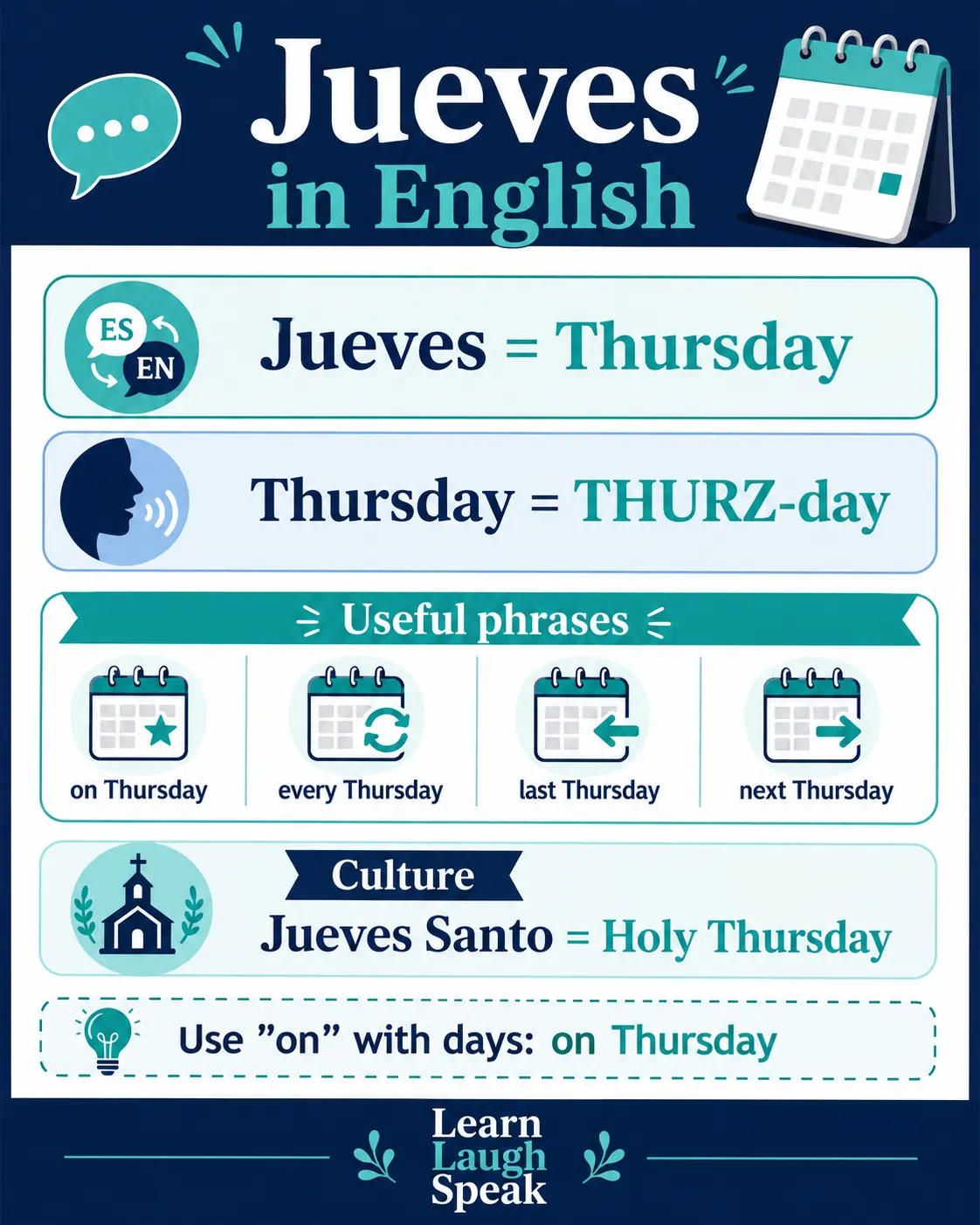
jueves = Thursday
So when you see or hear jueves in Spanish, the English translation is Thursday.
For example:
Tengo una reunión el jueves.
“I have a meeting on Thursday.”
Nos vemos el jueves.
“I’ll see you on Thursday.”
This may seem simple, but there are a few important details Spanish speakers should know. In English, we use on before days of the week, we always write Thursday with a capital letter, and the pronunciation can be difficult because of the th sound.
This guide will help you understand the meaning of jueves, how to use it in English sentences, how to pronounce Thursday, and common mistakes Spanish speakers should avoid.

What Does Jueves Mean?
Jueves is the Spanish word for Thursday.
Thursday is the day after Wednesday and before Friday.
In English, the days of the week are always capitalized.
Correct:
Thursday
Not:
thursday
Examples:
“I work on Thursday.”
“The meeting is on Thursday morning.”
“We have English class every Thursday.”
“My appointment is next Thursday.”
So, if you are asking what does jueves mean, the answer is simple:
Jueves means Thursday in English.
Jueves Translation Guide
Here are the most common ways to translate jueves into English.
| Spanish | English | Example |
|---|---|---|
| jueves | Thursday | Today is Thursday. |
| el jueves | on Thursday / Thursday | I have a meeting on Thursday. |
| los jueves | on Thursdays / every Thursday | I study English on Thursdays. |
| jueves pasado | last Thursday | I saw her last Thursday. |
| próximo jueves | next Thursday | We have class next Thursday. |
| Jueves Santo | Holy Thursday / Maundy Thursday | Holy Thursday is before Easter Sunday. |
This table is useful because jueves does not always translate as only one word in a full English sentence.
Sometimes you need on Thursday.
Sometimes you need every Thursday.
Sometimes you need last Thursday or next Thursday.
How to Use Jueves in English Sentences
The biggest difference between Spanish and English is that English usually uses on before days of the week.
In Spanish, you say:
Tengo una reunión el jueves.
In English, you say:
I have a meeting on Thursday.
You do not say:
I have a meeting in Thursday.
Here are more examples:
Spanish: Trabajo el jueves.
English: I work on Thursday.
Spanish: Tengo clase el jueves.
English: I have class on Thursday.
Spanish: Nos vemos el jueves.
English: I’ll see you on Thursday.
Spanish: La reunión es el jueves.
English: The meeting is on Thursday.
Spanish: Viajo el jueves por la mañana.
English: I travel on Thursday morning.
The pattern is simple:
on + Thursday
Use this when you are talking about something happening on that day.
Jueves is one thing in Spanish, but do you know the difference between gossip and chisme?
How to Pronounce Thursday in English
For Spanish speakers, the hard part is not usually understanding jueves.
The hard part is saying Thursday clearly.
A simple pronunciation guide is:
THURZ-day
Break it into two parts:
THURZ
day
The first sound, th, is difficult because many Spanish speakers naturally want to say Tursday or Dursday.
To make the th sound, place your tongue lightly between your teeth and let the air pass through.
Try this slowly:
th
Then:
thurz
Then:
Thursday
It may feel strange at first, but with practice it becomes easier.
You can practise with these short phrases:
“on Thursday”
“next Thursday”
“last Thursday”
“Thursday morning”
“Thursday night”
“every Thursday”
Do not worry if it is not perfect immediately. The important thing is to practise the sound clearly and slowly first.
Useful Thursday Phrases in English
Once you know that jueves means Thursday, you can start using common English phrases.
| English Phrase | Spanish Meaning |
|---|---|
| on Thursday | el jueves |
| next Thursday | el próximo jueves |
| last Thursday | el jueves pasado |
| every Thursday | todos los jueves |
| Thursday morning | jueves por la mañana |
| Thursday afternoon | jueves por la tarde |
| Thursday night | jueves por la noche |
| See you on Thursday | Nos vemos el jueves |
Examples:
“I’ll call you on Thursday.”
“We meet every Thursday.”
“The event is next Thursday.”
“I was sick last Thursday.”
“Can we move the meeting to Thursday afternoon?”
These phrases are more useful than only memorizing the word Thursday because they help you speak in full sentences.
Common Expressions With Thursday
In English, people often talk about Thursday as the day before Friday, so it can feel close to the weekend.
You may hear phrases like:
“It’s almost Friday.”
This is common on Thursday because people are thinking about the weekend.
You may also hear:
“Thursday night plans”
This means plans happening on Thursday night.
Example:
“Do you have any Thursday night plans?”
Another common phrase is:
“I’ll see you next Thursday.”
This is useful for meetings, classes, appointments, and plans.
Example:
“Thanks for your time. I’ll see you next Thursday.”
The original Spanish-style phrase “Thank God, it’s jueves” can work as a joke between Spanish and English speakers, but in normal English, people would say:
“Thank God, it’s Thursday.”
However, the more famous expression is:
“Thank God, it’s Friday.”
So if you say “Thank God, it’s Thursday,” it may sound playful because Friday is still one day away.

Jueves Santo in English
One important phrase connected to jueves is:
Jueves Santo
In English, this is usually translated as:
Holy Thursday
or
Maundy Thursday
This is the Thursday before Easter Sunday in the Christian calendar. It is connected to the Last Supper of Jesus with his apostles.
Example:
Spanish: Jueves Santo es antes del Domingo de Pascua.
English: Holy Thursday is before Easter Sunday.
In some countries, Jueves Santo is an important religious or cultural day.
This is a good example of why translation is not only about words. Sometimes you also need to understand the cultural meaning behind the phrase.
Common Mistakes Spanish Speakers Make
Here are some common mistakes when translating jueves into English.
| Mistake | Better English | Why |
|---|---|---|
| I have meeting in Thursday. | I have a meeting on Thursday. | Use on with days. |
| The jueves | Thursday / on Thursday | Do not mix Spanish and English. |
| Every jueves | Every Thursday | Use the English day name. |
| I see you next Thursday. | I’ll see you next Thursday. | Future meaning sounds better with will. |
| Thursday is in capital? | Is Thursday capitalized? | Days are capitalized in English. |
| I work the Thursday. | I work on Thursday. | English uses on before the day. |
The most important rule is:
Use on Thursday when talking about something that happens that day.
Examples:
“I have class on Thursday.”
“We leave on Thursday.”
“She works on Thursday.”
“The appointment is on Thursday.”
Jueves and the Days of the Week
If you are learning jueves, it also helps to review the days around it.
| Spanish | English |
|---|---|
| lunes | Monday |
| martes | Tuesday |
| miércoles | Wednesday |
| jueves | Thursday |
| viernes | Friday |
| sábado | Saturday |
| domingo | Sunday |
Notice that English days always start with a capital letter.
Correct:
Monday, Tuesday, Wednesday, Thursday, Friday, Saturday, Sunday
Not:
monday, tuesday, wednesday, thursday, friday, saturday, sunday
This is different from Spanish, where days are usually written in lowercase unless they start a sentence.
Practice Sentences With Jueves in English
Try reading these examples out loud.
Spanish: Hoy es jueves.
English: Today is Thursday.
Spanish: Trabajo el jueves.
English: I work on Thursday.
Spanish: Tengo una llamada el jueves.
English: I have a call on Thursday.
Spanish: Nos vemos el próximo jueves.
English: I’ll see you next Thursday.
Spanish: Estudio inglés todos los jueves.
English: I study English every Thursday.
Spanish: La clase fue el jueves pasado.
English: The class was last Thursday.
Spanish: Vamos a cenar el jueves por la noche.
English: We are going to dinner on Thursday night.
These examples help you see how jueves changes depending on the sentence.
Sometimes it is Thursday.
Sometimes it is on Thursday.
Sometimes it is every Thursday, last Thursday, or next Thursday.
Or do you know what donde estas means in Spanish?
Quick Learner Tip
When you translate jueves, do not only think:
jueves = Thursday
Also think about the full phrase.
Ask yourself:
Is it happening on that day?
Then use:
on Thursday
Is it repeated?
Then use:
every Thursday or on Thursdays
Is it in the past?
Then use:
last Thursday
Is it in the future?
Then use:
next Thursday
This will help you sound more natural in English.

Learn Days of the Week in English With Learn Laugh Speak
Learning words like jueves is a small but important part of building real English confidence.
You need vocabulary, pronunciation, grammar, listening, speaking, reading, and writing to work together.
Learn Laugh Speak helps adult learners practise English at the correct level with structured lessons and real examples.
Students complete a full level assessment and start from the level that matches their ability.
This means you do not waste time guessing what to study next.
You can practise useful words like Thursday, improve pronunciation, build sentence structure, and learn how to use English in real situations.
Whether you are learning days of the week, workplace English, pronunciation, or full conversations, Learn Laugh Speak helps you make progress step by step.
Final Thoughts on Jueves in English
Jueves means Thursday in English.
Use Thursday when naming the day.
Use on Thursday when talking about something that happens that day.
Use every Thursday or on Thursdays when something happens regularly.
Use last Thursday for the past.
Use next Thursday for the future.
And remember, Thursday is always capitalized in English.
Once you understand these small details, you can use jueves in English more naturally and confidently.