
 English
 Arabic
 Chinese (Simplified)
 Dutch
Dutch French
 German
 Italian
 Portuguese
 Russian
 Spanish
Leaving a job can feel uncomfortable, especially when English is not your first language. You may know you are ready to move on, but still feel unsure about the right words to use with your manager, team, or employer.
In professional English, it is usually better to avoid saying “I quit” directly.
That phrase can sound too sudden, emotional, or informal.
Instead, use phrases like:
- “I have decided to resign from my position.”
- “I will be moving on to a new opportunity.”
- “I would like to formally submit my resignation.”
- “After careful consideration, I have decided it is time for me to move on.”
These phrases help you sound respectful, confident, and professional while still being clear about your decision.
The Right Words to Use When You’re Running Late or Something Went Wrong
Still unsure on how to say I quit after reading this, contact our teachers on the website chat for support!
Quick Answer: What Is the Best Professional Way to Say I Quit?
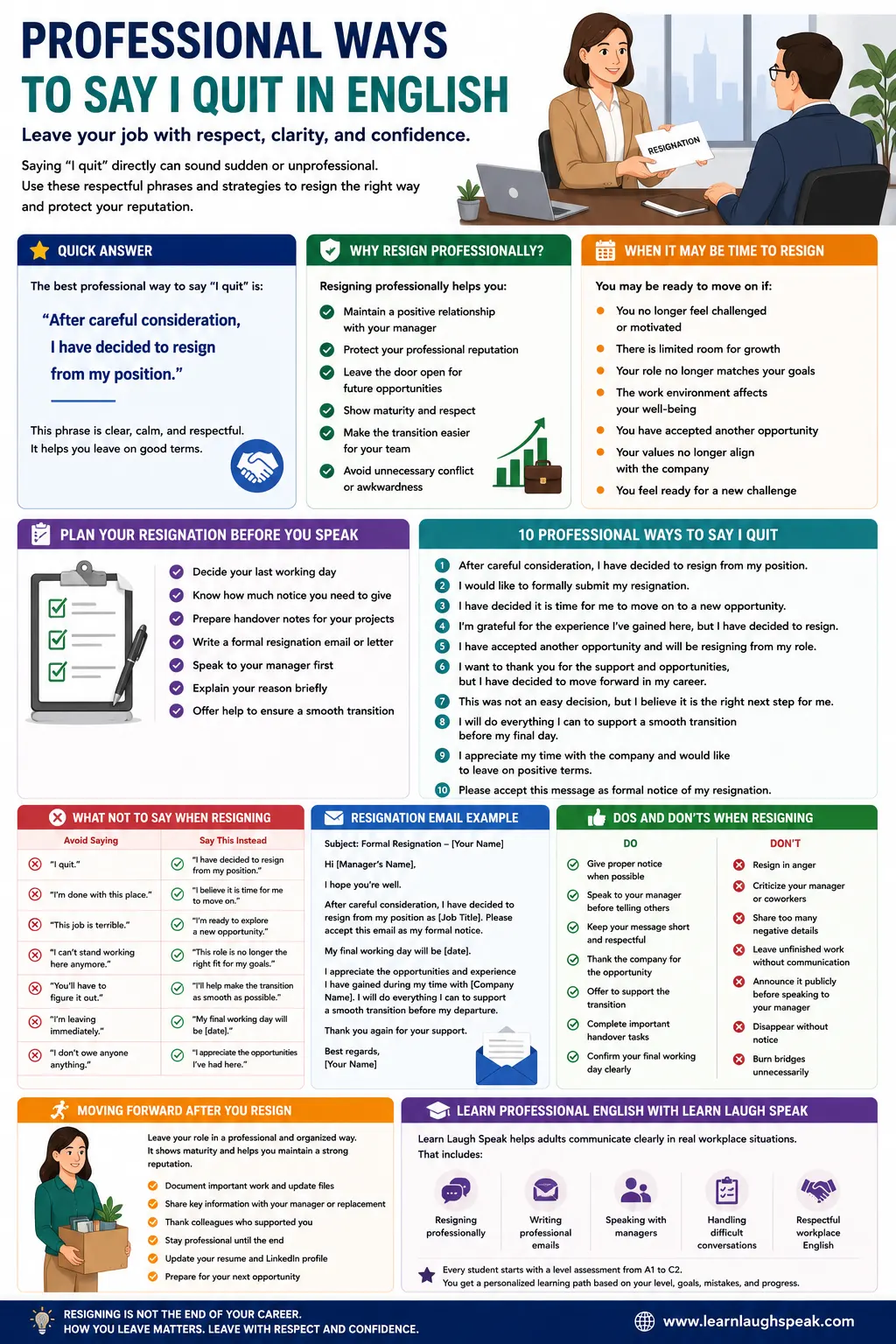
The best professional way to say “I quit” is:
“After careful consideration, I have decided to resign from my position.”
This phrase works because it is clear, calm, and respectful. It avoids sounding emotional or aggressive and helps you leave the company on good terms.
You can also say:
“I’m grateful for the opportunities I’ve had here, but I have decided to move on.”
This version adds appreciation and helps protect the professional relationship.

Why It’s Important to Resign Professionally
Knowing professional ways to say “I quit” matters because your final impression can affect your future career. Even if you are ready to leave, how you communicate your resignation can influence references, relationships, and future opportunities.
Resigning professionally helps you:
- maintain a positive relationship with your manager
- protect your professional reputation
- leave the door open for future opportunities
- show maturity and respect
- make the transition easier for your team
- avoid unnecessary conflict or awkwardness
A professional resignation is not only about leaving a job.
It is about leaving well.
The phrases to use when you need to cancel plans!
Ways to Say I Quit And How to Know Timing is Correct
Deciding to resign is personal, and every situation is different. However, there are common signs that it may be time to move on.
You may be ready to resign if:
- you no longer feel challenged or motivated
- there is limited room for growth
- your role no longer matches your goals
- the work environment is affecting your well-being
- you have accepted another opportunity
- your values no longer align with the company
- you feel ready for a new challenge
Before resigning, take time to think carefully.
If possible, avoid making the decision in anger or frustration. A calm decision helps you communicate more professionally.
The Right Way to Say You’re Not Feeling Well in English Correctly
Plan Your Resignation Before You Speak
Before you resign, it helps to prepare your message and plan the next steps. This makes the conversation easier and helps you avoid saying something too emotional in the moment.
Before resigning, consider:
- the date you want your resignation to begin
- how much notice you need to give
- what projects or tasks need to be handed over
- whether you need to write a formal resignation letter
- who should be informed first
- how you will explain your reason briefly
- how you can leave on good terms
If possible, speak to your manager before announcing your resignation to others.
This shows respect and keeps the process professional.
How to resign correctly – Tips here from an epic article
Learn more by checking out the links here to ensure you have the correct phrases for other situations other than I quit.
Phrases to use when quitting
Leaving a job is never an easy conversation, especially when it comes to saying “I quit.” For non-native English speakers, finding the right words can be even more challenging. That’s why we’ve compiled a list of 10 professional ways to express your intentions without burning bridges! So use them and say I quit in a positive and confident way!
10 Professional Ways to Say I Quit
Instead of saying “I quit,” use one of these professional resignation phrases:
- “After careful consideration, I have decided to resign from my position.”
- “I would like to formally submit my resignation.”
- “I have decided it is time for me to move on to a new opportunity.”
- “I’m grateful for the experience I’ve gained here, but I have decided to resign.”
- “I have accepted another opportunity and will be resigning from my role.”
- “I want to thank you for the support and opportunities, but I have decided to move forward in my career.”
- “This was not an easy decision, but I believe it is the right next step for me.”
- “I will do everything I can to support a smooth transition before my final day.”
- “I appreciate my time with the company and would like to leave on positive terms.”
- “Please accept this message as formal notice of my resignation.”
These phrases sound professional because they are clear, calm, and respectful.
What Not to Say When Resigning
Some phrases can sound angry, careless, or unprofessional. Even if you are unhappy, it is better to keep your resignation message calm and respectful.
| Avoid Saying | Say This Instead |
|---|---|
| “I quit.” | “I have decided to resign from my position.” |
| “I’m done with this place.” | “I believe it is time for me to move on.” |
| “This job is terrible.” | “I’m ready to explore a new opportunity.” |
| “I can’t stand working here anymore.” | “This role is no longer the right fit for my goals.” |
| “You’ll have to figure it out.” | “I’ll help make the transition as smooth as possible.” |
| “I’m leaving immediately.” | “My final working day will be [date].” |
| “I don’t owe anyone anything.” | “I appreciate the opportunities I’ve had here.” |
Professional resignation language helps you protect your reputation, even if the job was difficult.
Resignation Email Example
Subject: Formal Resignation – [Your Name]
Hi [Manager’s Name],
I hope you’re well.
After careful consideration, I have decided to resign from my position as [Job Title]. Please accept this email as my formal notice.
My final working day will be [date].
I appreciate the opportunities and experience I have gained during my time with [Company Name]. I will do everything I can to support a smooth transition before my departure.
Thank you again for your support.
Best regards,
[Your Name]

Ways to Say I Quit What Not to Say
When resigning, your goal should be to stay respectful, clear, and professional.
Do
- give proper notice when possible
- speak to your manager before telling others
- keep your message short and respectful
- thank the company for the opportunity
- offer to support the transition
- complete important handover tasks
- confirm your final working day clearly
Don’t
- resign in anger
- criticize your manager or coworkers
- share too many negative details
- leave unfinished work without communication
- announce it publicly before speaking to your manager
- disappear without notice
- burn bridges unnecessarily
The way you leave can matter just as much as the work you did while you were there.

Ways to Say I Quit: Moving Forward After You Resign
After you resign, focus on leaving your role in a professional and organized way. Complete important tasks where possible, prepare handover notes, and communicate clearly with your team.
This helps you leave with respect and confidence.
Before your final day, try to:
- document important work
- update files or project notes
- share key information with your manager or replacement
- thank colleagues who supported you
- stay professional until the end
- update your resume and LinkedIn profile
- prepare for your next opportunity
Leaving a job well shows maturity and helps you maintain a strong professional reputation.
3 thoughts on “10 Professional Ways to Say I Quit Easily & Correctly”
Pingback: How to Say I’m Quitting My Job Professionally & Easily
Pingback: How to Say No Professionally & Sound Respectful in English
Pingback: Correct & Professional Excuses for Missing Work in English