
 English
 Arabic
 Chinese (Simplified)
 Dutch
Dutch French
 German
 Italian
 Portuguese
 Russian
 Spanish
Learning how to pronounce words clearly is an important part of becoming a more fluent speaker. Clear pronunciation helps you communicate with confidence, especially in meetings, customer service, phone calls, interviews, and everyday conversations.
Do you ever feel like people misunderstand what you are saying in English?
It can be frustrating.
You may know the right word.
You may understand the sentence.
But missed one word.
But if the pronunciation is unclear, the listener may still have trouble understanding you.
This does not mean your English is bad.
It means your pronunciation, rhythm, stress, or speed may need more practice.
In this guide, we will look at practical ways to improve your speaking and pronunciation in English.
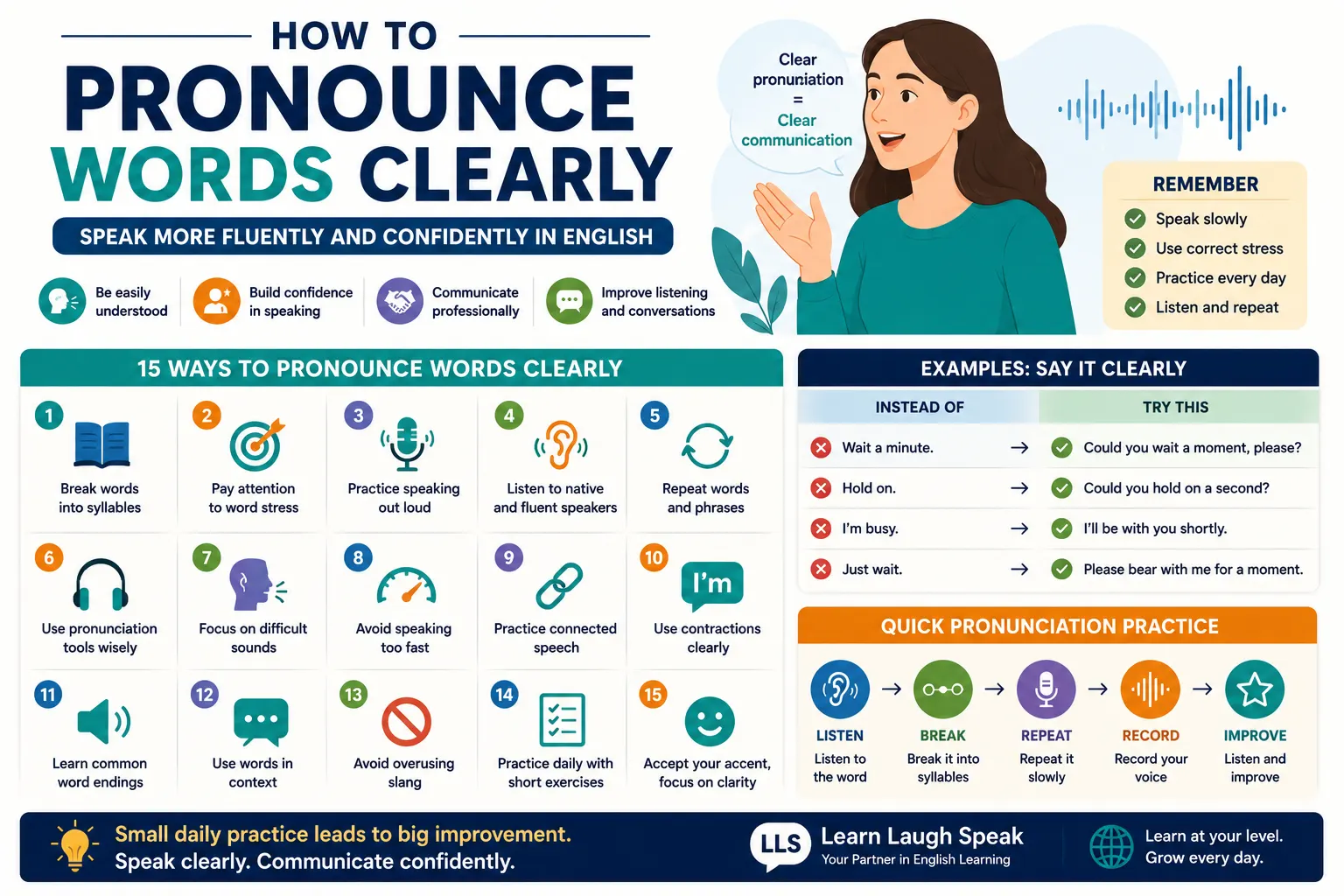
Quick Answer: How Can You Pronounce Words Clearly?
To pronounce words clearly, slow down slightly, focus on syllables, practise word stress, listen to native or fluent speakers, and repeat difficult words out loud.
Clear pronunciation is not about having a perfect accent.
It is about making your words easy to understand.
A good practice method is:
- listen to the word
- break it into syllables
- repeat it slowly
- notice the stressed syllable
- say it in a full sentence
- record yourself and compare
For example, the word employee has three syllables:
em-ploy-ee
The stress is usually on the final syllable:
em-ploy-EE
That small detail can make the word much clearer.
Why Pronunciation Matters in English
Pronunciation is important because English words are not always spoken the way they are written.
Some letters are silent.
Some sounds change when words are connected.
Some words look similar but sound different.
For example:
though
through
thought
tough
These words look similar, but they sound very different.
This is why pronunciation practice matters.
When you pronounce words clearly, you can:
- reduce misunderstandings
- speak with more confidence
- sound more professional
- improve listening skills
- communicate better at work
- feel more comfortable in conversations
You do not need to sound like a native speaker.
You need to sound clear.
That is the real goal.

1. Break Words Into Syllables
One of the easiest ways to pronounce words more clearly is to break them into syllables.
A syllable is a sound part of a word.
For example:
important = im-por-tant
communication = com-mu-ni-ca-tion
professional = pro-fes-sion-al
employee = em-ploy-ee
When a word feels difficult, do not try to say it quickly at first.
Break it down.
Say each part slowly.
Then put the word back together.
Example:
com-mu-ni-ca-tion
Then:
communication
This helps your mouth learn the movement.
It also helps your brain remember the sound pattern.
2. Pronounce Words Clearly With Correct Stress
In English, not every syllable has the same strength.
Some syllables are stressed.
That means they are louder, longer, or clearer.
For example:
PRE-sent can be a noun.
pre-SENT can be a verb.
Stress changes the way English sounds.
If you put the stress in the wrong place, the listener may still understand you, but the word can sound unnatural or unclear.
Here are some examples:
TA-ble
im-POR-tant
pro-FES-sion-al
com-mu-ni-CA-tion
When you learn a new word, learn the stress too.
Do not only learn the spelling.
Learn how the word sounds.
3. Practise Enunciating Words Out Loud
The more you practise speaking out loud, the easier pronunciation becomes.
Reading silently is useful, but it does not train your mouth.
You need to speak.
Choose a short paragraph, email, or dialogue and read it out loud.
Focus on:
- clear sounds
- natural pauses
- word endings
- rhythm
- stress
- not speaking too fast
You can also record yourself.
Then listen back and notice:
- which words were unclear
- where you spoke too quickly
- which sounds need practice
- whether your sentence rhythm sounded natural
This kind of practice can feel uncomfortable at first, but it is very effective.
4. Listen to Native and Fluent Speakers
One of the best ways to improve pronunciation is to listen carefully to people who speak English clearly.
This does not mean you need to copy one accent perfectly.
English is spoken with many accents around the world.
The goal is to notice how words are pronounced in real speech.
Listen for:
- word stress
- sentence rhythm
- connected speech
- pauses
- intonation
- pronunciation of difficult sounds
You can use:
- podcasts
- interviews
- business videos
- English lessons
- audiobooks
- workplace conversations
- short clips with subtitles
Listen once for the main idea.
Then listen again and focus only on pronunciation.
Repeat useful phrases out loud.
5. Repeat Words and Phrases
Repetition is simple, but it works.
If a word is difficult, repeat it many times slowly.
Then use it inside a sentence.
For example, if the word is comfortable, practise:
com-fort-a-ble
Then:
“This chair is comfortable.”
Then:
“I feel comfortable speaking English in small groups.”
This helps you move from word practice to real speaking.
Practising full phrases is often better than practising single words only.
For example, instead of only saying:
meeting
practise:
“I have a meeting tomorrow.”
“Can we reschedule the meeting?”
“Thank you for joining the meeting.”
This makes your pronunciation more useful for real conversations.
6. Use Pronunciation Tools Carefully
There are many pronunciation tools and apps that can help English learners.
They can be useful for listening, repeating, and checking sounds.
You can use tools to:
- hear the correct pronunciation
- slow down audio
- compare accents
- practise difficult sounds
- repeat phrases
- record your voice
Online dictionaries also usually include audio.
This is helpful because English spelling can be confusing.
However, do not rely only on apps.
Pronunciation improves faster when you also speak in real situations.
Use tools for support, then practise with real sentences and conversations.
7. Focus on Difficult Sounds
Every English learner has different pronunciation challenges.
This depends on your first language.
Some learners struggle with R and L.
Some struggle with TH.
Some struggle with short and long vowel sounds.
Some struggle with word endings like -ed, -s, or -es.
Common difficult sounds include:
think / this
right / light
ship / sheep
bit / beat
worked / wanted / played
Choose one sound at a time.
Do not try to fix every sound in one day.
Practise slowly and consistently.
For example, with TH:
think
thank
three
this
that
Then use full sentences:
“Thank you for this.”
“I think that works.”
“There are three things to check.”
8. Avoid Speaking Too Fast
Many learners think speaking fast means speaking fluently.
It does not.
Speaking too fast can make your pronunciation unclear.
Fluent speakers are not always fast.
They are clear, natural, and easy to follow.
If people often ask you to repeat yourself, slow down slightly.
Use pauses.
Group your words naturally.
For example:
Instead of rushing:
“Ithinkweshouldsendtheemailtoday.”
Say:
“I think we should send the email today.”
A small pause can make your English sound much clearer.
9. Practise Connected Speech
English words often connect together in natural speech.
This is one reason listening can feel difficult.
For example:
“What do you want to do?”
may sound like:
“Whaddaya wanna do?”
In professional English, you do not need to copy very casual connected speech, but you should understand it.
You can practise common connected phrases like:
“Could you…”
“Would you…”
“Do you want to…”
“I’m going to…”
“Let me…”
“Can I…”
These phrases appear often in real English.
Practising them helps you sound smoother and understand others more easily.
10. Be Careful With Contractions
Contractions are common in English.
Examples:
I’m
you’re
we’re
they’ll
don’t
can’t
The old advice is often to avoid contractions completely, but that is not always natural.
In real English, contractions are common in speaking and many workplace conversations.
The key is to use them clearly.
For example:
“I am going to send it.”
sounds more formal.
“I’m going to send it.”
sounds more natural in conversation.
Both are correct.
If a contraction makes your pronunciation unclear, practise it slowly first.
For example:
I am → I’m
do not → don’t
cannot → can’t
will not → won’t

11. Learn Common Word Endings
Word endings are important in English.
If you drop endings, your grammar may sound unclear.
Practise endings like:
-s
-ed
-ing
-tion
-ly
Examples:
works
worked
working
communication
clearly
Be especially careful with past tense endings.
For example:
worked
played
wanted
They do not all end with the same sound.
worked sounds like /t/
played sounds like /d/
wanted sounds like /id/
These small sounds help people understand your meaning.
12. Avoid Overusing Slang Until You Understand It
Slang can be useful, but it can also be confusing if you are not sure how to pronounce it or when to use it.
This does not mean slang is bad.
It means you should learn it in context.
Some slang is casual.
Some is regional.
Some is not appropriate in professional situations.
For workplace English, focus first on clear and polite language.
For example, instead of saying:
“Gimme a sec.”
you can say:
“Give me a second.”
or more professionally:
“Please give me a moment.”
Once you understand the context, you can decide when casual language is appropriate.
13. Practise Difficult Words in Context
Some words are harder to pronounce because they are long, unfamiliar, or have unusual spelling.
Examples:
comfortable
particularly
available
schedule
entrepreneur
rural
specific
development
Do not only repeat the word alone.
Use it in a sentence.
Examples:
“This time is available.”
“The schedule has changed.”
“I have a specific question.”
“The project is still in development.”
Context helps your pronunciation become more natural.
14. Accept Your Accent, But Improve Clarity
Having an accent is not a problem.
Everyone has an accent.
The goal is not to erase your identity.
The goal is to speak clearly enough that people can understand you.
A clear speaker:
- uses correct word stress
- speaks at a steady pace
- pronounces important sounds clearly
- pauses naturally
- checks understanding when needed
If someone does not understand you, do not panic.
You can say:
“Let me say that again.”
“I’ll repeat it more clearly.”
“What I mean is…”
These phrases help you stay confident.
15. Practise Daily With Short Exercises
Pronunciation improves with regular practice.
You do not need one long session every week.
Five to ten minutes a day can help.
Try this simple routine:
Minute 1: Choose three difficult words.
Minute 2: Break them into syllables.
Minute 3: Listen to the pronunciation.
Minute 4: Repeat each word slowly.
Minute 5: Use each word in a sentence.
Minute 6: Record yourself.
Minute 7: Listen and correct one thing.
This is simple, but it builds awareness.
Small daily practice is better than random practice once in a while.
Common Mistakes Made When Students Don’t Pronounce Words Clearly
Here are some common pronunciation mistakes and what to do instead.
| Mistake | Better Habit |
|---|---|
| Speaking too fast | Slow down and use natural pauses |
| Ignoring word stress | Learn which syllable is strongest |
| Dropping word endings | Practise -s, -ed, and -ing endings |
| Only reading silently | Practise speaking out loud |
| Trying to copy every accent | Focus on clear communication |
| Practising single words only | Use words in full sentences |
| Avoiding difficult sounds | Practise one sound at a time |
These small changes can make your English much easier to understand.
Learn Pronunciation with Learn Laugh Speak
Learn Laugh Speak helps adults improve English with structured lessons based on their level.
That includes:
- pronunciation practice
- speaking exercises
- listening practice
- vocabulary
- grammar
- reading and writing
- real conversation phrases
Every student starts with a level assessment from A1 to C2.
From there, learners follow structured lessons based on their level, mistakes, goals, and progress.
If you want to speak more clearly in English, Learn Laugh Speak helps you practise pronunciation, speaking, and communication step by step.

Final Thoughts on How to Pronounce Words Clearly
Learning how to pronounce words clearly takes time and practice.
But you do not need perfect pronunciation to become a strong English speaker.
You need clear pronunciation.
Focus on syllables, word stress, rhythm, difficult sounds, and speaking at a steady pace.
Listen carefully.
Repeat often.
Record yourself.
Practise words inside real sentences.
Over time, your pronunciation will become clearer, your confidence will grow, and people will understand you more easily.
5 thoughts on “How to Pronounce Words Clearly and Speak Fluently in English”
Way cool! Some extremely valid points! I appreciate you writing this write-up and also the rest of the website is very good.
thanks so much! LLS Team!
This is an interesting topic that can help me improve my speaking skills and become more confident in my pronunciation.
Glad you liked it. Have a great day!
Pingback: How to Use Multimedia Effectively in Your Classroom in 2023 - Learn Laugh Speak