
 English
 Arabic
 Chinese (Simplified)
 Dutch
Dutch French
 German
 Italian
 Portuguese
 Russian
 Spanish
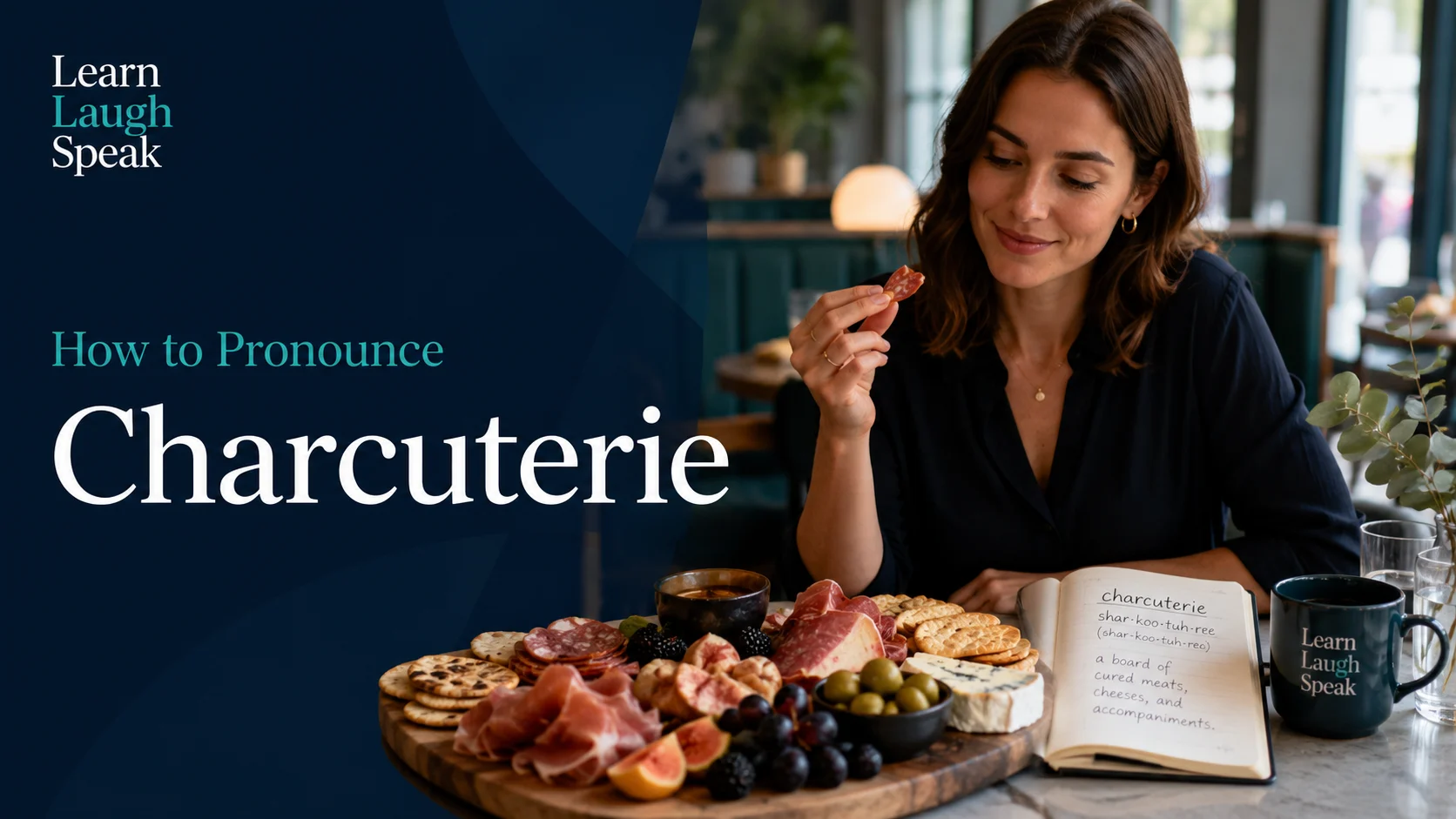
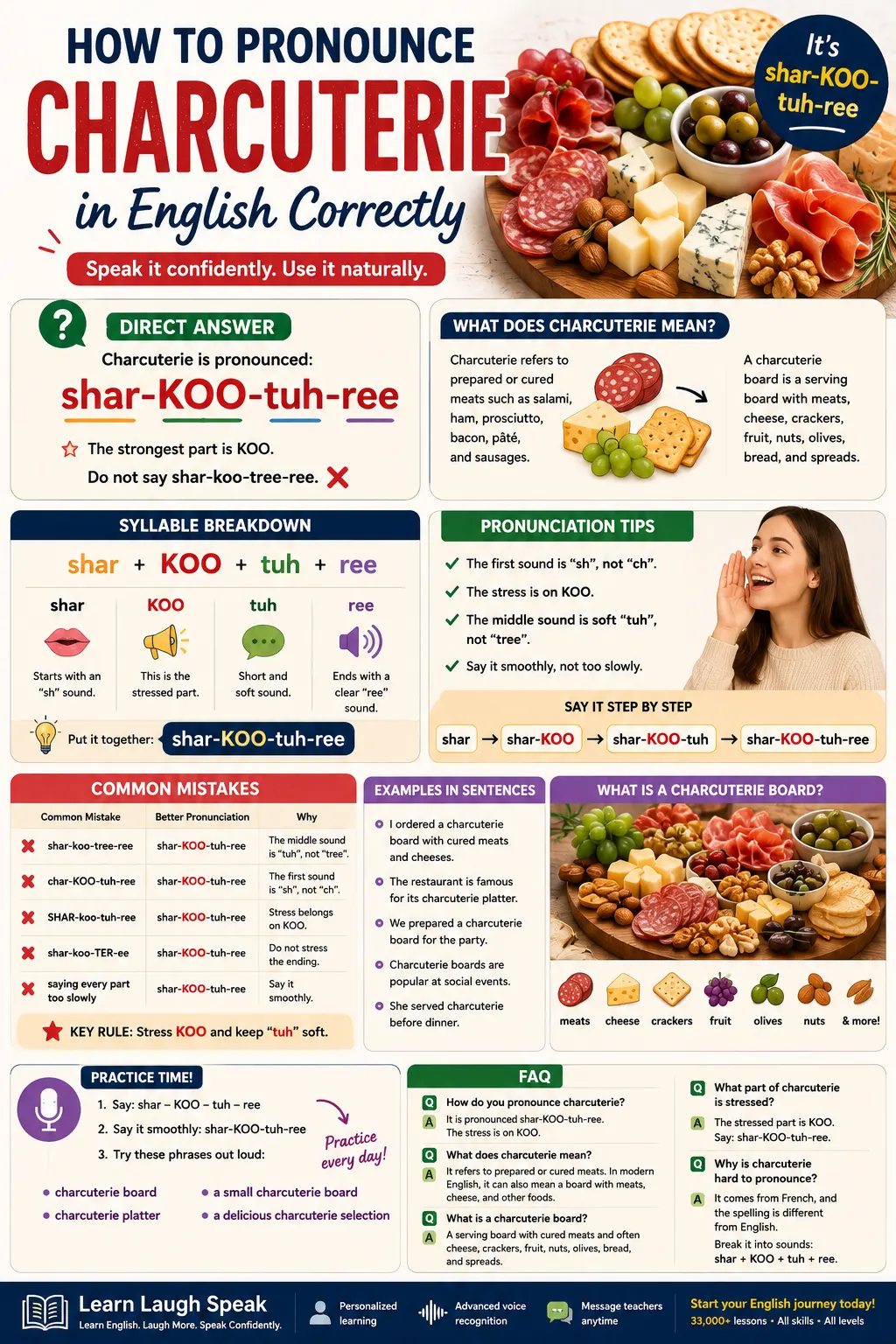
If you want to know how to pronounce charcuterie in English, the easiest pronunciation is:
shar-KOO-tuh-ree
The strongest part is:
KOO
So do not say:
shar-koo-tree-ree
Say:
shar-KOO-tuh-ree
A simple way to practise is:
shar + KOO + tuh + ree
Then say it smoothly:
shar-KOO-tuh-ree
This word comes from French, so the spelling can look difficult for English learners. But once you understand the sounds and rhythm, it becomes much easier to say clearly.
What Does Charcuterie Mean?
Charcuterie refers to prepared or cured meats, such as salami, ham, prosciutto, bacon, pâté, and sausages.
In modern English, many people use the word when talking about a charcuterie board. This usually means a serving board with cured meats, cheese, crackers, bread, fruit, nuts, olives, and spreads.
Example:
We ordered a charcuterie board to share before dinner.
So when you hear charcuterie, think of prepared meats and the popular boards served at restaurants, parties, events, and gatherings.
Learning how to pronounce charcuterie correctly helps you sound more confident when ordering food, talking about restaurants, or discussing recipes in English.
The History of Charcuterie
The history of charcuterie goes back many centuries.
The word comes from French. It is connected to the idea of preparing, cooking, preserving, and curing meat.
In the past, people used these methods because they needed to preserve food and avoid waste. Before modern refrigeration, curing and smoking meat helped communities store food for longer periods of time.
Charcuterie became especially important in France, where skilled food artisans prepared different kinds of cured and cooked meats. These specialists created techniques for smoking, salting, drying, and aging meat to produce different flavours and textures.
Over time, charcuterie became popular beyond France. Today, you can find charcuterie boards in restaurants, hotels, events, homes, and social gatherings around the world.
A modern charcuterie board often includes more than meat. It may also include cheese, crackers, fruit, nuts, olives, pickles, bread, honey, and spreads.
This is why the word is now common in English food conversations.
How to Pronounce Charcuterie: Syllable Breakdown
The word charcuterie can be broken into four simple sounds:
shar + KOO + tuh + ree
The second part, KOO, is the strongest sound.
| Part | Sound | Tip |
|---|---|---|
| char | shar | Starts with an sh sound |
| cu | KOO | This is the stressed part |
| te | tuh | Short and soft |
| rie | ree | Ends with a clear ree sound |
Put it together:
shar-KOO-tuh-ree
Say it slowly first:
shar — KOO — tuh — ree
Then say it naturally:
shar-KOO-tuh-ree
The rhythm matters. The word should not sound flat. The strongest sound is KOO, so give that part more emphasis.
Charcuterie Pronunciation Tips
To pronounce charcuterie clearly, focus on the sound, not only the spelling.
The first sound is shar.
It does not start with the English ch sound like in chair or cheese.
So do not say:
char-KOO-tuh-ree
Say:
shar-KOO-tuh-ree
Next, remember that the second part is the strongest:
KOO
Practise like this:
shar-KOO
shar-KOO-tuh
shar-KOO-tuh-ree
The middle sound tuh should be soft and short. Do not turn it into tree.
Common mistake:
shar-koo-tree-ree
Better pronunciation:
shar-KOO-tuh-ree
If you remember one thing, remember this:
Stress KOO and keep tuh soft.
Common Mistakes With Charcuterie Pronunciation
Here are common mistakes English learners make with this word.
| Common Mistake | Better Pronunciation | Why |
| shar-koo-tree-ree | shar-KOO-tuh-ree | The middle sound is tuh, not “tree” |
| char-KOO-tuh-ree | shar-KOO-tuh-ree | The first sound is sh, not English “ch” |
| SHAR-koo-tuh-ree | shar-KOO-tuh-ree | Stress belongs on KOO |
| shar-koo-TER-ee | shar-KOO-tuh-ree | Do not stress the ending |
| saying every part too slowly | shar-KOO-tuh-ree | Say it smoothly |
The key rule is simple:
shar-KOO-tuh-ree
Not:
shar-koo-tree-ree
What Is a Charcuterie Board?
A charcuterie board is a serving board with cured meats and often other foods such as cheese, crackers, fruit, nuts, olives, bread, and spreads.
Common foods on a charcuterie board include:
salami
prosciutto
ham
sausages
cheese
crackers
olives
grapes
nuts
bread
honey or jam
In traditional meaning, charcuterie focuses on prepared meats. But in modern English, many people use charcuterie board to describe a mixed board of meats, cheeses, and snacks.
Example:
The restaurant served a charcuterie board with salami, cheese, olives, and bread.
This phrase is very common in restaurants, catering, events, and food conversations.
How to Use Charcuterie in a Sentence
Using a new word in real sentences helps you remember it.
Here are some examples of charcuterie in English.
- “I ordered a charcuterie board with cured meats and cheeses.”
- “The restaurant is famous for its charcuterie platter.”
- “We prepared a charcuterie board for the party.”
- “The board included salami, prosciutto, cheese, crackers, and olives.”
- “I learned how to pronounce charcuterie correctly today.”
- “Charcuterie boards are popular at social events.”
- “She served charcuterie before dinner.”
- “The hotel offered a beautiful charcuterie selection.”
- “My friend made a homemade charcuterie board.”
- “We shared a charcuterie platter with a glass of wine.”
When you read these examples out loud, focus on saying:
shar-KOO-tuh-ree
Charcuterie in Restaurants and Social Events
You may hear the word charcuterie in restaurants, hotels, weddings, parties, wine bars, and food events.
For example, a waiter may say:
Would you like to start with the charcuterie board?
Or you may see this on a menu:
Artisan Charcuterie Board
This usually means a board with cured meats and other small foods to share.
If you want to order it confidently, you can say:
Can we have the charcuterie board, please?
Pronounced:
Can we have the shar-KOO-tuh-ree board, please?
This is useful because many English learners avoid words they are not sure how to say. But with practice, you can use the word naturally.
Charcuterie Board Vocabulary
Here are some useful words connected to charcuterie.
| Word | Meaning |
| cured meat | meat preserved with salt, smoke, or drying |
| salami | cured sausage often served in slices |
| prosciutto | thin Italian cured ham |
| ham | meat from pork, often cured or cooked |
| pâté | smooth spread made from meat or liver |
| crackers | thin crispy food often served with cheese |
| olives | small salty fruit often served on boards |
| spread | soft food added to bread or crackers |
| platter | large plate or board used for serving food |
| appetizer | small food served before the main meal |
Learning these words helps you talk about food more confidently in English.
Simple Practice Routine
Here is an easy way to practise how to pronounce charcuterie.
First, say the strongest part:
KOO
Now add the beginning:
shar-KOO
Then add the soft middle:
shar-KOO-tuh
Finally, add the ending:
shar-KOO-tuh-ree
Now practise with short phrases:
charcuterie board
charcuterie platter
a small charcuterie board
a French charcuterie board
a delicious charcuterie platter
Then practise full sentences:
We ordered a charcuterie board.
The charcuterie platter was delicious.
I can pronounce charcuterie now.
Practise slowly first, then speed up naturally.
FAQ: How to Pronounce Charcuterie
How do you pronounce charcuterie?
Charcuterie is pronounced:
shar-KOO-tuh-ree
The stress is on KOO.
Is it pronounced charcuterie or sharkooterie?
The sound is closer to:
shar-KOO-tuh-ree
The first sound is sh, not the English ch sound.
What does charcuterie mean?
Charcuterie refers to prepared or cured meats, such as salami, ham, prosciutto, pâté, and sausages.
In modern English, it can also refer to a board served with meats, cheeses, crackers, fruit, nuts, olives, bread, or spreads.
What is a charcuterie board?
A charcuterie board is a serving board with cured meats and often cheese, crackers, fruit, nuts, olives, bread, and spreads.
It is commonly served at restaurants, parties, and events.
What part of charcuterie is stressed?
The stressed part is:
KOO
Say:
shar-KOO-tuh-ree
Why is charcuterie hard to pronounce?
It is hard because it comes from French and the spelling does not look simple for many English learners.
The best way to learn it is to break it into sounds:
shar + KOO + tuh + ree
Final Thoughts on How to Pronounce Charcuterie
Learning how to pronounce charcuterie can feel difficult at first because the word looks long and unfamiliar.
But the pronunciation becomes easier when you break it into four sounds:
shar + KOO + tuh + ree
Remember:
shar-KOO-tuh-ree
The strongest sound is:
KOO
Do not say:
shar-koo-tree-ree
Practise the word slowly, then use it in short phrases and real sentences.
Soon, you will be able to say charcuterie confidently when ordering food, talking about restaurants, or discussing your favourite meals in English.
Improve English Pronunciation With Learn Laugh Speak
Learn Laugh Speak helps adult English learners improve pronunciation, speaking, listening, reading, writing, grammar, and vocabulary at the correct level.
Some English food words are difficult because spelling and pronunciation do not always match.
Words like charcuterie, salmon, Worcestershire, and acai can feel confusing at first, but with structured practice, they become easier.
With Learn Laugh Speak, students complete a full level assessment and begin learning from the exact point that matches their ability.
You can practise pronunciation, receive corrections, and improve step by step with lessons designed for real communication.
If you want to pronounce difficult English words more clearly and speak with more confidence, Learn Laugh Speak can help you make progress every day.

2 thoughts on “How to Pronounce Charcuterie in English Correctly”
Pingback: How to pronounce Shein in English? Easy Speak
Pingback: How to Pronounce Niche in English Correctly - Learn Laugh Speak
Comments are closed.