
 English
 Arabic
 Chinese (Simplified)
 Dutch
Dutch French
 German
 Italian
 Portuguese
 Russian
 Spanish
To become a public speaker, start by improving your speaking skills, practising in small groups, learning how to structure a speech, understanding your audience, using clear body language, and taking every opportunity to speak. You do not need to be perfect at first. You need practice, preparation, confidence, and a clear message.
Many people dream of speaking in front of an audience, sharing ideas, teaching others, or even becoming an international speaker. But if English is not your first language, public speaking can feel even more challenging.
The good news is that you can become a public speaker step by step. You do not need perfect English, a perfect accent, or a huge audience at the beginning. You need clear communication, useful preparation, and consistent practice.
This guide will help English learners and professionals build the skills needed to speak with more confidence in meetings, presentations, workshops, events, and public speaking situations.
Why Become a Public Speaker in English?
Learning to become a public speaker in English can open many opportunities. Public speaking is useful for work, business, education, leadership, networking, training, sales, and personal growth.
You may need public speaking skills to:
- give a presentation at work
- speak in a meeting
- lead a training session
- explain an idea to a team
- present a project
- speak at an event
- teach others
- share your professional experience
- build your personal brand
- become an international speaker one day
Public speaking is not only for famous speakers on a stage. It starts with small moments: speaking clearly in a meeting, explaining your opinion, asking a good question, or presenting an idea with confidence.
Become a Public Speaker by Building Strong Speaking Skills
The first step to become a public speaker is to improve your basic speaking skills. A good speaker needs to be clear, organised, and easy to understand.
Focus on these areas:
- pronunciation
- speaking speed
- sentence stress
- clear vocabulary
- confident tone
- natural pauses
- organised ideas
- audience connection
For English learners, clarity matters more than perfection. You do not need to sound like a native speaker. You need people to understand your message.
For example, instead of trying to use complicated English, say:
“Today, I want to share three simple ideas that can help our team communicate better.”
This sentence is clear, professional, and easy to follow.
Become a Public Speaker by Starting Small
Many people imagine public speaking as standing on a big stage. But most good speakers start small.
You can begin by speaking in low-pressure situations, such as:
- speaking in a team meeting
- giving a short update at work
- presenting to a small group of friends
- recording yourself speaking
- joining a class discussion
- explaining a topic to a colleague
- practising with a teacher or language partner
Start with one-minute talks. Then move to three-minute talks. Then five minutes. Small steps help you build confidence without overwhelming yourself.
Example topic:
“One thing I learned this week.”
You can structure it like this:
“This week, I learned how to explain my ideas more clearly in English. At first, I was nervous, but I practised using shorter sentences. This helped me feel more confident when speaking in our team meeting.”
Simple practice like this helps you become more natural over time.
Become a Public Speaker by Learning Speech Structure
A strong speech needs structure. If your ideas are not organised, your audience may feel confused.
A simple speech structure is:
- Opening — introduce your topic
- Main point one — explain your first idea
- Main point two — explain your second idea
- Main point three — explain your third idea
- Conclusion — summarise and end clearly
Example opening:
“Good morning everyone. Today, I’d like to talk about how better communication can help our team work more efficiently.”
Example transition:
“The first point I want to mention is…”
Example conclusion:
“To summarise, clear communication saves time, reduces mistakes, and helps teams work better together.”
When you use structure, your speech becomes easier to deliver and easier for the audience to follow.
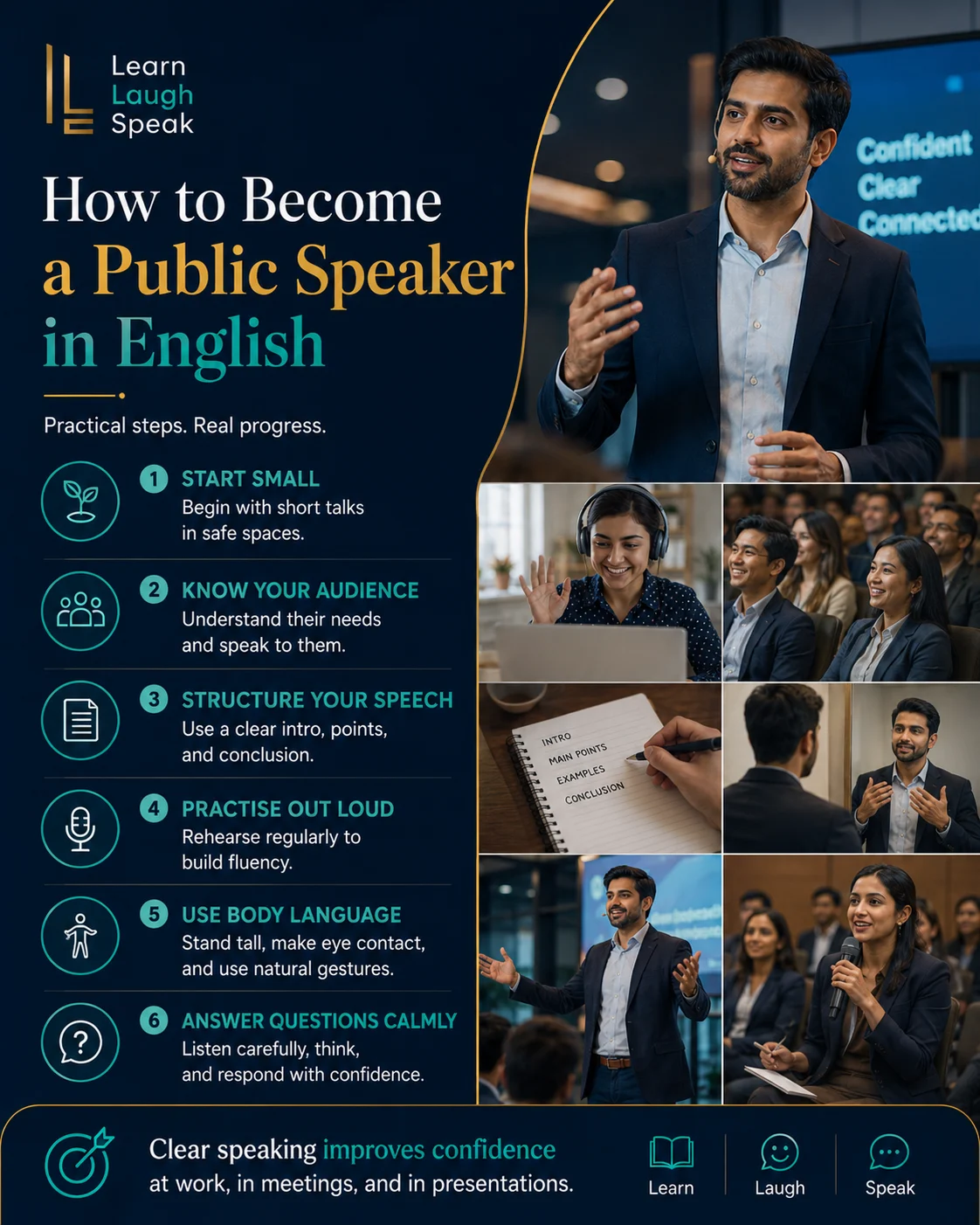
Become a Public Speaker by Knowing Your Audience
Before you speak, think about your audience. A good speaker does not only ask, “What do I want to say?” A good speaker also asks, “What does my audience need to hear?”
Ask yourself:
- Who is listening?
- What do they already know?
- What problem do they have?
- What do they want to learn?
- How formal should my language be?
- What examples will make sense to them?
- What action do I want them to take?
For example, if you are speaking to managers, your examples may focus on results, leadership, and team communication.
If you are speaking to English learners, your examples should be simpler, practical, and easy to apply.
Knowing your audience helps you choose better words, better examples, and a better tone.
Become a Public Speaker by Preparing, Not Memorising
Preparation is important, but memorising every word can make you sound robotic. It can also create panic if you forget one sentence.
Instead of memorising a full speech, prepare:
- your main message
- your key points
- important examples
- opening sentence
- closing sentence
- possible questions
Use notes with short prompts, not long paragraphs.
Example notes:
Topic: Better workplace communication
Point 1: clear updates
Point 2: asking for clarification
Point 3: confirming next steps
Example: team meeting confusion
Closing: clear English builds stronger teams
This helps you speak naturally while staying organised.
Become a Public Speaker by Practising Out Loud
Reading your speech silently is not enough. Public speaking is a spoken skill, so you need to practise out loud.
When practising, focus on:
- speaking clearly
- using pauses
- stressing key words
- controlling speed
- looking up from your notes
- using natural gestures
- sounding confident
Try this method:
- Practise alone.
- Record yourself.
- Listen and check your speed.
- Practise again.
- Present to one person.
- Ask for feedback.
- Improve one thing at a time.
Do not try to fix everything in one practice session. Focus on one improvement each time.
For example:
Practice 1: speak slower
Practice 2: improve opening
Practice 3: use better pauses
Practice 4: make eye contact
This is how real progress happens.
Become a Public Speaker by Improving Body Language
Body language affects how your audience sees you. Even if your English is good, nervous body language can make you look unsure.
Good public speaking body language includes:
- standing or sitting straight
- making natural eye contact
- keeping your hands relaxed
- using gestures to support ideas
- smiling when appropriate
- facing the audience
- avoiding looking down too much
- not moving too quickly
Example:
When you say:
“There are three important points.”
You can use your fingers to show one, two, and three. This makes your speech easier to follow.
Body language should support your message, not distract from it.
Become a Public Speaker by Using Visual Aids Well
Visual aids can make your presentation clearer. These may include slides, images, charts, diagrams, short videos, or examples.
But visual aids should not replace your speech. They should support it.
Good visual aids are:
- simple
- clear
- easy to read
- connected to your message
- not overloaded with text
- useful for the audience
Avoid reading every word from your slides. Instead, use the slide as support and explain the idea in your own words.
Useful phrase:
“As you can see on this slide…”
Another useful phrase:
“This example shows why the topic matters.”
Visual aids are helpful when they make your message easier to understand.
Become a Public Speaker by Handling Questions Well
Public speaking often includes questions from the audience. This can feel stressful, especially in English. But you do not need to know every answer immediately.
Useful phrases for answering questions:
- “That’s a great question.”
- “Let me think about that for a moment.”
- “From my experience…”
- “The short answer is…”
- “I’d explain it this way…”
- “I don’t have the exact answer right now, but I can follow up.”
- “Could you clarify what you mean?”
- “Can I check that I understood your question correctly?”
If you do not understand the question, ask for clarification.
Example:
“Could you repeat the last part of your question, please?”
This is professional and much better than guessing.
Become a Public Speaker by Joining Speaking Groups or Workshops
Speaking groups, workshops, English classes, and presentation clubs can help you practise in a supportive environment.
These spaces help because you can:
- practise in front of people
- get feedback
- learn from other speakers
- build confidence
- improve pronunciation
- practise answering questions
- reduce fear over time
You can also watch experienced speakers online. Pay attention to how they:
- open their speech
- use pauses
- explain examples
- move between ideas
- use stories
- answer questions
- close the presentation
Do not copy someone completely. Notice useful techniques and adapt them to your own speaking style.
Become a Public Speaker by Writing Better Speeches
Speech writing is a skill. A good speech should sound natural when spoken, not like a formal essay.
When writing a speech, use:
- short sentences
- clear examples
- simple structure
- strong opening
- natural transitions
- memorable ending
- words you can pronounce comfortably
Avoid writing sentences that are too long or complicated.
Too complex:
“The fundamental objective of today’s presentation is to evaluate the multi-dimensional implications of communication inefficiencies.”
Better:
“Today, I want to explain how unclear communication can create problems at work.”
The second sentence is easier to say and easier to understand.

Become a Public Speaker by Staying Passionate About Your Topic
Good speakers care about their topic. If you are not interested in what you are saying, your audience will feel it.
Before speaking, ask yourself:
- Why does this topic matter?
- How can it help the audience?
- What personal experience can I share?
- What do I want people to remember?
- What action do I want them to take?
Passion does not mean shouting or being dramatic. It means speaking with energy, purpose, and belief.
Example:
“I care about this topic because I know how difficult it can feel to speak English at work when you are still learning.”
This kind of sentence helps the audience connect with you.
Public Speaking Phrases in English
Here are useful phrases for presentations and speeches.
| Situation | Useful phrase |
|---|---|
| Starting | “Good morning everyone. Thank you for being here.” |
| Introducing the topic | “Today, I’d like to talk about…” |
| Explaining purpose | “The goal of this presentation is…” |
| Moving to a point | “The first point I want to mention is…” |
| Giving an example | “For example…” |
| Adding information | “Another important point is…” |
| Clarifying | “What I mean by this is…” |
| Summarising | “To summarise…” |
| Ending | “Thank you for your time.” |
| Inviting questions | “I’d be happy to answer any questions.” |
These phrases help you sound organised and professional when speaking in English.
What Not to Say and What to Say Instead
Some phrases can make you sound nervous, unclear, or too informal. Here are better options.
| What not to say | What to say instead |
| “I’m bad at speaking.” | “I’m still improving my public speaking skills.” |
| “Sorry, my English is bad.” | “Thank you for your patience while I explain this.” |
| “I don’t know what to say.” | “Let me organise my thoughts for a moment.” |
| “This is my speech.” | “Today, I’d like to share…” |
| “You understand?” | “Does that make sense?” |
| “I finished.” | “That brings me to the end of my presentation.” |
| “Ask me anything.” | “I’d be happy to answer any questions.” |
| “I forgot.” | “Let me return to that point in a moment.” |
These changes make your English sound more confident and professional.
Common Mistakes When Trying to Become a Public Speaker
Many new speakers make similar mistakes. They are normal, but you can improve them with practice.
1. Trying to sound perfect
Perfection is not the goal. Clear communication is the goal.
2. Speaking too fast
Nervous speakers often speak quickly. Slow down and use pauses.
3. Reading everything from notes
Notes are useful, but your audience wants connection. Look up often.
4. Using too much text on slides
Slides should support your message, not become your full script.
5. Not practising the ending
Many speakers practise the beginning but forget the conclusion. A strong ending matters.
6. Avoiding feedback
Feedback helps you improve faster. Ask one or two trusted people what you can improve next time.
How to Become an International Speaker
If your long-term goal is to become an international speaker, start by building credibility and experience.
Steps that can help:
- Choose your main topic.
- Build experience speaking locally or online.
- Record short talks or presentations.
- Share useful content on your topic.
- Network with people in your industry.
- Speak at small events first.
- Ask for testimonials or feedback.
- Build a speaker profile.
- Apply for relevant events.
- Keep improving your English and delivery.
Do not start by trying to speak at the biggest event immediately. Build your speaking skills, your message, and your reputation step by step.
International speaking is possible, but it usually comes from consistent work over time.
Learn Public Speaking English with Learn Laugh Speak
Learn Laugh Speak helps adult English learners improve speaking, listening, pronunciation, vocabulary, grammar, and professional communication.
If you want to become a public speaker, you need more than confidence. You need clear English, useful phrases, speaking practice, pronunciation support, and feedback.
Learn Laugh Speak helps learners build English for:
- presentations
- workplace speaking
- meetings
- interviews
- leadership communication
- customer service
- professional conversations
- pronunciation and fluency
- real-life communication
The goal is not to sound perfect. The goal is to communicate clearly and confidently in English.
FAQs About How to Become a Public Speaker
How can I become a public speaker in English?
To become a public speaker in English, practise speaking regularly, prepare clear points, learn presentation phrases, improve pronunciation, use body language well, and start with small speaking opportunities.
Do I need perfect English to become a public speaker?
No. You do not need perfect English. You need clear communication, preparation, confidence, and the ability to connect with your audience.
How can I improve my public speaking skills?
Practise out loud, record yourself, join speaking groups, ask for feedback, watch experienced speakers, and speak in real situations whenever possible.
How do I start a speech in English?
You can start with: “Good morning everyone. Thank you for being here. Today, I’d like to talk about…”
How do I handle questions after a presentation?
Use phrases like “That’s a great question,” “Let me think about that,” or “Could you clarify what you mean?” You do not need to answer immediately if you need a moment.
Can public speaking help my career?
Yes. Public speaking can help you communicate better at work, lead meetings, present ideas, build confidence, and create more professional opportunities.
Final Thoughts on How to Become a Public Speaker
To become a public speaker, start small, practise often, and focus on clear communication. You do not need to speak perfectly from the beginning. You need to improve one step at a time.
Build your speaking skills, understand your audience, prepare your message, practise out loud, use strong body language, and learn how to answer questions confidently.
With time and consistent practice, you can speak with more confidence in meetings, presentations, workshops, events, and even international speaking opportunities.
10 thoughts on “How to Prepare to Become a Public Speaker in English Correctly”
I would like to be a member of this Association.
Hi, we have sent you an email Vincent.
Thank you
I would like to be a member.
Hi Vincent, I have sent you an email. Have a nice day.
I’m so impressed by the 19th
tip and I’m just in love with
this blog.
Thank you so much for the comment and feedback! Appreciate it!
Hi I would gladly and appreciate being part of this and be a memy
Sorry we do not know what you mean, but feel free to send us a email if you have any questions. Info@learnlaughspeak.com
I want to be the international speaker. Please help me to register. Thanks
You can start improving your speaking here http://www.learnlaughspeak.com/pricing