
 English
 Arabic
 Chinese (Simplified)
 Dutch
Dutch French
 German
 Italian
 Portuguese
 Russian
 Spanish
Learning how to adjust your accent can help you communicate more clearly in English.
But let’s be clear from the beginning.
English pronunciation is difficult but not impossible.
The goal is not to remove your accent completely.
Your accent is part of your identity.
The real goal is to make your English easier to understand, especially in work, study, travel, customer service, and everyday conversations.
Accent adjustment is about improving pronunciation, rhythm, stress, intonation, and clarity.
With regular practice, you can speak more confidently and reduce misunderstandings without trying to sound exactly like someone else.
In this guide, we will look at practical ways to adjust your accent, improve your fluency, and speak English more clearly.
Teacher tip: Check our a good pronunciation dictionary when you have free time.

Quick Answer: How Can You Adjust Your Accent?
To adjust your accent, listen carefully to clear English speakers, practise difficult sounds, record yourself, repeat useful phrases, and focus on word stress and sentence rhythm.
You do not need to sound like a native speaker.
You need to sound clear.
A simple practice method is:
- listen to a short phrase
- repeat it slowly
- notice the stressed words
- record yourself
- compare your pronunciation
- practise again in a full sentence
For example:
“Could you repeat that, please?”
Listen to the phrase, repeat it naturally, and focus on the rhythm:
Could you RE-peat that, PLEASE?
Small daily practice helps more than one long practice session once a week.
How You Can Adjust Your Accent
Yes, you can train your accent.
There is no one-size-fits-all method because every English learner has different pronunciation habits.
Your first language affects how you hear and produce English sounds.
Some learners need to practise TH sounds.
Others need to focus on R and L, vowel sounds, word endings, rhythm, or stress.
The good news is that your accent can become clearer with focused practice.
You can train your ear to hear English sounds more accurately.
You can train your mouth to produce sounds more clearly.
You can also learn the rhythm and melody of English speech.
The key is consistency.
Accent adjustment takes time, but it is possible.
Why Accent Adjustment Matters
Accent adjustment can help you communicate with more confidence.
This is especially important when you use English at work or in professional situations.
A clearer accent can help you:
- reduce misunderstandings
- speak more confidently
- communicate better on calls
- improve customer service interactions
- understand native and fluent speakers more easily
- sound clearer in meetings
- feel more comfortable speaking English
This does not mean your accent is bad.
It simply means that clear pronunciation helps the listener understand you faster.
For example, if the word stress is wrong, the listener may need more time to understand the word.
If word endings are unclear, grammar can become harder to follow.
Small changes can make a big difference.

1. Listen to English Audio Every Day
One of the best ways to adjust your accent is to listen to English regularly.
Listening helps you notice how English sounds in real life.
You can use:
- podcasts
- interviews
- English lessons
- audiobooks
- business videos
- TV shows
- short clips with subtitles
- workplace conversations
Do not only listen for meaning.
Also listen for sound.
Pay attention to:
- pronunciation
- rhythm
- pauses
- word stress
- sentence stress
- intonation
- connected speech
Listen to a short clip more than once.
The first time, focus on the meaning.
The second time, focus on how the speaker says the words.
The third time, repeat useful phrases out loud.
2. Mimic Clear English Speakers
Mimicking means copying the pronunciation, rhythm, and tone of a speaker.
This is a useful way to improve your accent because it trains your ear and mouth together.
Choose a short sentence from a speaker you understand clearly.
Listen.
Pause.
Repeat.
Then try to copy the rhythm, not just the words.
For example:
“Let me check that for you.”
A clear rhythm might sound like:
LET me CHECK that for YOU.
This kind of practice is sometimes called shadowing.
You do not need to copy every detail perfectly.
The goal is to become more aware of how English sounds.
3. Focus on Difficult Sounds
Every learner has different difficult sounds.
This depends on your first language.
Common English pronunciation challenges include:
- TH in think, thank, this, that
- R and L in right and light
- short and long vowels in ship and sheep
- word endings in worked, played, and wanted
- final consonants in work, card, and need
Do not try to fix every sound at once.
Choose one sound and practise it for a few days.
For example, with TH, practise:
think
thank
three
this
that
Then use full phrases:
“Thank you for this.”
“I think that works.”
“There are three things to check.”
Practising sounds inside sentences makes the training more useful.
4. Practise Word Stress
English is a stress-timed language.
That means some syllables are stronger than others.
If you stress the wrong syllable, the word can sound unclear.
For example:
PHO-to-graph
pho-TOG-ra-phy
pho-to-GRAPH-ic
The spelling is similar, but the stress changes.
Here are more examples:
TA-ble
im-POR-tant
pro-FES-sion-al
com-mu-ni-CA-tion
When you learn a new word, do not only learn the meaning.
Learn where the stress is.
This will help your speech sound clearer and more natural.
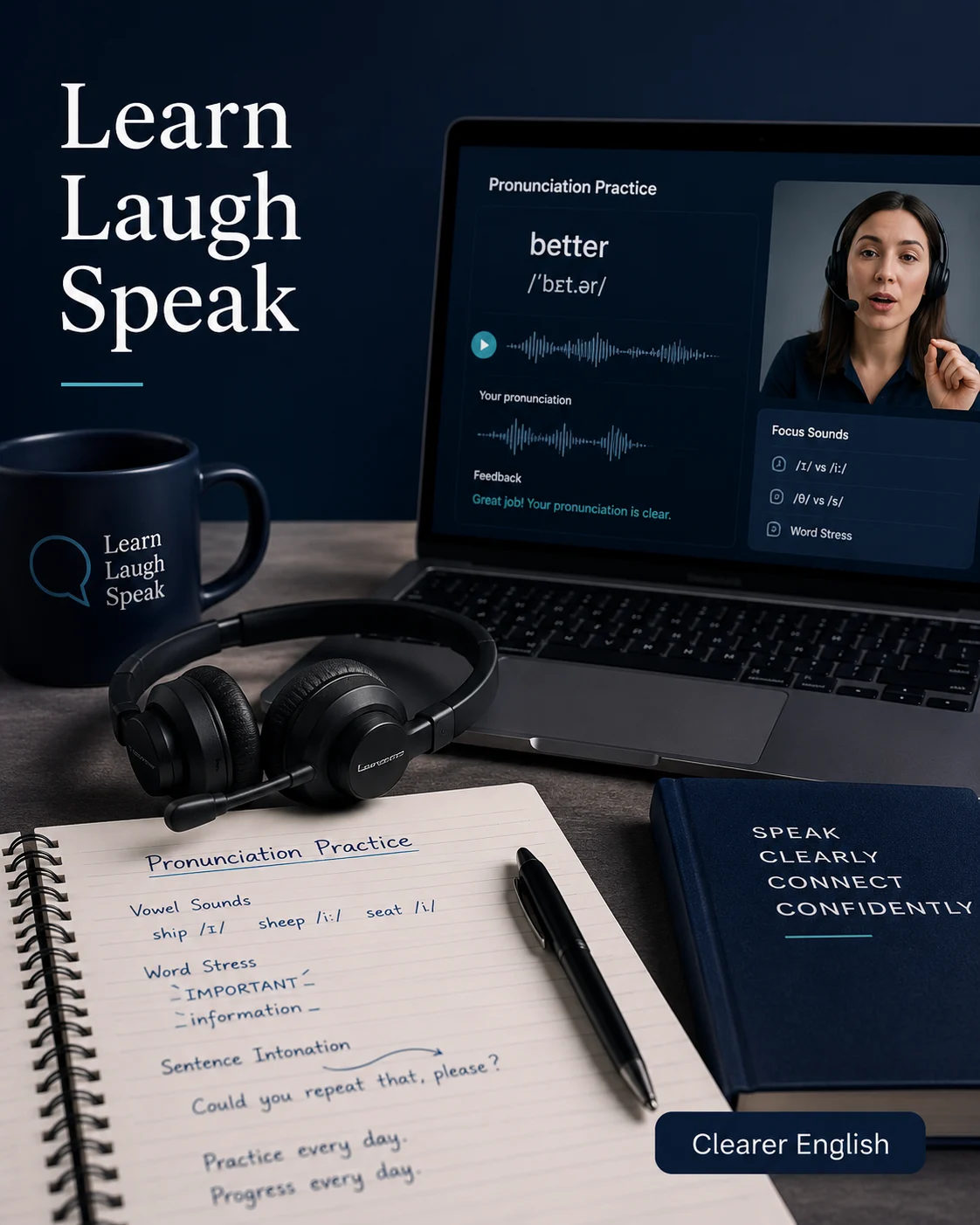
5. Pay Attention to Sentence Rhythm
English rhythm is not flat.
Some words are stronger, and some words are softer.
Important words usually receive more stress.
For example:
“I need to send the report today.”
The stronger words may be:
NEED / SEND / REPORT / TODAY
The smaller grammar words are softer.
This rhythm helps listeners understand the main message.
If every word has the same stress, your English may sound harder to follow.
To practise rhythm, read short sentences out loud and stress the important words.
Example:
“Could you send me the file today?”
Focus on:
SEND / FILE / TODAY
This makes your English clearer.
6. Record Yourself Speaking English
Recording yourself is one of the most useful ways to adjust your accent.
It can feel strange at first, but it helps you hear what others hear.
Choose a short sentence or paragraph.
Record yourself reading it.
Then listen and ask:
- Did I speak too fast?
- Were the word endings clear?
- Did I stress the right words?
- Was my rhythm natural?
- Which sound needs more practice?
You do not need to judge yourself harshly.
Just choose one thing to improve.
For example:
“Today I will focus on final sounds.”
or:
“Today I will slow down and use clearer pauses.”
Small corrections repeated often create progress.
7. Practise With Native or Fluent Speakers
Speaking with native or fluent English speakers can help you adjust your accent because you receive real listening and speaking practice.
This can happen through:
- conversation groups
- language exchanges
- online classes
- workplace conversations
- speaking clubs
- pronunciation practice sessions
The goal is not to be perfect.
The goal is to communicate clearly and notice where misunderstandings happen.
If someone does not understand you, ask:
“Was my pronunciation clear?”
or:
“Which word was difficult to understand?”
This kind of feedback helps you improve faster.
8. Use an Accent Coach or Teacher
An accent coach or English teacher can help you identify the exact sounds, stress patterns, or pronunciation habits that need work.
This is useful because learners often cannot hear their own pronunciation mistakes clearly.
A coach can help with:
- difficult sounds
- mouth position
- intonation
- stress
- rhythm
- connected speech
- confidence
- speaking practice
You do not need a coach forever.
Even a short period of focused feedback can help you understand what to practise.
9. Listen to English Podcasts
Podcasts are useful because they expose you to natural English.
You can hear different accents, speaking speeds, and conversation styles.
Choose podcasts that match your level.
If the podcast is too difficult, you may feel frustrated.
If it is too easy, you may not improve much.
A good method is:
- listen once for the main idea
- listen again for useful phrases
- repeat short sections out loud
- write down new pronunciation patterns
- practise one phrase from the episode
Podcasts are especially useful for improving listening and rhythm.
10. Watch English TV Shows and Videos With Subtitles
TV shows, videos, and short clips can help you understand natural pronunciation.
Subtitles can help, but use them carefully.
Try this method:
First watch with subtitles.
Then watch the same short section without subtitles.
Then repeat one or two useful phrases out loud.
This helps your brain connect spelling, sound, and meaning.
Be careful with very informal slang or strong regional accents if you are still building confidence.
Choose clear speakers first.
11. Read English Books and Articles Out Loud
Reading helps vocabulary.
Reading out loud helps pronunciation.
Choose short sections from books, articles, emails, or dialogues.
Read slowly.
Focus on:
- clear word endings
- natural pauses
- sentence rhythm
- word stress
- pronunciation of difficult words
You can also mark where to pause.
For example:
“Thank you for your email / I’ll review the information / and get back to you shortly.”
This helps you sound more natural when speaking.
12. Use Online Pronunciation Resources
Online dictionaries and pronunciation tools can help you hear correct pronunciation.
Use them to check:
- word stress
- vowel sounds
- British and American pronunciation differences
- difficult words
- example sentences
A good habit is to check the audio when you learn a new word.
Do not guess pronunciation only from spelling.
English spelling can be confusing.
Words like though, through, thought, and tough look similar but sound different.
Audio support helps you avoid memorizing the wrong sound.
13. Join an English Conversation Group
An English conversation group gives you regular speaking practice.
This is helpful because accent adjustment improves faster when you use English with real people.
Conversation groups can help you:
- speak more often
- hear different accents
- receive feedback
- build confidence
- practise natural rhythm
- use English in real situations
If possible, choose a group focused on English conversation, not only grammar study.
The more you speak, the more comfortable your pronunciation becomes.
14. Attend an Accent Reduction or Pronunciation Workshop
Some learners benefit from a focused pronunciation class or workshop.
These classes can help you understand exactly how to move your mouth, tongue, and lips for specific English sounds.
They may also help with:
- stress patterns
- rhythm
- intonation
- speaking speed
- confidence
- professional communication skills
The phrase accent reduction is common, but remember:
Your goal is not to remove your accent completely.
Your goal is to improve clarity.
A better way to think about it is:
accent clarity training
or:
pronunciation improvement
15. Practise Daily and Be Patient
Accent adjustment takes time.
There are no shortcuts, but there are simple habits that work.
Try this daily routine:
Minute 1: Listen to one short phrase.
Minute 2: Repeat it slowly.
Minute 3: Record yourself saying it.
Minute 4: Compare your version with the original.
Minute 5: Say the phrase in a full sentence.
Five minutes a day can create real progress over time.
The key is consistency.
Be patient with yourself.
Learning to adjust your accent can be challenging, but it can also be rewarding.
Common Mistakes When Trying to Adjust Your Accent
| Mistake | Better Approach |
|---|---|
| Trying to sound exactly native | Focus on being clear and easy to understand |
| Practising too many sounds at once | Choose one sound or pattern at a time |
| Speaking too fast | Slow down and use natural pauses |
| Ignoring word stress | Learn the stressed syllable with each new word |
| Only listening passively | Repeat phrases out loud |
| Avoiding feedback | Ask which words were unclear |
| Feeling embarrassed by your accent | Remember that clarity matters more than perfection |
These small changes can help you improve without losing confidence.
Learn Pronunciation and Speaking with Learn Laugh Speak
Learn Laugh Speak helps adults improve English through structured lessons based on their level.
That includes:
- pronunciation practice
- speaking exercises
- listening practice
- vocabulary
- grammar
- reading and writing
- real conversation phrases
- workplace communication
Every student starts with a level assessment from A1 to C2.
From there, learners follow structured lessons based on their level, mistakes, goals, and progress.
If you want to adjust your accent, improve pronunciation, and communicate more clearly in English, Learn Laugh Speak helps you practise step by step.

Final Thoughts on How to Adjust Your Accent
Learning how to adjust your accent is really about improving clarity.
You do not need to erase your accent.
You do not need to sound exactly like a native speaker.
You need to speak in a way that helps others understand you more easily.
Focus on listening, repetition, word stress, sentence rhythm, difficult sounds, and daily speaking practice.
Record yourself.
Ask for feedback.
Use English in real conversations.
Over time, your pronunciation will become clearer, your confidence will grow, and speaking English will feel more natural.