
 English
 Arabic
 Chinese (Simplified)
 Dutch
Dutch French
 German
 Italian
 Portuguese
 Russian
 Spanish
Accent adjustment means improving the clarity of your English pronunciation, stress, rhythm, and intonation so people understand you more easily. It does not mean removing your identity or forcing yourself to sound exactly like a native speaker. The goal is simple: speak English clearly, naturally, and confidently.
Many English learners worry that their accent makes them sound less confident in English. But accent adjustment is not about changing who you are. Your accent is part of your story, your background, and your first language. What matters most is whether your spoken English is clear enough for real communication.
If people often ask you to repeat yourself, misunderstand certain words, or struggle to follow your meaning, then working on pronunciation clarity can help. You do not need a “perfect” native accent. You need English that people can understand the first time.

Accent Adjustment Is Not About Sounding Like Someone Else
A common mistake is thinking that accent adjustment means removing your accent completely. This is not realistic for most adult learners, and it is not necessary.
Everyone has an accent. A person from Australia, the United States, Ireland, Scotland, England, South Africa, India, or Canada may all speak English fluently, but they do not sound the same. Their accents are different, but they can still communicate clearly.
The better goal is not:
“I want to sound exactly like a native speaker.”
The better goal is:
“I want to speak English clearly enough that people understand me easily.”
That small mindset change matters. It removes pressure and makes your practice more focused.
What Actually Makes an Accent Hard to Understand?
An accent becomes difficult for listeners when certain sounds, stress patterns, or rhythms make the meaning unclear. It is not usually the whole accent that causes problems. It is often a few specific areas.
For example, a learner may say:
“I need to leave the sheep.”
But they mean:
“I need to leave the ship.”
The problem is not the person’s identity or intelligence. The issue is one sound difference: ship and sheep.
Other common examples include:
live / leave
bit / beat
full / fool
rice / rise
thin / tin
very / berry
Small pronunciation differences can change meaning. Accent adjustment helps you notice these areas and practise them in a clear, useful way.
Accent Adjustment vs Pronunciation
Accent and pronunciation are connected, but they are not exactly the same.
Pronunciation is how you say individual sounds and words.
Accent is the overall sound of your speech, including rhythm, tone, stress, and patterns from your first language.
Accent adjustment focuses on making your spoken English clearer by improving the parts that affect understanding.
For example, you may pronounce individual words correctly, but if every word in a sentence has the same stress, your English may still sound flat or difficult to follow.
Compare this:
I need the report by Friday.
In natural English, the most important words are usually stronger:
I NEED the REPORT by FRIDAY.
This rhythm helps the listener understand the main message quickly.
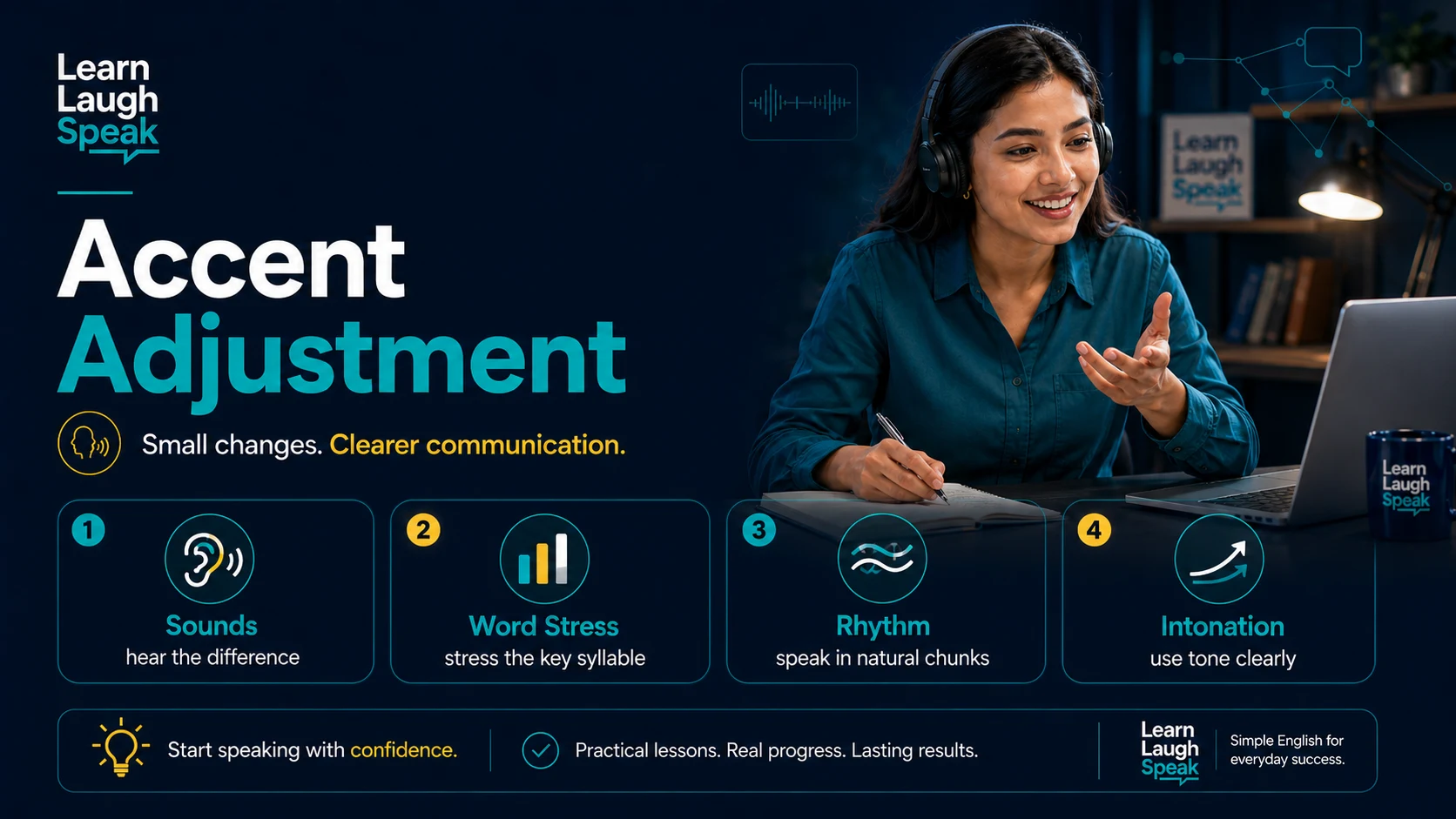
The Four Areas That Make English Sound Clearer
Instead of trying to change your whole accent, focus on four practical areas.
1. Sounds
Some English sounds may not exist in your first language. These sounds need extra practice.
Common difficult sounds include:
th in think
th in this
v in very
r in right
short and long vowel sounds, such as ship and sheep
Start with the sounds that cause the most confusion in your real conversations. Do not try to fix every sound at once.
2. Word Stress
English words often have one strong syllable. If the stress is in the wrong place, the word can be harder to understand.
Examples:
im-POR-tant
pro-FES-sion-al
com-MU-ni-cate
in-for-MA-tion
PRE-sen-ta-tion
Word stress is especially important in professional English because many work-related words are longer.
3. Sentence Rhythm
English has a rhythm. Important words are usually stressed, while smaller grammar words are softer.
For example:
Could you send me the report by Friday?
The stronger words are usually:
SEND / REPORT / FRIDAY
This rhythm makes your English easier to follow.
4. Intonation
Intonation is the rise and fall of your voice. It helps show meaning, attitude, politeness, and confidence.
For example:
“Really?”
This can sound surprised, interested, doubtful, or annoyed depending on your tone.
Intonation is very important in workplace English because tone can change how your message feels.
A Simple Accent Adjustment Routine for English Learners
You do not need to practise for hours every day. You need consistent, focused practice.
Try this routine for 10–15 minutes a day.
Step 1: Choose one short sentence
Use a sentence you might say in real life.
Example:
“Could you send me the report by Friday?”
Step 2: Mark the important words
Could you SEND me the REPORT by FRIDAY?
Step 3: Listen to a model
Listen to a native or clear English speaker say a similar sentence. Pay attention to rhythm, not only sounds.
Step 4: Repeat out loud
Say the sentence slowly first. Then say it more naturally.
Step 5: Record yourself
Listen back and ask:
- Did I speak clearly?
- Did I stress the right words?
- Was I too fast?
- Could someone understand me easily?
Step 6: Use the phrase in real life
Practice only becomes useful when you use the language in real conversations, meetings, classes, or messages.
7-Day Accent Clarity Practice Plan
Here is a simple one-week practice plan you can follow.
| Day | Focus | Practice |
|---|---|---|
| Day 1 | Record yourself | Read 5 workplace sentences and listen for clarity |
| Day 2 | Word stress | Practise words like important, professional, communication |
| Day 3 | Difficult sounds | Choose 3 sounds that are hard for you and practise them in words |
| Day 4 | Sentence rhythm | Stress the key words in 5 useful phrases |
| Day 5 | Shadowing | Listen to short audio and repeat immediately after the speaker |
| Day 6 | Workplace phrases | Practise phrases for meetings, emails, or presentations |
| Day 7 | Review | Record yourself again and compare with Day 1 |
This plan is simple, but it works because it focuses on small improvements. You do not need to fix everything in one week. You need to notice what is changing.
Workplace English: Where Clear Pronunciation Matters Most
Accent adjustment can be especially useful in professional situations where clarity matters.
For example:
- meetings
- phone calls
- presentations
- customer service
- interviews
- training sessions
- team updates
- hospitality conversations
- sales calls
- online meetings
In these situations, you may need to speak clearly under pressure.
Useful phrases to practise include:
“Could you clarify that, please?”
“I’d like to add one point.”
“Let me explain that another way.”
“Just to confirm, the deadline is Friday.”
“Thank you for your patience.”
“I’ll send the update after the meeting.”
Practise these phrases out loud. Focus on the words that carry the meaning.
For example:
Just to CONFIRM, the DEADLINE is FRIDAY.
This sounds clearer than stressing every word equally.
What to Practise Instead of Trying to Remove Your Accent
Do not waste time trying to erase your natural voice. Focus on the parts that improve communication.
| Instead of trying to… | Practise this instead |
| Remove your accent completely | Speak more clearly and confidently |
| Copy one native speaker perfectly | Build clear international English |
| Change every sound at once | Focus on the sounds that cause confusion |
| Speak faster to sound fluent | Slow down and use natural rhythm |
| Memorise random words | Practise real phrases you use often |
| Hide your accent | Improve clarity while keeping your voice |
| Wait until you sound perfect | Speak regularly and improve through practice |
The goal is not to become someone else. The goal is to make your English easier to understand.
A More Natural Way to Think About Accent Adjustment
At Learn Laugh Speak, we see this often with adult learners. Many students do not need a completely new accent. They need help with the small sounds, stress patterns, and sentence rhythm that make English easier to understand.
A learner can keep their natural accent and still speak clearly in meetings, interviews, customer conversations, and daily life. In fact, this is the best goal for most adult English learners.
Clear English is not about perfection. It is about control. You want to control your pronunciation enough that your message is not lost.
Common Accent Adjustment Mistakes
1. Thinking your accent is the problem
Your accent is not the problem. The problem is usually a few sounds, stress patterns, or rhythm habits that make communication harder.
2. Practising only single words
Single words help, but real communication happens in sentences.
Instead of only practising:
report
Practise:
“I’ll send the report by Friday.”
3. Speaking too fast
Many learners speak quickly because they want to sound fluent. But speed without clarity can make English harder to understand.
Slow down slightly and stress important words.
4. Ignoring word stress
If you stress the wrong syllable, the word may sound unfamiliar.
For example:
PRO-fessional sounds less natural than pro-FES-sion-al.
5. Avoiding speaking because of fear
Avoiding speaking makes pronunciation harder to improve. You need real speaking practice, even if it feels uncomfortable at first.
Accent Adjustment Practice: Before and After
Here are examples of how small changes improve clarity.
Example 1
Unclear rhythm:
I need to send the report to the manager tomorrow morning.
Clearer rhythm:
I need to SEND the REPORT to the MANAGER tomorrow MORNING.
Example 2
Too fast:
Couldyoupleaseconfirmthemeetingtime?
Clearer:
Could you please confirm the meeting time?
Example 3
Flat tone:
Thank you for your help.
Clearer and warmer:
THANK you for your HELP.
Small changes make your speech easier to understand and more natural.
How Long Does Accent Adjustment Take?
It depends on your starting point, your goals, and how often you practise.
You may notice small improvements in a few weeks if you practise regularly. Bigger changes take longer because pronunciation habits are physical habits. Your mouth, tongue, breathing, and listening skills all need time to adjust.
The key is not to rush. Focus on one area at a time:
- one sound
- one stress pattern
- one phrase
- one speaking situation
Small improvements build up.
Learn Accent Adjustment with Learn Laugh Speak
Learn Laugh Speak helps adult English learners improve speaking, listening, pronunciation, vocabulary, grammar, reading, and writing with structured practice.
For accent adjustment, the goal is not to remove your accent. The goal is to help you speak English clearly and confidently in real situations.
Students practise English at the right level, from beginner to advanced, with lessons designed for real communication. This helps learners build clarity, confidence, and control step by step.
Whether you need English for work, travel, study, customer service, interviews, meetings, or daily conversations, clearer pronunciation helps people understand your message faster.
FAQs About Accent Adjustment
What is accent adjustment?
Accent adjustment is the process of improving pronunciation, word stress, sentence rhythm, and intonation so your English is easier to understand.
Can I change my accent in English?
Yes, you can adjust parts of your accent with regular practice. You may not remove it completely, but you can improve clarity and confidence.
Is accent adjustment the same as pronunciation?
Not exactly. Pronunciation focuses on sounds and words. Accent adjustment also includes stress, rhythm, intonation, and overall speech clarity.
Do I need a native accent to speak good English?
No. You do not need a native accent. You need clear English that people can understand easily.
How can I improve my accent?
Listen carefully, practise shadowing, record yourself, focus on difficult sounds, learn word stress, slow down, and practise real phrases.
Is having an accent bad?
No. Everyone has an accent. An accent is only a problem if it stops people from understanding your message.
What is the best goal for accent adjustment?
The best goal is clear communication. You should aim to sound understandable, confident, and natural while keeping your own voice.
Final Thoughts on Accent Adjustment
Accent adjustment is not about losing your identity or pretending to be someone else. It is about speaking English clearly enough that people understand your message.
Focus on the areas that matter most: sounds, word stress, sentence rhythm, intonation, and confidence. Practise with real phrases you use at work, in study, and in daily life.
Your accent is part of your story. Clear communication is the goal. With regular practice, you can speak English more naturally, confidently, and clearly.