
 English
 Arabic
 Chinese (Simplified)
 Dutch
Dutch French
 German
 Italian
 Portuguese
 Russian
 Spanish
Good manners in English means using polite words, respectful tone, and thoughtful communication when speaking or writing. Simple phrases like “please,” “thank you,” “excuse me,” “I’m sorry,” and “could you please…” help you sound polite, professional, and respectful.
Learning good manners in English is important for everyday conversations, workplace communication, customer service, hospitality, meetings, emails, and social situations. Good manners help you build trust, avoid sounding rude, and make conversations more comfortable for everyone.
This guide gives you 7 practical tips for showing good manners in English, with simple examples you can use at work, in daily life, and when speaking with new people.
12 Ways to Practise Proper Interview Etiquette

Why Good Manners in English Matter
Good manners are important in every language, but they are especially useful when you are learning English. Sometimes English learners know the correct grammar, but their sentence sounds too direct because the tone is not polite enough.
For example:
Too direct: “Give me the file.”
Polite: “Could you please send me the file?”
The meaning is similar, but the second sentence sounds more respectful.
Using good manners in English helps you:
- sound polite and professional
- make a better first impression
- show respect to colleagues, customers, teachers, and friends
- avoid misunderstandings
- build stronger relationships
- communicate better at work
- feel more confident in English conversations
At work, good manners are not only about being nice. They help you communicate clearly and professionally.
7 Tips for Showing Good Manners in English
There are many ways to be polite in English, but these 7 tips are a strong place to start. They are simple, practical, and useful for English learners at any level.
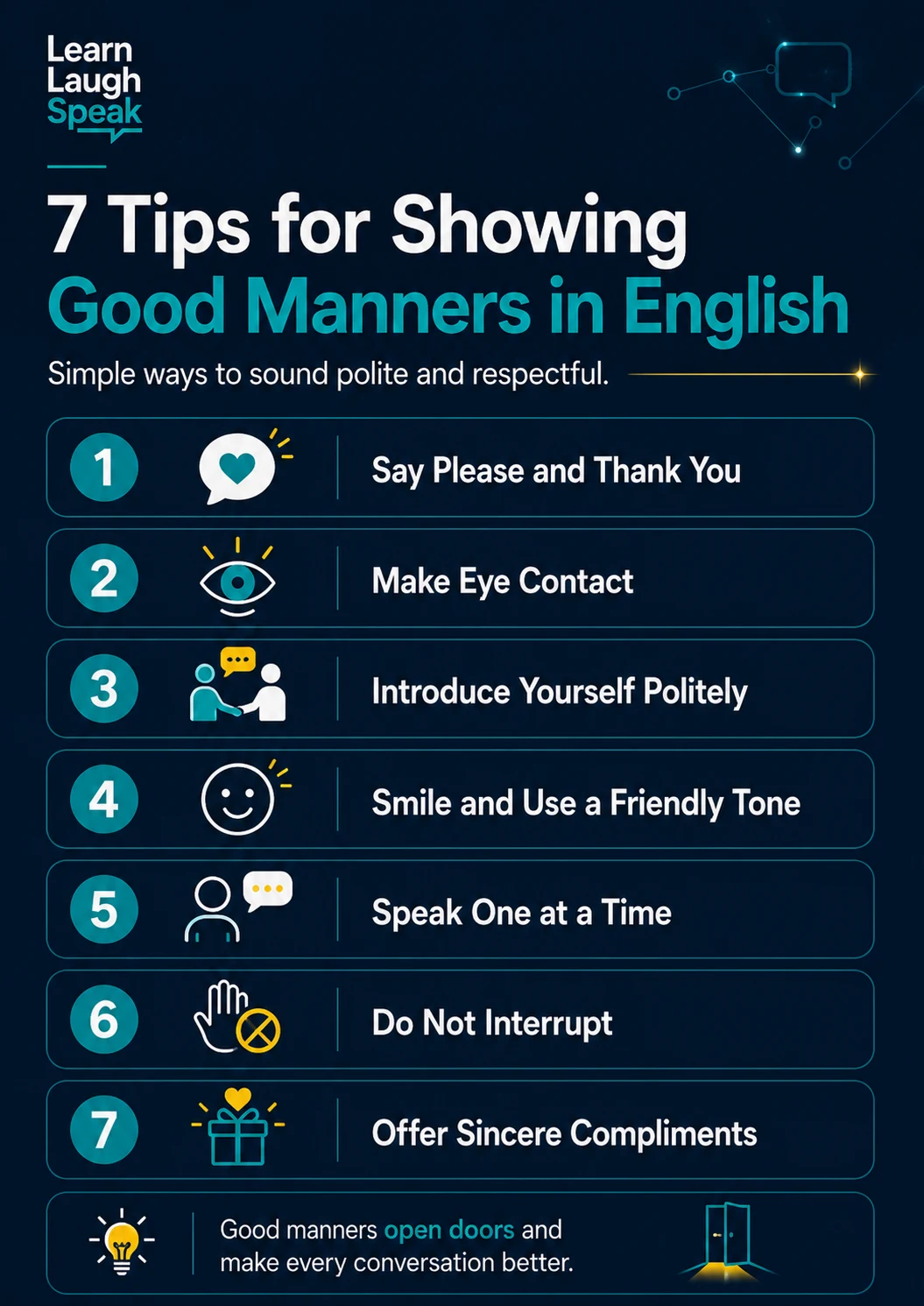
The 7 tips are:
- Say please and thank you
- Make eye contact
- Introduce yourself politely
- Smile and use a friendly tone
- Speak one at a time
- Do not interrupt
- Offer sincere compliments
Each tip will help you sound more respectful and natural in English.
Good Manners in English Tip 1: Say Please and Thank You
One of the easiest ways to show good manners in English is to use please and thank you. These words are simple, but they make a big difference.
Use please when asking for something:
“Could you please help me with this?”
“Can you please send me the report?”
“Please let me know if you have any questions.”
Use thank you when someone helps you:
“Thank you for your help.”
“Thank you so much for your time.”
“I really appreciate your support.”
In professional English, “could you please…” is often better than “can you…” because it sounds more polite.
Example at work:
“Could you please confirm the meeting time?”
Example in customer service:
“Thank you for your patience. I’ll check that for you now.”
Small polite words can make your English sound much more respectful.
Good Manners in English Tip 2: Make Eye Contact
Making eye contact is another important part of good manners in English, especially when meeting someone, introducing yourself, listening in a conversation, or speaking in a professional setting.
Eye contact shows that you are:
- listening
- paying attention
- interested
- respectful
- confident
You do not need to stare. Just look at the person naturally while speaking and listening.
Useful phrases when meeting someone include:
“It’s nice to meet you.”
“I’m glad we could speak today.”
“Thank you for taking the time to meet with me.”
Workplace example:
“It’s nice to meet you. I’m looking forward to working together.”
This sentence is simple, polite, and professional. When you say it with friendly eye contact, it creates a better first impression.
Good Manners in English Tip 3: Introduce Yourself Politely
Introducing yourself is one of the first chances you have to show good manners in English. A polite introduction helps people feel comfortable and shows confidence.
A simple introduction is:
“Hello, my name is [your name]. It’s nice to meet you.”
You can also say:
“Hi, I’m [your name]. I work in [department/company].”
“Good morning, my name is [your name]. I’m part of the customer service team.”
“Nice to meet you. I’m [your name].”
When asking someone else for their name, avoid sounding too direct.
Instead of saying:
“What’s your name?”
Say:
“Could you please tell me your name?”
Or:
“May I ask your name?”
Workplace example:
“Hello, my name is Ana. I’m part of the front desk team. How can I help you today?”
This is useful in hospitality, customer service, reception, sales, and office communication.
Good Manners in English Tip 4: Smile and Use a Friendly Tone
A smile can help you sound more polite, even before you speak. In English conversations, your tone matters as much as your words.
You can say the right phrase, but if your tone sounds cold or impatient, the message may still feel rude.
For example:
“Can I help you?”
This can sound helpful or annoyed depending on your tone.
A better version is:
“Hi, how can I help you today?”
A friendly tone helps you:
- sound more approachable
- make people feel comfortable
- reduce tension
- improve customer service
- create better workplace conversations
Useful friendly phrases include:
“How can I help you?”
“Of course, I’d be happy to help.”
“No problem at all.”
“Thank you for letting me know.”
“I appreciate your patience.”
In Learn Laugh Speak lessons, tone is important because real communication is not only about grammar. It is also about how your English sounds in real situations.
Good Manners in English Tip 5: Speak One at a Time
Another important part of good manners in English is allowing one person to speak at a time. In meetings, group conversations, classes, and workplace discussions, interrupting or speaking over someone can sound rude.
To speak politely in a group, use phrases like:
“Can I add something?”
“May I share an idea?”
“What do you think?”
“I’d like to add one point.”
“Could I say something here?”
These phrases help you join the conversation without interrupting.
Workplace example:
“Can I add something here? I think we should also consider the customer’s feedback.”
This sounds polite because you are asking to enter the conversation before giving your opinion.
In meetings, good manners show that you respect other people’s time and ideas.
Good Manners in English Tip 6: Do Not Interrupt
Not interrupting is one of the most important rules of good manners in English. Interrupting can make the other person feel that their opinion is not important.
If someone is speaking, wait until they finish before you respond. You can show that you are listening by saying:
“I see what you mean.”
“That’s interesting.”
“I understand.”
“Please continue.”
“Go on.”
If you need to interrupt because something is urgent, use a polite phrase:
“I’m sorry to interrupt, but may I add something quickly?”
“Sorry to interrupt, but this may be important.”
“Excuse me, could I clarify one point?”
If someone interrupts you, stay calm and polite. You can say:
“Please let me finish my thought.”
“I’ll just finish this point, then I’d be happy to hear your idea.”
This is firm but still respectful.
Good Manners in English Tip 7: Offer Sincere Compliments
Offering compliments is a positive way to show good manners, but the compliment should be sincere and appropriate.
Useful compliments in English include:
“Thank you for your help.”
“I really appreciate your support.”
“That was very kind of you.”
“You explained that very clearly.”
“Great work on the presentation.”
“I appreciate the time you put into this.”
In professional situations, compliments should usually focus on effort, work, support, or communication.
Workplace examples:
“Thank you for your help with the report. I really appreciate it.”
“You handled that customer situation very professionally.”
“Your explanation in the meeting was very clear.”
Compliments help build better relationships and create a more positive work environment.
Good Manners in English at Work
Good manners are especially important in professional English. At work, your language should be clear, polite, and respectful.
Here are useful workplace phrases:
| Situation | Polite English phrase |
|---|---|
| Asking for help | “Could you please help me with this?” |
| Asking for information | “Could you please clarify this point?” |
| Asking someone to wait | “Please give me a moment.” |
| Thanking someone | “Thank you for your support.” |
| Apologizing | “I’m sorry for the inconvenience.” |
| Joining a conversation | “May I add something?” |
| Ending a conversation | “Thank you for your time.” |
| Offering help | “Please let me know if I can help.” |
These phrases are useful in meetings, emails, customer service, hospitality, and daily office communication.
What Not to Say and What to Say Instead
Some English phrases can sound too direct or rude, even if the grammar is correct. Here are better options that show good manners in English.
| What not to say | What to say instead |
| “Give me that.” | “Could you please pass me that?” |
| “What?” | “Sorry, could you repeat that?” |
| “I want help.” | “Could you please help me?” |
| “Move.” | “Excuse me, could I get past?” |
| “You are wrong.” | “I see it differently.” |
| “Wait.” | “Please give me a moment.” |
| “I don’t care.” | “I understand, but I have a different opinion.” |
| “Tell me your name.” | “May I ask your name?” |
These small changes help your English sound more polite and professional.
Common Mistakes with Good Manners in English
English learners often make small mistakes with politeness because they translate directly from their first language. The words may be correct, but the tone may sound too strong.
1. Being too direct
Too direct: “Send me the file.”
Better: “Could you please send me the file?”
2. Forgetting to thank people
Too short: “Okay.”
Better: “Thank you. I appreciate your help.”
3. Interrupting too quickly
Too direct: “No, listen to me.”
Better: “Can I add something here?”
4. Asking personal questions too soon
Too personal: “How much money do you make?”
Better: Avoid personal questions unless you know the person well.
5. Using informal language in professional situations
Too casual: “Hey, give me a sec.”
Better: “Please give me a moment.”
Good manners are often about softening your language so the other person feels respected.
How to Practise Good Manners in English
The best way to improve is to practise polite phrases in real situations.
Try this method:
- Choose five polite phrases from this article.
- Say them out loud.
- Use them in short dialogues.
- Practise with work situations.
- Use one phrase in a real conversation or email this week.
Practice dialogue:
Customer: “Can you help me with this booking?”
Staff: “Of course. I’d be happy to help.”
Customer: “Thank you.”
Staff: “You’re welcome. Please give me a moment while I check.”
This short conversation shows polite tone, helpful language, and clear communication.
Learn Good Manners in English with Learn Laugh Speak
Learn Laugh Speak helps adult English learners build practical communication skills for real life and work. Good manners are a key part of speaking English clearly and professionally.
With Learn Laugh Speak, students can practise:
- polite workplace phrases
- customer service English
- meeting communication
- email writing
- listening and speaking
- professional tone
- daily English conversations
If you want to improve good manners in English, you need more than vocabulary. You need to know when to use each phrase, how formal it sounds, and how to say it naturally.
Learn Laugh Speak helps learners improve step by step with level-based English practice for real communication.
FAQs About Good Manners in English
What are good manners in English?
Good manners in English means using polite words, respectful tone, and thoughtful communication. Common examples include saying please, thank you, excuse me, sorry, and could you please…
How do you show good manners in English?
You can show good manners by speaking politely, listening carefully, not interrupting, saying thank you, making appropriate eye contact, and using respectful phrases in conversations.
What are polite words in English?
Common polite words and phrases include please, thank you, excuse me, I’m sorry, could you please, may I, I appreciate it, and you’re welcome.
Why are good manners important when speaking English?
Good manners help you sound respectful, friendly, and professional. They also help avoid misunderstandings and build better relationships at work and in daily life.
How can I sound more polite in English?
Use softer phrases like “Could you please…”, “Would you mind…”, “May I ask…”, and “Thank you for your help.” These phrases make your English sound more respectful.
Final Thoughts on Good Manners in English
Showing good manners in English does not require perfect grammar or complicated words. It starts with simple habits: say please and thank you, listen carefully, introduce yourself politely, avoid interrupting, and speak with a friendly tone.
These small actions help you sound more respectful and confident in English. They also help you build stronger relationships in work, study, customer service, and daily conversations.
If you want to improve your English for real communication, start by practising polite phrases every day. Good manners make your English clearer, kinder, and more professional.
One thought on “7 Useful Tips for Always Showing Good Manners in English”
Pingback: Simple but Important Slack Etiquette for ESL Teams - Learn Laugh Speak