English
 Arabic
 Chinese (Simplified)
 Dutch
Dutch French
 German
 Italian
 Portuguese
 Russian
 Spanish
Writing clear emails in English is easier when you know the right phrase for each part of your message.
Good structure helps your emails sound professional, polite, and easy to understand. This is especially important at work, where a simple message can affect meetings, projects, clients, deadlines, and relationships.
In this guide, you will find useful email phrases in English organized by the beginning, middle, and end sections of an email.
These business email phrases for work can help you write faster, avoid repeating yourself, and choose the right tone for different professional situations.
All expressions are suitable for work or business communication. Some are more formal, and some are more conversational. Where possible, the phrases are ordered from more formal to more informal.
How To Write a Professional Email (With Examples and Tips)
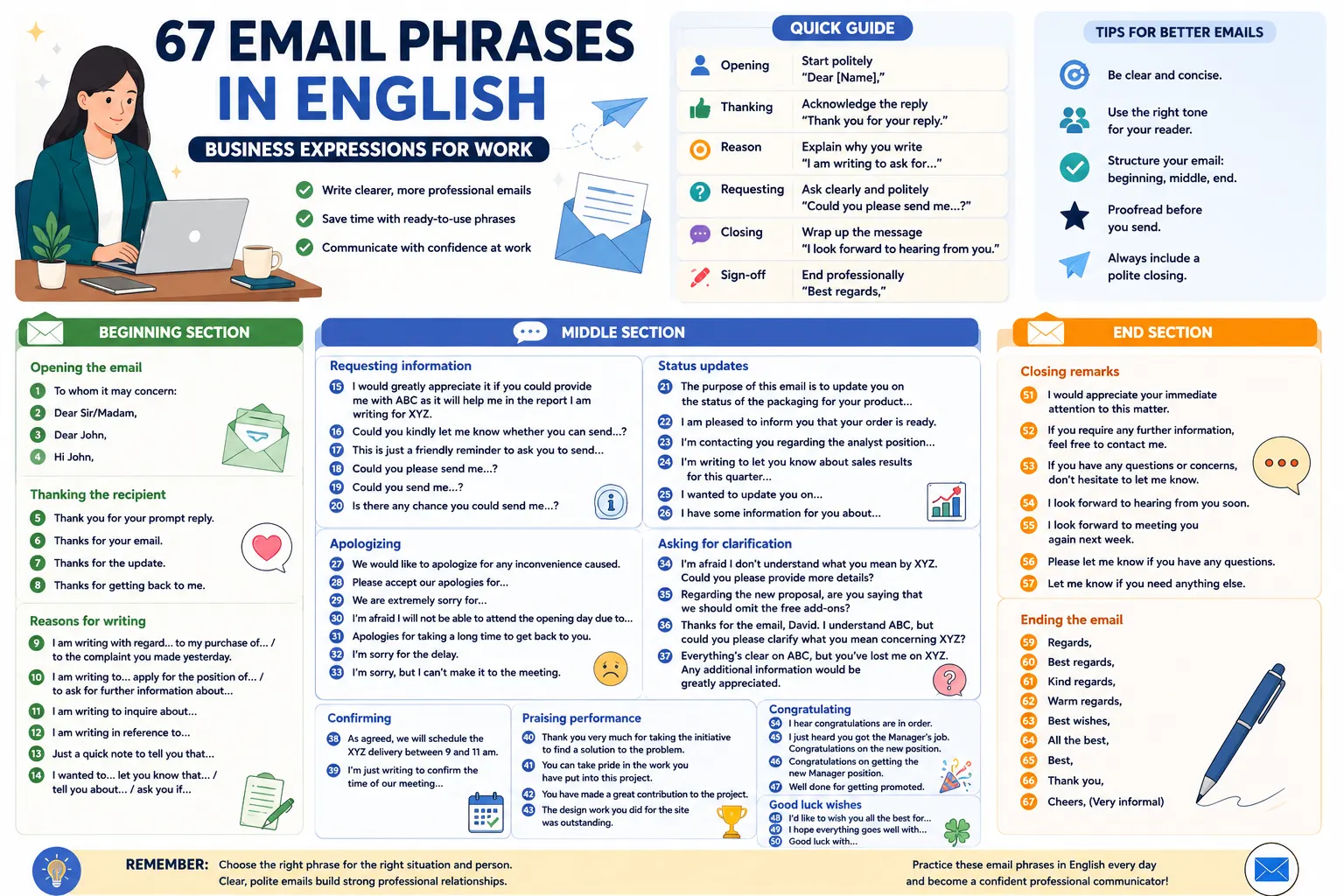
Why Email Phrases in English Help at Work
When you write emails in English, structure matters.
A clear email usually has three parts:
The beginning, where you greet the person and explain why you are writing.
The middle, where you give details, ask for information, apologize, confirm something, or update the person.
The end, where you close politely and make the next step clear.
Learning common email phrases in English helps you avoid writing long, unclear messages.
It also helps you sound more natural and professional when communicating with colleagues, managers, clients, or business partners.
Quick Guide to Business Email Phrases for Work
Here is a simple guide to help you choose the right phrase depending on the purpose of your email.
| Email Section | What You Need | Example Phrase |
|---|---|---|
| Opening | Start politely | “Dear [Name],” |
| Thanking | Recognize the reply or update | “Thank you for your prompt reply.” |
| Reason for writing | Explain the purpose | “I am writing to ask for further information about…” |
| Requesting | Ask clearly | “Could you please send me…?” |
| Clarifying | Avoid confusion | “Could you please clarify what you mean by…?” |
| Apologizing | Sound respectful | “Please accept our apologies for…” |
| Closing | End professionally | “I look forward to hearing from you soon.” |
| Sign-off | Finish naturally | “Best regards,” |
These business email phrases for work are useful because they give your message a clear direction.
Beginning Email Phrases in English
The beginning of your email sets the tone.
You can sound formal, neutral, or friendly depending on your relationship with the person.
Opening the Email
- To whom it may concern:
Use this when you do not know the person’s name. It is very formal. Use a colon after this phrase, not a comma. - Dear Sir/Madam,
This is formal and useful when you do not know the name of the person you are writing to. - Dear John,
This is professional and polite when you know the person’s name. - Hi John,
This is friendly but still acceptable in many workplace emails, especially with colleagues or people you already know.
Thanking the Recipient
Thanking the person at the start of your email is a polite way to create a positive tone.
- Thank you for your prompt reply.
- Thanks for your email.
- Thanks for the update.
- Thanks for getting back to me.
These are simple but useful email phrases in English because they help your message sound respectful from the beginning.
45 Different Email Greetings To Use at Work
Reasons for Writing
After the greeting, it is important to explain why you are writing.
This helps the reader understand the purpose of your email quickly.
- I am writing with regard to…
Example: “I am writing with regard to my purchase of…”
Example: “I am writing with regard to the complaint you made yesterday.” - I am writing to…
Example: “I am writing to apply for the position of…”
Example: “I am writing to ask for further information about…” - I am writing to inquire about…
Note: “Inquire” is more common in American English. - I am writing in reference to…
- Just a quick note to tell you that…
- I wanted to…
Example: “I wanted to let you know that…”
Example: “I wanted to tell you about…”
Example: “I wanted to ask you if…”
The more formal phrases are useful for clients, managers, applications, or official communication.
The more conversational phrases are useful for colleagues or people you already communicate with often.
Middle Section: Professional Email Phrases
The middle of the email is where you give the main information.
This part might include a request, update, apology, clarification, confirmation, praise, or good wishes.
Requesting Information
When asking for information, be polite and clear.
- I would greatly appreciate it if you could provide me with ABC, as it will help me in the report I am writing for XYZ.
- Could you kindly let me know whether you can send…?
- This is just a friendly reminder to ask you to send…
- Could you please send me…?
- Could you send me…?
- Is there any chance you could send me…?
These phrases are useful when you need information but do not want to sound demanding.
For work emails, “Could you please…” is one of the most common and polite options.
Status Updates
Status updates are common in professional emails.
They help people understand progress, changes, or next steps.
- The purpose of this email is to update you on the status of the packaging for your product…
- I am pleased to inform you that your order is ready.
- I’m contacting you regarding the analyst position…
- I’m writing to let you know about sales results for this quarter…
- I wanted to update you on…
- I have some information for you about…
These email phrases in English help you give information clearly without making the email too long.
Apologizing
Sometimes you need to apologize in a professional email.
The key is to be polite, clear, and responsible.
- We would like to apologize for any inconvenience caused.
- Please accept our apologies for…
- We are extremely sorry for…
- I’m afraid I will not be able to attend the opening day due to…
- Apologies for taking a long time to get back to you.
- I’m sorry for the delay.
- I’m sorry, but I can’t make it to the meeting.
For more formal emails, use phrases like “Please accept our apologies.”
For colleagues or internal emails, “I’m sorry for the delay” is usually natural and acceptable.
Asking for Clarification
If you do not understand something, it is better to ask clearly than to guess.
Clarification phrases help avoid mistakes and misunderstandings.
- I’m afraid I don’t understand what you mean by XYZ. Could you please provide more details?
- Regarding the new proposal, are you saying that we should omit the free add-ons?
- Thanks for the email, David. I understand ABC, but could you please clarify what you mean concerning XYZ?
- Everything’s clear on ABC, but you’ve lost me on XYZ. Any additional information would be greatly appreciated.
These are helpful business email phrases for work because they show that you are trying to understand the message correctly.
A phrase like “Could you please clarify…” is polite and professional.
How to Use Perfect Tense: Explained Simply With Examples
Confirming
Confirming details is important in business emails because it helps avoid confusion.
- As agreed, we will schedule the XYZ delivery between 9 and 11 am.
- I’m just writing to confirm the time of our meeting…
You can use confirming phrases for meetings, calls, deliveries, deadlines, bookings, or decisions.
Praising Performance
Positive feedback is also part of professional communication.
It helps build better workplace relationships.
- Thank you very much for taking the initiative to find a solution to the problem.
- You can take pride in the work you have put into this project.
- You have made a great contribution to the project.
- The design work you did for the site was outstanding.
These phrases are useful when giving feedback to a colleague, team member, or partner.
Congratulating Someone on a New Job or Position
When someone gets promoted or starts a new role, a short message can leave a positive impression.
- I hear congratulations are in order.
- I just heard you got the Manager’s job. Congratulations on the new position.
- Congratulations on getting the new Manager position.
- Well done for getting promoted.
The first phrase is more idiomatic.
The last phrase is more casual and works better with colleagues you know well.
Good Luck Wishes
Good luck messages are useful before events, interviews, presentations, launches, or important meetings.
- I’d like to wish you all the best for…
- I hope everything goes well with…
- Good luck with…
These are simple email phrases in English that help your message sound friendly and supportive.
Ending Email Phrases in English
The ending of your email should help the reader understand what happens next.
You may want to invite a reply, offer help, ask for action, or close the message politely.
Closing Remarks
- I would appreciate your immediate attention to this matter.
- If you require any further information, feel free to contact me.
- If you have any questions or concerns, don’t hesitate to let me know.
- I look forward to hearing from you soon.
- I look forward to meeting you again next week.
- Please let me know if you have any questions.
- Let me know if you need anything else.
These closing remarks are useful because they create a clear ending.
They also help the reader know whether you expect a reply or are simply offering support.
Ending the Email
Choose your sign-off depending on the level of formality.
- Regards,
- Best regards,
- Kind regards,
- Warm regards,
- Best wishes,
- All the best,
- Best,
- Thank you,
- Cheers,
This is very informal and is better for people you know well.
For most professional emails, Best regards and Kind regards are safe choices.
Short Examples Using Email Phrases in English
Here are a few simple examples showing how these phrases work inside a real email.
Example 1: Requesting Information
Subject: Request for Project Details
Hi John,
Thanks for your email.
I am writing to ask for further information about the project timeline. Could you please send me the updated schedule when you have a chance?
Please let me know if you have any questions.
Best regards,
[Your Name]
Example 2: Asking for Clarification
Subject: Clarification on Proposal
Hi David,
Thanks for the update.
Regarding the new proposal, are you saying that we should omit the free add-ons? I understand the main changes, but could you please clarify this point?
I look forward to hearing from you soon.
Kind regards,
[Your Name]
Example 3: Apologizing for a Delay
Subject: Apologies for the Delay
Dear [Name],
Apologies for taking a long time to get back to you.
I wanted to update you on the status of your request. We are reviewing the details now and will send you the next steps shortly.
Thank you for your patience.
Best regards,
[Your Name]
These examples show how email phrases in English can make your message clearer and easier to write.
Learn Business Email Phrases With Learn Laugh Speak
Writing professional emails in English is an important workplace skill.
You need the right tone, structure, and vocabulary to communicate clearly with managers, colleagues, clients, and teams.
Learn Laugh Speak helps adult English learners improve their English for real work situations, including emails, meetings, presentations, customer conversations, and professional messages.
With structured lessons at your exact level, you can practise email phrases in English and build confidence using them in real communication.
The more you practise, the easier it becomes to write clear, professional emails without overthinking every sentence.